

In her first institutional solo exhibition, Nour Jaouda brings intimacy to Spike Island‘s warehouse scale, where textile and bronze negotiate between transience and permanence.
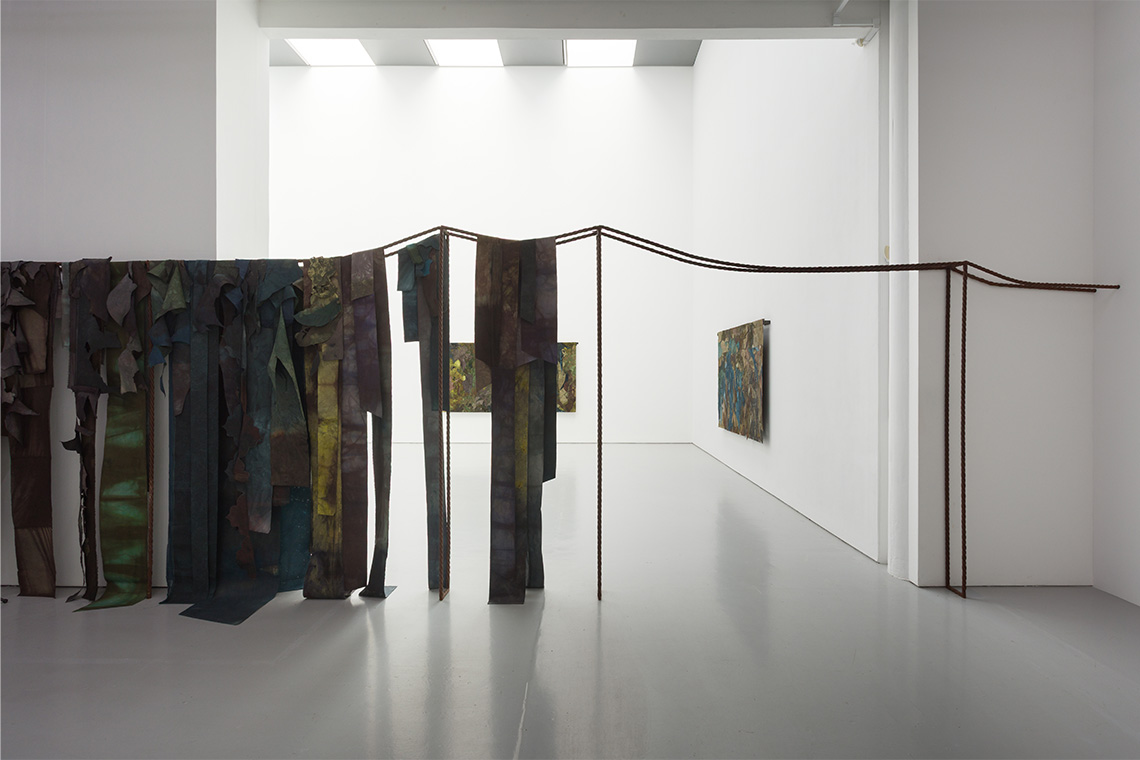
Nour Jaouda’s Matters of time begins not with a grand gesture but with the residue of making. Remnants of tomorrow (2025), a suspended rail of dyed textile fragments, hangs at the gallery entrance like laundry left to dry in a studio. I had to duck beneath it to enter – a physical negotiation with the work that immediately establishes the exhibition’s terms of engagement. It is an unexpectedly humble threshold for Spike Island’s vast warehouse gallery, one that suggests the exhibition will operate on intimate rather than monumental scales.
This tension between scale and intimacy becomes the exhibition’s structuring principle. Where many emerging artists might attempt to fill the gallery’s soaring volume, Jaouda does something braver: she brings the ceiling down. At the centre of the space sits The iris grows on both sides of the fence (2025), a hand-stitched Khayamiya tent produced in collaboration with master craftsmen from Cairo’s historic street of tentmakers. With its asymmetrically draped panels converging toward the far end, the structure has an unexpectedly utilitarian quality – something closer to field equipment than ceremonial textile.
This army-tent aesthetic feels significant. Jaouda’s tent does not perform the decorative excess of the festive tents that inspire it. Instead, three sections of hand-dyed fabric are tied together with neat bows – a detail that reads as both delicate and provisional, feminine and functional. The installation creates what the wall text describes as “an intimate retreat”, where visitors are invited to come together to “mourn a landscape that has been uprooted or dispossessed”. Yet the tent’s configuration suggests something more provisional: a temporary shelter, hastily erected, ready to be dismantled.
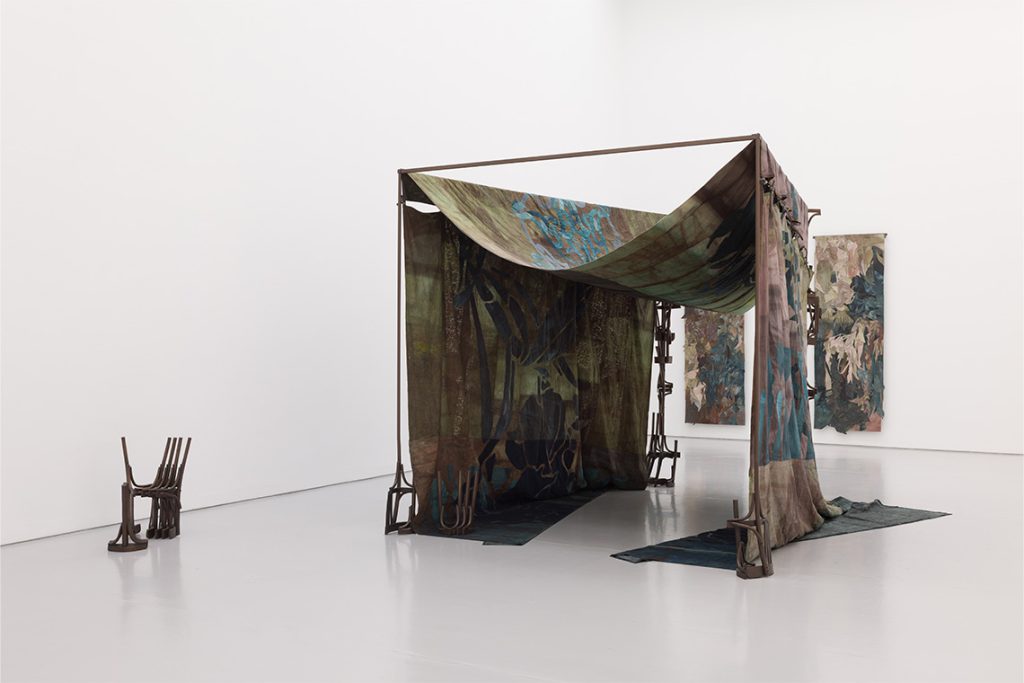
From outside, the tent appears opaque, its earthy pigments absorbing the gallery’s illumination. Inside, the fabric reveals itself as porous, punctured with both deliberate cutouts and more organic gaps that feel like gentle decay. Here, simultaneously enclosed by textile and exposed to the gallery’s white cube, you experience Jaouda’s central paradox – the tent shelters you from the institutional space while remaining fundamentally part of it.
The botanical motifs scattered across the tent’s surface – including the Faqqua iris, Palestine’s national flower – appear as shadowy presences, their forms partially abstracted through Jaouda’s process of décollage. In the context of Israel’s genocide in Gaza, these absent-present plants carry an unmistakable political charge. Yet Jaouda resists didacticism. The patterns emerge and recede, leaving interpretation to the viewer standing within this constructed landscape of memory.
Scattered throughout the space are the bronze components of An Echo Has No Shadows (2025) (marked on the gallery map as three parts). These cast café chairs from downtown Cairo – or rather, their fragments – appear in deliberately casual arrangements, variously stacked, toppled, tucked into corners. The exhibition map sends you hunting for the third element, which turns out to be resting on the tent’s edge, so unassumingly placed that I nearly missed it. Other chair fragments punctuate the canopy’s perimeter, their bronze character performing a convincing impression of weathered wood until you get close enough to register their weight, their permanence, their refusal of decay.
This is the exhibition’s material dialectic: bronze that looks like wood (permanent masquerading as more transient) and textiles that suggest landscape (ephemeral standing in for enduring). Jaouda is not simply juxtaposing opposites but also interrogating how we encode memory in material. The chairs, cast from objects shaped by use – dented, repaired, worn smooth – become what art historian Amina Diab aptly terms “carried sites” in her exhibition text, displaced from Cairo’s streets into Bristol’s gallery. The chairs carry the sociability of the city while insisting on their own sculptural presence.
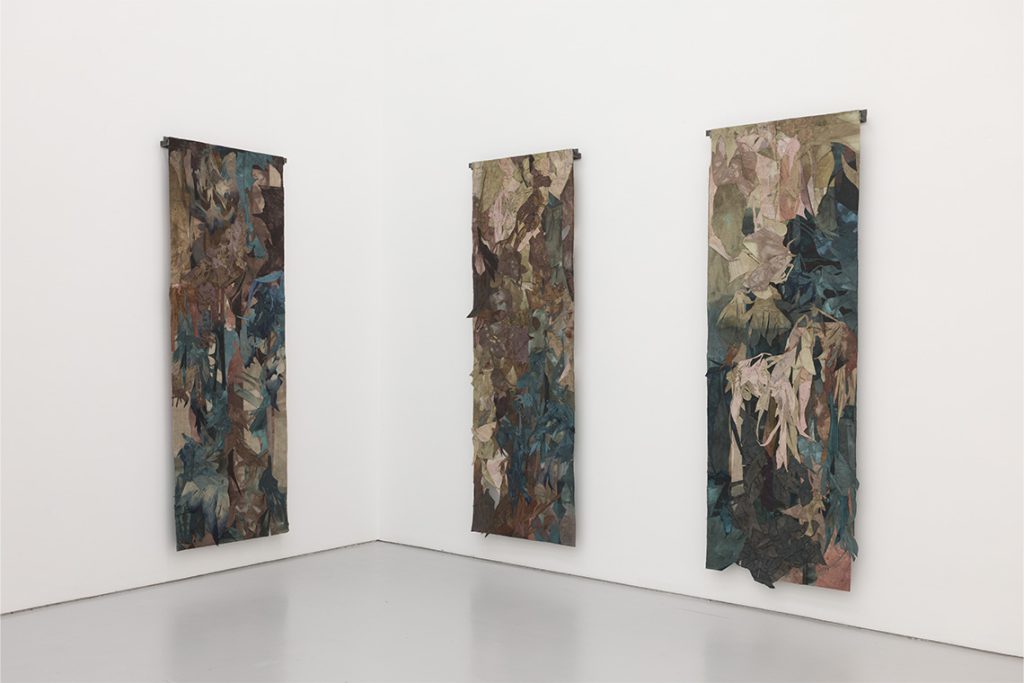
The wall-based textile works prove more elusive. Suspended inches from the gallery surface, these vertical tapestries contain gaps and perforations that reveal the complexity of their construction only to those willing to look closely. Without backlighting to announce their intricate layering, the works demand careful attention – you must move around them, peer at their edges, trace the shadows between fragments. This resistance to immediate legibility reinforces the exhibition’s hierarchy of experience: the tent rewards those who enter, while the wall works demand sustained looking.
This brings us back to that entrance piece, those hanging remnants that blur studio and exhibition space. In Jaouda’s practice, each work is partly constructed from the offcuts of previous pieces, creating what one might call a textile feedback loop. The exhibition itself becomes part of this continuum, an assembly of fragments in waiting, ready to be incorporated into future landscapes of memory. It is a strategy that embeds impermanence into the work’s very structure while paradoxically ensuring its perpetual becoming.
Jaouda demonstrates unusual confidence in restraint. Matters of time does not attempt to fill space but to fold it, creating pockets of intimacy within institutional vastness. The exhibition succeeds not despite its provisional quality but because of it – those neat bows holding the tent together, that chair tucked into a corner, those fragments hanging at the threshold. These are not gestures of incompletion but of ongoing becoming, of cultural identity as “a constant process”, as Jaouda says, rather than a fixed state.
