

The Bahraini artist explores the realm between the conscious and subconscious, between Sumerian antiquity and contemporary spiritual kitsch, between sincerity and satire.
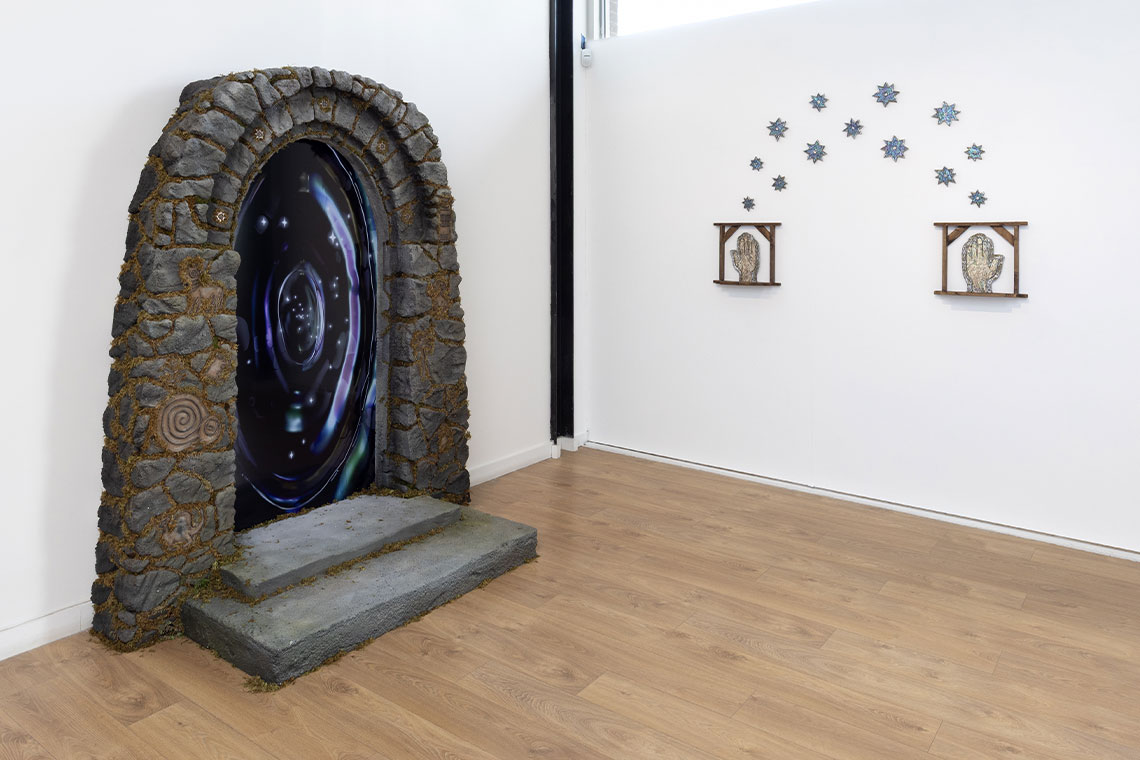
The instinct, on entering The Whisperings, Zayn Qahtani’s debut solo exhibition at Kristin Hjellegjerde Gallery, is to cross the room immediately. At the far wall, To Her We Return (2026) draws the eye before anything else has had a chance to register – an archway dense with live moss, carved with symbols harking back to Sumerian ceremony, that promises the entrance to a secret garden.
Look closer and the promise dissolves into something stranger. At its centre swirls an animated portal, created in collaboration with the motion studio CC Studio and engineered to refract light at precisely the index of an abalone shell. The Bahraini artist describes the result as “an animate, ever-transforming Abalone Being, Womb, Entrance / Exit”. The disruption feels apt – an exhibition exploring thresholds and in-between spaces begins by throwing into flux the very logic by which we read a room.
The show is built around what Qahtani calls the “whispering world” – a liminal space where subliminal communication slips through and makes itself known. That it was conceived in part during a period of acute global and regional anxiety is evident. Halfway through its making, the concept took on additional weight: “It became this act of world-building not just to explain certain subliminal phenomena or feeling but also to build a more safe, responsive version of the world,” Qahtani tells Canvas. The works that result from this impulse are grounded equally in the ancient and the contemporary, drawing on an unusually wide range of mythological and spiritual traditions – Sumerian, Near Eastern, Chinese and the pre-Islamic Dilmunite civilisation of Bahrain.
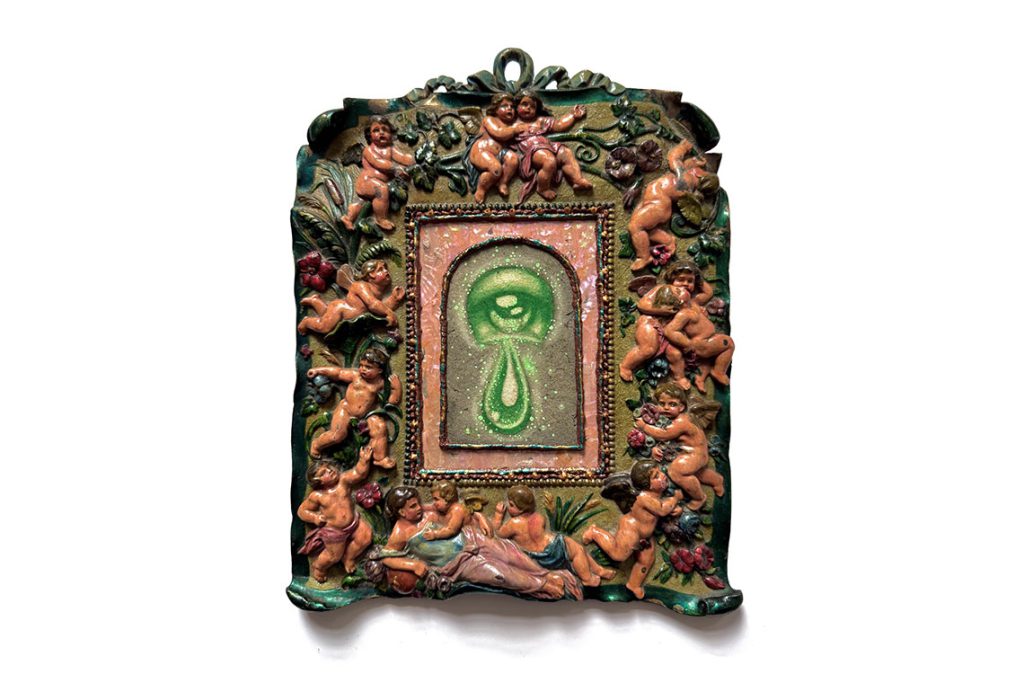
This eclecticism is most legible in the show’s sculptural assemblages, where different historical registers collide. The antique gilded frame in To Feed A Garden (2026) features cherubs – figures whose sentimental associations in the Western tradition obscure their origins as the powerful, winged hybrid guardians of sacred spaces in ancient Near Eastern mythology. Enkidu (2026) reaches further back still, to the Epic of Gilgamesh, rendering the wild man formed from clay in chrome gilt polylactide and abalone shell, from whose sculptural face painted watercolour eyes look directly out at the viewer. These are not exercises in archaeological citation, but something more fluid: a practice that treats different civilisations’ spiritual inheritances as a shared vocabulary.
The abalone shell is the recurring signature across that vocabulary. Present in its raw iridescent form, as crushed pigment, and – in Downloads (2026) – as the ground within which two sets of oil pastel eyes are set, embedded in a chrome gilt polylactide structure in which palm trees and cacti shimmer faintly in the metallic surface, the shell functions for Qahtani as what she calls “the ultimate symbol of ‘the in-between’. A membrane between the conscious and the subconscious.” Its iridescence does exactly what the artist claims for it, making the boundary between visible and felt worlds genuinely, physically thin.
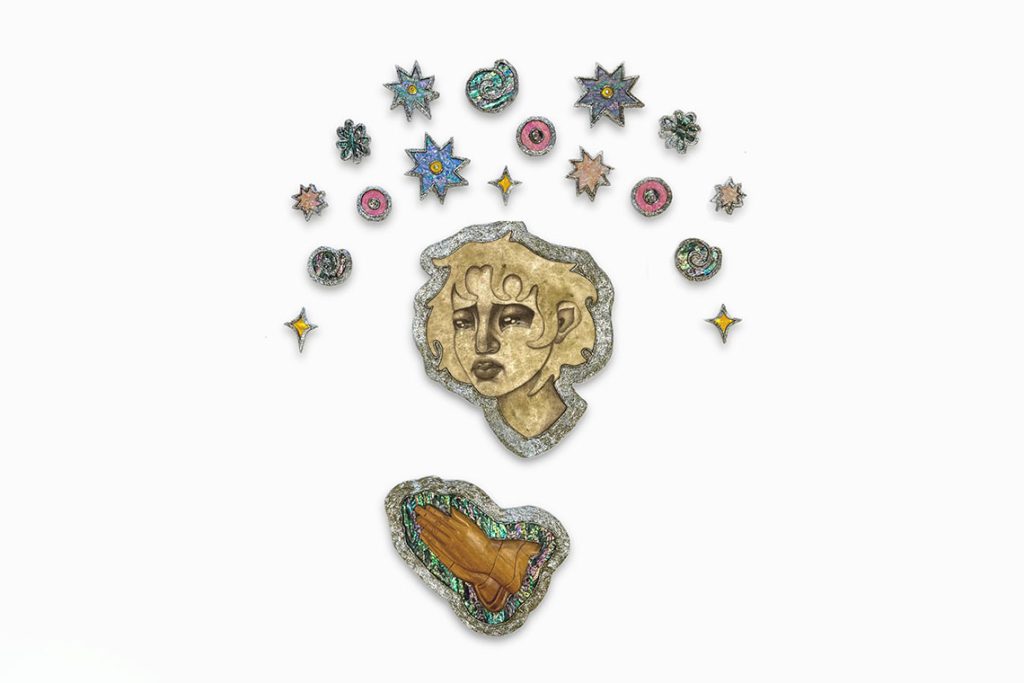
Eyes are everywhere in The Whisperings – looking in different directions, absorbed in private reverie, seemingly communicating with no one in particular. In the sculptural assemblages Manifesting (2026) and Energy Fields (2026), body parts are severed from one another: prayer hands mounted at a distance from a sculpted head, the body between them left for the viewer to mentally complete. Celestial imagery – stars, swirls, diamonds – rendered in three dimensions carries the quality of notebook margin doodles made suddenly solid.
The double entendres in the titles are undoubtedly intentional, as Qahtani is acutely aware of how capital has colonised the language of spiritual practice. “As much as capitalism has fully rooted itself in the practice of selling us a diluted version of the spirit… there nevertheless exists an honesty in the history and culture of these spiritual practices,” she says. Manifesting holds sincere devotion and dry critique simultaneously, without resolving the tension between them.
Across the paper-based works, two distinct groupings emerge. The Moon Blood Plant (2021), Growing Pains (2021) and Why Do I Still, Persevere? (2021) depict anthropomorphic plants moving through cycles of longing, grief and tentative renewal, their upturned faces tracing what Qahtani describes as the process of “digging for what already exists, taking the abstract concept of feeling, thought or experience and translating it into a more symbolic, oftentimes surreal, narrative.” Hung in shallow wooden trays, they carry a quality of both domesticity and containment; the rough edges of the recycled cotton paper suggest forms that might yet grow beyond their borders.
Later works Even the Set Sun Rises (2025), Watching the World Fall (2026) and Nightlight (2025) are equally inhabited, though by different creatures. Small golden anime-like figures that emerged from a period Qahtani spent living and working in China dwell among lotus flowers and luminous atmospheric landscapes. These figures, the artist explains, are “guardian spirits, nature dwellers, hidden guides, fairies. An embodiment of a friend or a wish.”
All of this is anchored in a deep and particular sense of cultural inheritance. Qahtani identifies, she says, not with “Bahraini identity as a generalisation” but with the largely undeciphered Dilmunite civilisation – with, as she puts it, “the people who didn’t document, but rather, simply lived, and when they did document, it was to allude to signs of life.” The Whisperings proceeds in exactly that spirit, not fixing experience into statement but leaving the trace of it – in pigment, shell, moss and gilt – for whoever is patient enough to look.
The Whisperings runs until 16 May
