

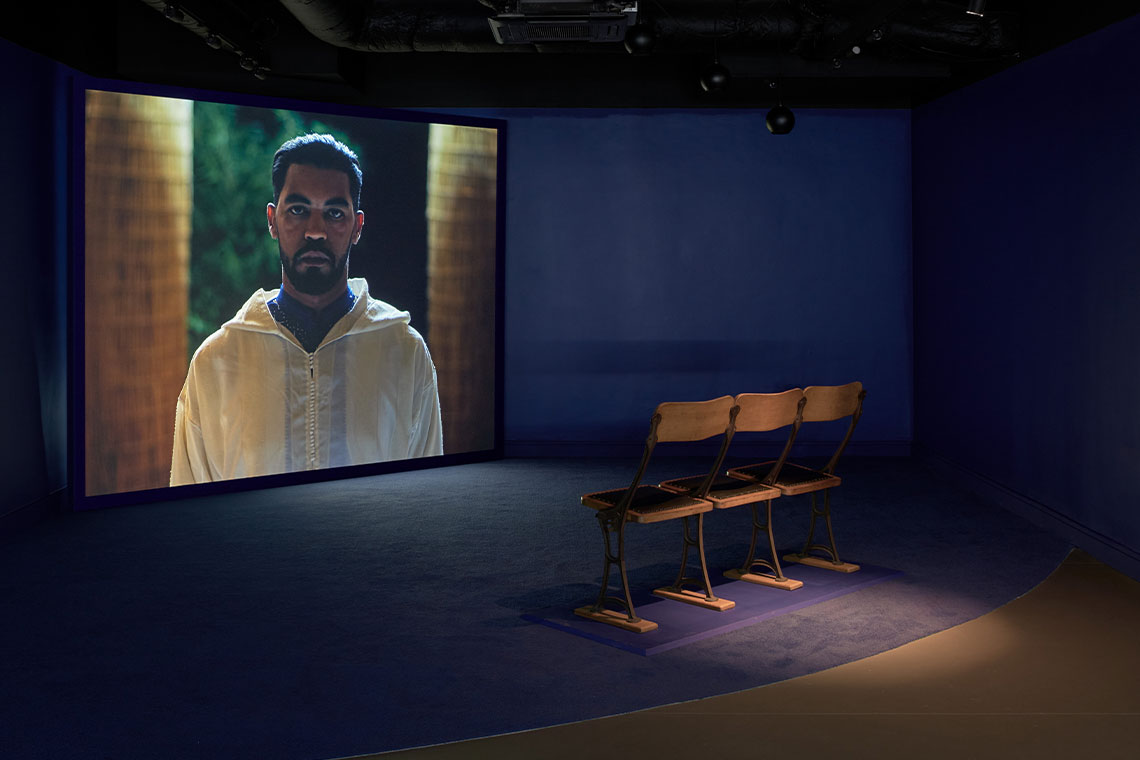
The French-Moroccan artist’s first public UK solo show inaugurates the reopening of Mosaic Rooms, a renowned space for Arab art, culture and dialogue.
We are each taught in various ways to see history with one eye. In her show Circles and Storytellers at London’s Mosaic Rooms, Bouchra Khalili casts “the oppressor” as a cyclops: “The oppressor’s eye never closes” and “The oppressor’s eye never dreams”. Using oral storytelling, archival material, young non-actors, poetry and cinema, Khalili mounts a strong, compact piece of montage. I say montage because her aim, even in curation, is to highlight her careful editing and assemblage of inherited public narratives. Here, she explores the quiet history of the Mouvement des Travailleurs Arabes (Movement of Arab Workers, or MTA in France), especially its theatre groups Al Assifa and Al Halaka (“the circle” and “the assembly” in Arabic). In doing so, she offers us ways of thinking beyond traditional boundaries and performances of citizenship, representation, rights, solidarity and resistance – a second eye.
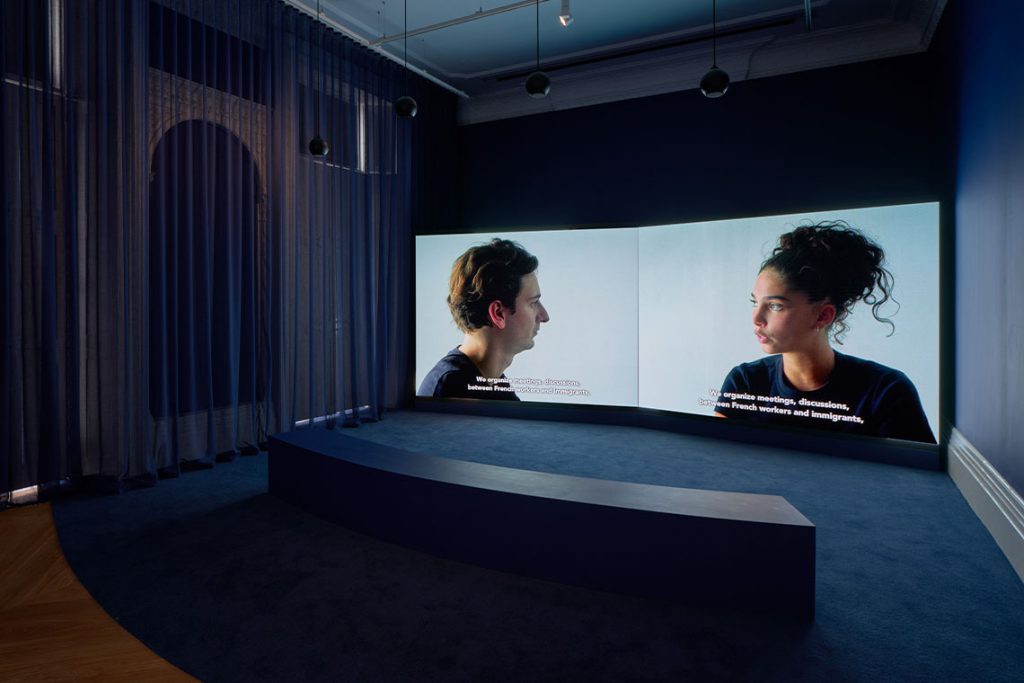
Although the show comprises only four works, these loop and cohere as tightly as the circle they are named for. The viewer is invited inside, where the stories told imply that receiving them involves being responsible for carrying them forward. In the longest video installation, The Circle Project (2023), Mia and Lucas, two young French people of North African descent, simultaneously uncover and (re)construct the evolution of MTA’s theatre groups, particularly how it led to the rise of Djellali Kamal, an anonymous candidate in the 1974 French presidential election. A pseudonym for an undocumented hunger striker who was an MTA and Al Assifa member, Kamal ran on behalf of the country’s immigrant workers. As the video progresses, Mia and Lucas both narrativise and imbibe this history in relation to their own lives (the film was shot in Marseille in 2022), connecting it like a “constellation”, Khalili states.
Phrases and questions such as ‘How to render oneself visible?’ appear as refrains, adding a circular, poetic quality to what is transmitted between artwork and viewer; they also loop together past, present and potential futures. Across the two-channel installation, Khalili shows shots of Mia and Lucas turning to look at, even speak to, the footage ‘next to’ them. Or she puts us directly behind their eyes, as they peer down at archival photos through a mounted iPhone, shuffling the images with their hands beneath layers of screens and lenses. Many viewers, like myself, will be diasporic immigrants from Mia and Lucas’s generation – one that has inherited countless marginalised histories of struggles for fairer access to belonging. But we have to work on finding and organising these pasts, which necessarily means finding and organising ourselves.
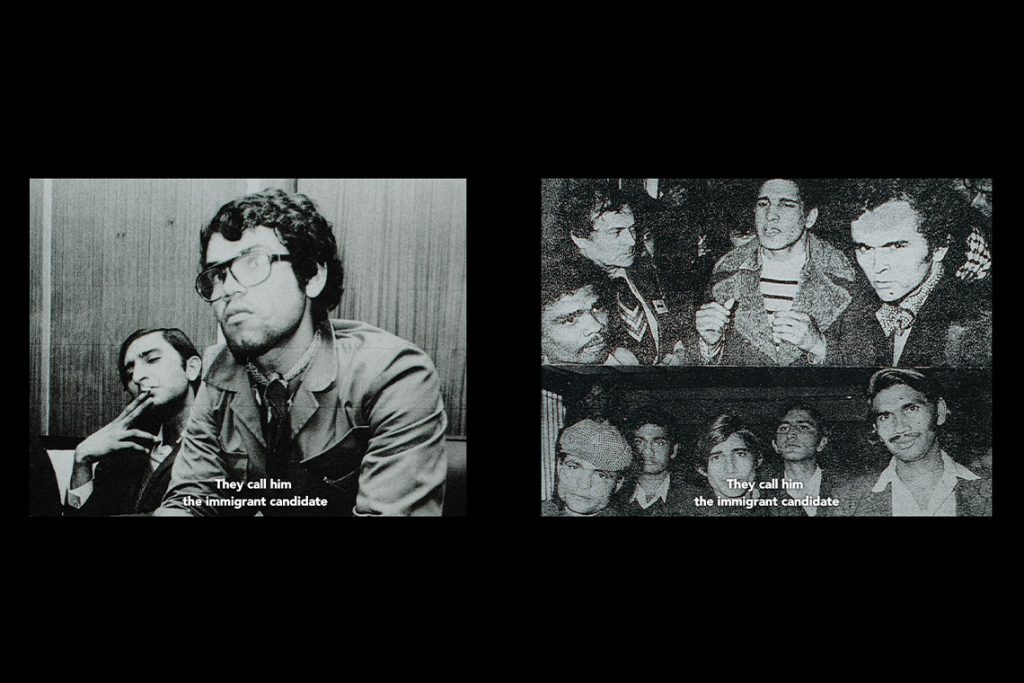
The MTA was active in the early to mid-1970s, as the extensive downstairs poster, Timeline for a constellation (2023), lays out. It was officially founded in 1972 following the fatal shooting of Djellali Ben Ali, a 15-year-old Algerian boy in La Goutte d’Or, an historically working-class, immigrant area of Paris. The establishment of the nation’s far-right party National Front would occur just months later. The MTA soon became “the main autonomous organisation of immigrants, operating at the intersection of several struggles… demands included rights to papers, decent working and living conditions, and cultural and artistic expression”. Khalili’s timeline is a work of editing-as-storytelling: with the putty of material that includes interviews with group members, archival images, performance recordings, manifestos, statements, fliers and posters, she proposes an alternative mould for history-making. Her method is research-based and multimedia, approaches time as cyclical/circular, forms in constellations and is necessarily aware of the chosen artifice of documenting any history altogether.
The Storytellers (2023) is a shorter 16mm film where, decades later, founding members of Al Assifa and Al Halaka reperform parts of their oral repertoire. These are sketches and poems about issues such as housing, racism and working conditions, and Khalili brings the old acts of resistance theatre back into public circulation. Downstairs in the lower gallery, the circle draws closer and more intimate – turning soporific if you’re not present, as the galleries are dark – with The Public Storyteller. Marrakchi narrator Mohsin Touil recounts the tale of Djellali Kamal’s radical candidacy using the poetic techniques of regional oral storytellers, with a brief musical interlude. He speaks to a group of, again, young North Africans, whose open, searching, hard-soft expressions Khalili cuts between close-ups of, as if to let Touil’s story sink into their faces and, thereby, their future selves.
The camera slowly revolves around the storyteller as if physically drawing the ‘circle’. It is, ironically, the drawing of a line, even a border, delineating a shape in which a community can form; in this way, the circle becomes an alternate template for the nation. The MTA’s wider goal was to stretch the shape of citizenship itself, at a time when various migrant communities in France were increasingly suppressed under the threat of expulsion. Khalili spends time examining a particular hunger strike in which 37 Pakistani, Mauritian and Arab workers (including Djellali) occupied a building on Paris’s Rue Dulong. It helps us see how transnational the MTA strived to be while stressing solidarity with French workers, as well as the scope of the organisation’s militancy.
Djellali Kamal became the face and figure of the movement wherein his political candidacy enacted the ultimate public performance. His ‘STATEMENT OF THE MIGRANT CANDIDATE FOR PRESIDENTIAL ELECTIONS’ reads firmly: “WE DIE TO LIVE”. Workers isolated, undocumented, unseen, up from dawn till late at night, away at factories and construction sites, grinding themselves down in order to survive – they were, and still are, fighting against their invisibility. How to render oneself visible? But ‘we die to live’ embodies too the human yearning: for freer paths to enjoy the most out of one’s life. Who gets the right to do that?
Circles and Storytellers runs until 14 June
