

The fifth edition of CI Bloom – smaller and more focused than its sister fair, Contemporary Istanbul – makes a case for ecosystem over spectacle.
At Lütfi Kırdar Rumeli Hall on opening day, visitors sipping traditional Turkish çay from tulip glasses stand cheek by jowl with others clutching iced strawberry matcha, while paintings hang alongside kinetic sculpture, digital work and photography fractured into cascading pixel chaos. CI Bloom trains its lens firmly on the local: emerging galleries, younger voices and the persistent question of what, and whom, such a platform is actually for.
Now in its fifth edition, with 28 galleries and four art initiatives across 2100 square metres, the fair is making that question harder to dodge. Curator, writer and Contemporary Istanbul consultant Professor Marcus Graf, who led a walkthrough of the fair, put it plainly: “This fair manages to reflect the state of the Turkish art scene and market”. It’s not trying to be anything else.
That grounded ambition has taken on new urgency this year. In January, Contemporary Istanbul cut participation fees by 30 per cent below last year’s per-square-metre rates and fixed the exchange rate in Turkish lira, insulating galleries from the currency exposure that has made international fair participation increasingly precarious. Director Ali Güreli described it clearly as “a solidarity decision” – one with structural logic behind it, given that the UBS Art Market Report finds that 35 per cent of gallery income is derived from fairs. Yet for many Turkish galleries, participation has grown financially untenable. Elif Sezer, founder of Kun Art Space in Adana and one of six first-time participants, was candid: “Without these adjustments, participation would have been significantly more challenging.” Dirimart’s sales strategy director, Yeşim Uygur, read the move in broader terms: “More than the practical relief it offers, it signals a willingness to absorb pressure collectively. In the current macroeconomic climate, that kind of collaborative thinking matters.”
Twenty-four of the 28 galleries come from Istanbul – a concentration that reflects where the scene remains centred, although as Graf noted, the presence of other cities signals that things are shifting. Among those from elsewhere, Kun Art Space arrives from Adana, while Loading Art Space and Rıdvan Kuday both represent Diyarbakır – the predominantly Kurdish city in Turkey’s southeast that serves as the symbolic and political capital of Turkish Kurdistan.
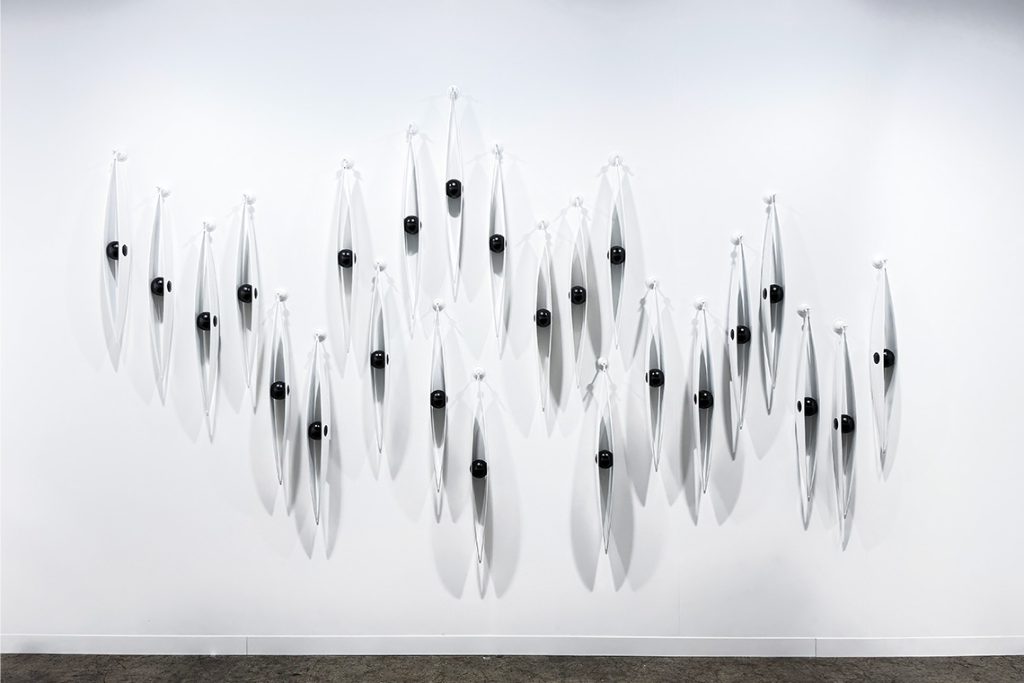
Image courtesy of Pi Artworks
Loading Art Space, founded by artist Erkan Özgen and now in its third CI Bloom, describes the fair not as a route to visibility but as “a ground for mutual circulation and exchange between different contexts” and emphatically not “a one-directional opening toward the centre”. Coordinator Bensu Tanriverdi explains that the initiative is Kurdish-owned and was founded specifically to create space for emerging artists, increase the visibility of Diyarbakır internationally and strengthen cultural dialogues across borders. The tension of a non-profit, artist-run space operating within a commercial fair is something Özgen frames as productive rather than problematic: a space in which the fair is also changed by its encounters with such organisations, not only the other way around.
Galeri 77 builds a different kind of bridge. The gallery is run by an Armenian Turk whose family has been rooted in Istanbul for generations, and its programme – which this year includes work by Armenian artists Sergey Narazyan and Narek Arumanyan alongside Turkish artists – operates in the context of a relationship between Turkey and Armenia still defined by the long shadow of 1915. The list of galleries at CI Bloom may read as predominantly Turkish, but the ethnic and cultural identities operating within that framework are considerably more plural than at first glance.
The art historical context matters here. Turkish contemporary art is grounded not in the Western arc from Renaissance to Baroque but in figurative traditions from the nineteenth century and the deep visual reservoir of the Ottoman period – above all, miniature painting. For a long time, Graf observed, that heritage sat largely dormant within contemporary practice. At CI Bloom, it resurfaces with wit and intention. Murat Palta, represented by x-ist, renders popular culture in the idiom of Ottoman miniature in A Clown’s Fever Dream (2025) and Ides of March ’26 (2026): televisions, American footballs, water coolers and piñatas painted with the delicate precision of a centuries-old courtly tradition. The anachronism is deliberate and comic, but the underlying argument – about the friction and kinship between cultural histories – is poignant.
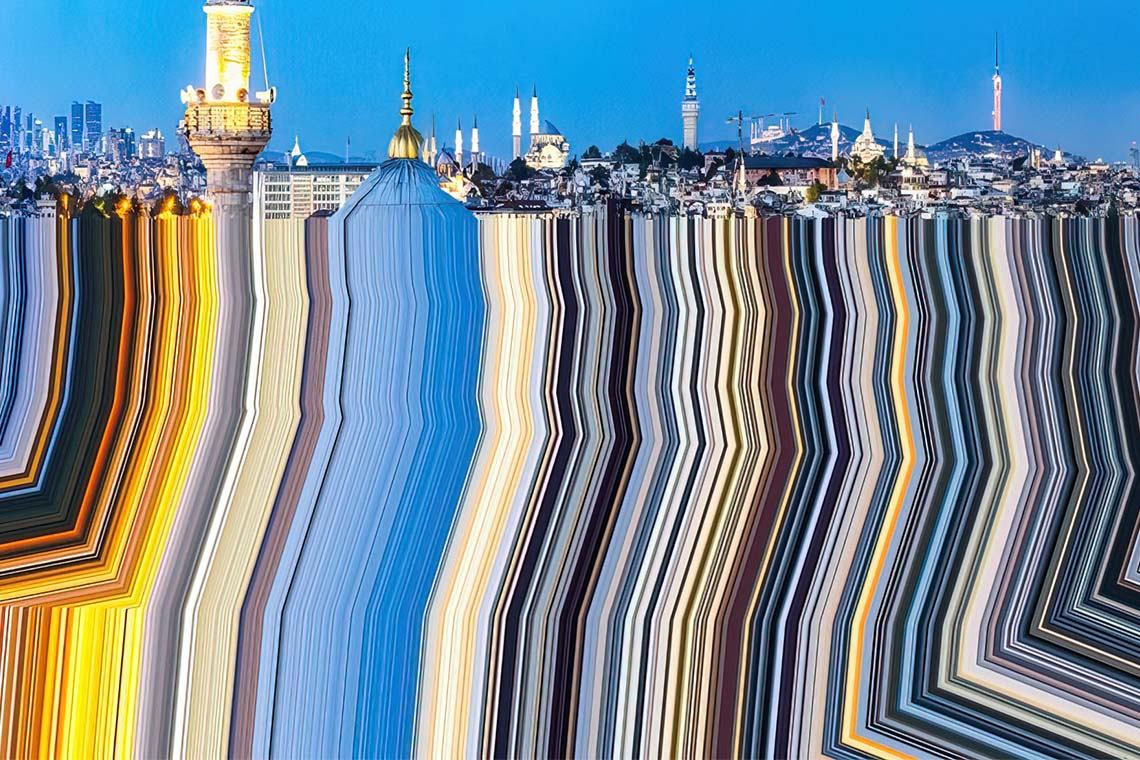
Graf’s broader point about the fair’s character runs through much of what else is on view: fairs are usually more conservative than biennales, more painting-oriented, but CI Bloom pushes against that impulse. Kübra Boy’s Hemhal-3 (2026), presented by Rast Gallery, places lungs and a rib cage rising from within a classical tile vase form – a living object needing to breathe, akin to a human being – making the tension between craft and contemporary practice viscerally legible. The same restlessness surfaces at DIFOART, a photographic collective that uses the medium as a laboratory. Murat Germen’s AI-processed images of tulips and cityscapes – Istanbul and London among them – are overwhelmed by software-generated glitching, fracturing into fields of chaotic, fractal-like pixels. What begins as the recognisable becomes unreadable, raising quiet questions about photography’s relationship to reality.
The case for CI Bloom’s multidisciplinary ambitions is made perhaps most pointedly, however, by Pi Artworks, which presents two sculptures rather than paintings. Osman Dinç’s Eyes in Downpour (2025) brings his rigorous minimal conceptual sensibility to bear, while Erdal Duman’s Boniboom (2025) takes torpedo-esque forms that can be spun like a toy – simultaneously joyful and about war. Given that 70 per cent of art fair revenue typically derives from painting, according to Graf, a two-sculpture booth is a considered statement of confidence in where the market is heading, and in the collectors who are moving with it.
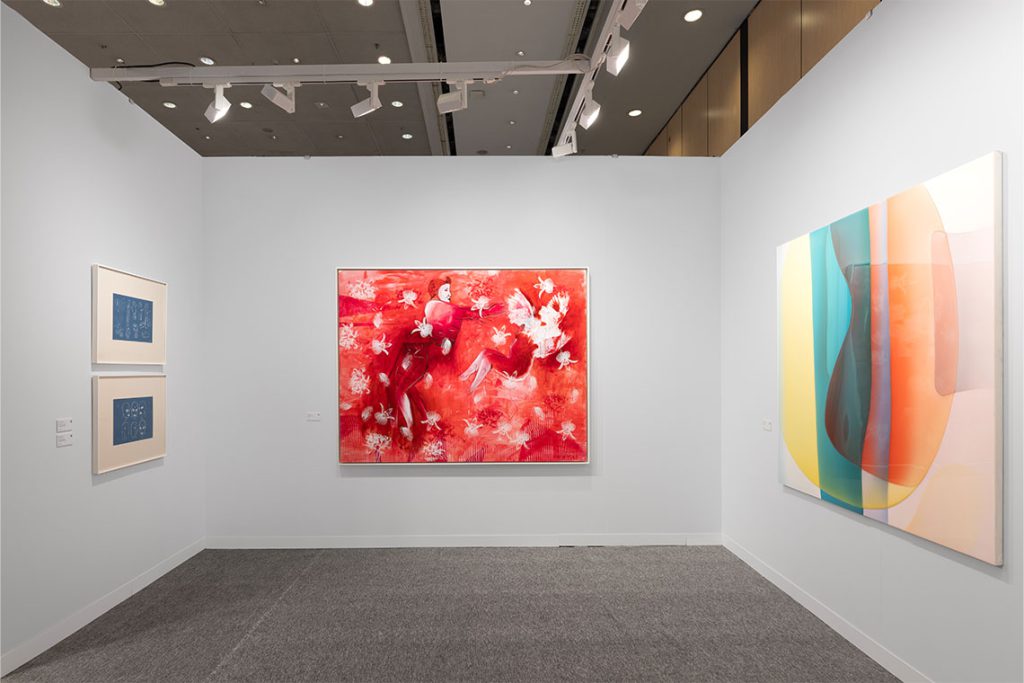
Medium is one frontier; subject matter is another. Rast Gallery also presents Mesut İkinci’s humorous but undeniably political Security Department (2026), from his Mars series: a group of bekçi, Turkey’s neighbourhood security guards, stand uselessly on the Martian surface, ostensibly securing something – although what, and from whom, remains deliberately unclear. At Dirimart, Ghada Amer’s Şafak (2025) pushes at different boundaries. The Egyptian-American artist’s work features women in autoerotic poses painted in bright, translucent blocks of colour – reminiscent of censorship bars, yet doing the opposite of censoring, being vivid enough to draw the eye rather than shield it. The figures remain fully visible beneath them, the paint daring viewers to look at what has so often been hidden from view.
Three galleries here – Dirimart, Pi Artworks and FAAR – now maintain London spaces alongside their Istanbul operations. Pi’s founding director Jade Yeşim Turanlı frames her continued commitment to CI Bloom in terms of responsibility: “Especially when the market is more challenging, it matters to stay present, support our artists and contribute to an ecosystem we believe in.” Dirimart’s Uygur is direct about the register in which the fair operates for a gallery of that scale: “This is our home city, our collector community, our ground”. Its particular intimacy, she argues, “suits the emerging end of our programme well – there’s a receptiveness that’s harder to achieve at a larger fair.”
CI Bloom’s latest edition will not rewrite the international art calendar. What it offers instead is less legible but arguably more durable: a fair that has absorbed economic pressure rather than passed it down the chain, that holds space for Armenian and Kurdish cultural production alongside the Istanbul mainstream, and that takes seriously the idea that a local ecosystem must be built collectively or not at all. Güreli’s observation that “art is the strongest tool we should keep in hand in this terrifying war environment” might read as rhetoric elsewhere. Here, surrounded by work made under exactly those conditions, it feels closer to a statement of fact.
