

A collateral exhibition at the 2025 Kochi-Muziris Biennale, പൊന്നുപോലെ / Like Gold examines both the labour and lustre behind a substance binding South Asia and the Gulf.
For South Asians, gold has tremendous value beyond the monetary, across social, cultural, religious, political and spiritual spheres. Anthropologists like Annette B Weiner have described it as “wealth that stays close to the skin”. To me, it is an object of patience: stretches of bored hours in my childhood while my mother and grandmother pored over earrings, agonising which purchase would eventually become inheritance. These ‘memories’ still sit stored in safes.
Gold remains a powerful status symbol and highly secure investment across the heterogenous patchwork of the Indian subcontinent, especially for women and as part of marriage traditions. Following economic liberalisation in the 1990s, it has especially flowed between India and the Gulf, creating a nexus of official and unofficial trade, labour and migration circuits between the two geographies. Dubai – with its enormous Indian, mostly Malayali, population and famous Gold Souk – is known as the ‘City of Gold’. Plans for a Dubai Gold District – a literal ‘yellow brick road’ – were recently announced before the outbreak of the US-Israel-Iran War, even as many are increasingly questioning the structures upon which the gold industry thrives and at whose expense it persists.
In a collateral exhibition for the 2025 Kochi-Muziris Biennale – entitled പൊന്നുപോലെ / Like Gold – curator Murtaza Vali has aimed to “complicate and demystify gold’s enduring appeal and its association with wealth, worth and value … in both a physical and Marxist sense”. Placing such an exhibition, produced by the UAE-based Rizq Art Initiative, in one of India’s most leftist states produces an intriguing, paradoxical experience. As anthropologist Neha Vora theorises, the UAE and wider Gulf ingest huge numbers of Indian migrants for whom gold is also more tangible than the possibilities of citizenship. It therefore becomes a repository for emotions, care and under-rewarded labour across distance – an alternative vessel of belonging.
Like Gold is so ideally suited to its location and audience, it is pleasurable to even just watch viewers engage with it. This is a show I can talk to my mother about with a preexisting shared language, sans any jargon. It is mostly generous, especially in its captions, only impaired by some variation in the quality of works. There is painting, sculpture, installation, textiles, photography and video by 23 artists largely from, between, or based in the UAE and India. When conceiving the show, Vali was originally “trying to understand the historical and contemporary urban conditions of the UAE and [his] relationship to it,” finding that gold ran through his childhood memories in his hometown of Sharjah and nearby Dubai. It is fitting then that Like Gold begins with a cosmic work by Kochi-based Vivek Vilasini that recreates a piece he first presented at the Sharjah Art Museum in 1995. The artist embodies an under-acknowledged aspect of the UAE’s art history – echoing how South Asians can be invisibilised in its canons – as he was part of the small artists’ coterie around Hassan Sharif in the 1990s.
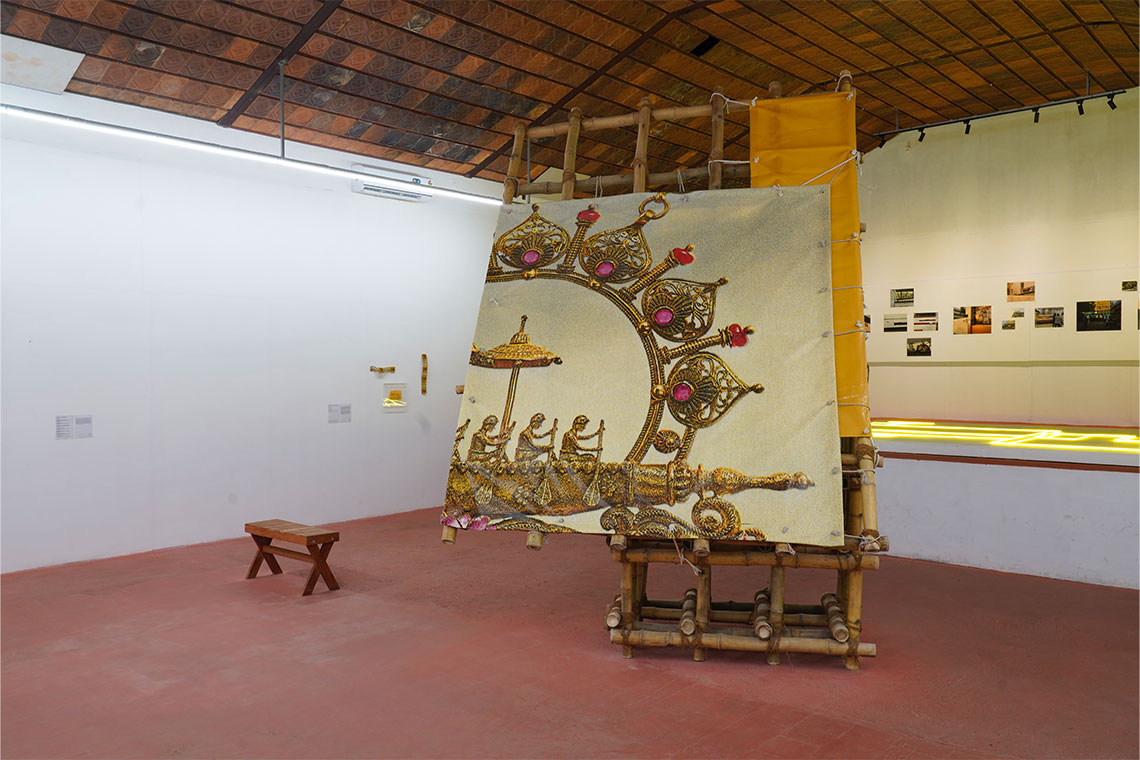
Big brands like Malabar Gold & Diamonds, Tanishq, Kalyan Jewellers and Joyalukkas were another curatorial inspiration for Vali in terms of how they have entrenched gold as a city-defining mythology in both the Gulf and South Asia. Vikram Divecha’s fantastic Roof/Structures (Gems and Jewelry, Fast Food) (2025) lays this aspect bare, repurposing tarpaulin from the giant billboard ads on Dubai’s arterial Sheikh Zayed Road in collaboration with workers he met at a tarp scrap market. In an installation we see men rowing a boat, a strip of golden yellow from a burger brand, and a disused Tanishq ad. The work cuts to the heart of what gold really represents in these seductive, migratory and capitalist images: the insatiable appetite of humans.
Photography is one of the strongest media in the exhibition. Anup Mathew Thomas’s images are patient observations of life in Kerala, from the interior world of a Syrian Christian church to a double portrait of a smiling political leader, in a classic cream mundu (a traditional garment worn around the waist) with gold-thread zari borders. At the show’s other end is a photo essay by Sreerag Jyothish entitled Golden Hour (2025), serving as a kind of bookend. The images were shot in Dubai’s ‘other’ City of Gold: a working-class neighbourhood called Sonapur (literally ‘City of Gold’ in Hindi/Urdu), which houses mainly manual and construction labourers. Not a single person appears in the photographs, but rather traces of their presence: shop signs, parked buses, drying towels. Vali says he wanted to explore as many aspects of gold as possible, including those “neoliberal spectacles” of advertising or urban infrastructure “that all but erase the hands and bodies of those who make them”.
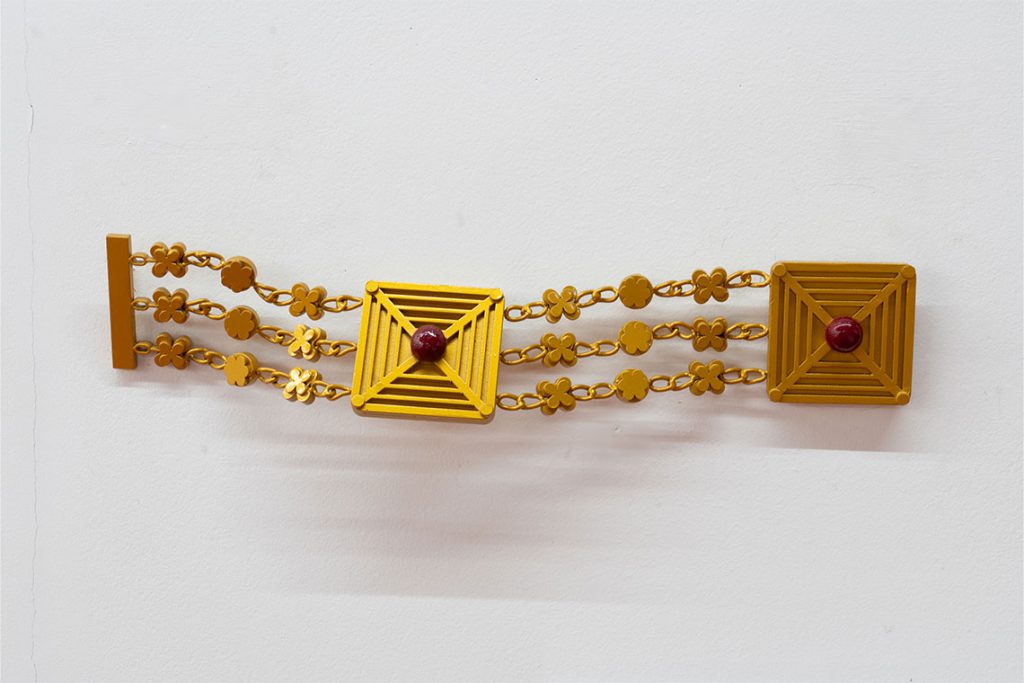
Jewellery, of course, has its place to shine. Karen Dias zooms in on Kerala’s “Gold Capital” Thrissur, 75km northeast of Kochi, in Untitled (Thrissur) (2018). She documents different parts of the gold ecosystem there, from a low-lit goldsmithing workshop to a stunning shot of a gold cross chain on a man’s chest, shyly blooming out from his vest. The lack of women in these photographs mirrors their relative absence from the gold manufacturing industry itself, despite being the product’s primary consumers. Yet, women’s perspectives appear nearby in the textile works of family jewels by Melissa Joseph, side by side with Roudhah Al Mazrouei’s resin replicas of her own family heirlooms, a traditional Emirati gold necklace and bracelet. Both artists’ materiality is culturally specific: Al Mazrouei infuses her resin with snaah, a fragrant saffron and mahlep paste once used for perfuming hair, particularly in bridal rituals, while the Indian American Joseph uses felt, wool, and recycled sari silks, nodding at inherited cultural aesthetics, as well as the soft, fibrous textures of memory.
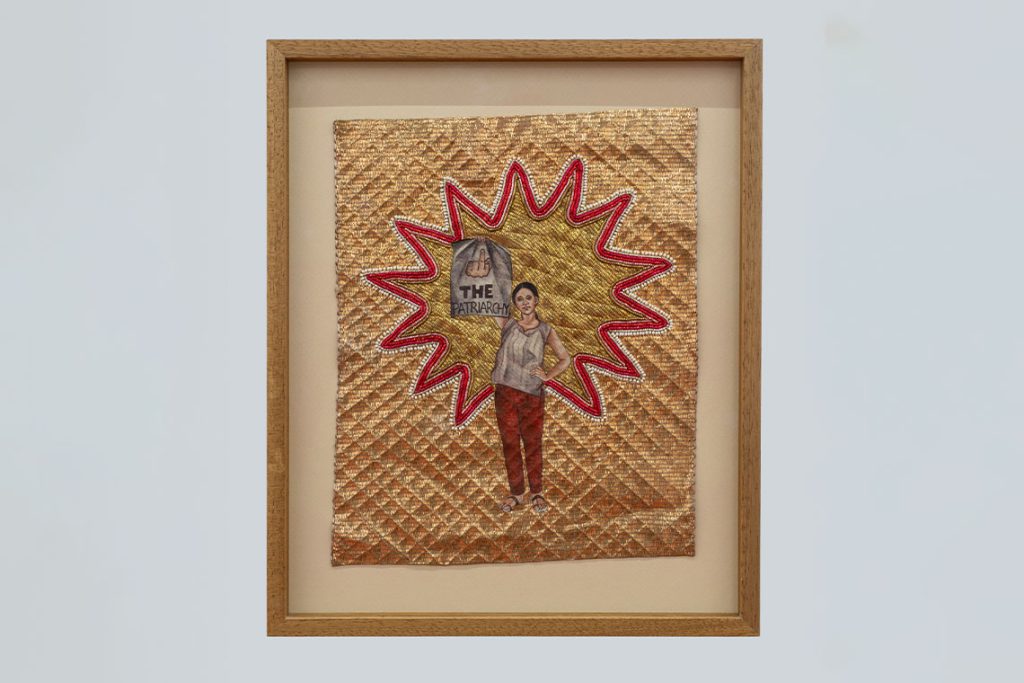
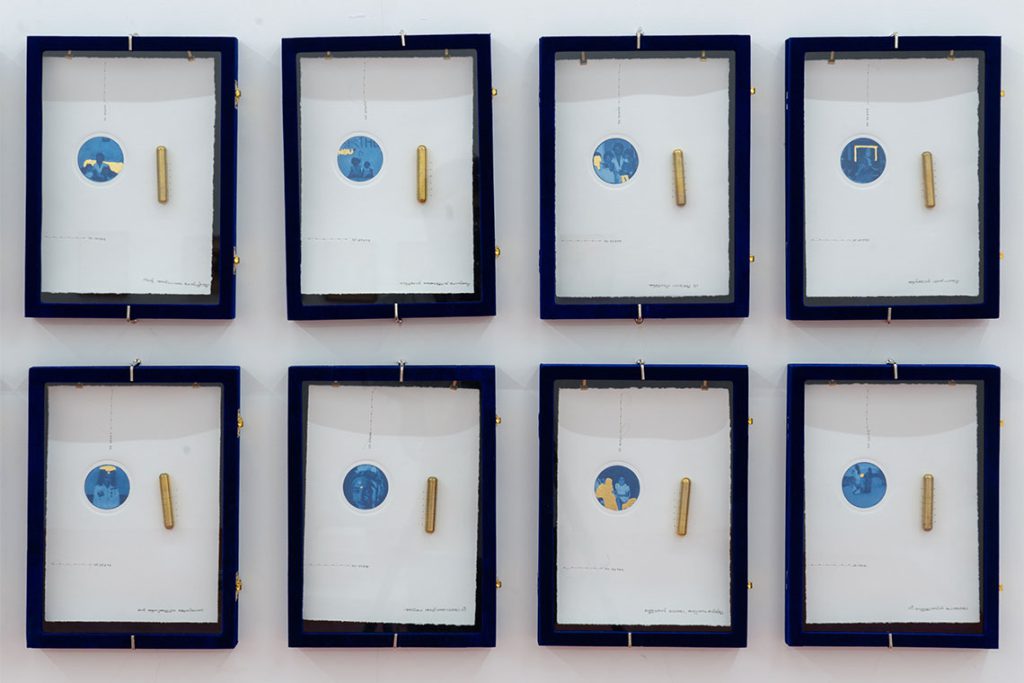
Varunika Saraf’s 2025 Jugni series makes golden icons of women activists engaged in protest, letting us reflect on who we choose to worship and why. It is a heartening work, celebratory and gumptious, complemented by Indu Anthony’s beautiful I Brought Her Up Like Gold (2021) on the wall opposite – one of my favourite works here. The name comes from the common Malayalam expression for the “tender yet excessive affection” parents extend to their daughters, and also gives the exhibition its title. Anthony explores its double meaning, including the often high expectations held of daughters. She frames enchanting blue cyanotypes in wooden jewellery boxes, incorporating intimate personal objects from her life, including what her own mother wanted from her and what she ‘failed’ to give – there are written demands, talismans, family photographs, even her own hair. Anthony both opens up and questions the very definition of an ‘heirloom’.
Vali’s curatorial statement references the term ‘chrysopoetics’ – processes of transformation where material, language or thought is turned into gold, not literally but metaphorically. A superior alchemy, in short. I see the term’s guiding force in many of the works and curation, perhaps most importantly in the ways it functions as a metaphor specifically for artmaking in societies governed by patriarchy and racial capitalism. Gold moves us: for money, for beauty, for power, for image. This is not unique to a single region, but an expression of shared human interests, traded across all manner of borders. To adorn ourselves, we extract from someone else’s earth.
പൊന്നുപോലെ / Like Gold runs until 31 March
