

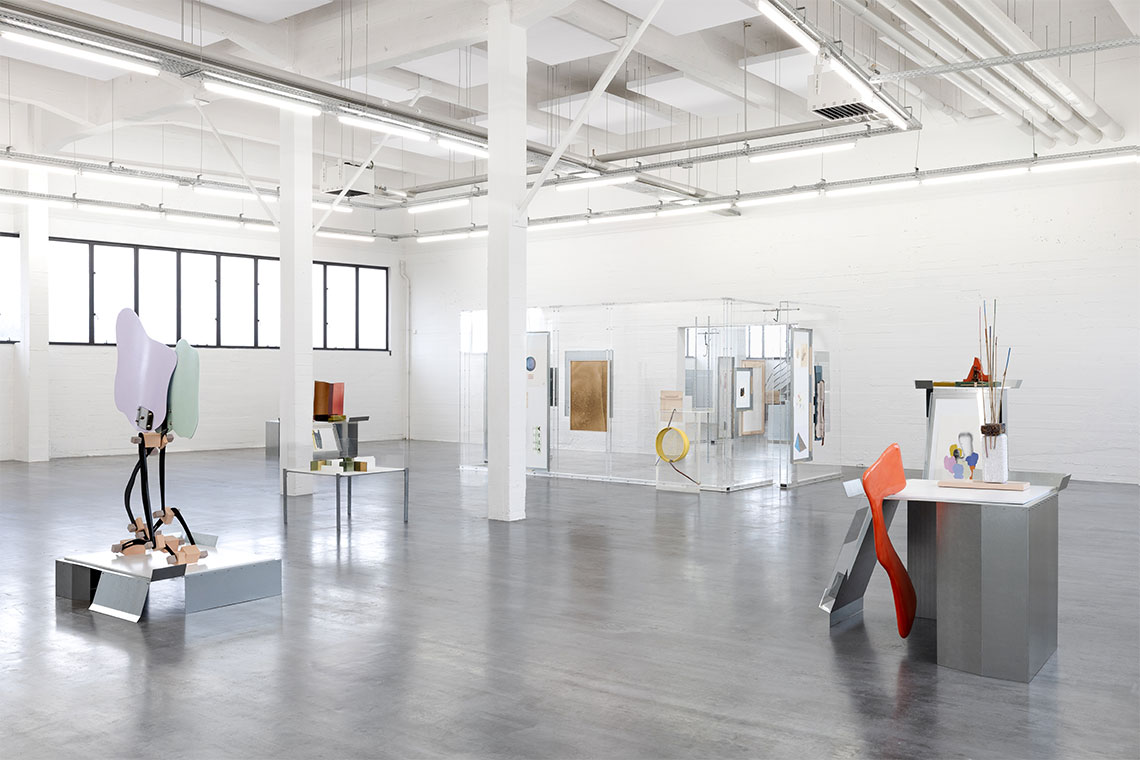
Nairy Baghramian presents sculptures that shift between new and reworked forms, inviting reflection on material, space and changing meanings.
Exhibitions can often take a long time to plan, design and mount. Few, however, take as long as Nairy Baghramian’s new presentation at WIELS in Brussels. The invitation to the Iranian-born artist goes back to 2008 following her participation in the public gallery’s opening exhibition, Expats & Clandestines. Now, some 17 years on, that offer has come to fruition with nameless, a richly poetic, delicate and playful intermingling of new and existent work from the now globally recognised artist.
“Back then, Nairy was a fairly unknown German artist,” says Dirk Snauwaert, director of WIELS. “I discovered her work in a gallery exhibition at Galerie Nagel Draxler in Cologne, and her career has since skyrocketed internationally from Germany to France, the USA and Japan.” The invite remained open with countless conversations between museum director and artist about solo projects or participation in group exhibitions, but it had never quite felt the right time for both parties. As Snauwaert observed, Baghramian’s multi-material, singularly identifiable sculptures have become a regular presence internationally, especially with a major 2016/17 survey co-organised between S.M.A.K. in Ghent and Minneapolis’s Walker Art Center, and the 2023–24 Façade Commission for the Metropolitan Museum, in which empty arched niches were filled with site-responsive, colourful compositions, breaking against and seemingly tumbling from the neoclassical order.
With the Ghent exhibition still a recent memory, Snauwaert knew he would have to wait a few years before another major Belgian Baghramian presentation, but despite the pause there is a connection. “[This exhibition] is an echo of the S.M.A.K exhibition,” he suggests, “which was quite full, quite dense, and the first synthesis of her work.” Indeed, some of the works on show here were present nine years ago, but it is a bit of a game to work out the components and their histories – a game that is equally fun for both the mind and the eyes.
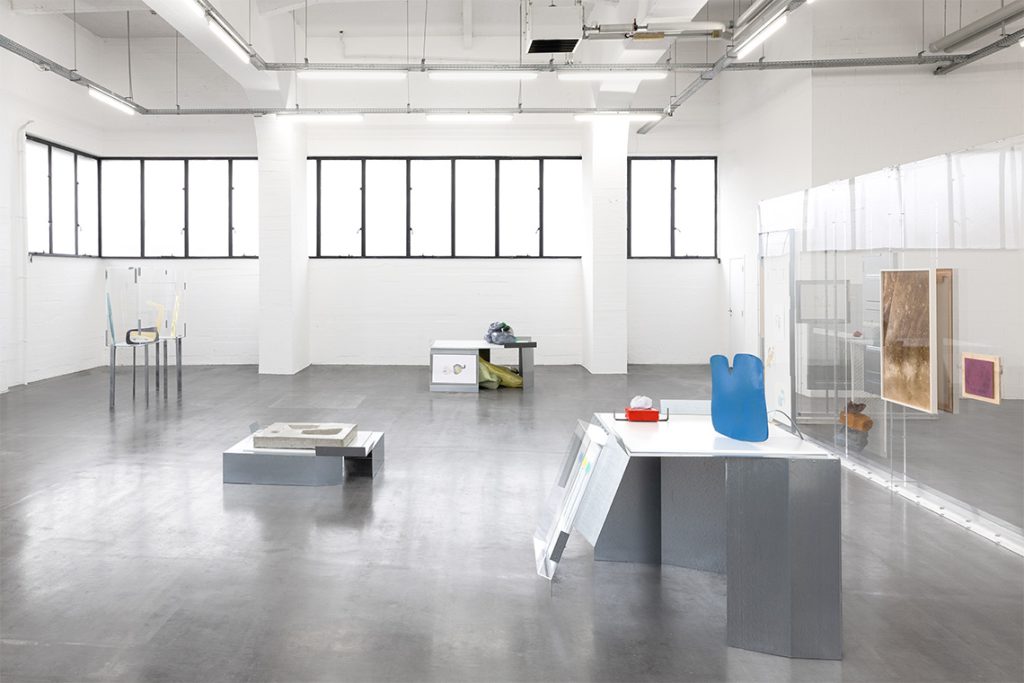
Baghramian has split her exhibition across two of WIELS’s solid concrete home, converted from a modernist 1930s brewery, with the lower of the two floors a busy interplay of forms, colours, material and references. The sculptural works – mounted on purpose-designed plinths, wall-mounted frames and interconnected set pieces – are all untitled and undated. With the normal convention upon entering a gallery being to pick up the literature with names, dates and descriptions, at first this is a bit confusing or even frustrating. With works placed around the space carefully to relate to one another and the architectural details of the building, there is also no prescribed pathway. Instead, the visitor is left alone to discover it all for themselves, on their own terms, led by their own curiosities. The lack of direction in turning from what at first is confusing or discombobulating, quickly becomes freeing, allowing the works to speak less to a dogmatic meaning, history or narrative, and more on their own terms.
Throughout the rich mix, however, there are countless connections to architectural, art and design history. There are models that could be Miesian floor plans. Polystyrene forms that nod to Lin May Saeed. Schwitter-like amalgams of materials. Pomo plays of colour and scale reminiscent of Claes Oldenburg. Folded forms that conjure the aesthetic of Isamu Noguchi.
Avant Garde forms that honour the work of Polish artist Katarzyna Kobro. Plus more, many more, in a whirlwind of association and suggestion. At no point, however, does the show seem heavy, referential or didactic – the connections remain poetic and nuanced, with Baghramian seemingly aware of the ecosystem from which she emerges but not beholden to other sculptural voices. “What I tried for this exhibition is not to get rid of their voices but to respect them for their own sake, not to misuse them,” the artist says. “I learned a lot from them, my work is influenced by the past, but the hard part is how to I get to my own sculpture.”
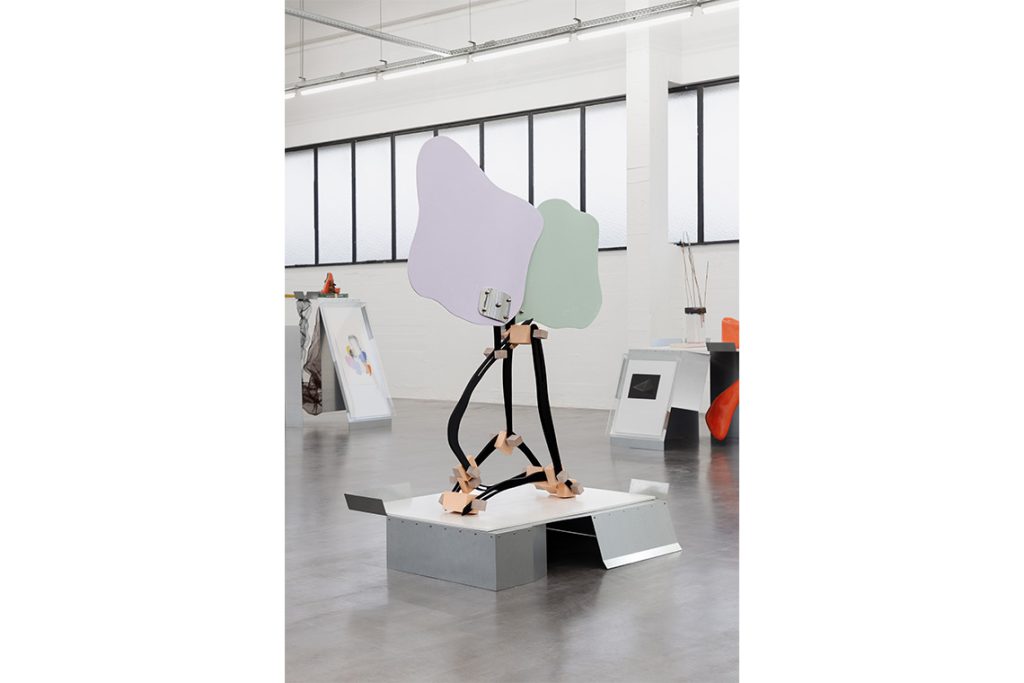
Many of the artists from whom Baghramian draws inspiration were exiled from autocratic regimes, perhaps speaking from abstracted or formal sculptural and making a translation and transition between places, people, language and politics. Throughout all the works is a celebration and attention to the simple act of making, whichever the material and whatever the process. Many of those artists who have a spectral presence in the show continued to make work despite their predicament and means – a purple-and-green papier mache blob-like piece perhaps speaks back to Jean (Hans) Arp’s 1936 Maimed and Stateless.
Such lack of dates, titles and descriptive texts help with that dislocation and sense of fluidity – indeed, some of the works have not only been seen in previous exhibitions but have also been reformulated, reconfigured and reimagined, adding to their sense of impermanence and unfixity. “There was a need for a sense of the temporary, and the idea that works, writing, thinking about art, listening to art, is something that changes,” the artist offers.
Such mutability of form, and perceptions of it, are grounded by the solidity and unavoidable massiveness of the concrete architecture that contains it all. “If I believe in that idea of the abstract, and if I could describe my work as ‘ambiguous abstraction’ or ‘ambivalent abstraction’ that also relates to writing and reading, that ambiguity is always in relation to the architecture and space where the works are,” the artist says. Here, the architecture has been reinforced and made present through simple acts: uncovering windows, removing partition walls, revealing vistas across the spaces previously occluded.
This tweaking is most present in WIELS’s upper floor which, after having been opened up, has had some new off-kilter walls seemingly wedged into the space at awkward angles. This area is often reserved for a monumental statement work, but when a visitor enters for this show they see nothing but a largely empty space, the inserted, skewed walls adding a Caligari unease. From the entrance, the only visible works are cushion-like glass forms sat on slender shelves, almost translucent objects that in this emptiness seem to carry a heaviness and depth.
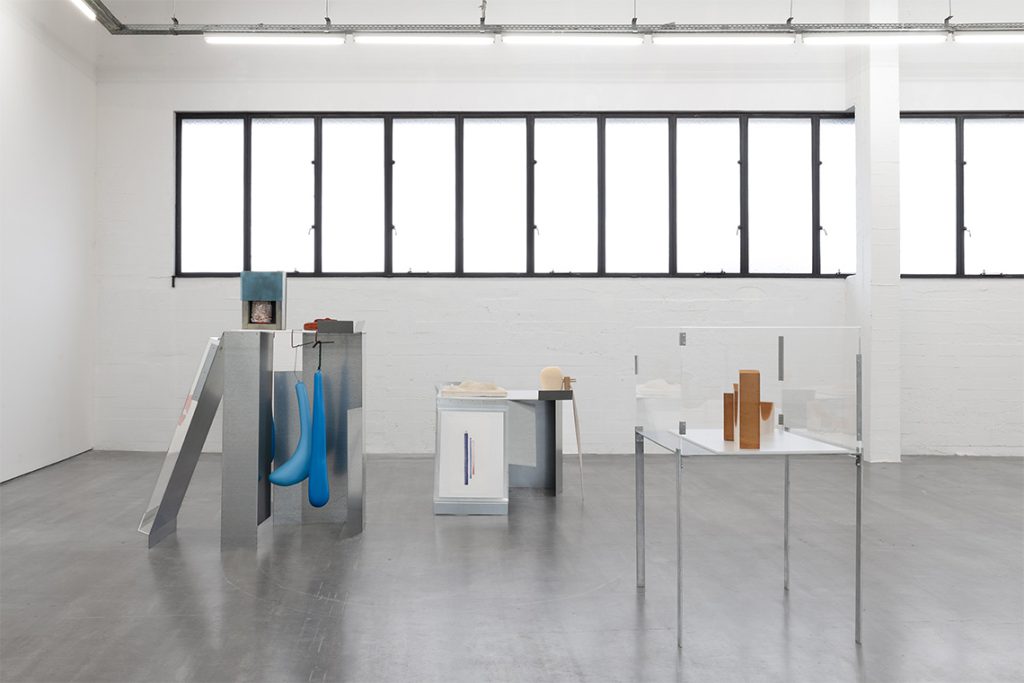
Whereas the floor below is busy and crowded with forms, here there is a quiet void. “I have the feeling we are rushing through things,” the artist says, “so maybe that’s why I kept the centre empty – for gathering, standing and talking.” The floor is, however, packed with work. A number of serpentine sculptural glass pieces are mounted on the back side of the angled walls, facing the external opened-up windows. They are only discovered after entering and exploring the space, sometimes in hard-to-access compressed, angular corners that offer an intimate and personal encounter with the work.
Baghramian had visited the Italian city of Turin, famed for its arcades illuminated with neon signs and writing. Such neon-tubed signage is increasingly rare, a superseded technology replaced by more energy-efficient and cheaper alternatives. Here, none of the tubes carry electricity or light, but their redundancy is also present in the deformed, twisted and adjusted forms that the material takes. When used as a form of capitalism, the neon tubes spell out brand names and signify logos. Here, melted and mutated, they are freed from that ideology, almost as if offered up to be recognised and appreciated for their own materiality.
“When there’s light inside the tubes, when they light up in colour, you cannot see the interior, you don’t see inside but are focused on what they mean and what they define as a sign, you cannot see what’s true,” the artist says of the objects that, when illuminated from without rather than within, reveal their flesh in altogether new ways. This attention to the translucency and nuance of material is picked up in nearby new works, multi-layered wax castings made in wooden frames that at first seem solid but which, like Rothko, reveal a depth and softness discerned as external light allows new readings.
It is here, in such a that shifts about in new light, that Nairy Baghramian’s work sings. It is an impermanence that speaks to a mutability of material and meaning, and which understands that art is less a trajectory of progress that references or improves upon past canon as a web of coexistence across geographies and times – a dimension in which artefacts are not solid, fixed coordinates, but freely migrating, open to reinterpretation and reimagination.
