

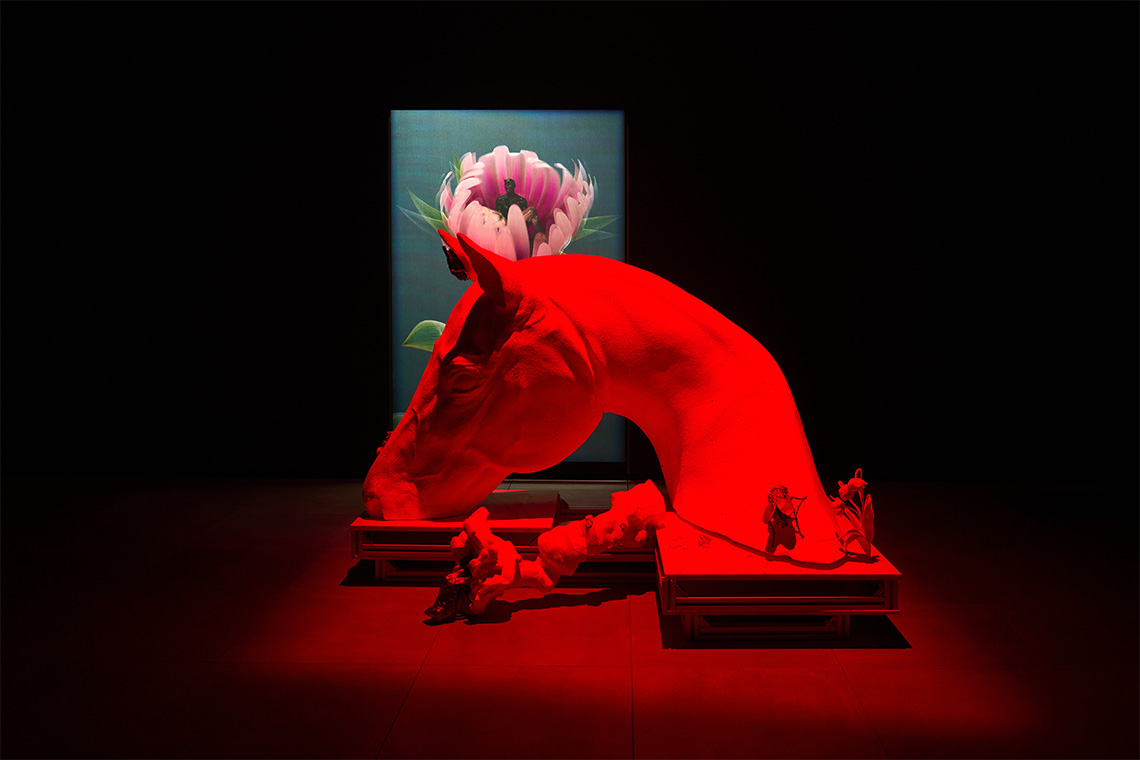
At FACT Liverpool, Bassam Issa Al-Sabah treats fantasy not as escape but as survival strategy – a way of enduring digital culture’s relentless demands by inhabiting instability itself.
Descending the ramp into FACT Liverpool’s darkened gallery feels less like entering an exhibition than slipping into a video game mid-level – disoriented, uncertain where the beginning was or if there is meant to be an end. Bassam Issa Al-Sabah‘s immersive installation, THE MISSION IS THE END, THE END IS ALL I WANT!, engulfs visitors in this state of suspended animation, where navigation becomes intuitive rather than linear.
The Belfast- and Dublin-based artist has created an environment where film, sculpture, lenticular prints and shifting light refuse to settle into coherent narrative. At the room’s far end, a large screen glows with a new film work – the exhibition’s gravitational centre – whilst polystyrene sculptures emerge from pools of targeted light like fragments surfacing from dark water. The walls bear lenticular images: horses rearing dramatically, teeth bared in frozen combat, their surfaces shifting as you move past them in a low-tech echo of the digital glitching that pervades the show.
CGI rendered faces fill the screen in extreme close-up – lips, some fanged, some sparkly, mouthing words slightly out of sync with the voices we hear. “Fiction is a full-time job,” one announces early on. What we are watching are versions of figures rather than distinct personalities, voices speaking about their manufactured existence. “I can’t tell if I’m being seduced, erased, or I’m just slowly being consumed,” says a bald avatar draped in an ethereal blue sheer dress.
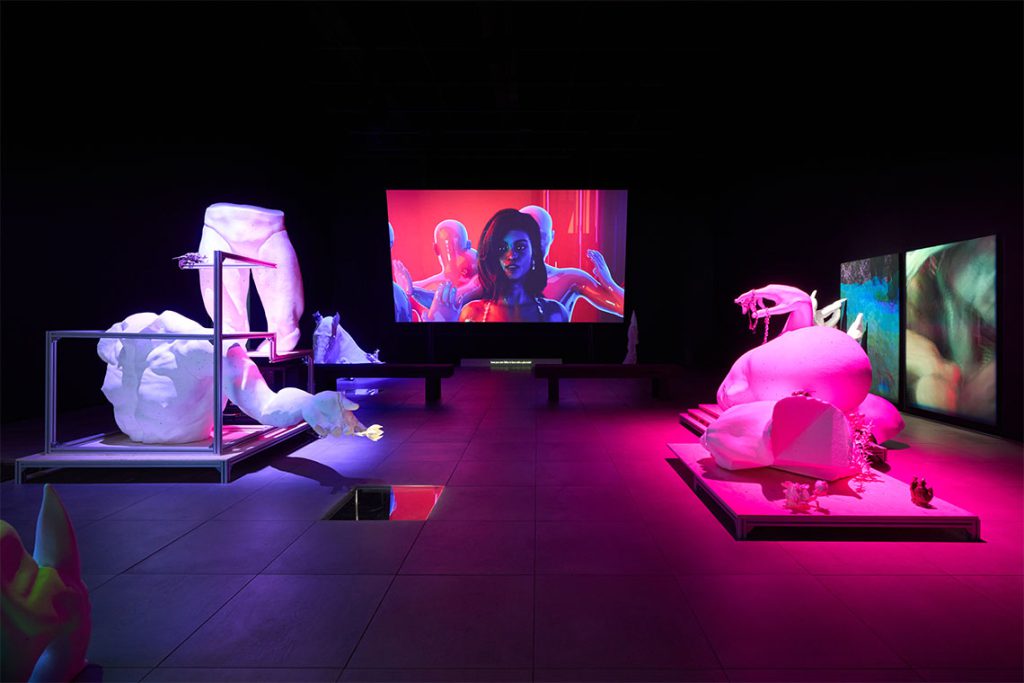
Al-Sabah describes the “end” in his title not as closure but as “a desire for release rather than resolution”, and the film embodies this distinction. Chapter titles punctuate the film work – “It’s impossible to see the water you swim in” – but provide no roadmap, only atmospheric markers in an experience structured more like gameplay than cinema. One particularly arresting sequence shows the blue-clad figure digitally melting, its coherence dissolving into refracted colour before collapsing into complete pixellation. As the film progresses, the faces begin to degrade in different ways – some pixellating into pure digital noise, their structural integrity visibly failing. “People fall into me and forget what they’re running from,” sparkly lips pronounce near the film’s end. “And I let them. It’s an act of mercy, or maybe kink. Same thing these days.”
The sculptural elements function as this digital world’s crashed debris. Large polystyrene forms rework classical references into something precarious and strange – bodies strain towards each other without achieving connection, heads tilt together in ambiguous poses, a slowly rotating male abdomen wrapped in chains hangs from the ceiling. These sculptures borrow from the visual vocabulary of monuments and classical grandeur, but arrive utterly destabilised, exposing the gap between ideological weight and aesthetic surface. Two horse heads appear amongst them, one displayed beneath the floor level as though half-buried, their solid forms contrasting sharply with the grainy, glitching horses in the film and lenticular prints.
Throughout the space, the body appears fragmented – severed fingers, isolated hands, partial torsos – reflecting what Al-Sabah calls the “constant compression” of digital identity. “Online, you’re flattened into a profile,” he explains, “a surface that has to stand in for a body, a history, a set of contradictions.” The sculptures literalise this fragmentation whilst the film shows avatars struggling to maintain coherence under the pressure to be endlessly legible, optimised, present.
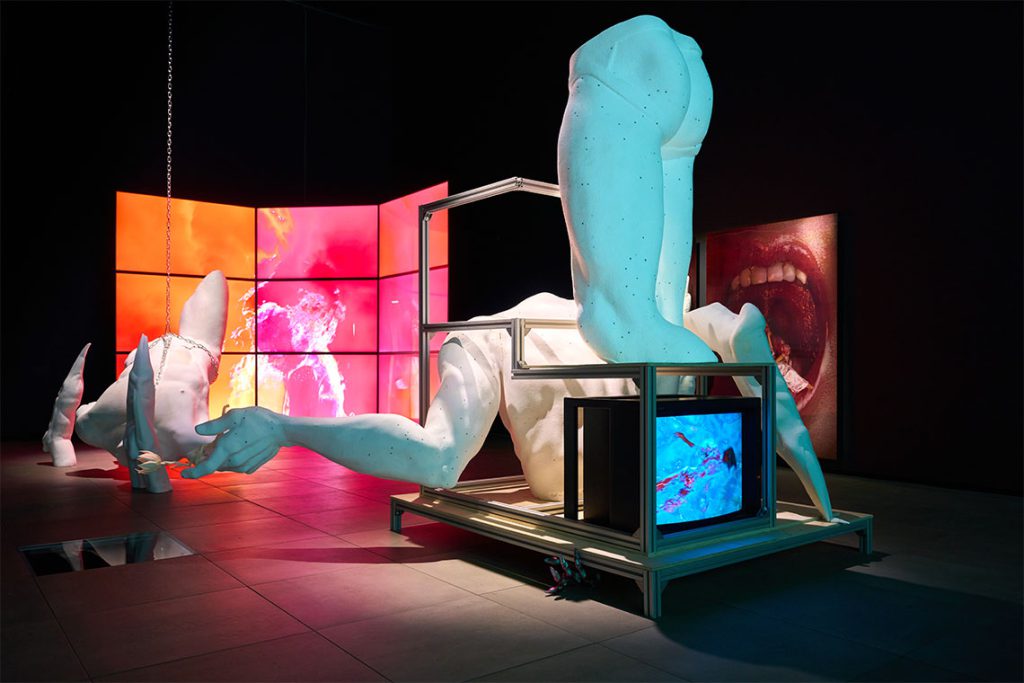
Wings suggest escape or transcendence, yet feel uncertain here. Elements of nature – leaves and flowers seemingly held by the figures – evoke abandoned sites being reclaimed, or graves. Chains dangle from the screen itself, as though the digital space has its own material weight. Light moves through the gallery in waves, synchronised with the film’s rhythm, creating an atmosphere of restless exposure.
What Al-Sabah achieves is a space that mirrors the looping logic of digital life, where reinvention becomes less about transformation and more about constant upkeep – an exhausting treadmill of perpetual adjustment. Yet the work refuses to position itself outside these systems. Instead, Al-Sabah treats fantasy as a survival mechanism – not escape into perfection, but a way of enduring by inhabiting instability itself, where relief comes from dissolution rather than resolution. Drawing on video game structures – Baldur’s Gate 3 among his references – he creates an environment that “promises agency while constantly enclosing you in systems you can’t fully escape”. The exhibition offers no captions, no individual work titles; it functions as a single installation that resists being parsed into discrete, consumable units.
The show refuses conventional closure. The boundaries between elements soften – the film’s images lose clarity, the sculptures recede into shadow, everything becomes less distinct. Rather than building towards any climax, the work trails off, leaving thoughts suspended. For an exhibition exploring digital culture’s relentless demand for performance and visibility, this refusal of resolution feels necessary: perhaps an acknowledgment that in these systems of endless cycles, the only honest response may be to let things remain incomplete.
THE MISSION IS THE END, THE END IS ALL I WANT! runs until 22 February
