

New paintings at her exhibition in Istanbul show Ghada Amer is still disrupting conventions.
Painting is an act of resistance for Ghada Amer. When she was studying art in France in the 1980s, she and other female students were stopped at the classroom door by an instructor who insisted that painting was for men only. Deprived of that formal training, she left with a more consequential lesson: that painting was something to be reimagined.
Amer returns to the brush in the exhibition Aurora, at the Istanbul gallery Dirimart, which includes five new works in acrylic and ink on wood. Each is named for the dawn in Arabic, French and English to mark a new phase in her relationship to painting. “I’m almost over this incident with the horrible teacher in 1986,” she says wryly. Centre stage at Dirimart are Amer’s erotic archetypes, borrowed from the pages of adult magazines that once populated the back rows of newsstands. Her hypersexualised figures, with exaggerated breasts and bottoms, fleshy lips and cascading manes, skewer a visual language long shaped by male desire as their direct gaze asserts that they are masters of their realm. “They are idealised beauty, it’s the same in all of art history. But these are not submissive women. They are strong,” Amer says.
Drawing on art history, pornography and feminist theory, the Egyptian-born, French-reared and New York-based artist has spent four decades challenging the masculine canon and recasting painting across a dextrous practice that includes embroidered canvases, sculpture, ceramics, land art and a recent turn to appliqué. After she was barred from the classroom, Amer rushed to the school library to find the women painters in standard histories, only to see little trace of them. “It was a slap in the face,” she says. “I never thought that painting was gendered. I had been brainwashed. This was my beginning.”
Amer dove into sculpture, video and installations, but painting – with its “colours, configurations, the fun, the joy and beauty” – always beckoned. Rather than reject it, she replaced pigment and oil with thread, and the needle served as her brush. Embroidery, long dismissed as feminine or decorative, became her signature mode. It was not a substitute for painting but a way of freeing it from its conventions. She began looking at mass-produced pornography after finding “something missing” in her earliest embroidery that portrayed women at home engaged in domestic duties, like ironing and cleaning. The new source material allowed her to confront how women’s bodies are publicly constructed and visually consumed.
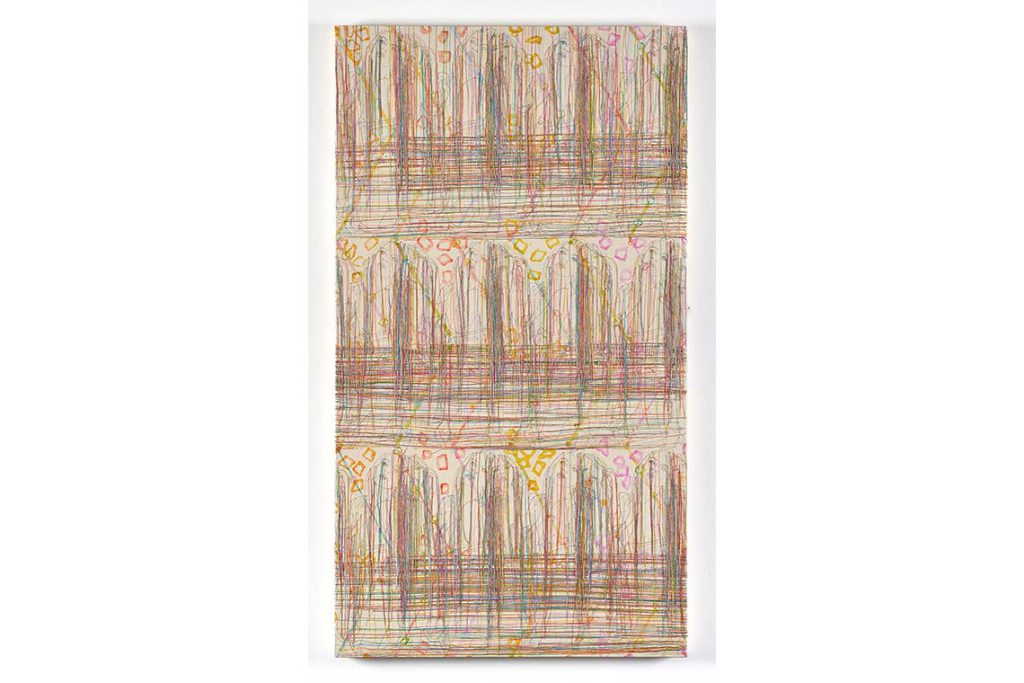
At the Dirimart show, the artist’s second at the gallery after 17 years, her stitched canvases include A Golden Drip (2023), in which the image of three women recurs in overlaid sequences to become a blur of limbs, hair and breasts. Much of the thread is ripped out, leaving behind ethereal outlines. Two identical line-drawn women in Twins (2023) pose atop the embroidered words of Nawal El Saadawai, the late Egyptian writer and physician, that equality is not given but taken by force. “At the core of Ghada’s work is the issue of inequality,” says Levent Özmen, international gallery director at Dirimart. “This imagery is from an industry directed by men. But she also looks at the inequality between West and East. She depicts the eroticisation of the white female body, but does not include her own sexuality.”
The Grid of 2025 with Pink and Yellow – RFGA (2025), a collaboration with the painter Reza Farkhondeh, duplicates a pair of women who are blanketed in strands that refuse to settle into a fixed meaning: at once constraining and connecting the figures. Amer herself is not confined by embroidery, and a trio of bronze sculptures from 2021 and 2022 renders her needlework into three-dimensional line drawings. From a short distance, Flora (k) (2025) and In the Tent of Suzy and Jennifer (2025) appear as painted portraiture, but are hand-stitched appliqué textiles on canvas. Amer returned to her home city of Cairo to collaborate with artisans working in the centuries-old tradition of khayamiya. Used to line the interiors of temporary pavilions that house Egyptian weddings and public festivities, this vibrant, layered cotton fabric is an endangered art form, edged out by cheap, prefabricated imports.
Wary of offending the craftsmen’s conservative sensibilities, Amer initially asked them to work with text, translating feminist quotations into a contemporary take on Kufic script that looks like QR codes to the modern eye. In the end, the tentmakers showed little hesitation when faced with her nude figures. “They are artists because they invent new forms,” she says. Vernacular art and its power to connect with people collapses the boundaries between so-called low and high culture.
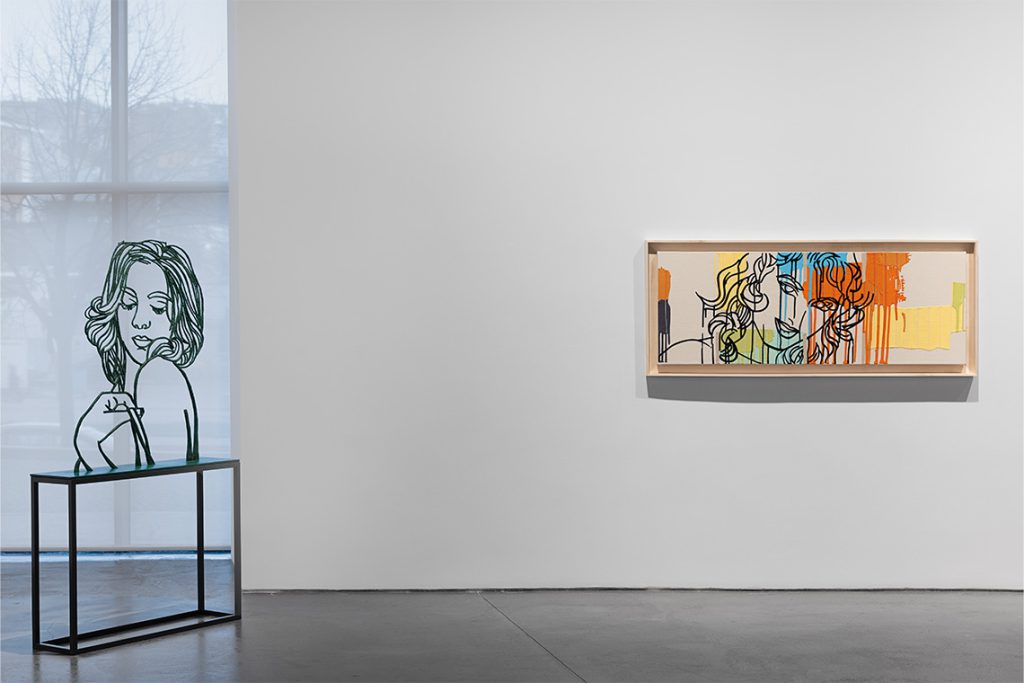
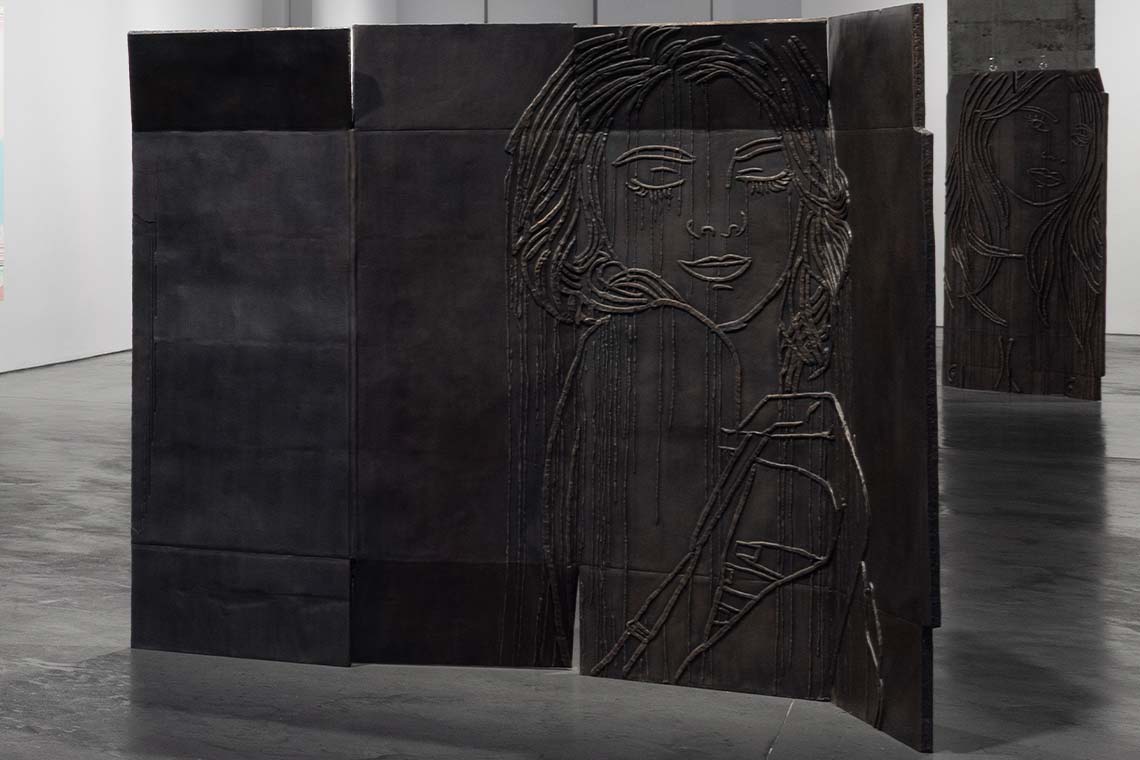
Even at its most playful, the imagery can be unsettling. “With this latest work, her characters become more colourful, but the issues she raises hang there like ghosts, circling around us,” says Özmen. The lost-wax bronze Suzy Playing (2023) recreates the unfurled cardboard boxes Amer gathers from the street and uses as surfaces upon which to sketch and paint. Positioned like a privacy screen at the entrance of the show, it carries a note of irony: a reminder that her work has not always been permitted to remain in view.
Some exhibitions have been accompanied by trigger warnings for explicit content. In 2001, a sculpture inspired by the tenth-century Encyclopaedia of Pleasure, considered the earliest erotic text in Arabic, was excluded from a public gallery in New York because it contained explicit anatomical language. Panamanian authorities seized her series Six Chinese Proverbs in 2003 in what Amer describes as a “violent” attempt to suppress it. She worked with local graffiti artists known for decorating buses with pop-cultural and religious imagery to create billboard-like paintings inscribed with adages, such as “For the love of money, truth will fall silent” and “Occupy the higher ground to exercise control”, and placed them next to government buildings and in working-class neighbourhoods. Despite the non-explicit, universal messages, the series was too incendiary to be seen.
These episodes embody the tension between presence and erasure that runs through Amer’s work, where what is seen is not fully visible and what has been suppressed breaks through the weave.
Aurora runs until 10 May
