

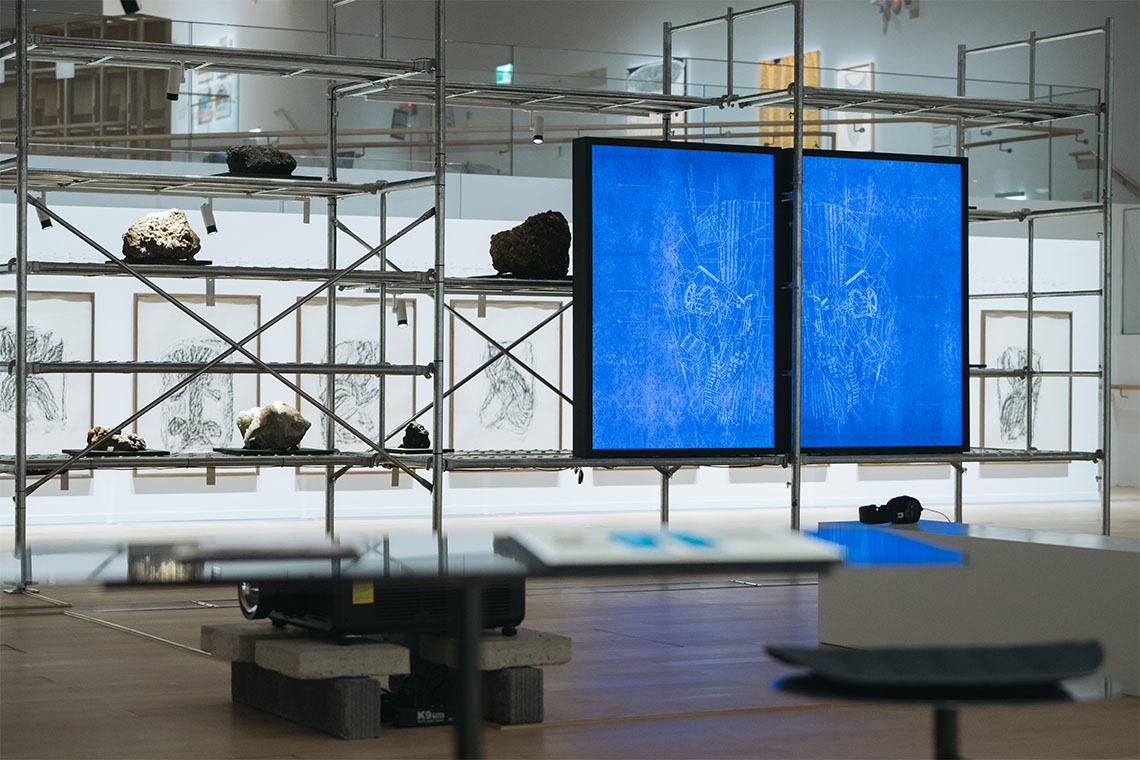
A group exhibition at the newly opened New Taipei City Art Museum explores transnational solidarity while reminding us of the importance of curatorial care in assembling exhibitions.
There is a particular hope that animates a certain kind of contemporary exhibition: that a material – a fibre, a mineral, a grain – might serve as a thread connecting disparate histories, and that to follow it is to recover a story otherwise lost to nation, capital and time. Of Thread and Stone, which opened in February 2026 at the newly inaugurated New Taipei City Art Museum, places its faith in this hope with admirable conviction. Curated by Tsou Ting and Wang Han-fang, the exhibition draws on the textile and mining industries that shaped New Taipei City, two industries unfolding on parallel tracks: aboveground and underground, perhaps also in the gendered division of factory women and pit-working men, coalescing into a single urban fabric and cultural memory. One of the exhibition’s arguments is transnational solidarity, and one’s sympathy for that argument is genuine. Yet what the materials themselves keep whispering is that they cannot easily be lifted out of the specific ground in which they were dug, woven or burned. Translating that specificity into the form of an exhibition turns out to be one of the most difficult tasks of all.
The first few objects the audience encounters are not artworks at all. They are a copper carbide light and a plastic helmet with an emergency breathing system once owned by a local miner, displayed alongside fragments of his life history: a note of mining knowledge, a schedule of his shift. Before any artist’s name appears, a labouring body appears. These objects are a nod to artist jiandyin’s newly developed chapter of Magic Mountain, which connects the extractive nature of mineral-mining in northern Thailand and New Taipei. In Magic Mountain: The Lost Golden Pumpkin (2025–26), several mineral specimens collected by the miner are exhibited alongside his interview, telling his memories of working underground. The miner’s helmet at the entryway is not yet a metaphor for anything. It is the residue of a specific shift, in a specific shaft, worn by a specific body. The exhibition’s faith in transnational connection begins, rightly, from that irreducible specificity.
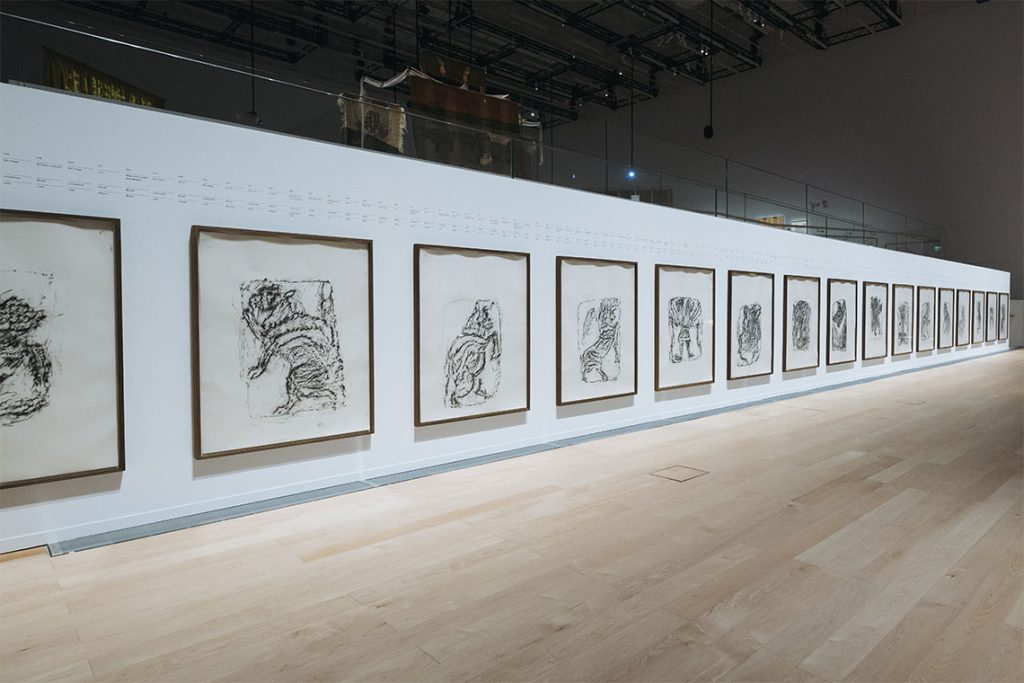
As one moves into the galleries proper, two practices come into view that share a remarkably similar method: that of the artist who returns to the family archive in order to read a much larger history through it. Rayyane Tabet’s Fragments (2016–ongoing) begins from the inheritance left by his great-grandfather Faek Borkhoche, who served in 1929 as translator and secretary to the German archaeologist Max von Oppenheim during the excavation of Tell Halaf in present-day Syria. In Orthostates, Tabet has spent years making charcoal rubbings of the ninth to tenth-century BCE orthostats that Oppenheim’s expedition unearthed and which now sit fragmented and dispersed in museums across Berlin, Paris, Baltimore, and New York.
Huang Po-chih’s long-term investigation, on the other hand, grew out of his own mother’s working life as a garment worker, and the threads led him to the once-booming textile industry in Hong Kong. Untold in those beatified stories of seeking a better future through linear progress, Huang’s work reinterprets the life of a garment stallholder in Hong Kong, from his illegal crossing of the sea to Hong Kong to his activism in the anti-relocation movement, reenacted in performances of cutting layered garments on someone’s body or wandering through stacks of fabrics. The quiet rhythm between Huang’s dreamy moving image and Tabet’s rubbing is that both witness a grand history from a closed-up point of view. Neither artist offers solidarity as an abstraction. What they offer is the specific texture of the story bound in certain locality and time.
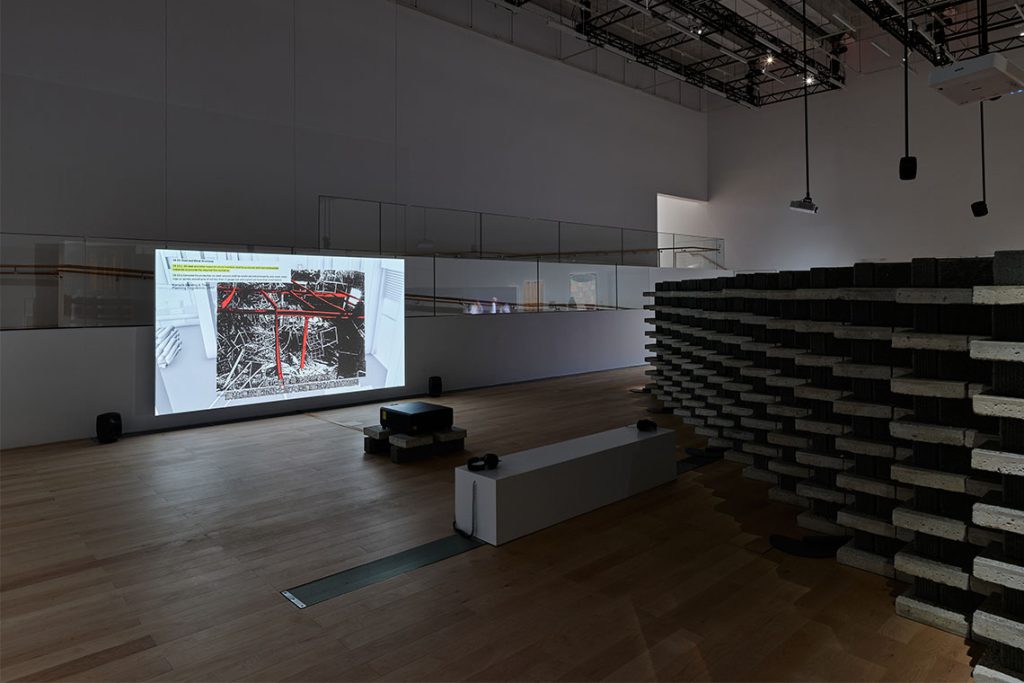
It is in the two works by Forensic Architecture, the London-based research agency, that the exhibition’s twin metaphors arrive at their most explicit articulation. Living Archaeology in Gaza focuses on the ancient seaport of Anthedon on the Gaza shoreline, a layered city inhabited from 800 BCE to 1100 CE. Since archaeologists have been restricted from the site for nearly a decade, and with Israeli bombardment and coastal erosion placing the ruins under continuous threat, the agency has digitally reconstructed the strata of habitation from drone footage, archaeological records and satellite imagery. Each reconstructed layer tells a different story of lived experience through its material culture. The Ali Enterprises Factory Fire turns from stone to cotton, reconstructing through 3D simulation the September 2012 fire at a textile factory in Karachi supplying the German retailer KiK, in which 259 garment workers died. Together, the two investigations bind the exhibition with the very materials that opened it.
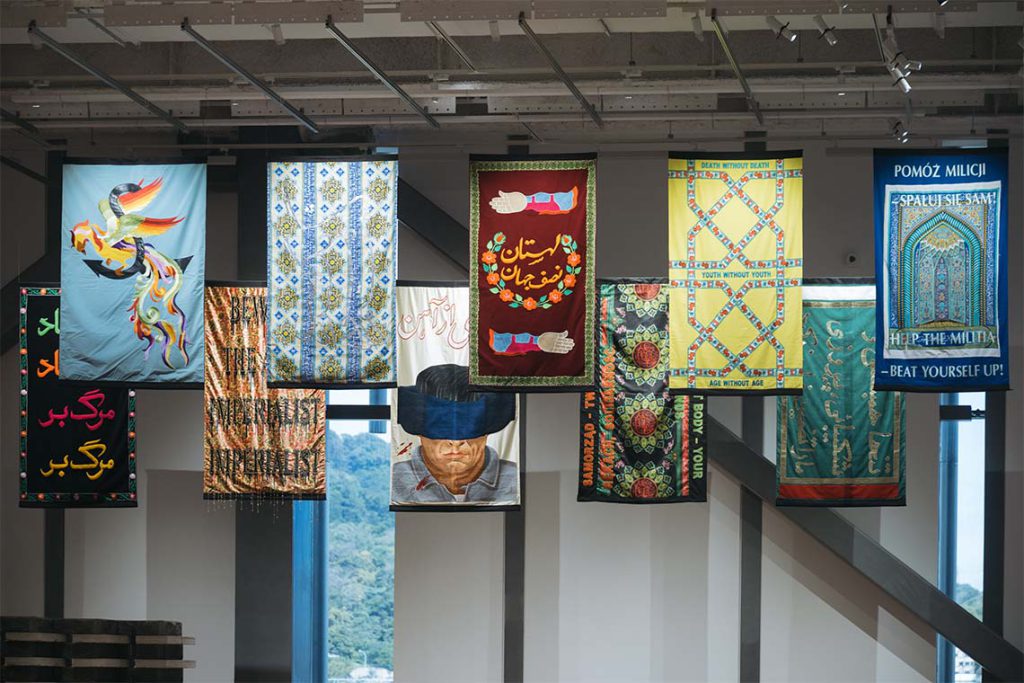
Weaving practice is not strange to Indigenous knowledge systems and ways of living. Kieren Karritpul, a Ngen’gi wumirri man from Australia’s Northern Territory, translates the textile vocabulary used by female elders into abstract painting. In a separate gallery, Akac Orat’s documentation of the Indigenous Amis tradition of rattan gathering is shown alongside Nii Nami’s project, in which handwoven qabang (blankets) are used to cover a mining area that is also the traditional territory of the Bunun people. Hanging in the same space, the crafted banners of Slavs and Tatars are, as ever, intelligent and visually distinctive. The Berlin-based collective contributes textile and printed works drawn from Central Asian ritual, Soviet modernity, and political allegory. The grouping is generous. Yet it also reveals the difficulty at the heart of any exhibition with this ambition. Nii Nami’s qabang is bound to a particular hill in eastern Taiwan, while the Slavs and Tatars banners are bound to a very different context. The materials, even arranged in the same gallery, do not always travel toward one another at the same speed.
It is here that the exhibition’s deeper provocation, perhaps unintended, becomes legible. The materials at the heart of Of Thread and Stone are the ones that most stubbornly insist on their specific conditions. The reason these materials feel meaningful at all is precisely because they refuse to be lifted out of their specific ground. The miner’s helmet at the entrance moves us because it has not yet been asked to mean anything beyond itself. The Forensic Architecture investigations move us because they treat thread and stone not as concepts but as physical conditions under which specific people have died, and under which specific places are now buried. Of Thread and Stone is a serious and worthwhile exhibition, full of careful objects and important practices, and one leaves it grateful for the conviction with which it has been assembled. What it gently reminds us is that transnational solidarity is a horizon worth working toward, but the work begins with the specific weight of what is in the room. When that specificity is hard to translate into curatorial form, the ideal does not collapse so much as quietly wait, asking to be carried more slowly, and with more of the local conditions intact.
