

Across immersive installations and personal works, A Night of a Lifetime unpacks the layered meanings of marriage.
In Ayman Yossri Daydaban’s performance Standing (2012-26), the artist strolls along Jeddah’s corniche and through other public places. He wears a white T-shirt emblazoned with the phrase “I want to get married” in pixelated Arabic; passers-by mostly don’t seem to care. Here, small images from this performance are occluded by scratched-up glass and hung against a showy golden backdrop; they are joined by a 2026 update, in which the artist – now much older, greyer and, presumably, wiser – faces the camera. Printed much larger with all the clarity of hindsight, he seems rather less impressed with the whole enterprise.
The work is part of A Night of a Lifetime, an exhibition at SAMoCA that is similarly ambivalent about the concept of marriage. A visual feast, it deploys theatrical gestures, earnest kitsch and sumptuous maximalism to consider the emotional scaffolding surrounding marriage: the negotiations between private tendresse and the weight of tradition, the longing to finally be ‘seen’ by someone, and for that being seen to be acknowledged by those around you. Curated by Alaa Tarabzouni and Philippe Castro, the show features more than 30 artists from Saudi Arabia, the wider SWANA region and Europe. Often, there is the feel of a wedding with too many guests, but in the general more-is-more visual logic of the show, these works feel like NPCs rather than something that detracts from the show.
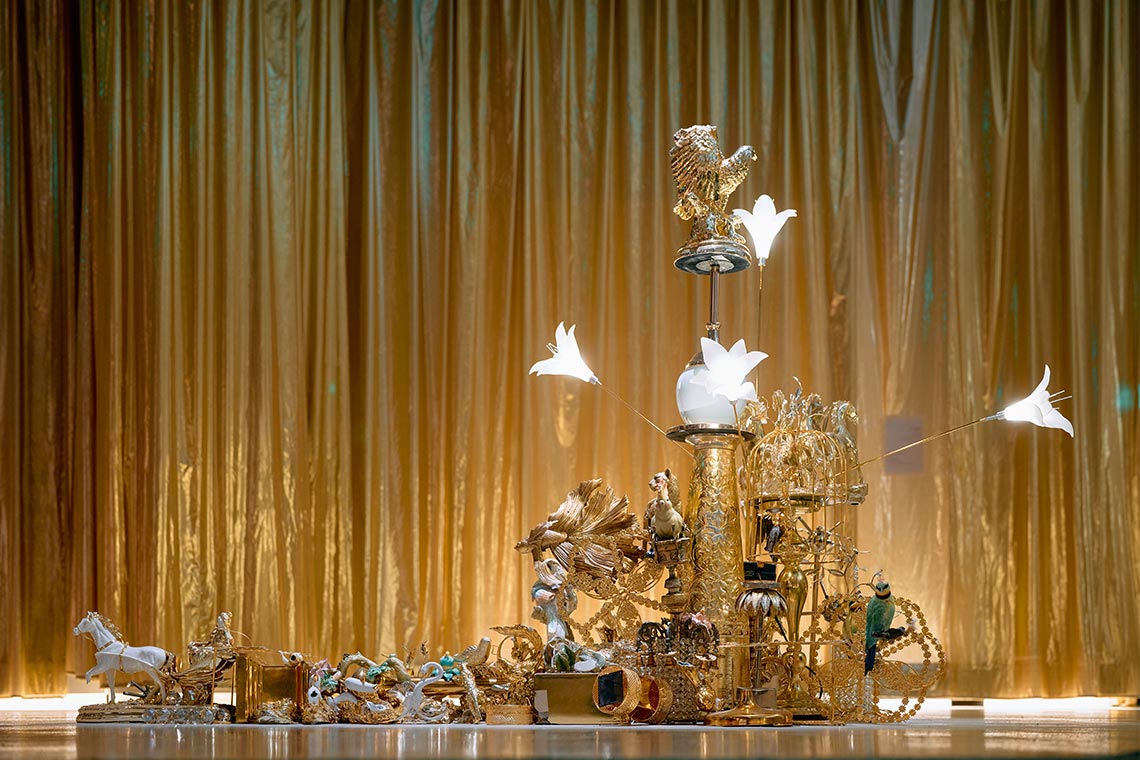
It’s worth noting that SAMoCA’s temporary location is a rather difficult space, with scaled-up dimensions that consistently make shows feel rather corporate and cynical. Not so here, where scenography has been deployed to fantastic effect, particularly in the exhibition’s first section. Gold lamé curtains encircle the room, and the same fabric is draped across the ceilings at the entrance, an effect that – along with rococo loveseats and lavish carpeting – immediately brings the visitor into the lifeworld of the show. Sometimes the curtains are plush velvet in red or inky blue, as a treat, while works like Ibrahim Romman’s Assemblage II (2026), a gilded menagerie of decorative animal objects, further enhance the sense of the space feeling like a set.
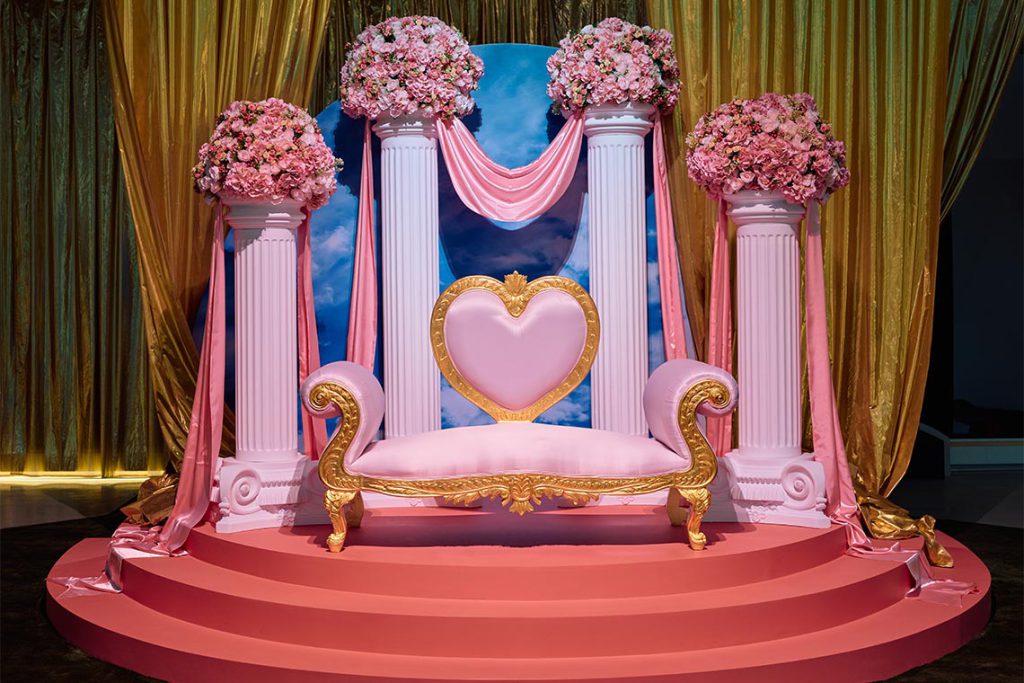
Aziz Jamal’s Hearts, bear witness (2026) completes the picture, a pastel confection of a kosha or decorative wedding stage, replete with a sweet pink loveseat, columns and the kind of sky print more usually seen on ceilings up and down the coastal Gulf. Visitors are encouraged to pose, as if with their future spouse, or to ham it up; a small camera captures their ‘performance’ and projects it elsewhere in SAMoCA.
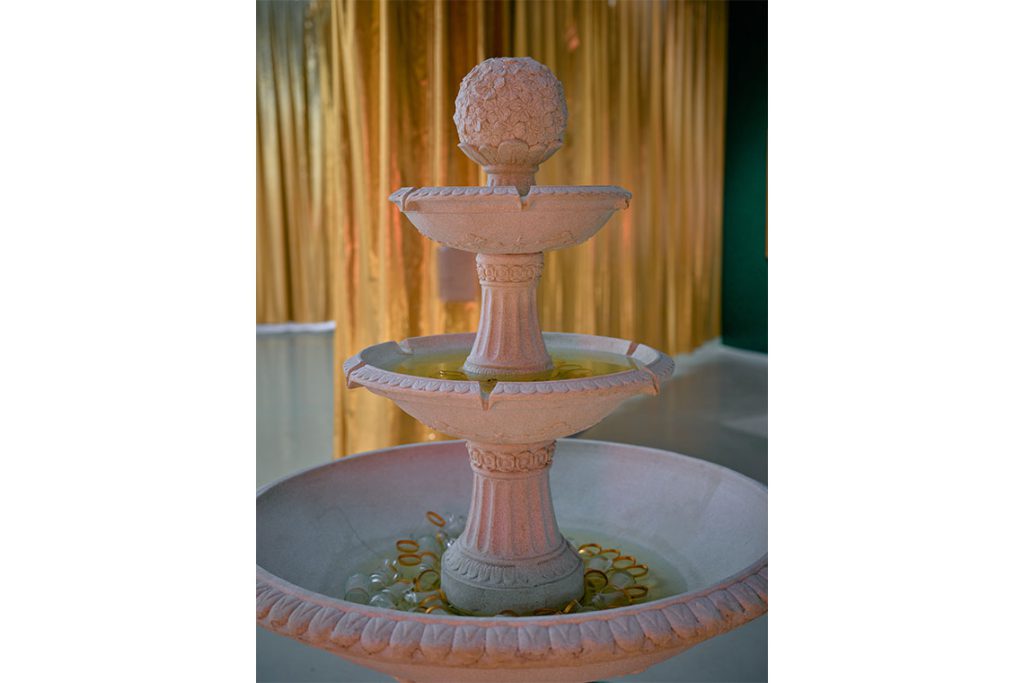
The most compelling works here drill down into specificities of Saudi wedding traditions. Especially delightful is Hoda Alnasir’s burbling fountain Aqua vitae (2025) to be filled with gold bangles. A closer look proves that the objects are instead gold-rimmed coffee cups, in reference to the anti-evil eye ritual, Ghasl Al Finjan. This involves the afflicted person washing with the water that coffee cups have been rinsed in after a gathering. It’s a practice that neatly avoids the awkwardness of directly involving the person believed to have cast the evil eye, satisfying the dictates of hospitality while still providing a spiritual cure. As such, it exemplifies the delicate social balance with which many works in this show grapple.
Also beautiful – and gorgeously redolent – is Reem Al Nasser’s Seven Sisters (2026), which recreates at scale the intricate jasmine crowns worn by Jezani brides and the donning of which she sees as crossing a temporal threshold. Mashael Alsaie’s For Safiyya (2025), which reimagines a relative’s difficult marriage via her wedding-day photographs, and Rami Farook’s enigmatic painting in the next hall, A Few Hours Before the Wedding (2015–25), which depicts a groom musing pre-ceremony, both mine a similar elegiac air.
If the main hall deals with the lead-up to the night – the anticipation, the celebration, the optimism – the second hall considers what comes afterwards: death, divorce or simply the lived tedium of staring down a lifetime of “well, now what”. The works here extend threads found in the first section, such as the joyful kitsch of Shourrouk Rhaiem’s Swarovski-bedazzled household objects in Le Trousseau (2025) and Romman’s assemblage, which are recast in Sultan Bin Fahd’s To Dust (2019). A fenced-in multi-chandelier pile-up, the work seems to encapsulate the creeping sense of consumerist excess – and perhaps guilt – that seems to settle onto a venue after a celebration.
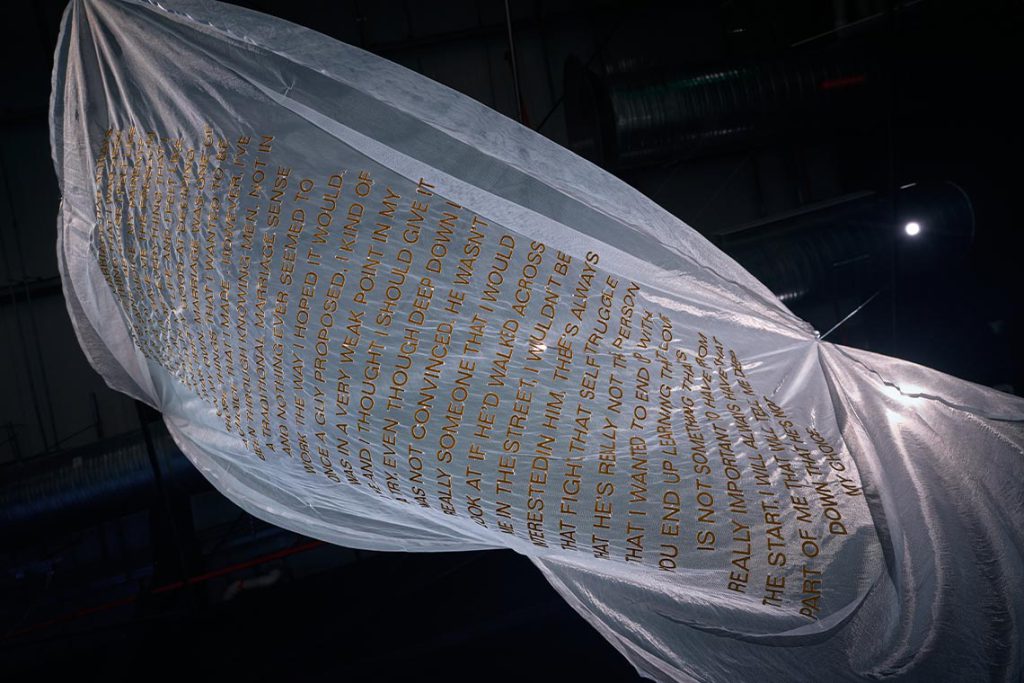
As such, works in this section mostly provide a cautionary note. In Amani Al-Thuwaini’s He Is Not Your Choice (2016), a screed about arranged marriage is embroidered on suspended, gossamer-thin wedding veils that cast beautifully onto the floor below, while Dur Kattan’s mixed-media collage Pleasures of Reality (2021), which maps wedding, divorce and obituary announcements onto the same space, reminds us that with every joy comes sorrow. Meanwhile, Meshal Alsabi’s Time Wins (2026) is a simple yet remarkably effective installation of two polycarbonate panels installed at an angle: a narrowing of options and the familial pressure that accompanies it, perhaps, or just the inexorable march towards old age and death. Despite all this, the show remains hopeful, settling on a kind of rare vulnerability that emphasises the unglamorous labour and maintenance work of marriage – the one hand that cannot clap.
A Night of a Lifetime runs until 18 April
