

In its latest iteration, the Basel Social Club makes the situation quite clear: it does not want your job.
Now in its fifth edition, Basel Social Club leans fully into its new location: a vacant, multistorey office building designed by Diener & Diener near the Basel SBB train station. There, it is clearer than ever that the Club is not applying to be the next art fair. The art world isn’t hiring anyway.
Basel Social Club’s intention has always been to create social spaces for art professionals with no entrance fee, no HR favourites and no free lunch. It has transformed unconventional spaces – from a villa and a farm to a factory and a bank – into sites for after-art-fair stress relief. It is a young, rebellious, nonconforming hire in the Basel business. I once overheard a curator ask, “No one goes there for art, who buys there?” An artist quickly responded, “We sold a bunch already”. Who trusts a personality hire, anyway?
Circling back, at first glance the Club’s ‘office’ is business as usual. As in any office building, each floor serves a distinct purpose. The lobby is for welcoming and eating, the upper floors are for companies, and the basement is reserved for parking, shady deals and cleaning supplies. However, it only opens at 4pm. No one is allowed in before that, not even the exhibitors. Perhaps this caters to guests who have stayed up partying in the basement until 3am the night before, or maybe it is a clear act of resistance to standard office rules.
The Club reconsiders the workplace as a site for critical reflection. While integral to the concept, art tends to become a wallflower here. Most deliverables directly reference ‘office-ness’, while others spin the idea entirely. Labour takes centre stage, aestheticised to the point that it blurs ethical lines. Everyone is working, from a psychologist and a nail artist to a Botox doctor, a Counter-Strike computer table and a suntanner. Even visitors are expected to work. If you choose to take a break, Silvio Lorusso’s installation is there as a reminder: “Shouldn’t you be working?”
Artworld superstars are present in the mix. Warhol is a prize, and Abramović is everything: the Midsummer Game Show WIN–A–WARHOL by suns.works gets crowded from time to time, offering an artist-built scenography for gambling where “the choice is yours” to win an original artwork. Meanwhile, Abramović pivots a bus into THE BUS – an exhibition on wheels, a mobile sculpture, a meditation capsule, a unifying experiential space, and, and, and… I didn’t see Jenny Holzer this time, though.
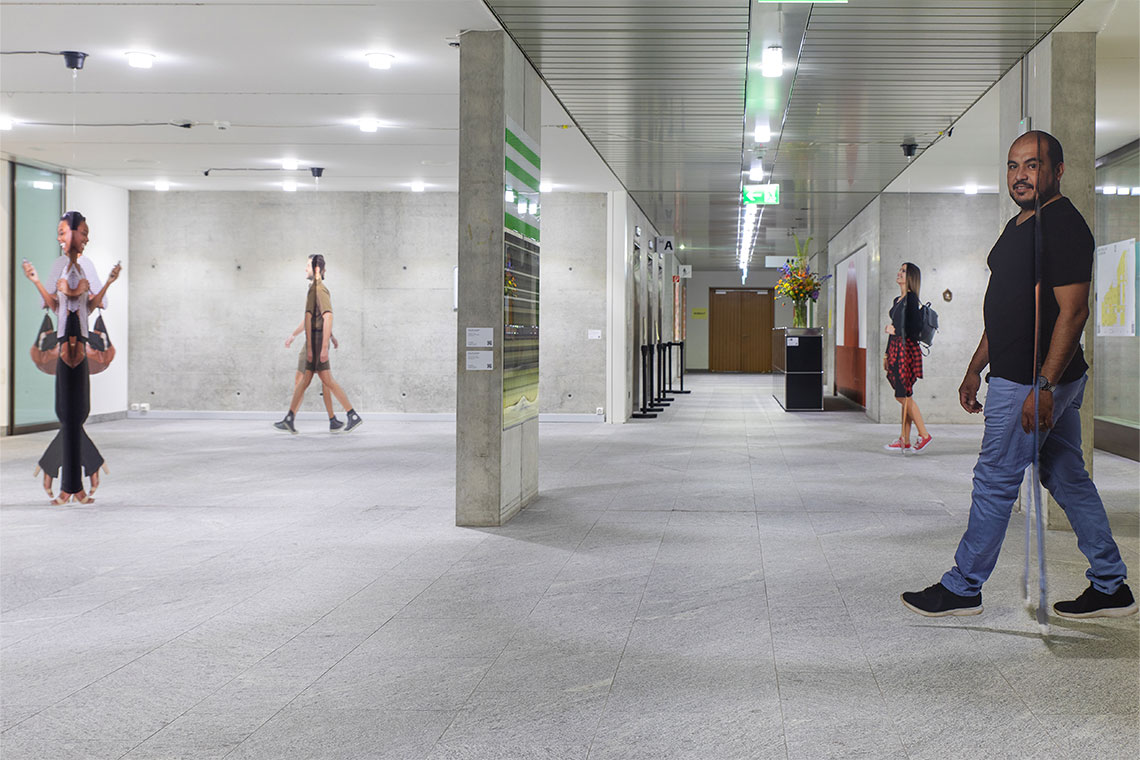
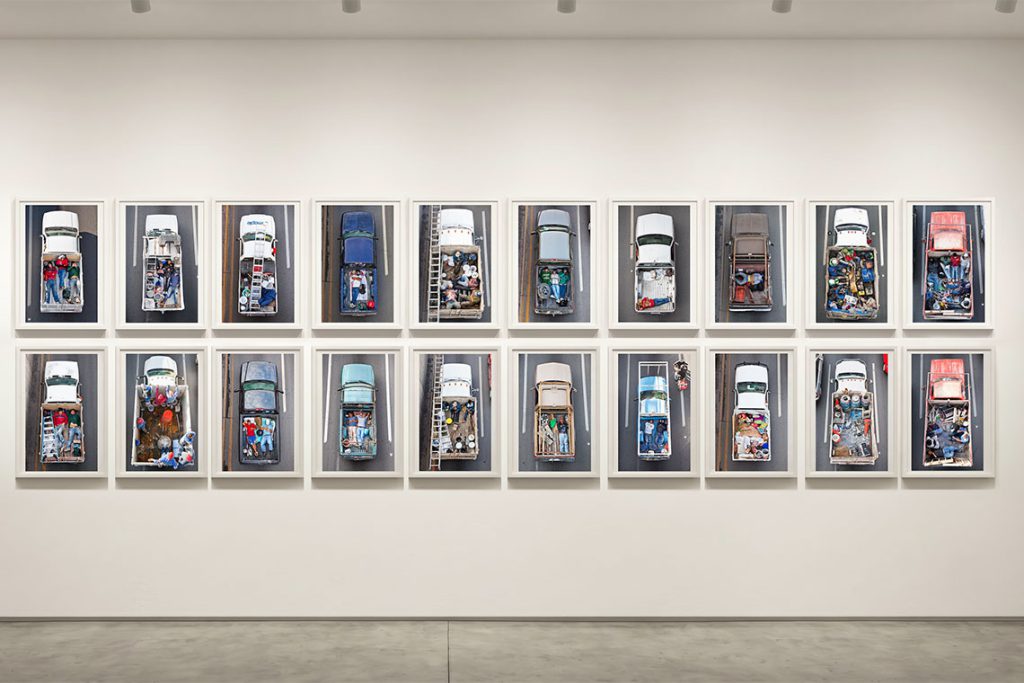
Photography is working the floor so hard, becoming the medium of the year, hung across the entire building beyond its traditional frames. Alejandro Cartagena’s 20-grid Carpoolers frames the in-between of work and home with photos of labourers resting in pickup trucks. Mark Wallinger’s Isolated Figures – life-sized 3D cutouts that rotate to disorient the viewer – are so lifelike that I almost apologised when I bumped into one. Emi Kusano’s prints invoke confusion over whether they are AI-generated or staged, their uncanny quality reminiscent of a pre-caffeine office encounter. This mood continues in Sina Shiri’s comical photograph of birds on a desk and Siyi Li’s large prints of party favours.
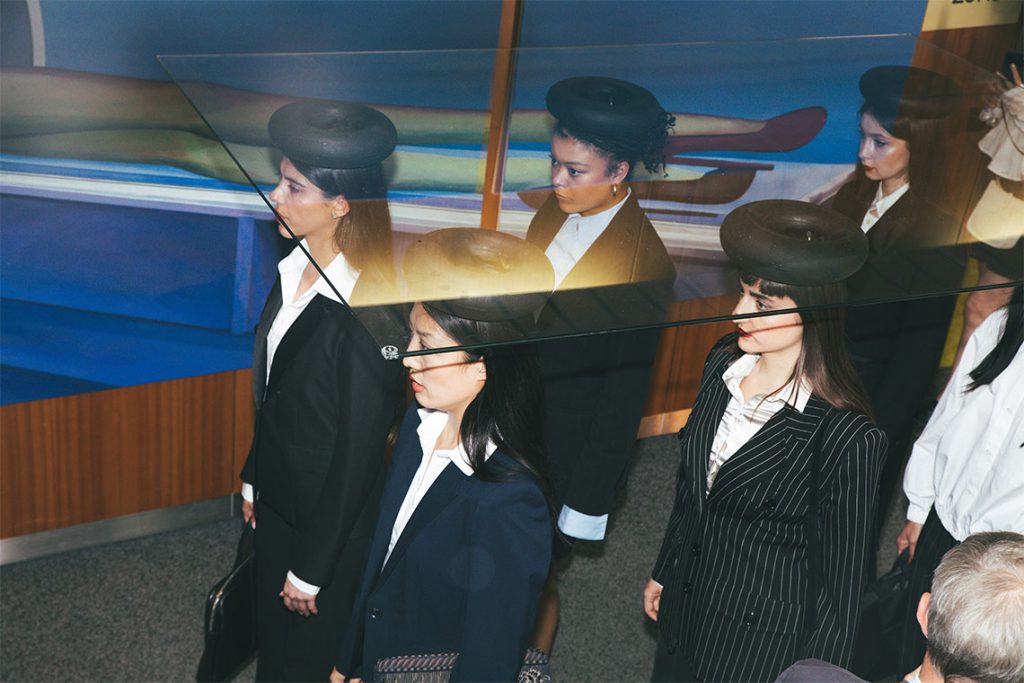
Labour is performance art, while office supplies are sculptures. Jessie Holmes’s Mini-jobs: Lift Boys (2026) employs performers to push elevator buttons for able guests. Alicia Framis’s The Walking Ceiling (2018) puts six women in office wear beneath a glass ceiling for 30 minutes. Malte Zenses displays daily paintings on newspapers, following a disciplined job-like schedule. Business cards are enlarged paintings in Marie Karlberg’s sprawling display, exposing gallery directors’ phone numbers and offering artists direct access while breaching trust and privacy.
Tables are everywhere. One sharply divides business from pleasure, showing just ice skaters’ legs in Antone Liu’s slipper. Another table holds Anthony Chit On Cho’s laborious pencil-sharpening performance, symbolising how “the machine will grind you into dust anyway (whether or not we speak)” (2026).
Office romance accompanies toilet breaks, where desires are bejewelled wall-pieces by Lily Bunney and Elleanna Chapman. In the basement, Shamiran Istifan’s Lucida lets angels sleep, embroidered in metallic textile, untouched as receipts fall. Next door, a duvet by a broom hints at rest. Workmutates into life in System No. Omega (2026), where David Jong Sung Myung stages an empty slumber party in a broom closet; an aspiration never reached, as the artist is upstairs performing from 4–11pm.
Basel Social Club continues to be everything for everyone. An infectious all-work-all-play driver that keeps us hoping it won’t miss a turn and become an aimless hot mess. If that ever happens, Basel will once again be pure business and no pleasure.
If the club isn’t for you, you can always circle back to Messeplatz.
Basel Social Club runs until 20 June
