

The curator of the National Pavilion UAE shares how the group exhibition, Washwasha, delves into the ways through which sound conveys local histories and culture.
Canvas: The meaning of Washwasha, ‘whispering’ in Arabic, is multi-layered. What inspired this concept for the pavilion and how has the local context informed the exhibition?
Bana Kattan: A couple of things really drew me to this idea. The first was an artwork by Lawrence Abu Hamdan that appeared on the Abu Dhabi Corniche during the first Public Art Abu Dhabi Biennial. The piece was called Wsh Wsh (2024–25), and the concept of Washwasha emerged from that reference. What really interested me about the word itself is that most Arabic words are built from three-letter roots, whereas washwasha comes from a rarer four-letter root. Thinking about it linguistically was also fascinating to me, especially because language and sound are so deeply intertwined.
Another thing that attracted me to it as both a concept and a title was its simplicity. It’s just one word, but it holds a complete idea in a very concise form, and even if you don’t speak Arabic, it still functions through onomatopoeia – you can intuitively understand it. Interestingly, Arabic actually has fewer onomatopoeic words than many other languages because it’s such a descriptive language with a very extensive vocabulary. In many cases, Arabic simply doesn’t need as many sound-based words as, for example, English. So even within Arabic, washwasha is a bit of an anomaly in more ways than one.
Why whispering as opposed to speaking, or even shouting?
It’s all about subtlety. Sometimes that whisper exists in your own head, sometimes it’s the whisper of society. Sometimes it emerges through friends sharing secrets with one another. That flexibility within the concept really comes through in how differently each artist approaches it. You see artists engaging with language and communication, which may feel like the most intuitive interpretations, but there are also artists working with technology, which is undeniably part of our contemporary times. Alongside that, many of the works focus on the idea of intangible culture, which is the perfect framework for thinking about Washwasha because you can’t contain what is inherently uncontainable. Pushing that idea further, especially in the context of Venice, the exhibition reflects on the elusiveness of intangible histories and the ways that they inevitably exceed the boundaries and frameworks of nation-states.
How did you bring the various artists into conversation with one another?
All six artists have deep connections to the UAE and have lived there for a long time. They are multi-generational, and each of them is thinking about Washwasha, not in terms of the description of the word or the definition of the word, but more about the activation of it, in terms of what can it do or what can it be?
Jawad Al Malhi’s work, Naiman (2008/2026), was actually really surprising. I asked to show an older work of his, and he was a little thrown off by that. He even had to go back to Palestine to find the tapes from the first iteration because they hadn’t been played in quite a few years. The installation is a series of recordings that he made of men in their seventies telling the story of the night before their wedding. In Palestine, there’s a tradition of the bachelor going with his friends to the bathhouse and this work specifically referred to one in East Jerusalem called Hammam al-Ayn. For the exhibition, we architecturally reimagined the beautiful dome of the space and it’s also a piece that brings forth the idea of oral history.
In Kūnī Kai Akūna Kamā Aqūl! (Be, so that I may be as I say!) (2026) by Mays Albaik, she has made two sets of mouth molds. The piece is focused on language and its embodiment, and how it links to migration, exile and identity. Lamya Gargash’s Majlis (2009) is an older series, and brings in the idea of Washwasha and the importance of gathering and of sonic spaces. Both Albaik and Gargash’s works are silent pieces, which reinforces the idea that this is not a ‘sound show’.
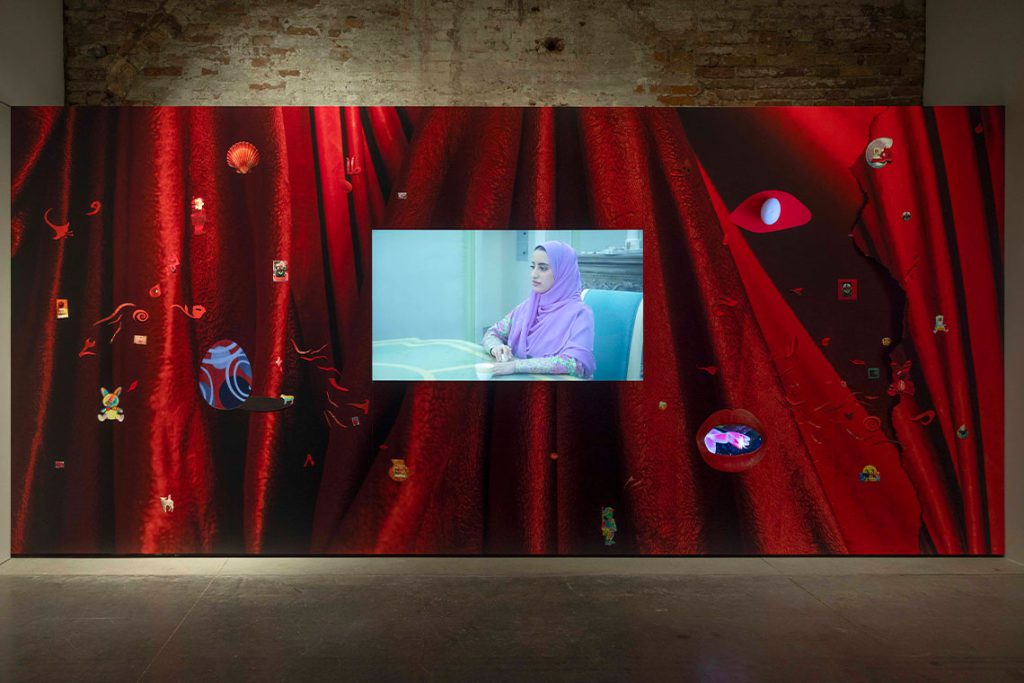
Farah Al Qasimi’s The Curse (2026) is an installation and newly commissioned film. There’s a storyline running through it about childhood guilt, about this child who thinks she brought a curse upon her village through her scream. However, at the end of the day, the piece is also about navigating communication, both successful and unsuccessful.
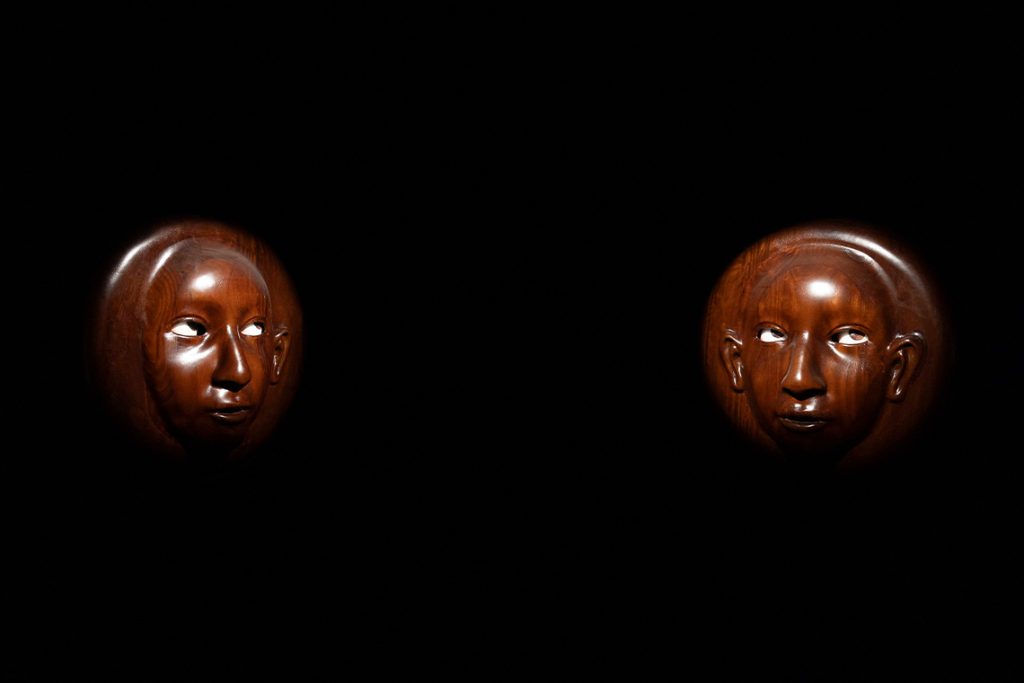
Alaa Edris’s work called Wiswās (2026) comprises three sculptures in a dark room with animatronic eyes that rotate asynchronously like a clock and are synced with a robotic voice that says “This is the beginning, this is the middle, this is the end”. Alaa was thinking about the word washwasha in the Emirati dialect, where it means muddlement and a noise rather than a whisper.
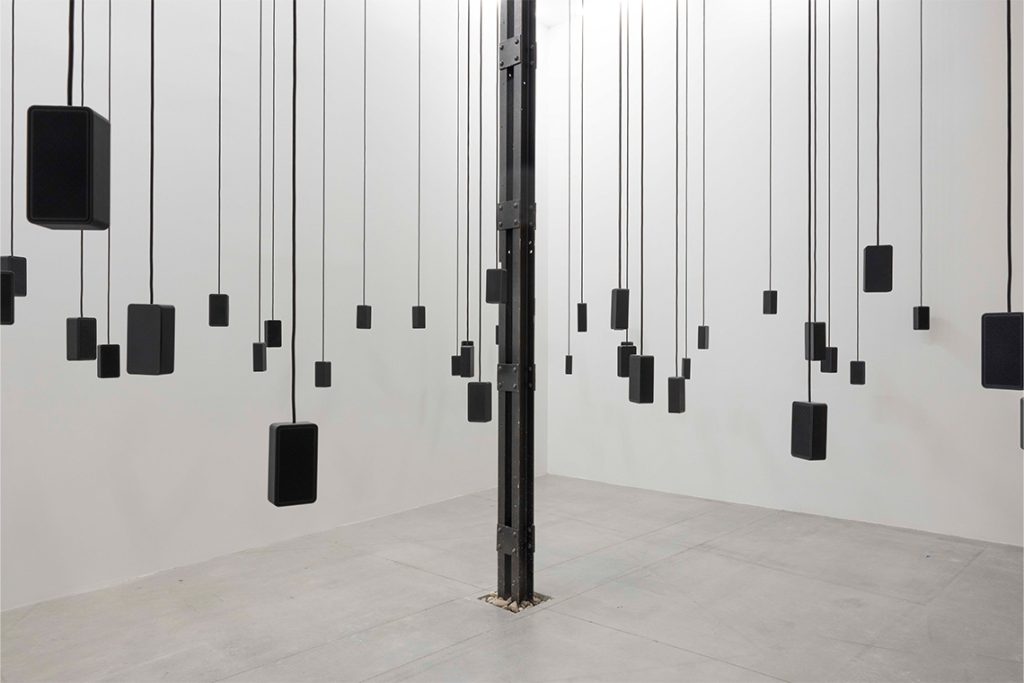
Taus Makhacheva’s Dear R., R., K., S., M., A., C., S., K., I., G., L., A., A., L., P., G., E., J., D., M., C., B., O., F., F., R., D., M., E., L., I., F., L., A., M., T., K., K., L., P., F., V., A., L., L. (2018/2026) is made up of 52 speakers installed throughout the room. These sound clips are emails from the artist or people in her community with excuses for tardiness. So: “Sorry my email was late, I got Covid” or “I’m sorry for my late response, motherhood really is a full-time affair”. There are 52 different excuses, and they are all relatable and some are almost poetic. There’s another work by Taus in the show, a new commission called And What Did You Say? (2026). In this work, the artist approaches gossip with an inquisitiveness on its potentiality. The piece consists of a 30-minute audio and bench installation, and a performance that will take place in the summer. Taus thinks about the idea of “metabolising gossip,” turning it into movement and speech.
We briefly touched on technology. What does that method of communication do to the act of conveying memories or thoughts, especially when technology can be manipulated or changed so easily?
The reality is that we live in this hyper-connected world where the expectations on communication via technology are so extensive. In our publication, there’s a part in my and assistant curator Tala Nassar’s essay on technology and how sound and our communication has changed so dramatically, specifically in the Gulf and in the UAE over the years.
How has the current situation in the Gulf, with the war between the USA and Iran, made you reflect on communication differently?
There’s a lot of sound elements that go along with the situation. From the alerts on the phones to the noises in the cities, the contemporary sound environment continues to change every day. What sounds will we be thinking about in the future? I think that some of the best art is not reactive but responsive, so we’ll see what comes out of this period in time.
There also seems to be a link to the body. What role does this play in physically experiencing the space?
We were lucky to collaborate with the wonderful Büro Koray Duman (B–KD) Architects, who worked with us to design the space with the body in mind. You experience the exhibition as you walk through three chambers, with some of them requiring close listening while others are consumed by noise and sonic overlap. For example, the last piece by Taus is loud when you enter, but you need to zoom in and listen closely so that you can get one voice at a time. The body is 100 per cent involved in receiving these communications.
The National Pavilion UAE is located in the Arsenale
This interview first appeared in Canvas 123: Venice Special Issue
