

Bringing together contemporary works and historical artefacts, an exhibition at the Fondazione Merz in Turin uncovers Gaza’s layered history, offering a space for its past, present and future.
Behind a heavy velvet curtain in Turin’s Fondazione Merz, a large room with impressively high ceilings beckons in visitors. An assortment of plywood boxes of varying heights are laid out in the centre of the room, facing a wall onto which a motion picturefeaturing marionettes is projected.
This is The Secrets of Karbala (2015), the third part of Wael Shawky’s marionette epic trilogy Cabaret Crusades. In the film’s initial sequences, the artist walks audiences through the 680 CE Battle of Karbala, which led to the ongoing division between Sunni and Shia Muslims. Later in the video, we are transported by hand-blown glass marionette animation through the Second, Third and Fourth Crusades, thus setting the scene for the Fondazione Merz’s latest exhibition: GAZA, the future has an ancient heart. Materials and memories of the Mediterranean.
As a geographically strategic location on the Mediterranean, Gaza’s place as a highly contested piece of land long predates the current land grab by the Israeli state. The exhibition’s press release underlines how historically Gaza has been a “crossroads of trade, cultures and beliefs”, a small piece of land with an indisputably rich past and important heritage. Yet the process of presenting this dimension to an audience is innately fraught. Curating an exhibition that seeks to foreground the historical significance of a place currently experiencing a real-time loss of human life will never be straightforward. In 2025 the exhibition Trésors sauvés de Gaza at the Institut du monde arabe (IMA) in Paris fell flat, its photographs of destroyed heritage sites only serving to highlight the show’s apparent blind eye to the ongoing human tragedy in the Strip.
At the Fondazione Merz, the exhibition text states that GAZA, the future has an ancient heart. Materials and memories of the Mediterranean “removes the territory from an exclusively topical interpretation and invites reflection on the universal value of heritage as a place of memory, identity and future.” A collaboration between the Fondazione, the Egyptian Museum of Turin and MAH – Musée d’art et d’histoire of Geneva, the show brings more than 80 artefacts from these institutions in conversation with works by seven contemporary artists: Samaa Emad, Mirna Bamieh, Khalil Rabah, Vivien Sansour, Wael Shawky, Dima Srouji and Akram Zaatari.
Here, Gaza is presented as somewhere intrinsically worthy of being recognised as valuable. A site of ancient history, yes, but also a place where the millennia-old ebb and flow of trade, exchange and movement present it as a location in a state of constant flux, shaped by time and myriad connections, where past, present and potential future converge. The character and history of Gaza are oscillated in the hands of the participating artists, who weave deftly between timelines to shed light on the complexities of human experience in what is now one of the world’s most densely populated places.
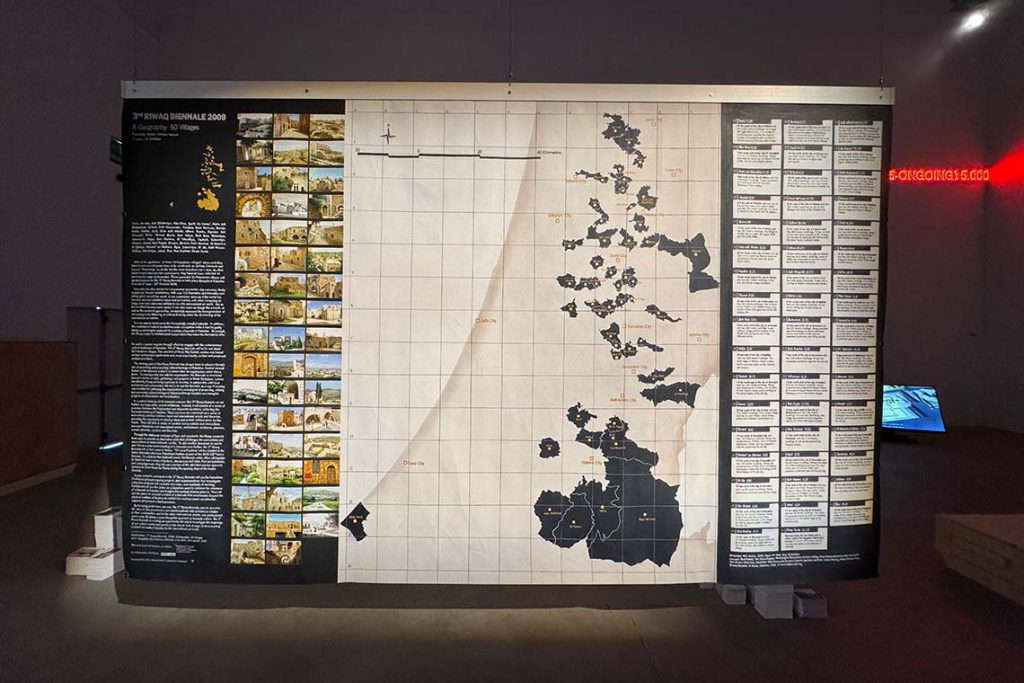
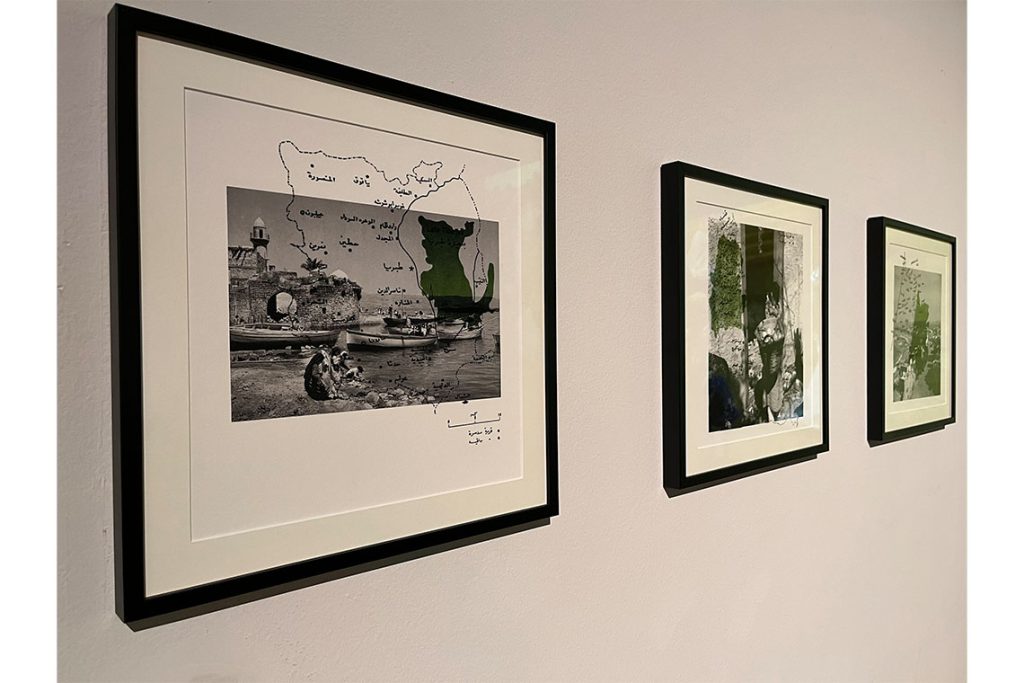
Samaa Emad’s series of collages entitled Reimagining Homeland embodies the exhibition’s sense of temporal movement. Based on stories heard from her family and wider oral histories, the work layers archival imagery of Palestinian life from before the 1948 Nakba under hand-drawn maps of Palestinian villages with their original names restored, the process of collaging itself opening up new conversations and possibilities for repair. Opposite, Khalil Rabah’s 50 Postcards, Another Geography (2008) from the series A Geography. Another Geography depicts what looks initially like a photograph of a map of Palestine, highlighting historical buildings through pop-up postcards that ‘zoom’ into the locations. Upon closer inspection, the hung map is revealed to be hand-painted by Rabah. It is surrounded by stacks of the very same postcards, which visitors can take with them. The stacks gradually diminish as more people take home these souvenirs from Palestine, a statement on the attritional decay of these heritage buildings and a gesture that is heartwarming and heart-wrenching in equal parts.
The tension between past, present and future is a constant theme. When admiring the vast array of artefacts, from clay vases to jewellery and even an Egyptian sarcophagus whose ‘slipper’ design is showcased, we are reminded that this movement of people, objects and even fashions is emblematic of Gaza’s place as a hub on the Mediterranean. Yet this history jars with the Strip’s current predicament, under siege by Israel for decades, with the movement of everything and everyone restricted.
In the final room of the exhibition, we are confronted with the bleak reality of Gaza’s present with Dima Srouji’s Phantom Votives (2025). In a darkened room, an eerie light is cast onto beeswax-cast forms suspended from the ceilings and swaying gently in a non-existent breeze. They are revealed to be body parts, hanging like pieces of meat in a butcher’s shop but carved similarly to the marble artefacts adorning the exhibition space. Suddenly, the Gaza of the past and the Gaza of the present crash into each other, bringing into sharp relief that these two timelines are one and the same, both belonging to the same place. The room almost feels like a warning not to view Gaza through a purely historical lens, lest one inserts a dispassionate distance between oneself and the violence that is still an everyday occurrence.
While GAZA, the future has an ancient heart. Materials and memories of the Mediterranean does not provide an answer to Gaza’s future, it seems to argue that, no matter what, Gaza will have one. It demonstrates that Gaza, and by extension Palestine, lives on not just in its history or its geographic location but also through its people, through the stories passed down through generations. Akram Zaatari’s On Photography, Dispossession and Times of Struggle (2017), which examines photography as a record of displacement and war through individual stories, the family recipes shared and perfected over time in Mirna Bamieh’s fermented Sour Things or Samaa Emad’s reimagined culinary creations in Genocide Kitchen (2024) that highlights the resourcefulness and resilience of Palestinians in Gaza in adapting to food scarcity, serve to underline the unbroken chain of human memory and heritage.
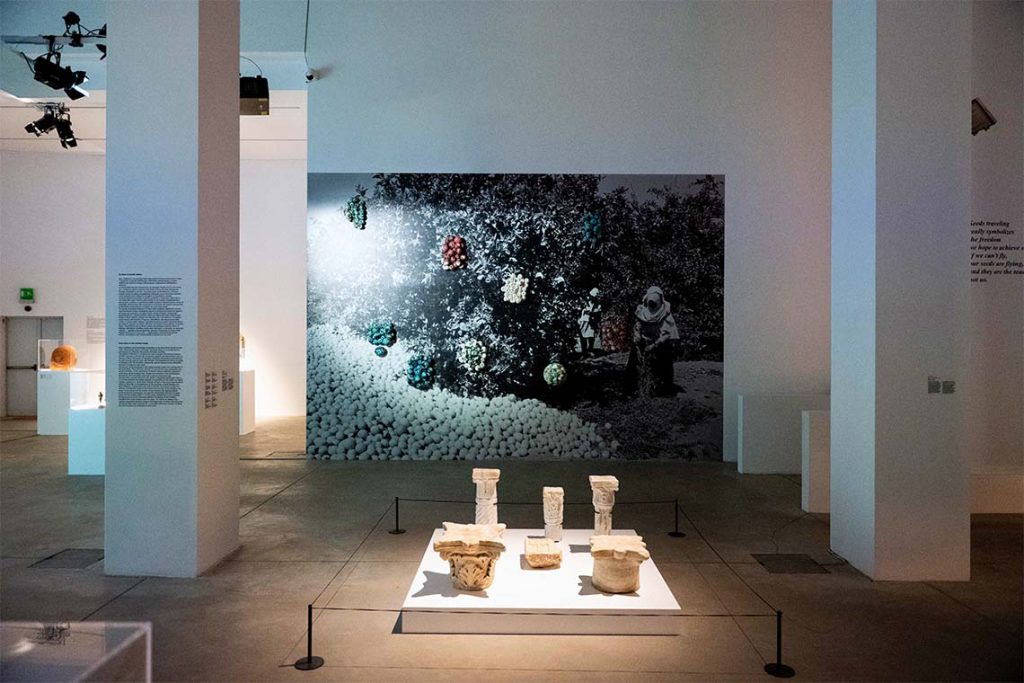
As Vivien Sansour’s Seeds out of Concrete (2025) posits, Gaza is a seed, its spores travelling far beyond its borders to seek new life and take root wherever they may land. An exhibition text recounts the tale of Sinuhe, in which an Egyptian man flees to Syria and settles there, marrying a local woman and building a life. In old age, he increasingly longs to return to Egypt so that his body may lie in the ground of his home country after death. As far as the seeds of Gaza can travel, one cannot help but feel as though, like Sinuhe, those seeds might want to return home.
