

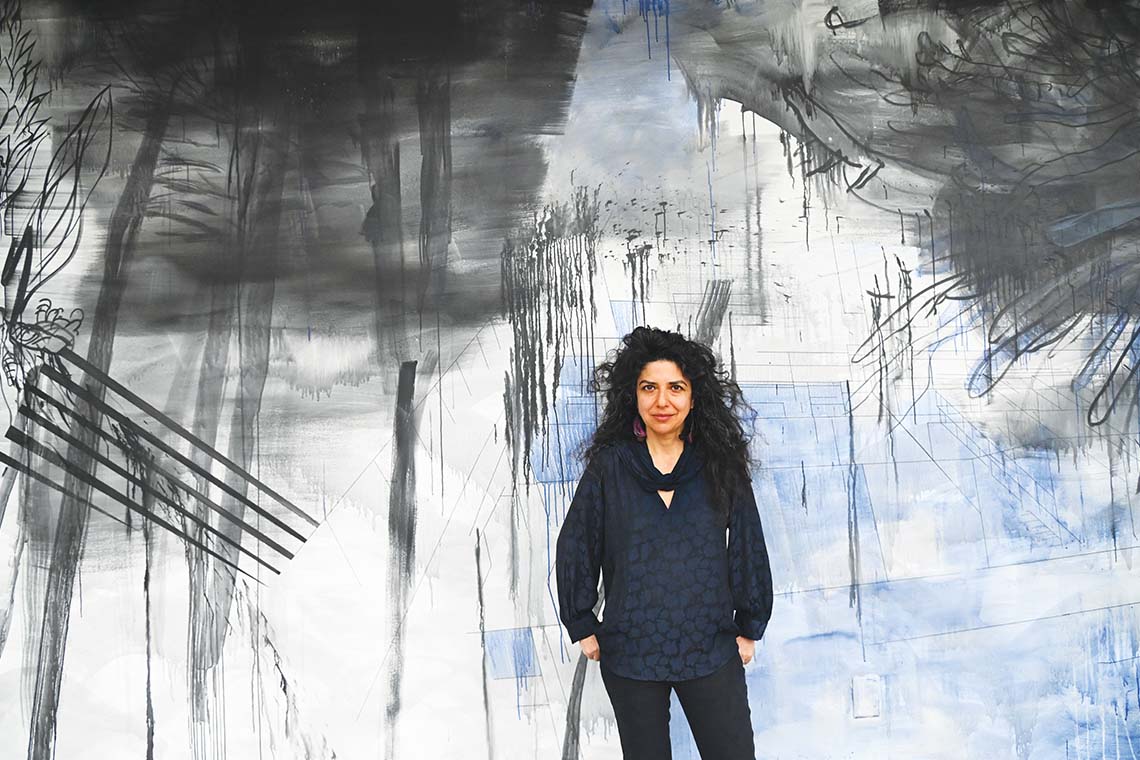
The Iranian-American artist is working to create her very own garden, a place to fertilise ideas and nurture resistance.
For Bahar Behbahani, every visit back home to Iran calls for a few stops in historic gardens. Besides visiting those in Shiraz and Tehran, the New York-based artist often finds herself in Isfahan’s seventeenth-century garden of Chehel Sotoun, where an art- and fresco-filled pavilion arises amidst roses, waterways and a pond. Their hypnotic calmness and impeccable geometries aside, Behbahani’s contemplative strolls in these opulent pockets of nature seek more than what most visitors are after. “There are spirits here, so many layers of history that are diplomatic, political and ecological,” she tells Canvas.
It was this multi-layered promise of traditional Persian gardens that intrigued Behbahani for her 15th Sharjah Biennial installation, Garden of Desire (2023). In fact, the oldest garden of them all – the Fin Garden in Kashan, which was completed in 1590 – was central to the multimedia project, which espoused a long layout of soil within a grid steel structure out of which sheets of paper grew. “The underground water system at the Fin Garden still works, magically,” says the Tehran-born artist. Beyond its intricately composed cycle of botany, Behbahani’s project held its own mysteries to decode: the wet earth and the insistently growing plants hinted at past political turmoils sunken below.
The Safavid era garden in Kashan is notorious for the murder of the Qajar reformist chancellor Amir Kabir at its ornate bathhouse in 1852. Behbahani grew up with this history and, like any Iranian child, visited the Fin Garden on school field trips. Later, in her adult New York life, she delved into the story of the American architecture scholar (and CIA spy) Donald Wilber, who used his fascination with the garden in the plotting of a coup to overthrow the democratically elected Iranian prime minister Mohammad Mosaddegh in the 1950s. “The beauty and the brutality,” according to the artist, are intertwined in the UNESCO World Heritage Site garden, making it an appropriate emblem of her own practice, which weaves threads of repose and enquiry through works that simultaneously offer pause and intrigue.
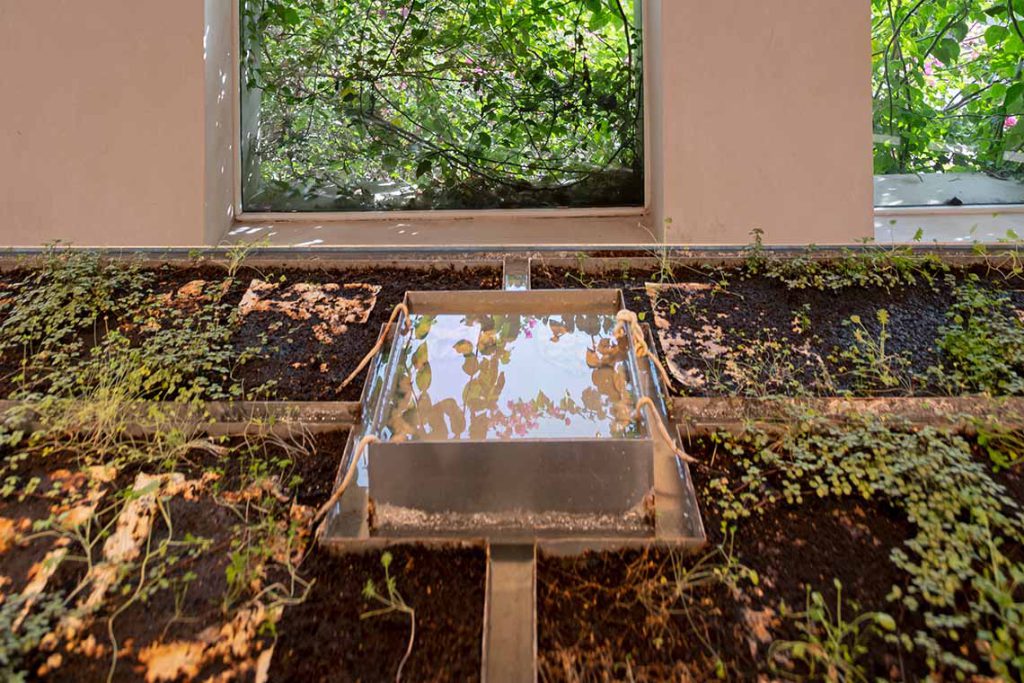
An academic from Princeton University, in 1942 Wilber was the first scholar to ever study the Fin Garden in detail. “I was in a way upset that nobody had ever done a survey of this place until then,” admits the artist. For her Sharjah installation, Behbahani embedded pages of Wilbur’s classified CIA records of the coup
that was co-organised by the American and British governments after Mosaddegh’s attempt to nationalise the Anglo-Iranian Oil
Company. The artist collaborated with Brooklyn paper-making non-profit institution Dieu Donné to create her own cotton paper by moulding and pulling each sheet. She laid these over trays of soil, into which she planted seeds for germination. The alchemy of the arrangement of paper also included copies of different parts of Wilber’s secret report, which appeared as broken fragments around and between the tiny plants that continued to poke out of the soil throughout the show’s nearly five-month run.
The process required the artist to push her own skills to the limit, both in terms of printing and gardening. She initiated the paper pulping in Brooklyn Navy Yard, but expanded it to the Emirati environment with help from the Sharjah City Municipality, as well as local botanists and an agricultural engineer. The daily maintenance of the self-watering installation was handled by South Asian gardeners, “whose knowledge and attention gave the work its lived rhythm”, says the artist. “Seedlings and weeds kept pushing through the seeded paper, and I watched the work always changing, reminding me that care, growth and disappearance are all part of the same cycle.”
Behbahani has dedicated over a decade to the research and delivery of multimedia work on the admiration and horror embedded in romanticised Persian gardens. Now she is working on Ispahan Flowers Only Once, a new garden which the artist plans to install across five New York City boroughs in the near future and which has been in development for over six years. “I’ve been thinking about the European gaze and the ecological wisdom behind these places,” she explains, “but have realised that I can no longer grasp all these ideas with a two-dimensional surface.” Although the Covid-19 pandemic brought financial and logistical challenges, the ambitious project has so far received various types of support, including from Creative Capital, the Pollock-Krasner Foundation and the Joan Mitchell Foundation. Last year, Creative Time invited Behbahani to give a presentation, titled I do not believe in time, I do believe in water, as part of its annual summit. There, the artist installed a mini garden on the stage at the Brooklyn Academy of Music in order to discuss nature’s own constant formation through waterways and how it resists systematic control over elements such as borders and migration.
Between New York’s lauded landmarks such as Central Park and its semi-private community gardens, Behbahani is invested in what she calls the “grey areas” to tell the “untold histories” that are hidden somewhere in the idea of an enclave awash in nature. For Ispahan Flowers Only Once, she plans a mobile quadrilateral structure which accommodates easy reassembly at different stops. The movable format, she hopes, will ease the bureaucratic challenges and expand the garden’s access. Modularity will prompt malleability and community engagement with each iteration being rebuilt by local volunteers. Inside, the artist envisions an “oasis” with cues from Persian miniature painting. Patches of nature in organic geometrics will envelope visitors – “educators, neighbours, activists and passersby” – and encourage them to deliberate, commiserate and simply spend leisure. “I’ve been thinking about where we can gather to talk about different issues, if not auditoria, libraries or cafés,” she says. The idea partially stems from her search for a “pleasing place [to discuss] difficult topics” in proximity to plants with healing medicinal powers that can “soothe the conversation”.
Nature’s uncontrollable rhythm with its own pace of growth, demise, and rebirth will invigorate the exchange and camaraderie, Behbahani hopes. Lush or brittle, she considers care for a garden an essential component of the year-long process. Among her guiding lights is the Farsi expression of “garden with no leaves”, which encourages appreciation of the winter phase without the luxuriant beauty of summer.
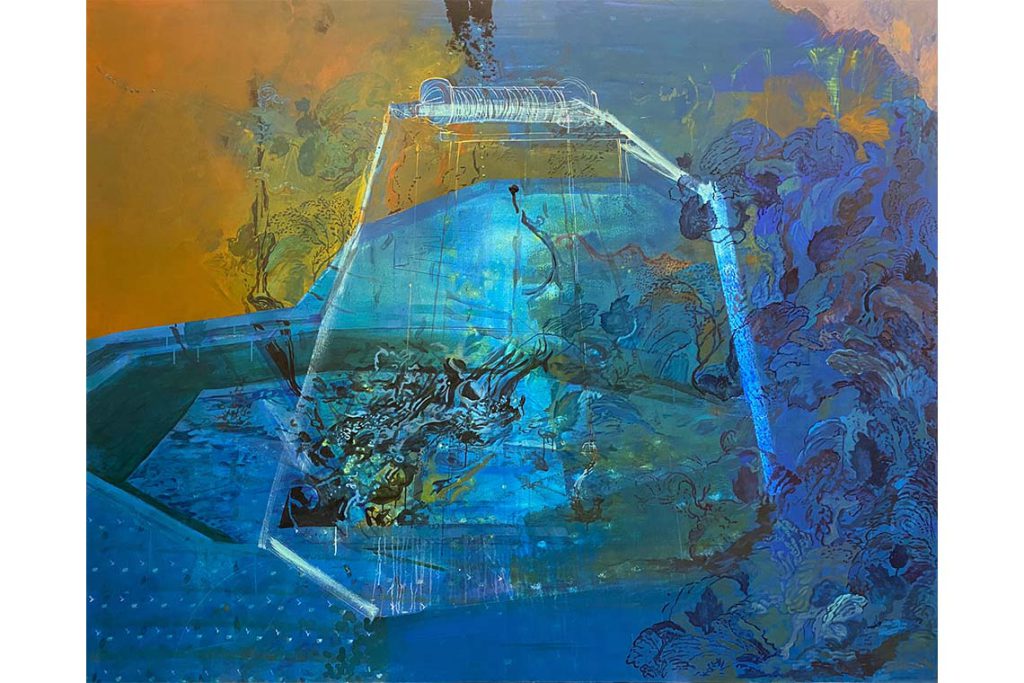
Behbahani’s most recent mixed-media painting series Biography of Garden City (2023–24) adopts elements from her appetite for observation. Long hours of scrolling through rapidly changing data sets on heatwaves and observing visitors looking at Persian prayer rugs in the Metropolitan Museum of Art lent
themselves to a suite of semi-abstract paintings that explore the visual and social structures of cartography and politicisation of movement, both daily around cities and politically between lands. “I’ve become interested in what borders and edges mean and how elastic they can be,” says the artist, who has been taking long walks around her Brooklyn studio near the East River. The resulting bold-hued paintings are quite large, some of them exceeding her own height, with layered bird’s-eye-view images of unspecific lands. Occasionally, these are “blueprints of gardens”; in others, blotches of paint bear consistent abstractions that form loose grids with bleeding edges. Thick like grass, her colour palette conveys a sense of liquidity and openness, not unlike her meditations on value, visibility and the precariousness of existence.
Behbahani still cherishes her childhood memories of grabbing bunches of dill from her father’s hand to smell their freshness. “I always appreciated these little moments,” she recalls, noting also her enduring fascination for little leaves finding their way through cracks of asphalt. “There is so much we can learn from plants about resilience,” she says, trusting also in her garden’s offering of a remedy. “Art doesn’t necessarily erase trauma, but it definitely transforms how we carry it, especially when experienced collectively.”
