

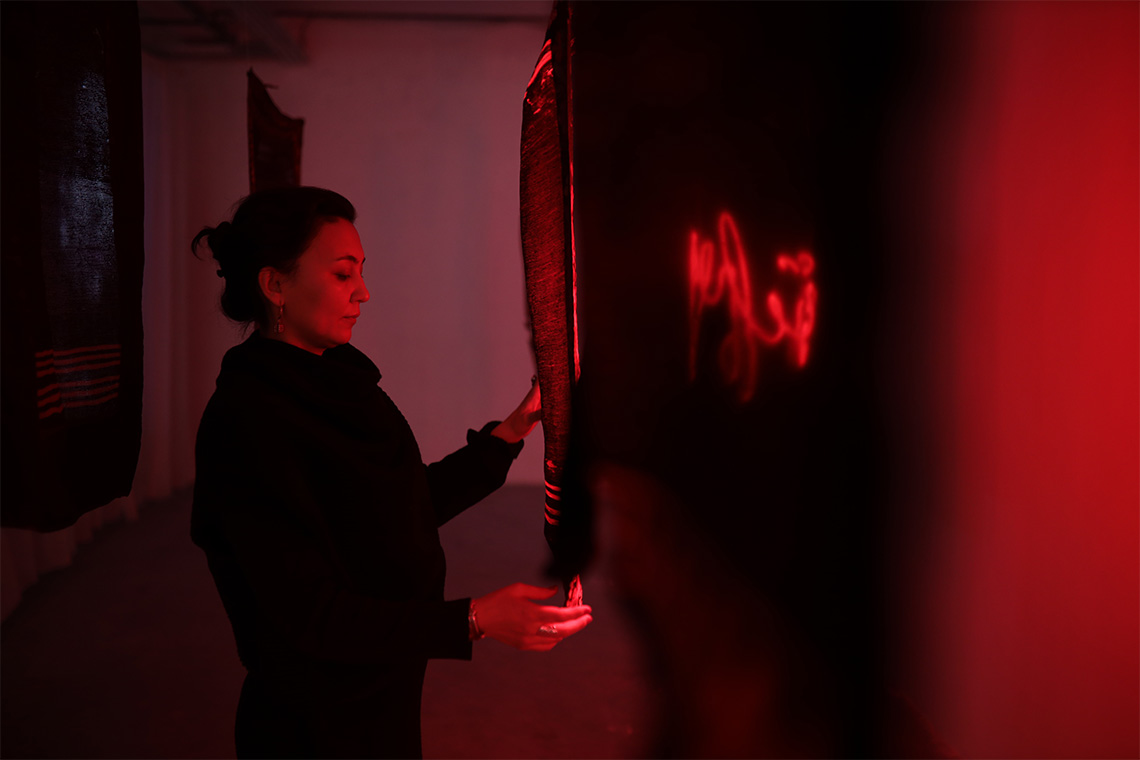
Ever deliberate and composed, the Uzbek filmmaker painstakingly unpicks the complex threads of post-Soviet Central Asia to shed new and revealing light.
I’ve been interviewing artists for the best part of 20 years, butI don’t think I’ve ever spoken to anyone quite so conscious of not repeating themselves as Paris-based filmmaker Saodat Ismailova. Over the course of our 90-minute conversation, she is at pains to avoid telling the same old stories she has dished out to journalists and curators in the past. “I don’t like the repetitions, repeating the same narratives,” she says. It is striking that she appears to apply much the same principle to her artistic practice. Her films are extraordinary things – poetic, elegiac meditations on Central Asian identity and the place of women within that porous sphere. Often incorporating archival footage and sometimes performance elements, her works examine the territory in the here and now at the same time as harking back to a lost world, one that suddenly evaporated before the artist was even into her teens.
Born in 1981 in what was then the Uzbek Soviet Socialist Republic, Ismailova grew up in a creative milieu. Her father was a cinematographer at Tashkent’s only film studio. “It was a community, you know, friends of my parents and the people who were surrounding us,” Ismailova elaborates. “They are still connected to the cinema today.” It was a prestigious job that spoke of the Uzbek SSR’s rapid – perhaps rather too rapid – process of industrial modernisation under communist rule: Russian was the lingua franca, religion was sidelined and life marched in lockstep with Lenin’s famous formulation: “Electrification plus Soviet power equals Communism”. Nevertheless, folkloric traditions persisted in this corner of Central Asia.
“It was a way of being and seeing – just a normal part of life,” Ismailova continues, “and to grow up with this imaginary of possible other worlds or existences… I really find it beautiful.” Yet this don’t-ask-don’t-tell symbiosis of superpower authoritarianism and traditional custom was about to crumble. In 1985, Mikhail Gorbachev unveiled twin policies of reform: ‘Glasnost’, or economic liberalisation; and ‘Perestroika’, a means to a greater degree of freedom of speech. Together they hit the sclerotic Soviet system like a hurricane, the former enabling profiteers and causing chronic shortages of everyday goods, the latter unleashing a tidal wave of nationalist sentiment in the non-Russian republics of the USSR. Coupled with Gorbachev’s withdrawal from Eastern Europe and Afghanistan, the double shock precipitated the disintegration of the USSR and fracturing of the post-Second World War world order.
Nowhere was this felt more keenly than in Uzbekistan. “When the Soviet Union fell apart,” Ismailova says, “it was probably the biggest and most important event in modern Central Asian history. Yet I don’t think that we really look properly at that period.” She makes a telling point, especially as in the West we tend to see the dissolution of the USSR as a liberation of oppressed nationalities and in some cases – in the Baltic states, or in Georgia, for instance – it certainly was. Yet, as Ismailova elaborates, “before the Soviet Union, [the Central Asian nations] were not countries – they were emirates. It’s such a contradiction. These nations, these republics, were created during Soviet times and we were all in one country.”
There was an important legacy element. “So when real independence happened, each country inherited what was created during Soviet times,” she explains. “Of course, they were busy – and they are still busy – trying to create a clear statement of ‘one identity’, of, say, one national hero, one national epic story. It happened in the West too, of course, but for us it’s just a recent thing.” Questions of this sort haunt Ismailova’s filmography. A narrative of particular inspiration, for instance, is the story of Gulaim and the Forty Girls, an Uzbek legend about a formidable warrior-queen who, along with a band of courageous female fighters, fought a heroic battle to save their imperilled lands. Ismailova, who first made a short film on the subject in 2014, saw Gulaim as an entry into exploring folkloric stories of cultural identity.
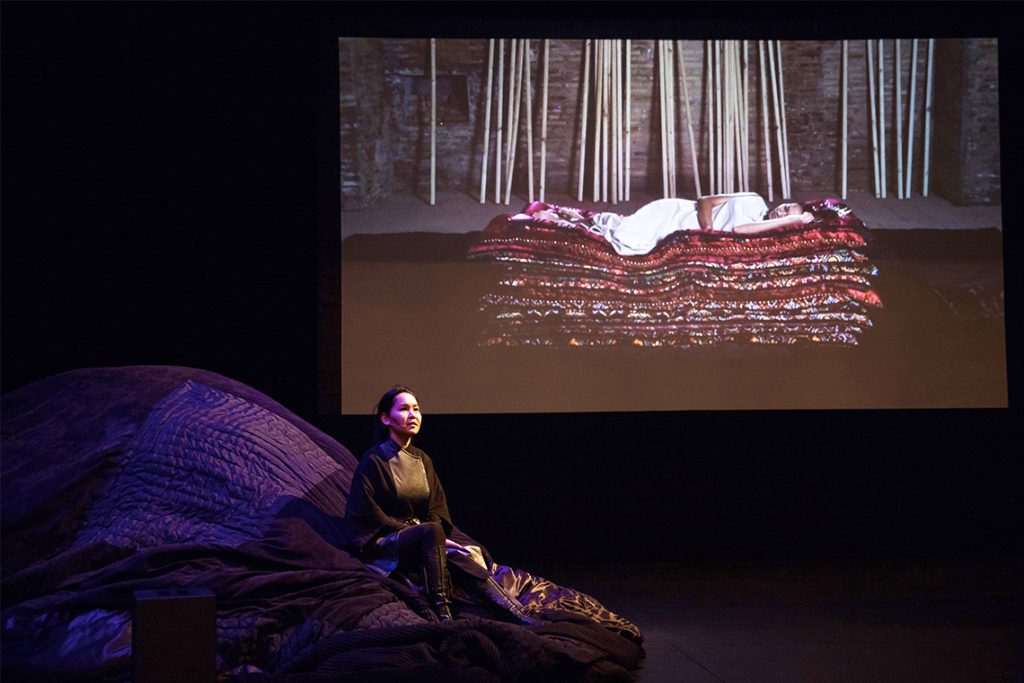
“For me it was interesting,” she says. “Do we know many female epic stories? Normally they’re male, but I looked into it and found that there were plenty of female epics which are not recited anymore, because society doesn’t want to hear about a female hero. Then of course it was kind of a travel into the past, because there was a matriarchal society here in the region […] so I guess it’s looking into the real possibility of an alternative way for society to function.” Ismailova expanded on her research into the story to realise her 2018 project Qyrk Qyz (Forty Girls), a performance in which she reimagined the tale backed by a formidably talented group of Central Asian female musicians playing on traditional instruments.
“Girls, in the region I come from, really need some extra support,” Ismailova explains. “Perhaps two or three times more so than men, because the society itself puts them into a situation in which the only way is to have children and raise a family. There is not so much space for girls to believe in themselves, and through this character of Gulaim, it really took me to this activity of creating a platform for young girls from the region and to anything I can do on the scale of my possibilities, even if it’s just to create a space that empowers them and lets them believe in themselves.”
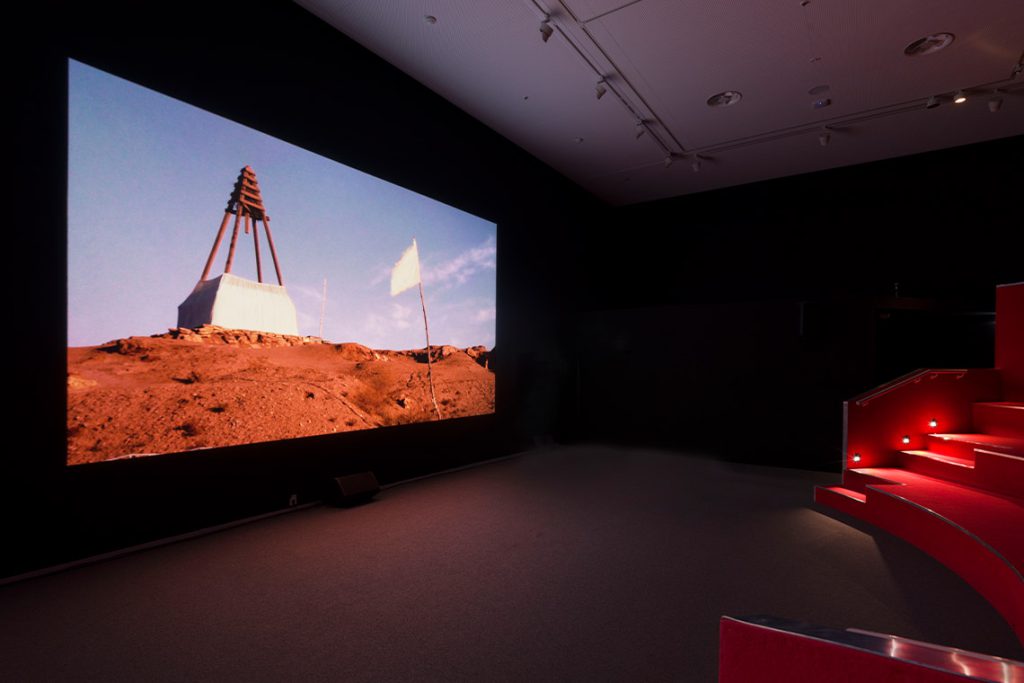
Ismailova’s explorations of her homeland’s memory and culture are not confined purely to the realm of folklore. For one of her first major projects, a documentary called Aral: Fishing on an Invisible Sea (2004), she travelled to the Aral Sea, a body of water that once separated Kazakhstan and Uzbekistan and was the world’s third-largest lake, clearly visible from space. In the 1960s, however, the Soviet Union diverted some of the rivers flowing into it for gigantic agricultural projects in the region. Since then, the Aral has shrunk to almost nothing, its desertification annihilating the local fishing industry and ruining the lives and livelihoods of the communities along its shores.
Ismailova’s film investigated the lives of three generations of fishermen who had remained in the region, striving to eke a living from what remained of the Aral. “It’s a big, dramatic legacy of the Soviet era which has affected not only Central Asia but also had a global impact,” the artist explains. “You know, we don’t have water – Uzbekistan is a double-landlocked country – and the loss of the Aral is very complicated. What can I say? It was hard to see people surviving there. I thought, why would they stay there? There’s nothing to hold on to, but people are still somehow connected to the land.”
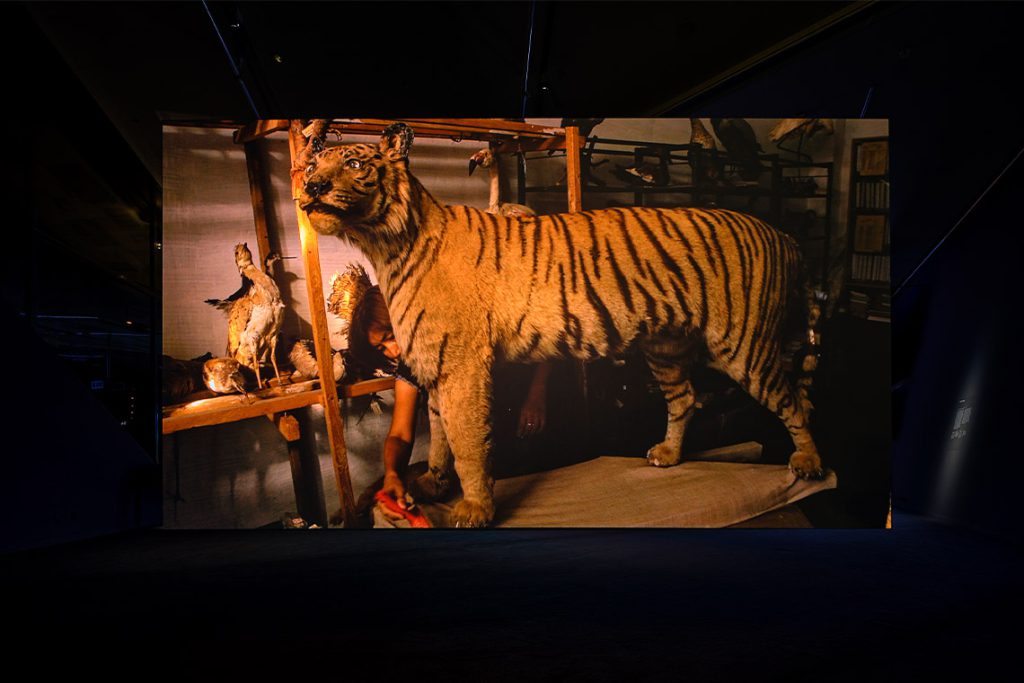
She further explored manmade natural catastrophe in her films Stains of Oxus (2016), a multi-screen video installation that ruminated on the cultural memory and mythology surrounding the Amu Darya, the mighty river that once fed into the Aral Sea, and The Haunted (2017), about the disappearance of the Turan tiger, a species once widespread in Central Asia but wiped out by humans. “I was interested in questions of extinction, the transformation of the landscape, the consequences of the industrialisation there, which was done in a strangely short-sighted way,” she notes.
At the time of writing, Ismailova has her hands full with an ambitious piece set to take place at Brussels’s Festival des Arts in May. Alongside a live performance, it will incorporate a new video work that she is currently editing from existing footage sourced from Uzbek feature films realised as the USSR collapsed and thence over the first decade of independence. She watched many of them herself in the cinema at the time of their release. “They capture a kind of transitional moment, which I find in cinema is very interesting,” she explains. “With Gorbachev’s glasnost, there was more connection to the outside world – different music was arriving, foreign films were coming – and you can see it in these films, the way people dressed, or the way they behave. So there was a liberation, but if you look at the films, you see [the break-up of the old order] was very painful as well.”
Ismailova is delightful company, even over the dreaded medium of Zoom. The sense I really get is that she is entirely and tirelessly dedicated to her craft. Indeed, it seems she constantly has several projects on the go. I ask her whether she’s ever experimented with AI to expedite the technical facets of her practice. “I’ve tried to use it!” she exclaims. “Listen, I think that these tools are amazing, I don’t see any danger in them. If there is this possibility, then why not use it? I tried, but I just didn’t really have enough time – it’s a game, you have to master it in terms of how you feed it, how you direct it. So it’s a time dedication. Who knows, though?” Who indeed. It would be a category error to put anything beyond the capabilities of this singularly imaginative artistic presence.
