

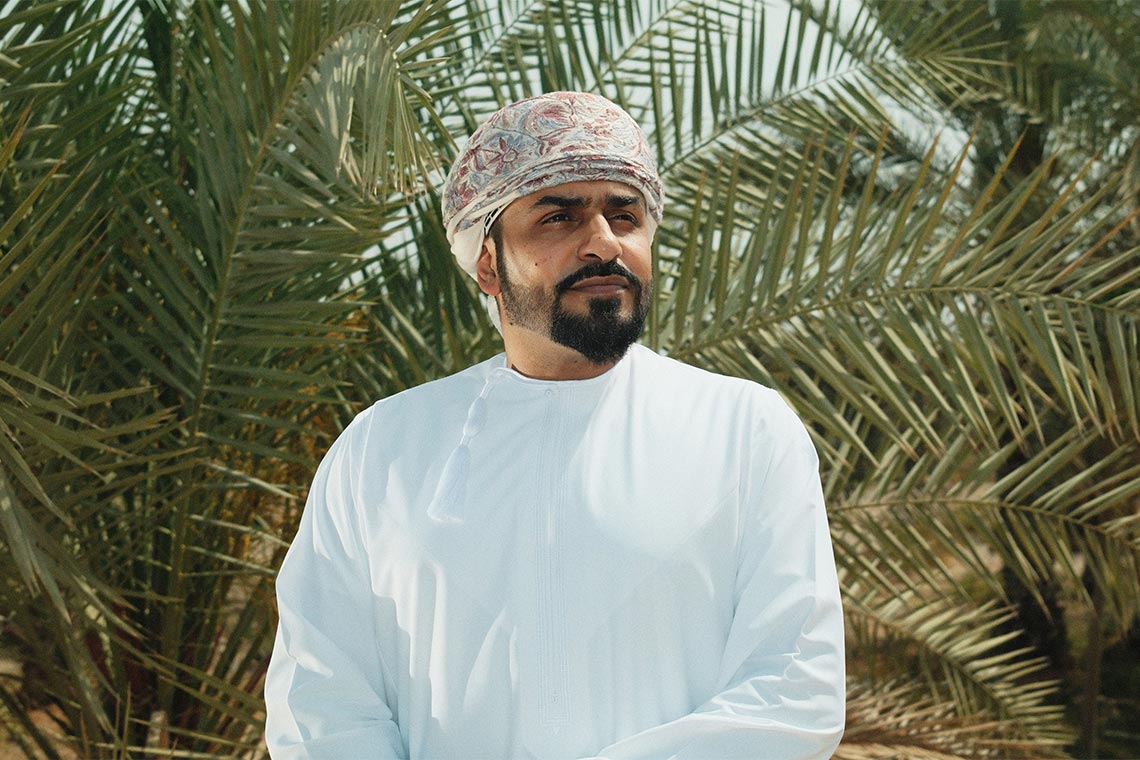
Representing the Pavilion of the Sultanate of Oman with his work Zīnah, the artist investigates the intersection of cultural narrative and spatial experiences.
Canvas: As both curator and artist of the Omani Pavilion, what are the central themes you are exploring?
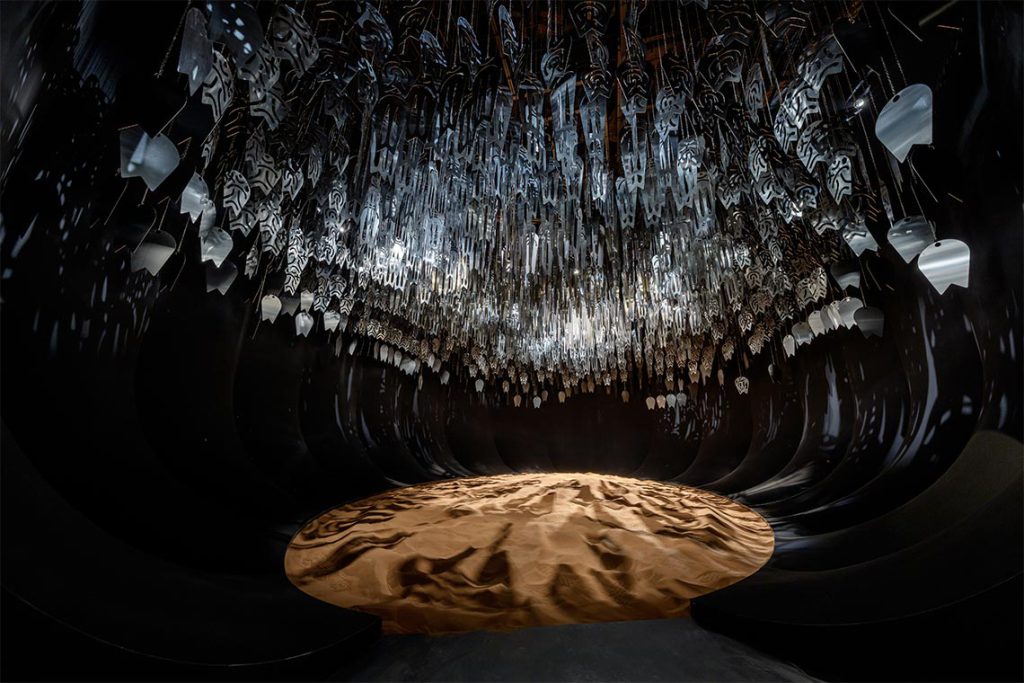
Haitham Al Busafi: The idea of the installation, which is entitled Zīnah (Adornment), is drawn from the Omani tradition of Al-zaanah, the silver jewellery crafted for horses. It is an adornment that extends beyond decoration to embody cultural identity and craftmanship, as well as the relationship between the human and the horse. This tradition reflects a broader cultural understanding in which adornment is not separate from function, but deeply intertwined with it. When a man prepares himself for a special occasion, he adorns himself with silver, and this act extends to the horse as well. The animal is therefore not perceived as an external object, but as an extension of the self. In developing the installation, I sought to translate this concept into a spatial and experimental form. Al-zaanah is not only ornamental but also functional. It facilitates the interaction between the rider and horse, while simultaneously carrying notions of beauty and identity. This duality between function and expression becomes a central framework within the work.
How has your architectural training shaped the way in which you approach storytelling and media production?
Architecture gives you a more holistic approach to the world. You learn to break things down to their core parts and rebuild them, which naturally led me to creating immersive works and acts of storytelling rather than something linear or direct. In a world where we are constantly on our devices, I try to create environments that make you want to put your phone down and be present. Maybe at first you take a photo, but then you stop and actually experience the space. That is the goal – something dense, intense and emotionally engaging.
You studied under influential architects like Zaha Hadid and Kazuyo Sejima. What key lessons from that experience still inform your work today?
I did my bachelor’s in Oman, then moved to Vienna to pursue my master’s under the mentorship of renowned architects Hani Rashid and Zaha Hadid. Their studios were more like research labs than classrooms. They encouraged experimentation and originality and pushed us away from repeating what already exists. The biggest lesson I took was to be obsessive about ideas that resonate with you, working to develop them deeply and connect them to people through space, material and experience. That level of rigour and layered thinking has stayed with me. Being in Vienna also exposed me to constant flow of art and culture, something that is still evolving in certain Gulf countries.
Your work Memory Grid (2025), which won the Best Design Medal at last year’s London Design Biennale, explores themes of memory and value through material. How do you approach material as a carrier of meaning in your work?
Memory Grid looks at what we hold as truly valuable today – our thoughts, emotions, memories and interactions. These are things that feel most personal to us, yet in reality most of them now exist and are stored in data centres that we never see or interact with physically. The installation placed visitors within that context, creating a spatial experience inspired by data centres. However, instead of servers, you encountered transparent vessels. These were modelled after ancient pottery forms, reflecting how, thousands of years ago, people used handcrafted clay pots to store what was precious to them. Memory Grid asked a simple question: if something is truly precious to you, where and how do you choose to store it today?
Where do you draw the line between functional design and artistic expression? How is this expressed in your work at the Biennale?
Architecture is a sophisticated form of art, in the sense that you do not have the same palette that a traditional artist would have. Instead, you work with a more constrained and rigid set of tools. The most fluid elements of this palette are space, light and the sequencing of events – qualities that are unique to architecture. However, they must be constructed through material and structural system. Very few people have the ability to create art through architecture, because one must first pass through the threshold of mastering the technical, functional and engineering aspects. If one is able to do so even once or twice, it is already a significant accomplishment. This approach is central to Zīnah (Adornment), where the technical systems behind the silver canopy and the shifting soundscape are not separate from the artistic intent – rather, they are the very means through which it is expressed.
Can you walk us through the visitor experience and explain how the work responds to the space?
The visitor enters a darkened, immersive environment where the ground is covered with sand shipped from Oman. This immediately shifts the sensory experience, encouraging a slower and more conscious mode of movement. Above is a suspended silver canopy composed of multiple elements that form a constellation-like structure. As the visitor moves through the space, the installation responds dynamically through subtle motion and sound, creating a direct relationship between the body and the space. Zīnah (Adornment) is designed so that it is never complete without the presence of the visitor. Their movement activates the space, meaning that each experience is slightly different, depending on how one navigates it. There is also a deliberate contrast between weight and lightness, between the ground, the tactile nature of the sand and the reflective silver structure above. This tension creates a heightened awareness of presence within the space.
The Pavilion of the Sultanate of Oman is located in the Arsenale
This interview first appeared in Canvas 123: Venice Special Issue
