

For the inaugural Kingdom of Morocco Pavilion, the artist transforms craft into a living language of gesture, transmission and presence.
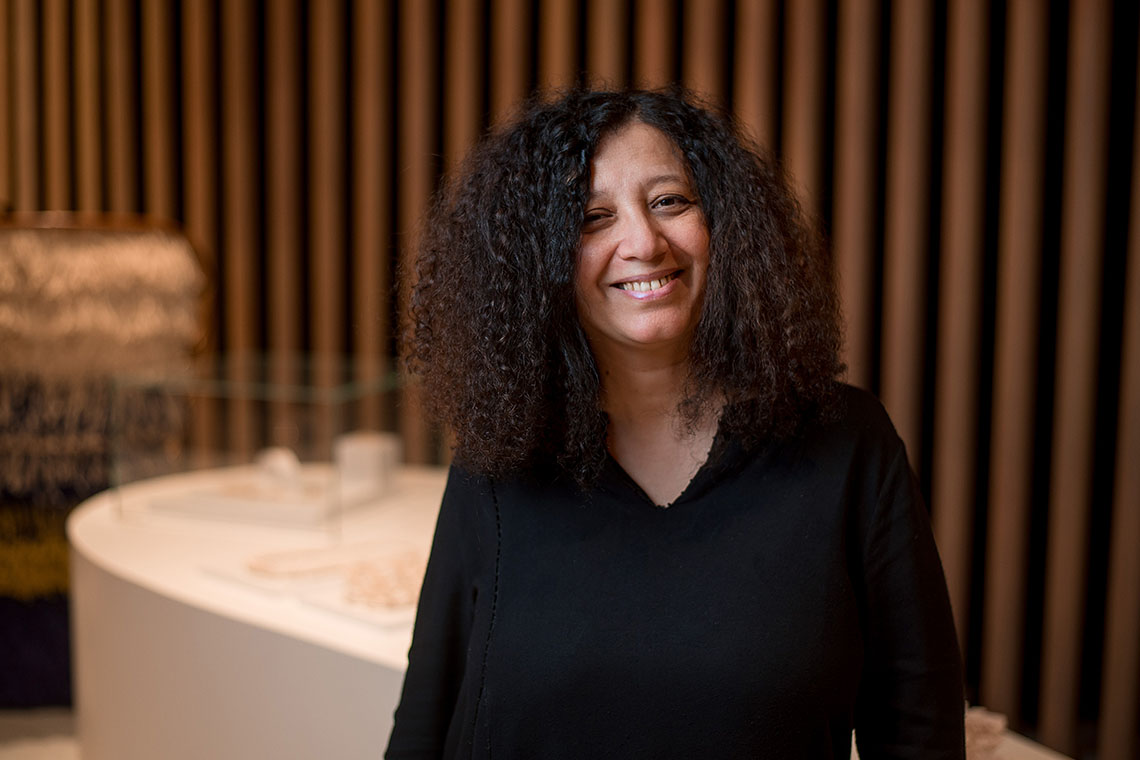
There is something disarming about Amina Agueznay’s work. At first glance, it appears simple. Fibres suspended in space, repeated gestures, forms that seem almost self-evident. However, nothing about it is immediate. Her installations unfold slowly, resisting instant readability and asking for time, for attention, for a certain surrender to rhythm. What emerges is not an object, but a presence. A field of energy shaped through touch, repetition and relation.
To encounter Agueznay’s work is to step into something that is already on the move. “I’m in constant motion,” she says. “There isn’t just one studio, there are many, and they are out in the field.” This sense of movement is not a figure of speech – it is the very condition of the Moroccan artist’s practice. She moves continuously across Morocco, between Casablanca, the Middle Atlas, the Souss region and Marrakech, where an “espace test” allows her to assemble and recalibrate her installations. Nothing is produced in a single place. Everything is distributed, negotiated, assembled through distance. In Casablanca, a network of artisans works alongside her, led by a head craftswoman. In rural regions, other groups contribute to the making of modules, each shaped by a different hand, a different rhythm, a different environment. What emerges is not a unified object, but a constellation of presences. Each element carries its own density, its own temporality, its own story. What Agueznay constructs is less an artwork than a system of relations, which she describes as a choreography – not metaphorically, but structurally. Each module is conceived as an individual entity, yet one that must find its place within a collective composition. Her installation for the Biennale brings together these multiple presences into what she calls “Gentle Giants”, anthropomorphic forms that must be “welcomed with grace and inserted into a community”.
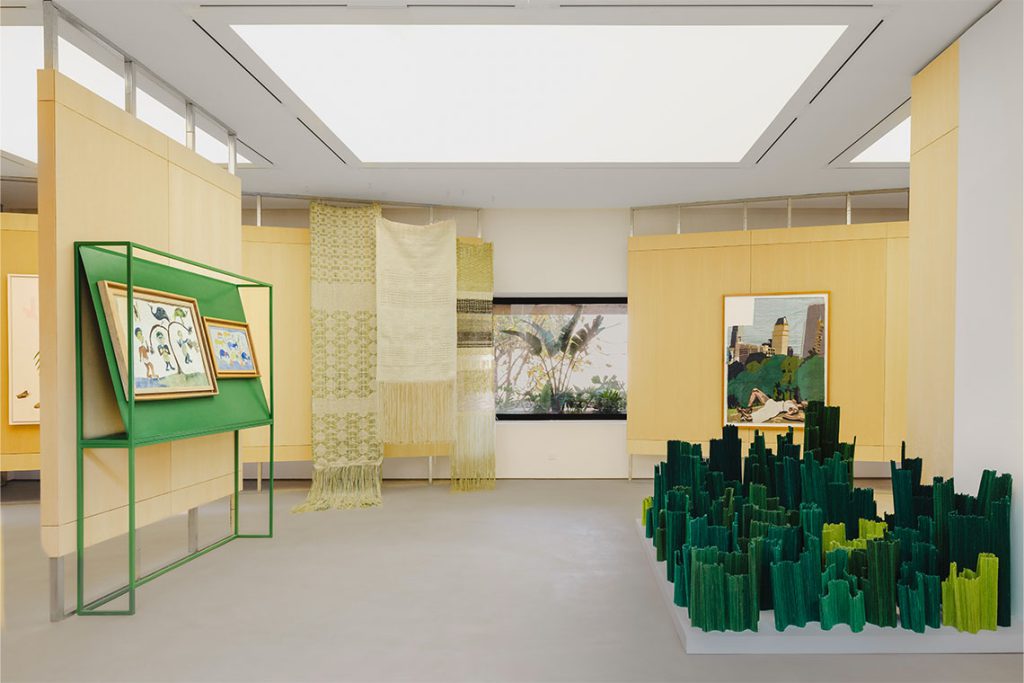
Agueznay’s vocabulary is precise. Nothing is neutral and everything is relational. The nomad artist’s work is often approached through its materials – fibre, wool, sabra, metal – but what she develops is not simply a material practice, it is a language. “I create matter from raw matter. I create my own material,” she affirms. This shift is decisive, marking the moment at which craft ceases to be a technique and becomes a mode of thinking. The material is no longer given. It is constructed, activated and redefined through process, with the artist’s trajectory reflecting this gradual expansion. She begins with jewellery, working in silver and copper. Then something shifts, and her gaze turns towards her immediate environment. Everyday elements begin to register differently. Whether plastic, paper, knots or fragments, everything becomes potential matter, not in a symbolic sense but as a physical vocabulary waiting to be reorganised. Later, textile fibre enters the practice, particularly sabra, opening an entirely new field of exploration. What remains constant is the logic of accumulation.
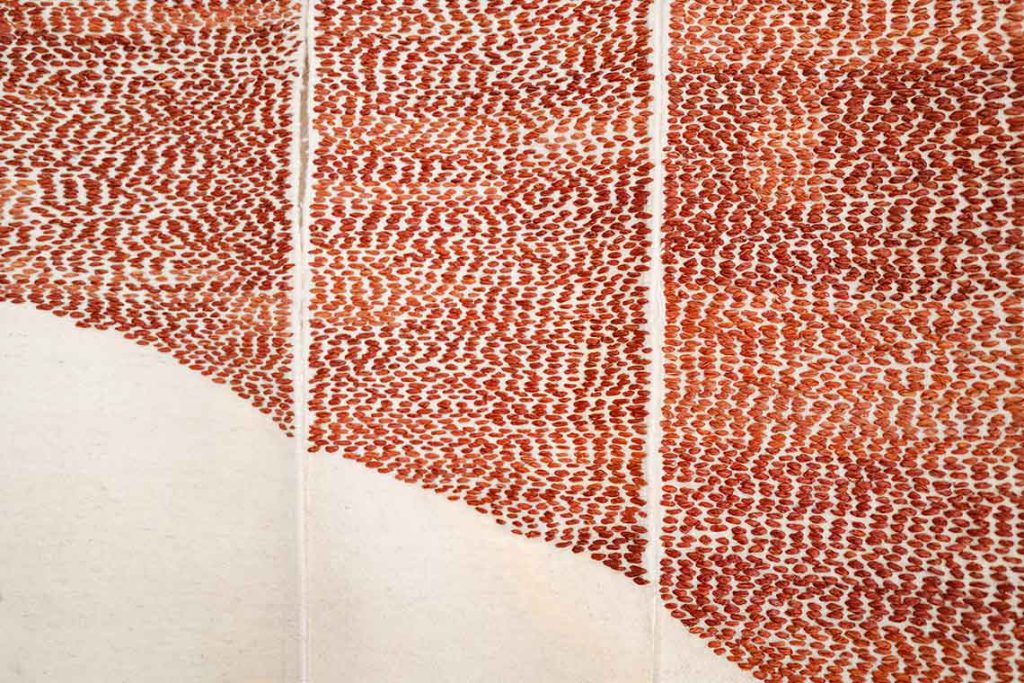
“I started accumulating these pieces on the body,” the artist explains. “Then they left the body to inhabit space.” The movement is almost organic, as jewellery becomes density, density becomes volume and volume becomes environment. The work does not break from one form to another, instead expanding and following its own internal necessity. This expansion is inseparable from Agueznay’s background in architecture, not as a discipline that she applies, but as a way of perceiving. “I like this constant movement between scales,” she says. “From the very large to the very small.” Scale, in her work, is not a question of size but of intensity. What defines magnitude? Is it the impression produced by the object, or the concentration of meaning it holds? Her installations often appear monumental, yet they are built from minute, repetitive gestures. Threads, fibres, knots. The monumental emerges from the accumulation of the fragile. This tension between micro and macro is never resolved. It is sustained, activated, made visible.
Agueznay’s practice also quietly dismantles one of the most persistent myths in contemporary art: that of the solitary artist. “I’m alone in the final decisions. But the process is much more diverse,” she notes. Diverse here means collective, but not diluted. Each module is produced by a specific artisan, often a woman working within a cooperative, producing gestures that are not anonymous but situated, embodied and carrying the imprint of lived knowledge. Yet the work does not dissolve into collaboration, as the artist retains authorship through composition, rhythm and the final articulation of the whole. What emerges is a porous space where individual and collective logics intersect without cancelling each other. If there is a central principle running through her practice, it is one of transmission – but not as a linear movement. “Transmission is never one-way,” she says. It is essentially a circulation between the artist and the master craftswomen with whom she works, as well as between her and the pavilion curator, Meriem Berrada, whose presence extends into the field, conversations and shaping of the project. It also reaches out between the work and the viewer, who completes the experience through their perception.
This circulation is also temporal. Agueznay’s research is empirical, grounded in the present moment. “What interests me is to capture a moment,” she points out. “To say, ‘This is how it is done”. There is something quietly radical in this position. Rather than reconstructing a past or projecting an abstract future, she anchors her work in the immediacy of practice. Techniques, vocabularies, gestures are not fixed, instead evolving, shifting, sometimes disappearing. Her work acknowledges this instability and becomes a living archive, not of objects, but of gestures.
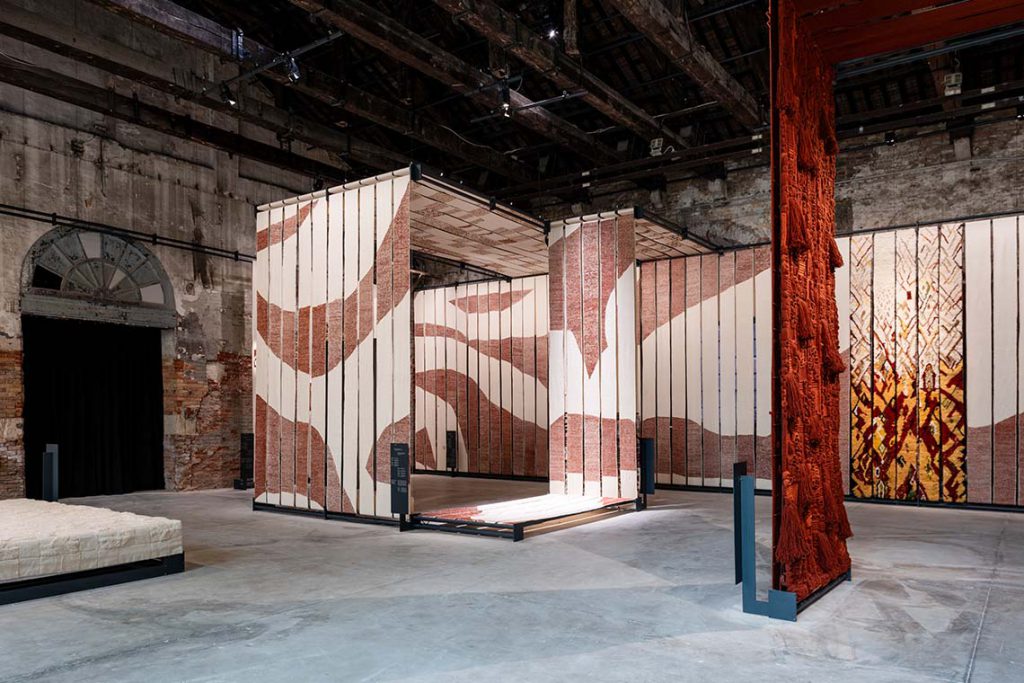
These gestures – accumulated, transmitted and transformed – find a new form in Asǝṭṭa, Agueznay’s monumental project for the Biennale. Spanning 300 square metres, it comprises a range of textile weavings displayed as suspended architecture. The title of the installation is an Amazigh word for ritual weaving and refers first to the loom itself, the structure through which threads are stretched and transformed, before extending to a wider vision of making in which creation becomes ritual, transmission and renewal. “When a carpet is finished, it is detached from the loom. There is a birth, a death, rituals, songs. But that ending is also the beginning of another life,” the artist declares. Nothing is fixed. The work exists within a continuum, with each piece extending from previous ones, carrying forward a vocabulary that is constantly reconfigured. There is, as she describes it, a “thread” running through her practice. Not as a metaphor, but as a structural continuity.
In Venice, this continuity takes the form of an environment. Not an object to be observed, but a space to be inhabited. “In a world where everything moves fast, I want this space to slow things down,” the artist urges. “To make people stop. To breathe.” This attention to the viewer is not secondary, but integral, with the installation conceived for multiple modes of engagement. Some visitors will pass through quickly, while others will linger. Some will focus on the overall composition, others on the details. The work accommodates these different temporalities without hierarchy. Presented within the Arsenale, the installation enters into dialogue with a space already saturated with history. The walls carry traces, memories, layers of past uses. “There are strong connections with the space,” Agueznay notes. “The walls carry history. The work dialogues with them.”
The encounter is not neutral. It produces resonance and creates a tension between different temporalities, different geographies and different narratives. There are also more intimate connections at play, between Morocco and Italy, as well as between personal trajectories and collective histories. For the artist, presenting this work in Venice is not simply an institutional milestone, it is an act of weaving. Not only of materials, but relations, both visible and invisible. After years of practice, what remains striking is Agueznay’s refusal of closure. For her, a work is never finished: “As long as I have something to say, I will continue.” With no fixed destination and a process sustained by curiosity, encounters and the need to translate stories into matter, her obsessions persist – among them the movement between scales and the modular vocabulary inherited from architecture. However, new materials and new desires continue to emerge. The practice absorbs, like a sponge, and returns something altered. In the end, nothing in Agueznay’s work is static, everything is in relation. Perhaps that is where its quiet power lies.
The Kingdom of Morocco Pavilion is located in the Arsenale
This profile first appeared in Canvas 123: Venice Special Issue
