

The National Pavilion of Qatar is more than a presentation of artwork. Commissioned by HE Sheikha Al Mayassa bint Hamad bin Khalifa Al Thani, chairperson of Qatar Museums, untitled 2026 (a gathering of remarkable people) is a celebration of visual form and movement, art installations and activations.
The central intention for the pavilion was to bring together the rich diversity of the Arab world within the notion of Qatari gathering spaces, rather than a platform-style presentation. The work presented and shared in a celebratory setting is by international creatives including Rirkrit Tiravanija, who was born in Buenos Aires; Qatari-American artist Sophia Al-Maria; Lebanese artist Tarek Atoui; Kuwaiti-Puerto Rican artist Alia Farid; and Palestinian chef Fadi Kattan. An international orchestra was also selected to be part of the pavilion’s vernissage and opening weekend. It included Lynn Hadib (voice, Syria); Mazen Kerbaj (trumpet, Lebanon); Naghib Shehbenzadeh (percussion, Iran); Sam Shalai (oud, Egypt/Canada); Ghassan Sahhab (qanun, Lebanon); Lucy Railton (cello, UK); and Tomás Gouband (percussion, France/Algeria), along with culinary offerings by chefs Noof Al Marri (Qatar), Noor Murad (Bahraini-born) and Majed Ali (UAE); with mixology by Anna Patrowicz (France).
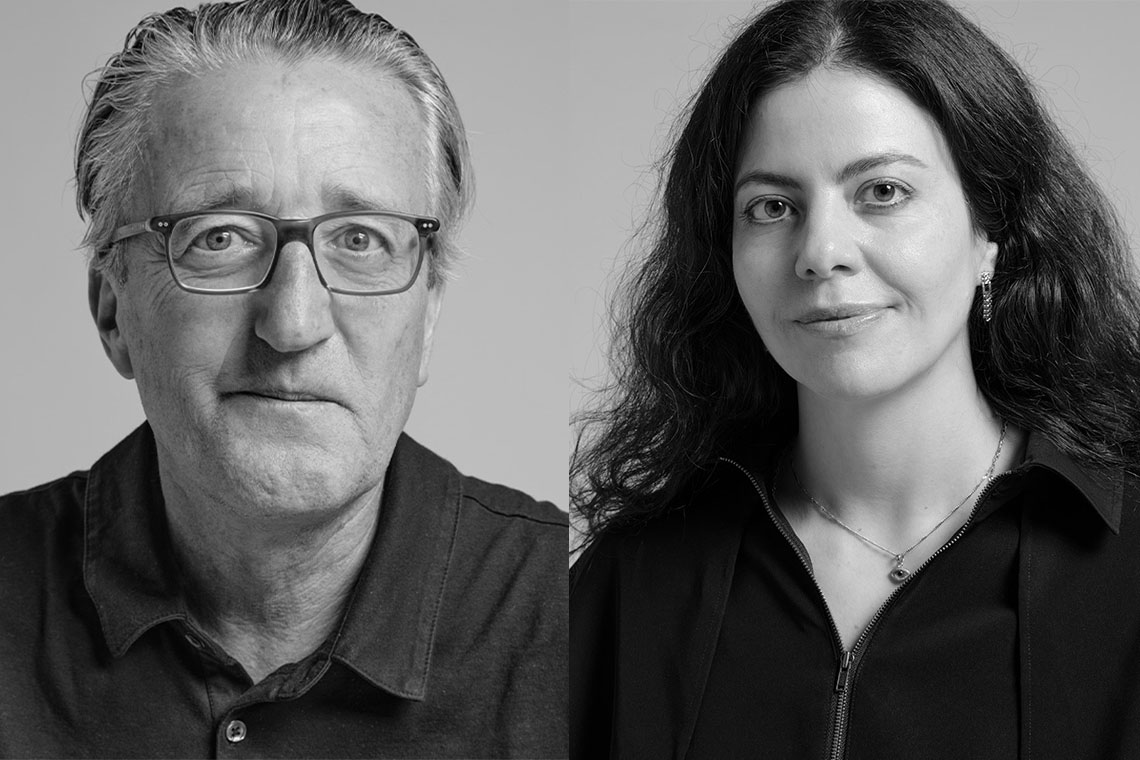
Sophie Kazan Makhlouf for Canvas met with curators Tom Eccles and Ruba Katrib to learn more about this impressive gathering.
Sophie Kazan Makhlouf: Rirkrit Tiravanija is a central figure in the Western canon of relational aesthetics, but the concept of ‘Art as a social gathering’ has ancient roots in the Arab world through the majlis and sikka. Tom and Ruba, in your selection process, how did you negotiate the intersection between Tiravanija’s own ‘relational’ practice and the organic, historical modes of Arab hospitality, in practical and conceptual terms?
Tom Eccles: Rirkrit’s work has always been deeply responsive to culture and, in particular, to the nuances of cultural exchange. The Qatar Pavilion is also connected to Rubaiya Qatar’s presentation in Doha, untitled 2025 (no bread no ashes), where Rirkrit created an outdoor bread oven in MIA Park, which is still activated regularly, and so bringing his work into the pavilion felt like a natural fit. His practice often creates structures and situations that allow forms of sociability and encounter to emerge.
Ruba Katrib: Under the tent-like structure Rirkrit designed for the pavilion, many different moments are unfolding, centred on food, music, conversation and performance from across the Arab world and beyond. Hospitality is an essential part of Qatari culture, and his work creates a framework through which ideas of exchange, gathering and collective experience can evolve in an open and experimental way.
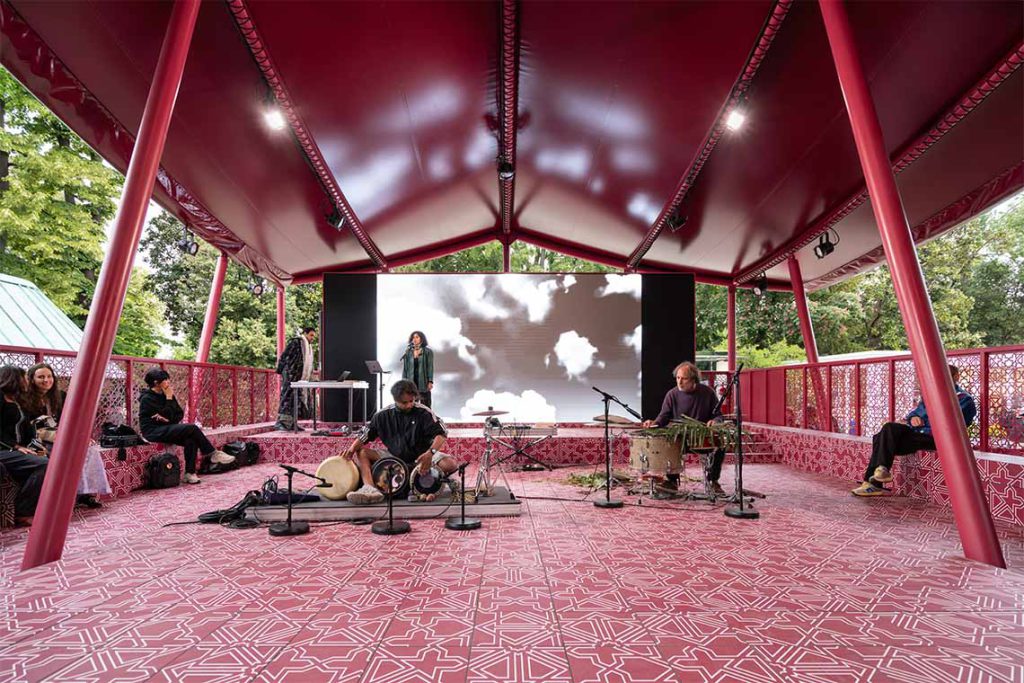
SKM: Tarek Atoui’s work often functions as a sonic archaeology. By focusing on the takht (classical Arabic orchestra) and the wasla (a musical suite or sequence) for the opening, you reintroduce an element of classical Arabic performance to a Western audience. How do you anticipate this challenging the Eurocentric Biennale visitor, who may be expecting to see an art object as the primary transmitter of culture?
TE: A central part of our thinking for the pavilion involved tracing lines of influence, exchange, tradition and innovation across time. We were interested in how cultural forms are preserved, transformed and continually reimagined.
RK: For Tarek, improvisation is essential. His collaborations with invited musicians use improvisation both as a method of engaging tradition and as a way of making it newly resonant in the present. The performances are not simply illustrative or archival – they are living, evolving forms. I think visitors will encounter this through the experience of the pavilion itself, where sound, performance and gathering become primary carriers of meaning alongside objects and images.
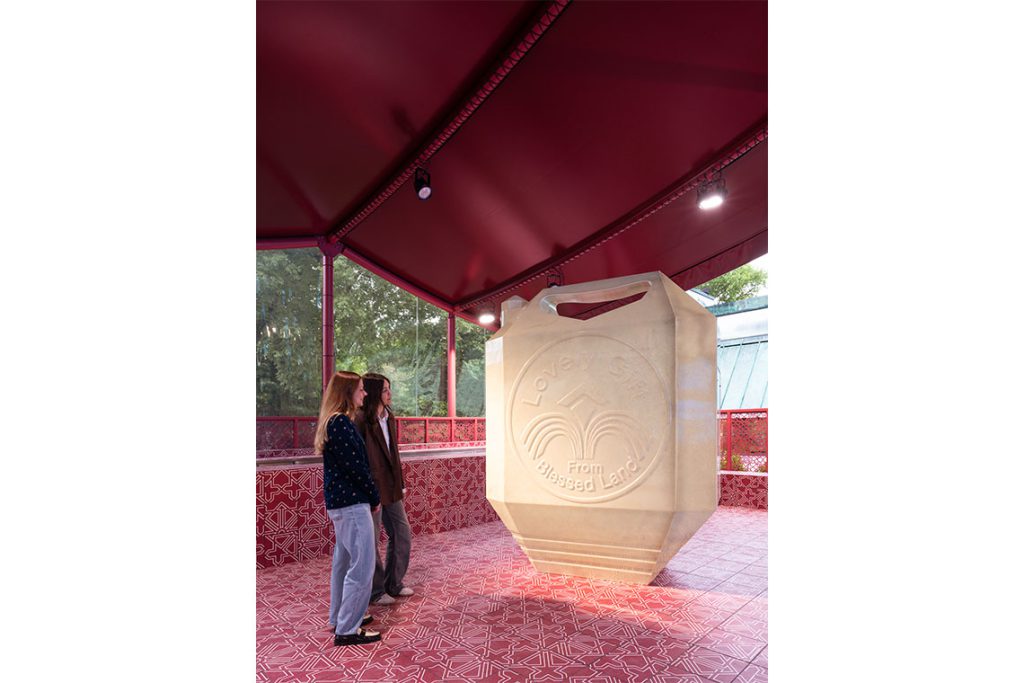
SKM: Alia Farid’s Jerrican sculpture series addresses the industrial and urban landscapes of the Gulf. Her regular use of materials such as fibreglass is specific to the modern aesthetic of the Khaleeji city. Can you discuss the curatorial decision to bring such ‘monumentalised’ everyday objects into the Giardini, and what does this say about the evolution of public art and infrastructure in the Arab world and within the Arab diaspora?
TE: Alia’s vessel is a key element of the pavilion and also appears within Sophia’s film, so we were excited by the dialogue and interconnection between the different components of the project. Right across the pavilion, food, music, film, sculpture and performance continuously overlap and speak to one another.
RK: The jerrican is an everyday object that also carries associations with water, infrastructure, migration and resource distribution. By enlarging it to a monumental scale, Alia transforms something familiar into a powerful symbol of the region and its histories. It becomes both highly specific and broadly resonant, connecting questions of daily life to larger political and environmental conditions.
SKM: The inclusion of Fadi Kattan and the focus on harees/jareesh [dishes recently inscribed on the UNESCO Intangible Cultural Heritage list for several Arab nations] transforms food from ‘event catering’ to a form of artistic medium or identifier. As curators, did you feel the need to position these culinary techniques as a form of contemporary ‘innovation’ rather than just anthropological curios or an ethnographic display?
TE: Throughout the Biennale, there will be select weekends during which both Tarek and Fadi activate the pavilion through sound and food. For both of them, these practices are not simply representational or illustrative but also deeply tied to lived experience, memory and cultural transmission.
RK: Like Tarek’s performances, Fadi’s work engages the stories, histories and social rituals embedded within everyday and ephemeral forms. The culinary programme is not intended as an ethnographic presentation, but rather as an embodied and participatory experience through which visitors encounter culture through the senses, exchange and conversation.
SKM: Sophia Al-Maria is known for her ‘Gulf Futurism’ concept and for this pavilion you have chosen one of her films that deals with a dream-like journey into sound. How did you balance this dystopian narrative with the more grounded, archival and heritage-focused work of the other collaborators? Also, is there a message here about a specific ‘Arab Future’?
TE: Sophia’s film was newly commissioned for the Qatar Pavilion and will later travel to the Rubaiya in Doha. In many ways, it functions as a connective thread within the larger project. The film follows a newscaster who, after losing her job, embarks on a dreamlike journey that begins to destabilise distinctions between reality, memory and imagination.
RK: Throughout the film, Sophia foregrounds performances by musicians from across the Arab world, suggesting the transformative and transportive qualities of sound. Rather than positioning heritage and futurity in opposition, the film proposes that the past continuously informs possible futures. Across the pavilion as a whole, we were interested in how tradition, experimentation, preservation and speculation can coexist and remain in active dialogue with one another.
The National Pavilion of Qatar is located in the Giardini
This interview first appeared in Canvas 123: Venice Special Issue
