

Devastated by the impact of wildfires on her Californian home, the artist finds new direction by listening to the creative impulses of her body.
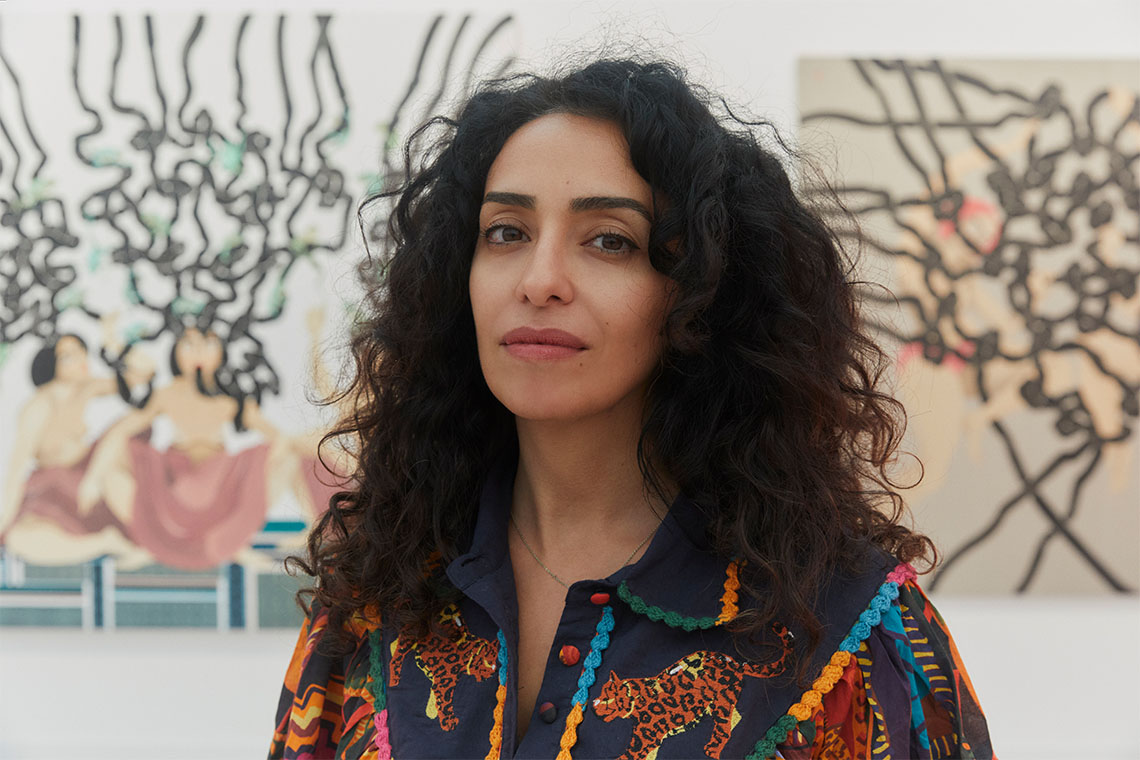
Fire has been on Hayv Kahraman’s mind. The artist, born in Iraq and currently residing in Los Angeles, speaks to me from her studio as she prepares her next exhibition, at Jack Shainman Gallery in New York City in September. But the show is not foremost in her thoughts as we begin our conversation. In an unlikely turn of events for someone who, she admits, has always been very nomadic, her home in Los Angeles – which she purchased in 2022 – was heavily damaged by the Eaton and Palisades fires that raged through the city of angels in January 2025, killing 29 people and damaging more than 18,000 structures. As I speak to her, Kahraman is still grappling with the aftermath of this most recent trauma. Eerily, she had begun painting what she calls “ghost fires” several months prior, when developing a body of work for the Hawai’i Triennial. Settling down in Los Angeles had, for the first time, calmed her nervous system, and she describes an ancestral pull to the mountains behind Los Angeles, which reminded her of Kurdistan in northern Iraq.
Having left her home in Baghdad at the age of ten to immigrate to Sweden, Kahraman’s upbringing in Scandinavia was marked by what she terms “multiple erasures” and “refugee syndrome”, an internal trauma response in which the person who has arrived in a host country feels a perpetual need to explain, justify, and above all, validate their presence in the new place. She recently realised the effect this way of operating has had on her connection to a more spiritual and intuitive self. “A lot of my work reflects the rupture that happens when you are severed from the place where you were born, where your ancestors are buried and lived,” she tells me. This manifested in both Kahraman’s life and art in an ever-present need to explain and back up her work: “I’ve always approached my painting in a very rational way. There’s tons of research done before I start any body of work, all of these academic fields coalesce, and it can all be explained”.
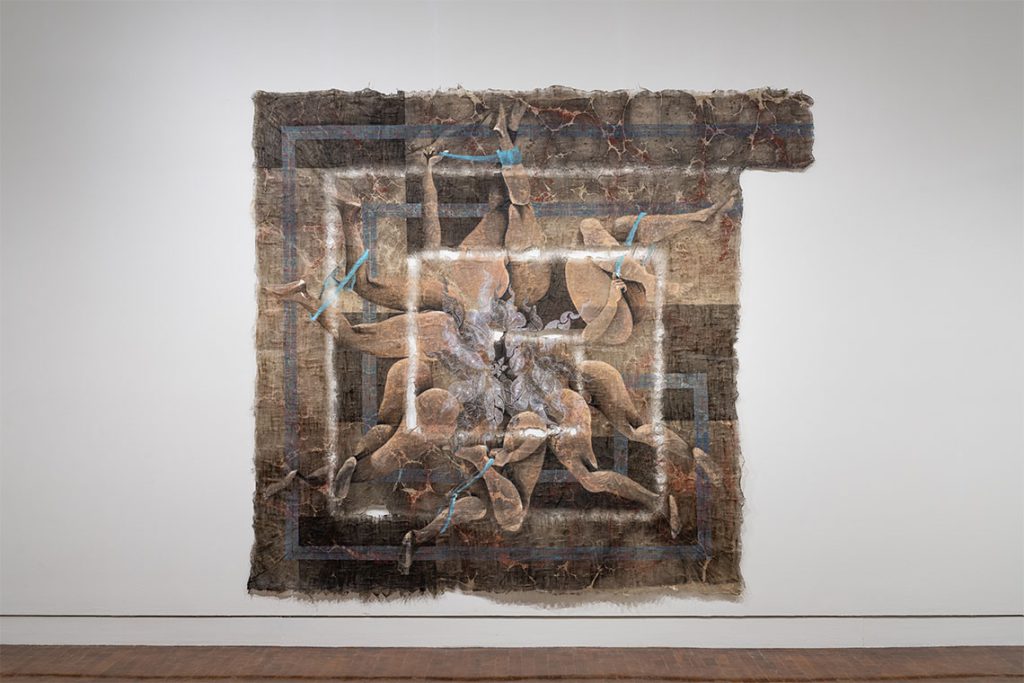
While thinking of how to connect more deeply with her intuitive self and, by extension, to the world around her during preparations for the Hawai’i Triennial, Kahraman was drawn to a tale told to her by her great-aunt during her childhood in Kurdistan. I listen with rapt attention as Kahraman passionately recounts in vivid detail the accidental death of the flea husband, who went into the fire of the tannur oven, the side of which he and his louse wife were sitting on, to retrieve a thimble she had dropped in the oven. The devastation of the louse upon the flea’s death reverberates across the world, prompting various beings to shed their hair, feathers and leaves in grief, with the cascading effect of this devastation ultimately concluding with a mother by a saj oven hearing of the tragedy, and sitting on it, burning her womb.
To Kahraman, the story is ultimately about mourning the extinction of species and the interconnectedness of things. There is the question of what remains after this extinction, a void which Kahraman had at the forefront of her mind when creating the “ghost fire” works for the triennial. “The story of the ghost is that it refuses to move on,” she explains, “and when it stays, it haunts. That haunting is important because it reminds us of what coloniality and modernity have done to our world.” She explains how she felt this most acutely during her research into the Hawaiian snail. Reading Donna Haraway and Mike Hadfield’s Tree Snail Manifesto (2019) led Kahraman to the Bishop Museum in Hawai’i, where she spoke to malacologists and spent time with the six million different snail shells held there. She describes being surrounded by them as a deeply moving, pivotal moment, akin to being in the literal presence of ghosts, while feeling more in tune than ever with the world around her.
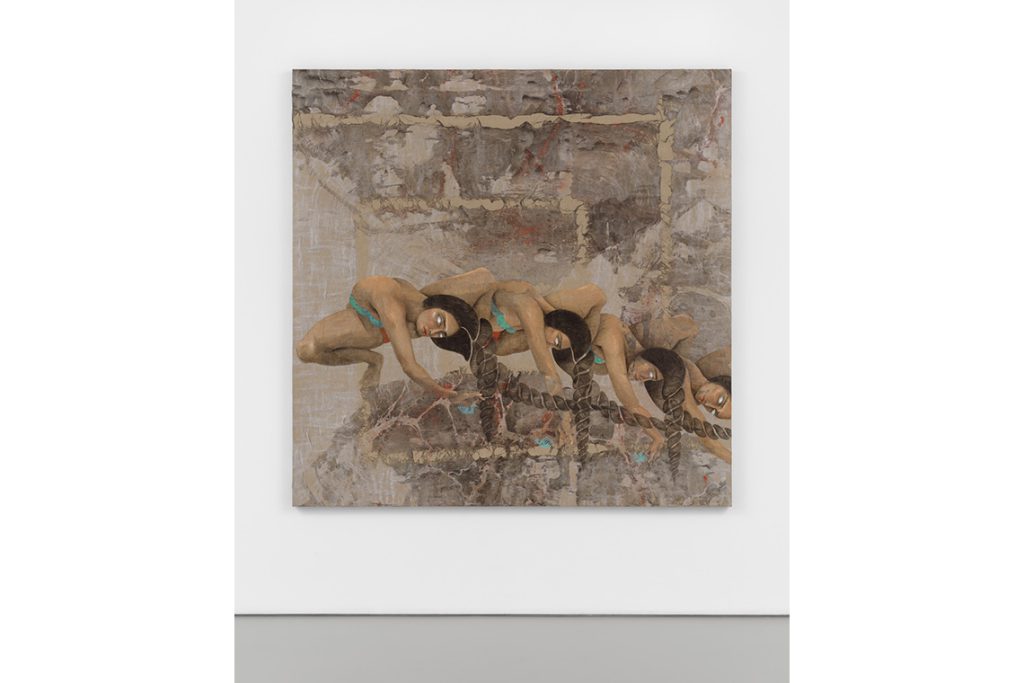
Kahraman began wondering at what point ghosts can move on. Is healing ever really possible or simply a modern impulse to fix rather than live with, disconnecting us from Earth? It was in this newfound state of reflection that the fire found her, not as a ghost but as a deeply real, terrifying embodiment of the very trauma she had begun to distance herself from. “I don’t have many memories of the war, but I remember looking out our living-room window in Baghdad and seeing lights falling from the sky during air raids,” she recalls. “Six months ago, at 6:30pm on Tuesday, 7 January, I look out my daughter’s window and there’s a fire on the mountain, less than half a mile away.” She pauses. “My daughter is ten years old, and I am transported to my ten-year-old self. We pack one bag and we flee, absolutely terrified. It’s impossible, the winds are insane, you can’t stand outside. Everything’s flying and, as we’re driving away, there are huge tree branches hitting the car. It’s just like a war zone.”
Not one to sit idly by and wait for the home she had built to be burnt to the ground, Kahraman set off at nine in the morning the next day, upon hearing that neighbours were attempting to fend off the flames themselves. She recounts the story with so much warmth and humour that I laugh with her, incredulous, as she describes the day suddenly turning into night as she drove through the plume of smoke. The structure of her house miraculously still intact, she doused it again and again with a garden hose, until the water ran out. Kahraman recalls a helicopter from local firefighting forces flying right above her house to do a water drop. Her body reacted without thought, ducking in terror, as if a bomb were about to be dropped on her body from the sky. “I thought about that moment a lot,” Kahraman tells me, “because I can’t access an actual memory, yet my body responded that way. It’s in here somewhere, my body remembers.”
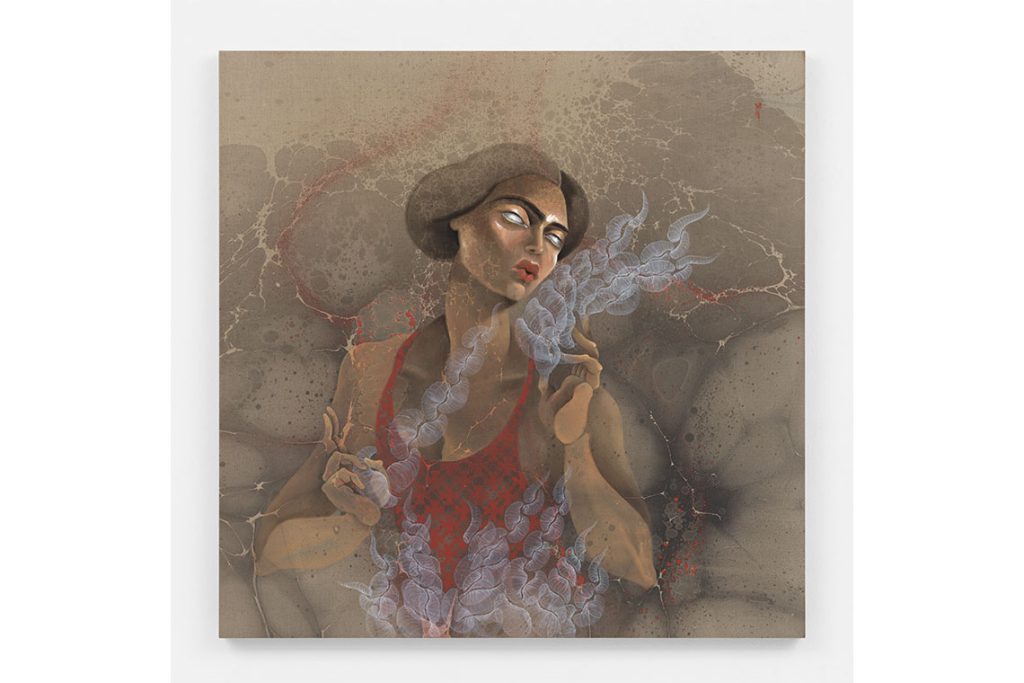
The emotion with which she recounts this is still raw. She asks, more to herself than to me, how she can heal if she doesn’t remember. This affinity with ghosts and spectres, which has always pervaded her work, she attributes to the PTSD and trauma she has experienced, stating: “How do you move on when you have experienced this much violence?” When speaking of the debilitating depression she experienced in the wake of the Los Angeles fires, Kahraman tells me of an out-of-body experience, of time being warped and distorted. However, just as her body had instinctively protected her from the memory of a threat, it came to her aid yet again. Summoning the strength, she somehow ended up back in her studio, after weeks of being unable to function. “I don’t know how I got to my studio. I got there and was like, you know what?” she says, “I’m just going to paint. I picked up a brush, and within half an hour it was like a magical door appeared and opened. I could walk through it and I could see, I could remember. I started remembering myself.”
There is a form of reverence in how Kahraman speaks about the experience. She is now attempting to let her body and her hand guide her intuitively as she moves across the canvas. It is not easy, but it is a start, she laughs, as she shows me the back of a flax canvas in tatters behind her. She does not know exactly where she is going from here, or if she has fully embraced this new way of painting, but this is part and parcel of the fluidity of life. “It is about existing in this place of unsettlement, of error, and being ok with it,” she concludes.
