

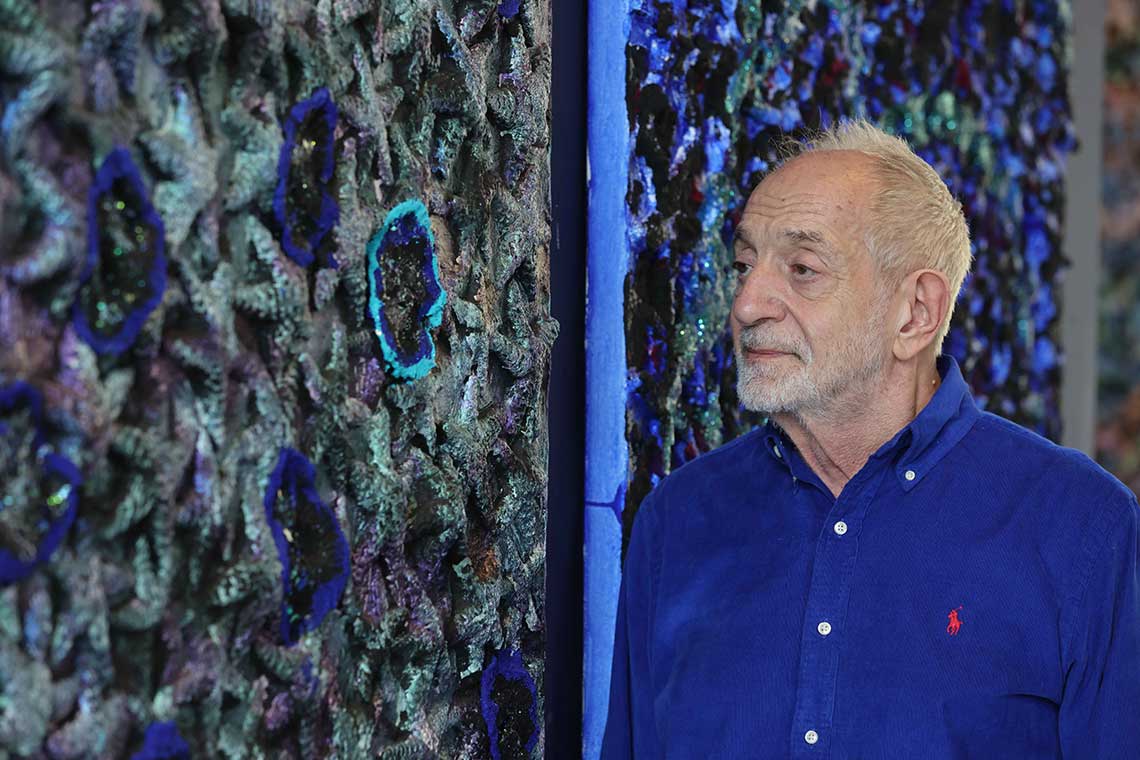
Representing the Pavilion of Lebanon, the artist engages matter as both subject and process to mirror the complexity of natural and cosmic systems.
Have you ever questioned the smallest particles of your surroundings, the barely perceptible texture of matter, the unseen structures that bind the cosmos to the everyday? In the work of Nabil Nahas, these questions are not rhetorical – they are embedded within the work itself. His paintings do not depict the world so much as reconstruct its behaviour, tracing what he describes as “a universal rhythm” that moves seamlessly between the microscopic and the infinite.
This sensitivity to structure is traced back to an early visual awareness formed in the late 1960s in Beirut, a city that Nahas remembers as “extremely sophisticated and hip”, where cultural exposure was not only available but immersive. By the time he left for the United States in 1968, enrolling at Louisiana State University – a decision shaped by family connection and an ultimate desire to reach New York – he had already developed an unusually refined visual language. From a young age, he recalls buying artbooks whenever he had a few coins in his pocket. What began as a childhood habit quickly became a form of self-education.
Art was never a distant concept or institutional influence for Nahas, it existed within the intimacy of home and family. His immediate visual world included artists such as Bibi Zogbé, a family acquaintance whose works he recalls fondly. “We had her paintings around and I still like them a lot”, he says, adding how he remembers her distinct style and recurring floral subjects. That proximity to artistic expression translated directly into his own practice. He began painting at the age of ten, setting up in his grandmother’s garden. “I started painting flowers”, he recalls, “and wanted to become a flower painter”. Yet even within these early gestures, a more complex visual language was already forming.
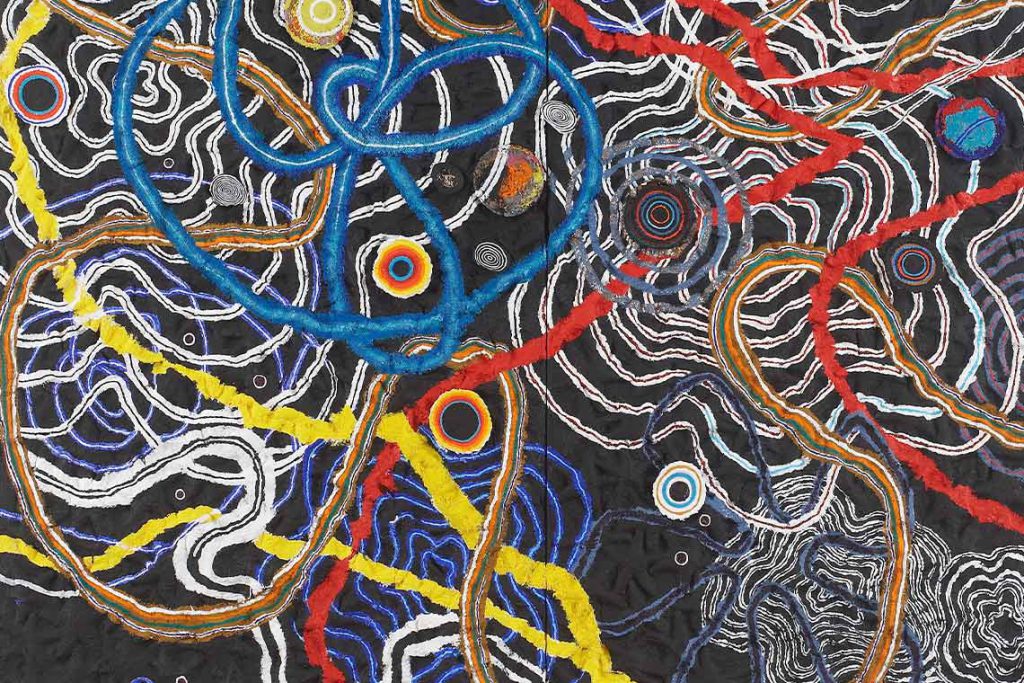
The architectural and archaeological landscapes of Lebanon also played a formative role in shaping the artist’s visual sensitivity. Nahas was captivated by the ancient stones of Byblos and Baalbek, intrigued by the way in which massive blocks were interlocked with apparent ease and balance. This early fascination with structural harmony and geometric order laid a groundwork for the precise forms that would come to characterise abstract paintings such as his work Untitled (1978). At the same time, another impulse was already present – looser, more lyrical, almost calligraphic. “It seems that I have two trends going on,” he reflects, describing a practice split between what he calls “very sophisticated geometric paintings” and more fluid expressive works. This duality was further nurtured when he gained admission to Yale University to study an MFA degree. While there, he was immersed in an environment rich with visiting artists and with access to New York’s dynamic art scene, allowing him to engage directly with contemporary movements and test his developing ideas in a broader artistic discourse.
By the early 1980s, against the backdrop of the Lebanese Civil War, the shift had become unavoidable. Geometric precision gave way to more expressive, black-and-white ‘drip’ paintings that carried a distinct spiritual resonance. Living in New York and following the turmoil in Lebanon from afar, his paintings began to reflect a new sensitivity to the forces of nature as a dynamic system. This process remained open-ended – “the subject is preconceived”, he explains – and allowed each work to unfold unpredictably. This openness would later extend into an exploration of texture. Following an encounter with Hurricane Bob in the Hamptons, Nahas began incorporating starfish into his paintings, initially using real specimens before developing cast versions. These were not literal references, but organic structures through which he could engage what he calls “the way nature proceeds”.
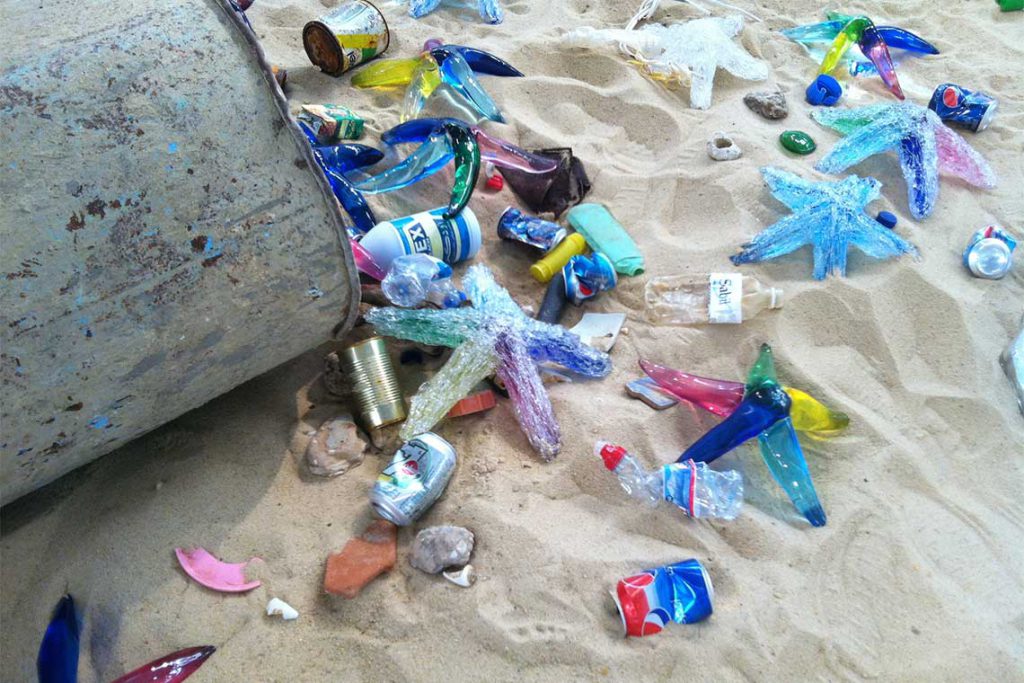
There is no fixed boundary to Nahas, only a continuous negotiation with material. What starts as painting extends into a wider field of experimentation, where intention gives way to discovery. It is within this space of openness that Nahas’s engagement with glass emerges, not as a calculated departure but as another encounter. Following a retrospective in Beirut, in 2011 Nahas was invited to participate in Glasstress, a project initiated by Adriano Berengo in Murano where contemporary artists collaborate with master glassmakers. Entering this context required a shift in approach – rather than asserting control, he describes leaving “it open, because the master knows more than you do about the material and what can be done and what cannot be done”, allowing the expertise of artisans to guide the process.
the beaches of Beirut – fragments of waste carried back by the sea – were incorporated directly to the work, interspersed with glass starfish forms produced in Murano. The starfish appear almost encrusted, their coloured arms catching the light like small constellations embedded within refuse. This contract is striking, the discarded and the precious coexisting within the same field. Yet rather than moralising, the work observes a cycle, where the sea returns what is given to it and where even debris becomes part of shifting, material ecology.
In more recent works, these various strands converge. Geometry, fractals and organic forms begin to merge into complex compositions, where tree branches intersect with precise linear lines. Nahas approaches this process as cumulative rather than linear, returning to earlier ideas and reworking them over time. “They’ve become like parts of a puzzle and they fuse together,” he explains when describing how these distinct visual languages gradually coalesce. In works such as Untitled (2016), these elements expand across the surface in layered systems that oscillate between control and spontaneity. Created through time-intensive processes and the creation of custom pigments, the paintings accumulate material and energy, their surfaces shimmering with density and depth.
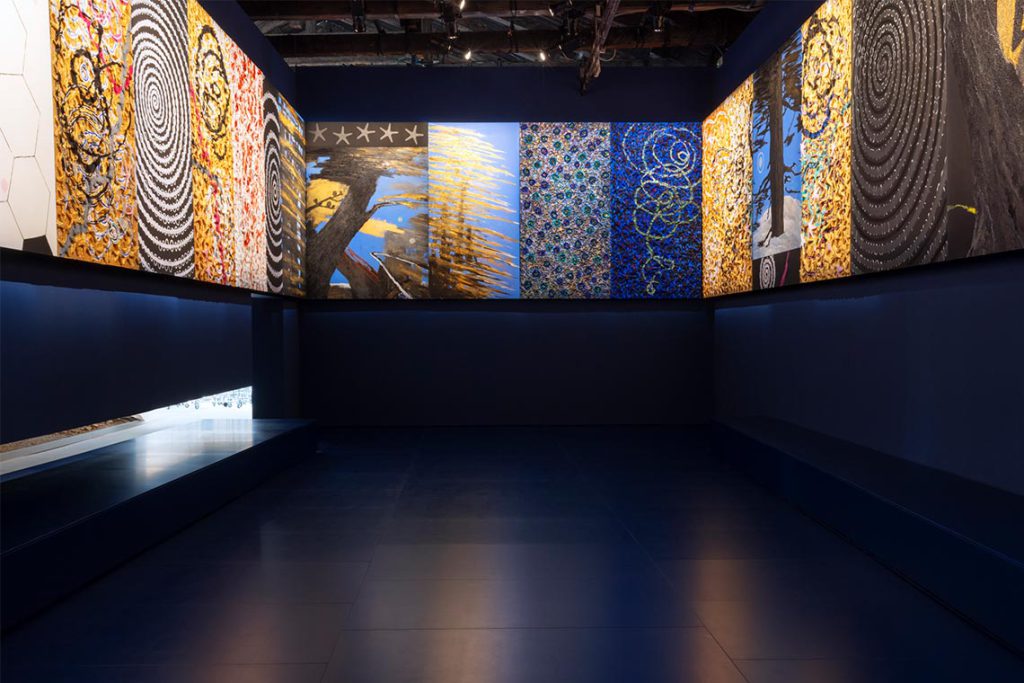
In the Lebanese Pavilion at the Biennale, Nahas presents a project commissioned by the Lebanese Visual Art Association and curated by Dr Nada Ghandour. His immersive installation Don’t Get Me Wrong (2026) examines the relationship between man, nature and the cosmos, merging geometric abstraction and fractal patterns to reveal structures underlying both the universe and human experience. Nahas describes it as “a visual and spiritual experience that transforms the monumental into vehicle for introspection”, emphasising the work’s capacity to engage viewers on multiple sensory and conceptual levels. Spirals drawn from Sufi mysticism guide an inward journey, while cedar and olive trees evoke rootedness and endurance. He explains that it “reflects Lebanon’s fluid and multicultural identity, celebrating unity in diversity and the beauty of contradictions”, presenting the country as a dynamic living landscape where the infinitely small and the infinitely large coexist.
In the sanctuary of his Beirut studio, Nahas finds that his thoughts are inseparable from the land of Lebanon itself – its history, its fractures, its persistent vitality. “The Lebanese have an in-built resilience in their DNA which allows them to coexist with the invader, never to lose their identity, and so it has been for millennia,” he observes. Amid waves of forced displacement and the pressures of the ongoing regional conflict, he continues to paint, to seek what he calls a vision of the “larger picture”, a map of patterns that spans from the intimate to the cosmic.
The Pavilion of Lebanon is located in the Arsenale
This profile first appeared in Canvas 123: Venice Special Issue
