

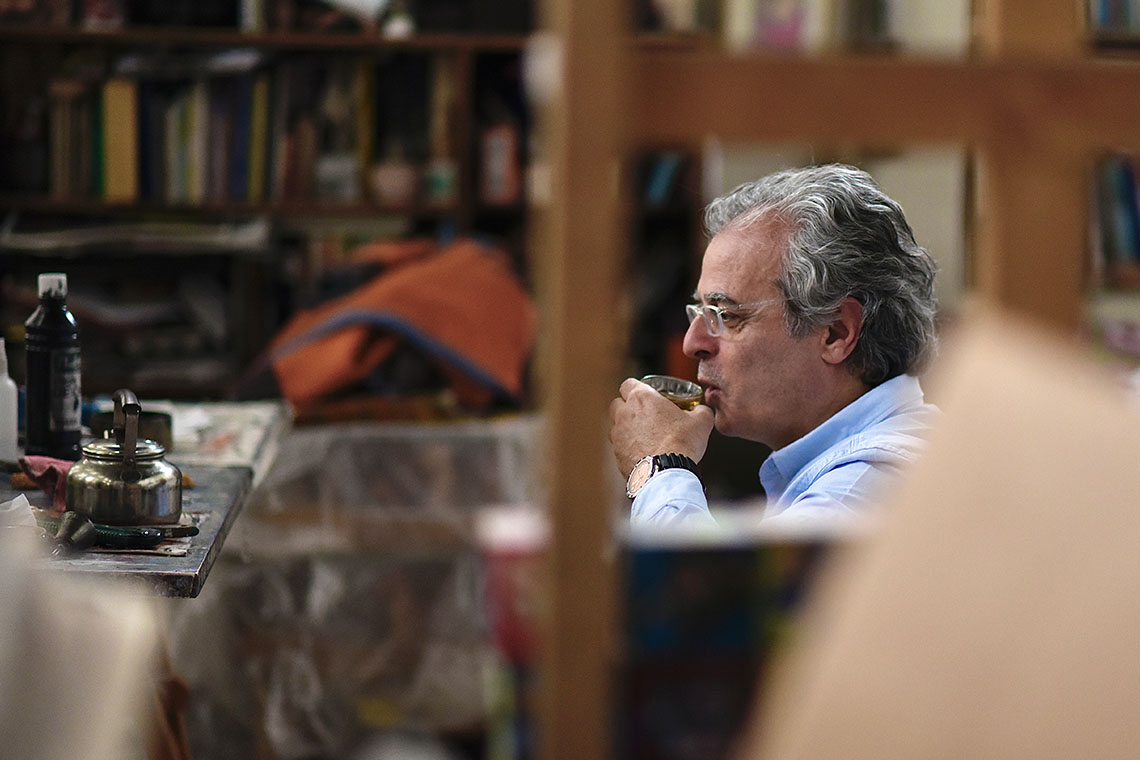
Breaking free from classical figurative painting, the artist charges his cartoonish figures with raw human emotion.
The Syrian artist Fadi Yazigi refers to his depicted figures, whether on canvas or in clay, as “my people”. It is no wonder that he holds a certain affection for them, as he has mostly devoted his hand to raw figurative art, portraying his little figures, seeing them develop – as well as suffer – for nearly four decades. “The human being, including myself and the people around me, has always been my concern,” he tells me from his longtime base of Damascus.
Born in 1966, Yazigi is a son of the Syrian coastline, for which he holds fond memories. He is originally from the northwest Syrian village of Marmarita, where significant Christian communities reside, and was raised by the sea in Latakia until the age of eighteen. “Latakia has all the characteristics of maritime cities,” he explains. “There is a sense of openness and of contact with the outside world. There’s a particular strength to Latakia’s port, since it is 3000 years old.”
From an early age, he and his brother leaned towards making art – “Children always express themselves with naive drawings before letters or words,” he says – and when Yazigi decided to pursue it professionally (calling art his “big dream”), he was supported by his family. In 1984, he joined the Faculty of Fine Arts in Damascus through a competition to which thousands of potential students applied but only 75 were admitted. Yazigi was one of the lucky ones. Yet, when I ask how his university years were, he recollects them as being purely academic and conservative, a time when materials and freedom of expression were limited. “There were no real liberties,” he recalls. “The whole region was never exposed to freedom and openness. Everything was so academic and had to be carefully considered. New ideas were repressed. If you stepped out of your palette, it was a problem.” He would, however, frequent exhibitions by great Syrian masters such as Mahmoud Hammad and Fateh Moudarres, and one of his mentors was the late Elias Zayat, who guided the aspiring artist and had conversations with Yazigi about his practice.
Yazigi graduated in 1988 and has continued to create art ever since, when many of his peers have taken other, non-artistic paths in life. “Ever since I graduated, I’ve made time for art. I haven’t worked on anything else. Art was, and remains, my means of expression. It has actually been my friend all this time,” he affirms. Aside from painting and drawing, he has also worked in theatre decor and relief sculpture. Perhaps because he came from such a reserved educational system, Yazigi aimed to break free and create art that was real and raw, diving into the depths and complexities of human emotion. Between 1990 and the early 2000s, he began working on emotionally charged figuration, initially inspired by statuesque Babylonian figures, which made him more recognised in domestic art circles and saw his works appearing in group exhibitions abroad, including in London and Washington DC. “I kept resisting,” he reflects. “It’s been a long ride. Our teachers did important works that were modern and are a true base for us. I respect them a lot, but I wanted to confront the taboo of what the shape of the body should look like. I wanted to break this idea in our heads. It’s a kind of mischief and a desire to find something new, to find my own new figure.”
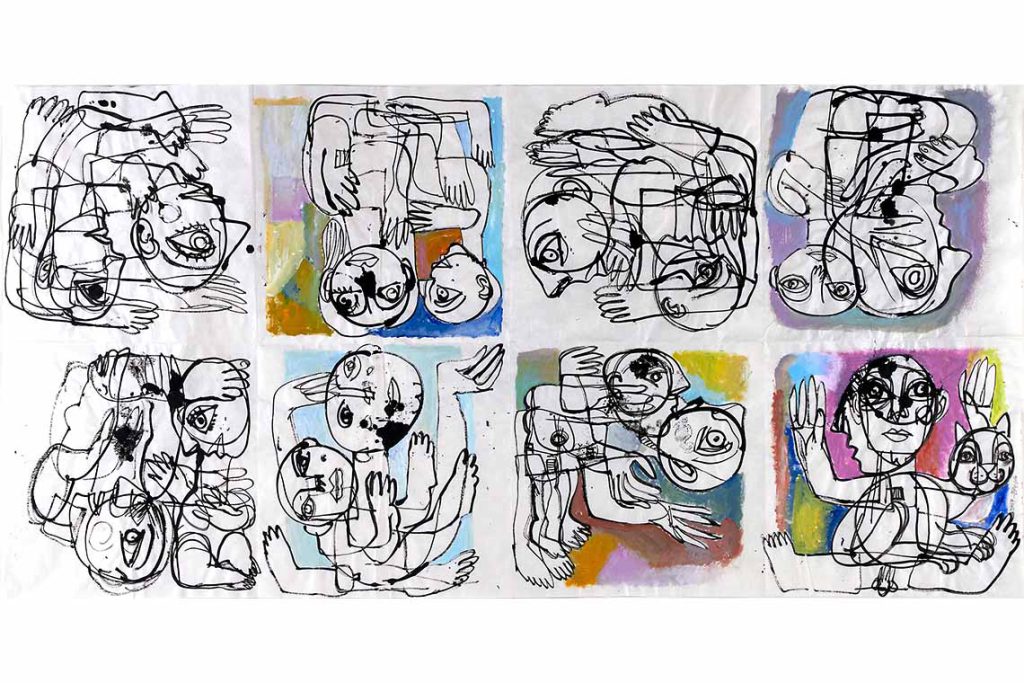
What is instantly palpable in Yazigi’s intense compositions is the chaotic atmosphere in which his figures must survive. The artworks are foggy, messy, full of scribbles and thick contours. There is an element of loss and pain. “We have never lived in a stable region,” he says by way of explanation. “I always say ‘lucky are those that live in a country that has stability’.” His figures are childlike and cartoonish, portrayed sometimes in aimless floating mode and crammed settings. In essence, his work underlines the socio-political realities of his immediate environment, particularly Syria. He applies this style of depiction, where foetus-like figures have large heads and small bodies, for the simple reason that he believes that society has still not grown up and matured. “That’s how I see our people,” he remarks. “They are kind, but there is a lack of growth. My people still haven’t grown, and there’s something sad about that.” The birth of Yazigi’s two children also played a role in his aesthetics and understanding of his figures. “They’re the best sculptures that I have made,” he says with a chuckle. “For me, they are a full responsibility and a passion in my life. They’re like plants, and you need to keep nurturing them to grow and thrive.”
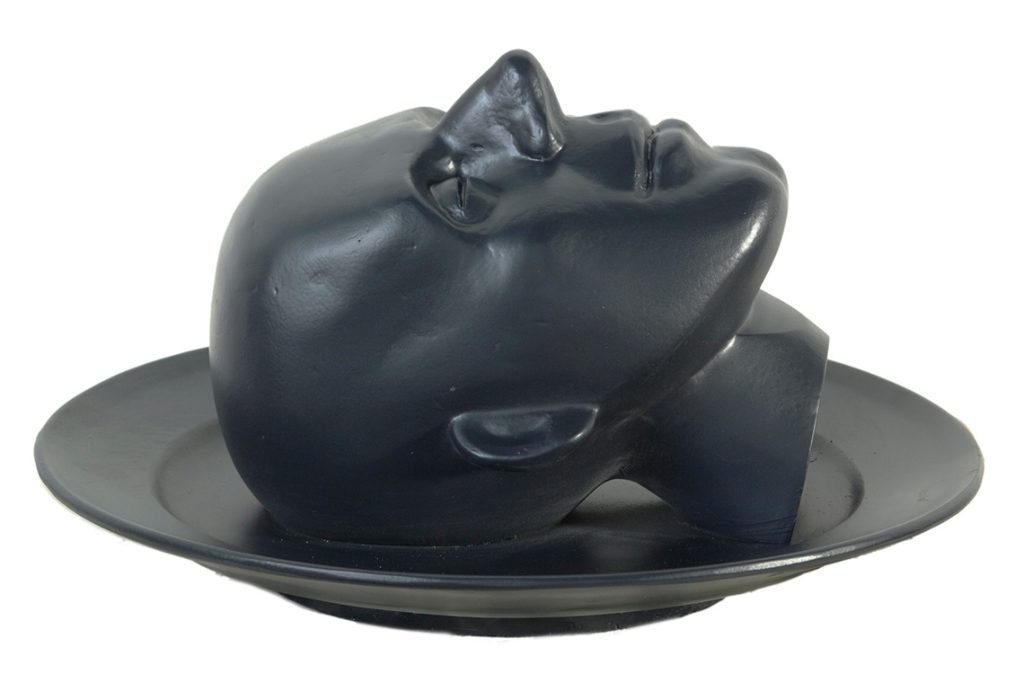
The 2011 war in Syria, which Yazigi lived through, marked another important chapter in his life, driving him to observe his surroundings ever more closely and produce (at times morbid) work that addressed the suffering of his people. Despite the ground-breaking fall of the Assad regime in late 2024 and the hope it spawned, Yazigi believes that some things have not changed. “Sometimes when I am on the streets and I see people, you can see a sickness in their faces. Blood has been sucked out of their faces. You don’t see people smiling,” he notes. One striking example of Yazigi’s war-inspired sculptural pieces is Head on a Plate (2012), made from bronze. Referring to the violence that Syria had witnessed, it literally depicts a head resting on a plate. “It didn’t come out this way because of fantasy. A decapitated head became part of daily life,” he says. “The biggest issue is that I still feel the head is here. Until now I feel this fear and pain in our society.”
By the time of my conversation with Yazigi, Syria had already endured a series of recent unfortunate tragedies, such as the terrorist bombing of the Mar Elias Church in Damascus, the destructive wildfires of Latakia, the Israeli bombing of Syria’s military headquarters in the capital and, most recently, the deadly clashes in Sweida. If such events continue to occur, it looks like Yazigi’s artworks will remain turbulent. Will the day ever come where he paints a clear, serene and hopeful image? “I can’t say that I’m pessimistic or optimistic,” he declares. “There has definitely been a big change in Syria. There was a little window of hope, but I don’t know how true it can be. I think we need time. We need to wait and see.”
