

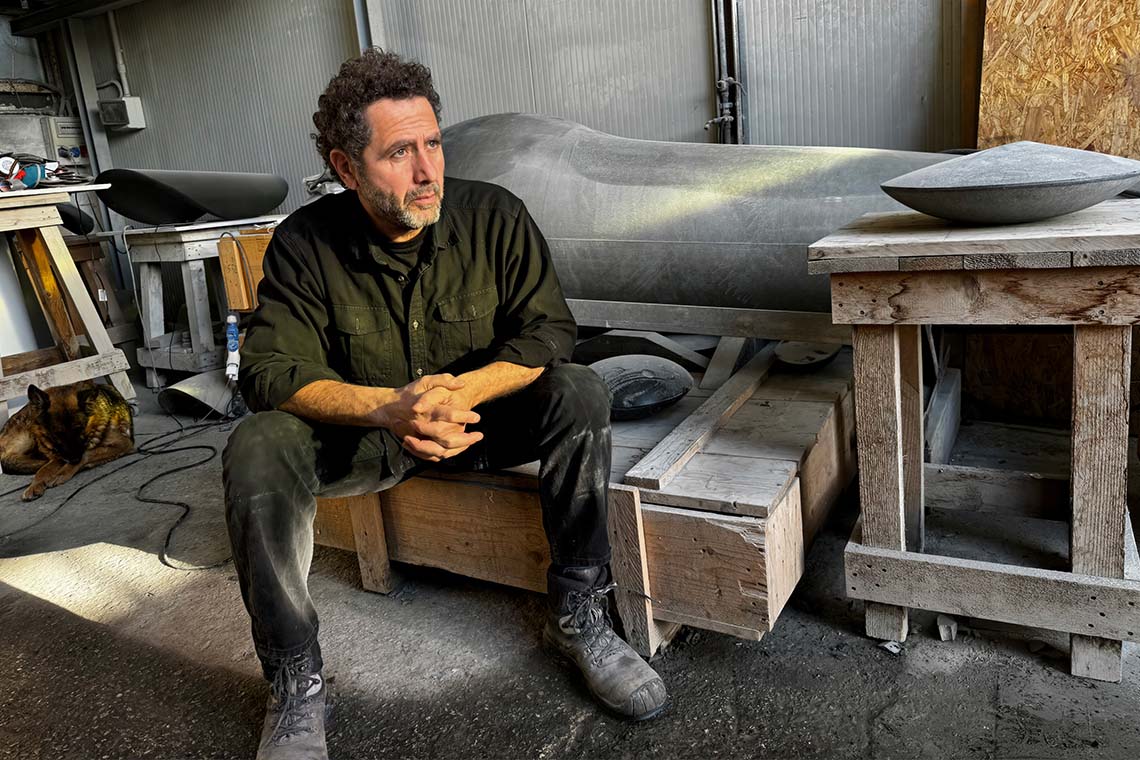
Representing the National Pavilion of Egypt, the artist is focused on creating artworks that are resistant to circumstantial events or even aesthetic fashions.
There is something careful, studied and quiet about Armen Agop’s practice. It is as if his works – which he describes as “detached, independent entities” – vibrate at lower frequencies, harder to hear but lasting much longer and travelling much further than the usual higher, more audible, signals. He is very keen to imbue his sculptures and paintings with that sense of autonomy, saying, “I like to remove all traces of the process”. What remains is the work itself, independent, entire and very present.
Agop’s work features a defined dimension of particular skill and deliberate labour. Its simplicity of form does not negate the laborious process of working a material like granite, for example – a heavy, difficult and rough stone. The artist sees that the relationship with stone was, and remains, crucial to the survival of humankind. “We made our first tools with these stones,” he observes. “They helped us to exist and survive, and were also used in representing divinity. Stone can still help us fulfill our spiritual needs”. For Agop, this long human history with the material itself is invoked and triggered when we touch it and work with it – a millennia-old and intimate association that can be recovered if we allow ourselves to have that tactile, close experience.
The skill and labour required to work granite are not invisible, but at the same time not necessarily translated into a complexity of form. It is a paradox that Agop seems to relish. The simplicity is almost a disguise that visually telegraphs an intense involvement with the medium and its materiality. In a remarkable show of skill and virtuosity, the artist’s sculptures come across as soft and delicate; even when shaped on a larger scale, there is a gentleness to them that is as surprising as it is captivating.
Born and educated in Egypt, Agop studied at Helwan University’s Faculty of Fine Arts in Cairo and developed an early interest in sculpture. He is of Armenian descent, and the legacy of the Armenian Genocide of 1915 onwards spurred within him a drive to create something that survives and endures, an impetus that was reinforced by his growing up surrounded by the historical monuments, artefacts and cultural legacy of Ancient Egypt. The idea of surviving the genocide, of persisting and creating, together with the beliefs and craftsmanship of the Ancient Egyptians, whose entire world view was centred around the journey of the afterlife and the concept of immortality, has encouraged Agop think about the temporality of an artwork, its material, what it is meant to do and our relationship to it.
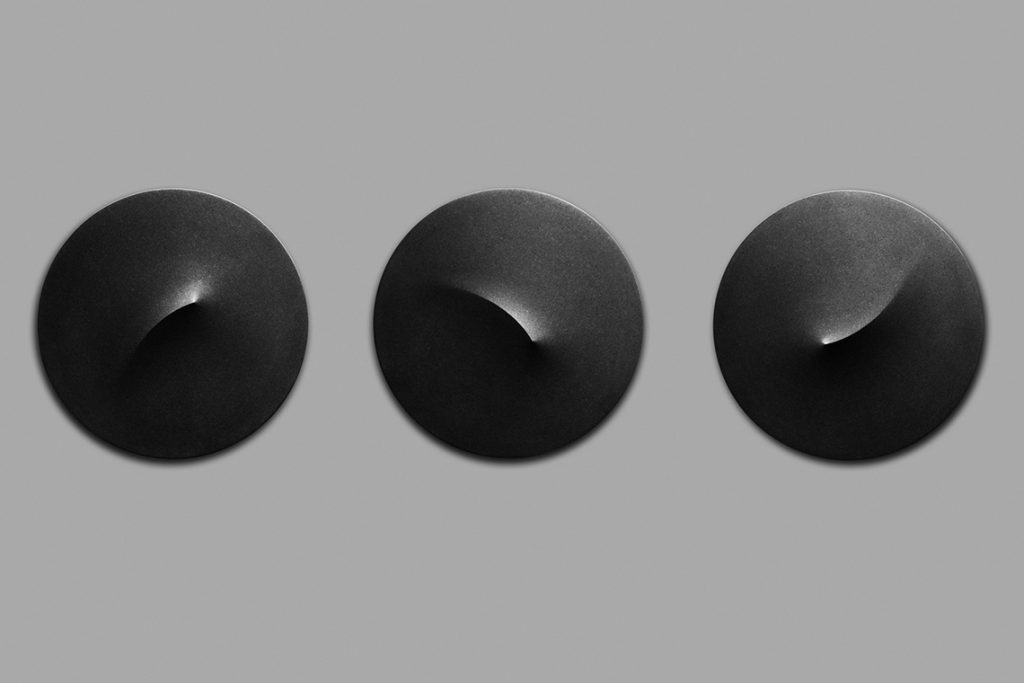
In his series of works, Transcontemporary (2008–), he explicitly questions the notion of ‘contemporary’ as tied specifically to the present and somehow divorced from the past or unable to continue into the future. The futuristically inclined sculptures, looking more like miniature models of spacecraft, are sleek embodiments of forms that are timeless but somehow still becoming. This idea of how forms and material can continue is also expressed in the series Sufic (2010–); while borrowing its title from Islamic mysticism, it is really less about representing that tradition and more of an exploration of the form of the circle and the dot. The series shows oblate spheroids that have the tiniest ripple effect on their surface, indicating the faintest trace of a movement. This distillation of form looks deceptively simple, but carries the form further.
Agop is currently curating and presenting his work in the Egyptian National Pavilion at the Venice Biennale. He declined an earlier invitation to participate, in 2011, explaining that back then he felt that his work might not have been very relevant to the urgencies and significance of that particular moment, the time of the Arab Spring. He had already exhibited often in Egypt and had moved to Italy in 2000. When asked now how he feels about representing Egypt while not living there full time, he replies that he feels no less Egyptian living abroad than he did in Egypt, and that audiences and institutions abroad see him as Egyptian.
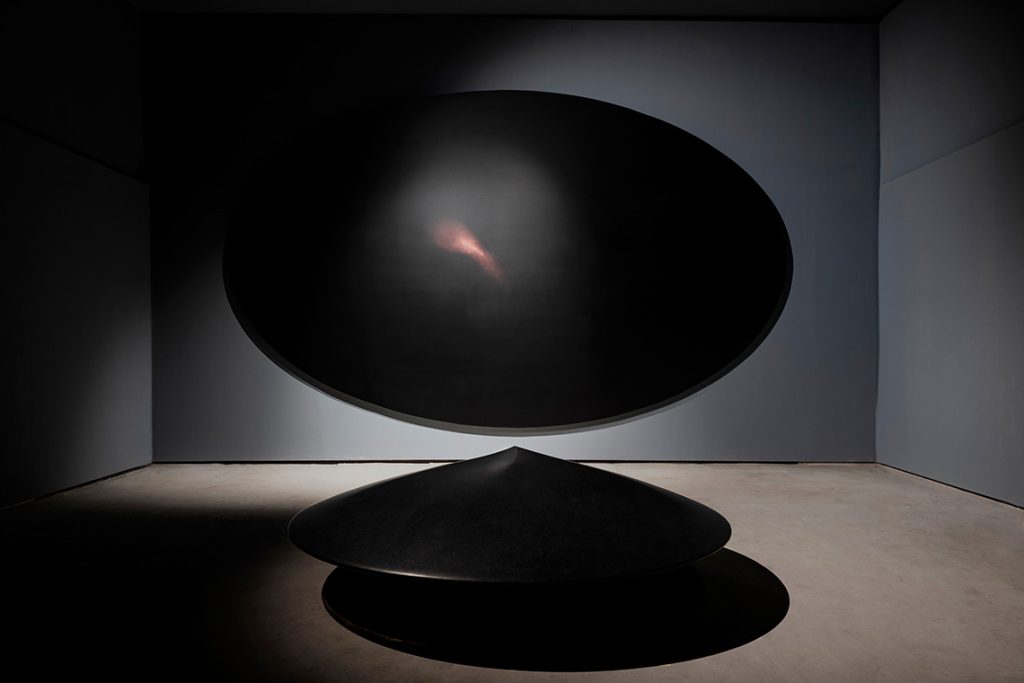
For this year’s Egyptian Pavilion, Agop has proposed a conceptual framework centred around the invisible, imperceptible and what is revealed only through deep and meaningful engagement. The exhibition title, Silence Pavilion: Between the Tangible and the Intangible, is serendipitously aligned with the general theme of the curated group show at the Arsenale, In Minor Keys, as developed by the late Koyo Kouoh. Her curatorial framework is also focused on listening and on the shifting of our attention to the nuances of minor keys. “Through a visual and meditative procession, the exhibition prompts all senses to interconnect and meander from one universe to the other, rendering visible the possibilities that reside in the in-between spaces and beyond the portals”, reads her curatorial statement. In a happy coincidence, Agop’s own practice very much resonates with this concept and vision.
In conversation with Agop, he says that he is very familiar with the Egyptian Pavilion, both as a physical space and a creative presence, as well as with the Biennale itself, having been living in Italy for more than 25 years. He is not creating a site-specific work for the pavilion, however, with the exhibition and its overall design and process more an extension of his ongoing practice. “I have been working on this sentence for the past 15 years,” he says, referring metaphorically to his continuing and profound engagement with the thematic of monumental artwork, a form that is beyond scale and deeply invested in our understanding of time and continuity.
The exhibition is divided into three main rooms, named Intangible, What we touch, touches us, and Listening to the silence. Each space invites the audience to contemplate through the gradual use of the senses: vision, touch, sound and smell. The first focuses on what cannot be seen directly, but perceived through presence. The second invites the audience to directly engage with artworks through touch mainly, and the last room attempts to engage with all the senses together, combining aspects of sight, sound, touch and smell. Agop asks that the audience views the works in silence, with no phones allowed, explaining that it is an encounter designed around slowness and a meditative interaction with the artworks. “Silence here is key to reunite with ourselves, [in order] for us to connect on another level,” he notes.
Agop’s contribution to the Biennale is conceptualised as an antidote to fast consumption and fleeting attention, instead proposing artworks and an audience experience that endure beyond a specific context or contingency. Kouoh’s prophetic idea for the Biennale has itself endured, with Agop and the Egyptian Pavilion serving as a much-needed extension of art that is thoughtful, slow and quiet enough for us to listen.
The National Pavilion of Egypt is located at the Giardini
This interview first appeared in Canvas 123: Venice Special Issue
