

Across various media, Pull Up a Chair creates a conversation between personal memories and experiences.
Pull up a chair. Look around. Stay a little longer. The title of this exhibition extends a warm invitation, setting the tone for a gathering of 17 Emirati women artists whose works offer perspectives on personal experience and everyday encounters. Curated by Sara Al Sulaimani, the exhibition opens a dialogue between these different voices, allowing each artist to approach its themes through their own experiences.
The atmosphere is calm and inviting. True to its title, Pull Up a Chair encourages visitors to linger, mingle and wander through the works at their own pace. There is a quiet femininity and sense of intimacy throughout the exhibition, beginning with Sara Mohamed Jumaa Alromaithi’s What Consumes My Thoughts (2026), a series of eight ink-on-gel-plate prints that, at first glance, resemble scenes from the cosmos. Look closer, however, and what appear to be celestial forms begin to reveal themselves as medical IV tubes, which the artist has used as a printing tool, transforming the clinical into something unexpectedly expansive.
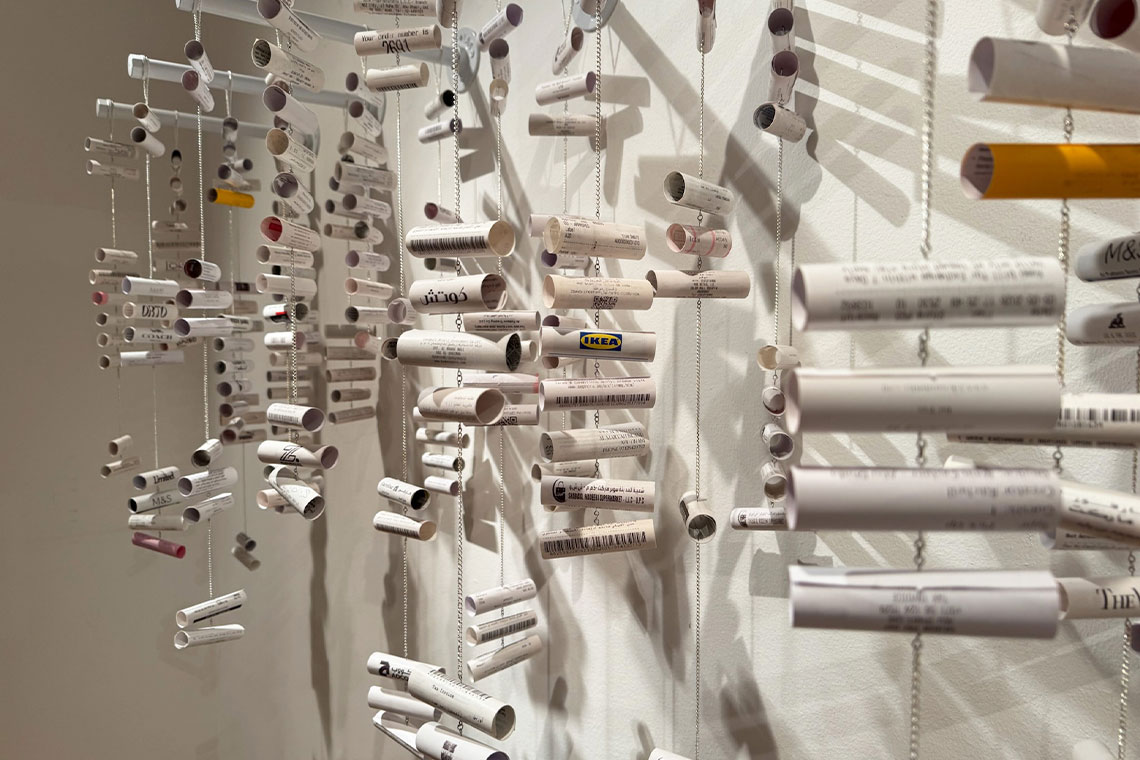
Nearby, a series of dangling, rolled-up receipts touch and sway against one another, capturing fragments of the artist’s transactions. In Consumed (2026), Maitha Alhosani turns her attention to the ordinary act of consumption, reflecting on how quickly a transaction can be made with a tap of the phone and how the money spent and thrill of acquiring something new can produce a fleeting sense of euphoria. From receipts bearing the names of brands to a simple ADNOC tank fill, the work traces the constant rhythm of spending that has become embedded in everyday life.
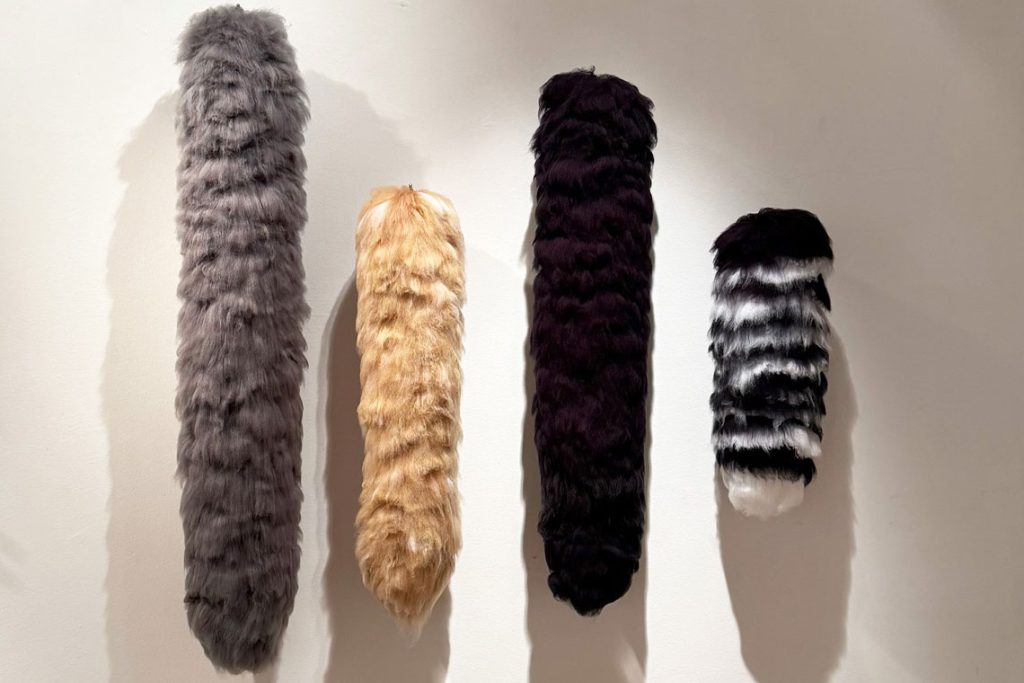
Beneath the Fur (2026) almost resembles a collection of car-wash brushes suspended in mid-air. Made from acrylic yarn, the furry forms draw from Sara Alketbi’s relationship with cats, translating the intimacy of touch into a tactile installation. The softness of fur becomes a source of comfort, recalling the quiet intimacy of touch between human and animal. Similarly, through a process centred on care and intimacy, Indeed, Allah Is with the Patient (2026) by Fay Almazrouei comprises of individually covered foam beads made with dried rose petals collected from the artist’s late grandmother’s garden. Revisiting her memory of learning to make beads with her grandmother, the work focuses on the gesture of creation and the handmade, where the slow, repetitive process of constructing each bead becomes an act of care.
In a corner, a sewing machine caught in a moment of suspension, accompanied by a pool of translucent organza, sets the scene for Shamsa Al Qubaisi’s meditation on memory and repair. Entitled On the Edge of Absence (2026), the work made of screen-printed images appears to be fragmented and layered across the fabric, resembling photographs caught mid-development, fleeting recollections that have been pulled apart, reassembled and held together through embroidery. The delicate fabric allows the images to overlap and bleed into one another, blurring the boundaries between what is remembered, what is forgotten and what has been deliberately left behind. The act of stitching becomes both physical and symbolic – each thread draws fragments together, suggesting the labour of tending to neglected parts of the self.
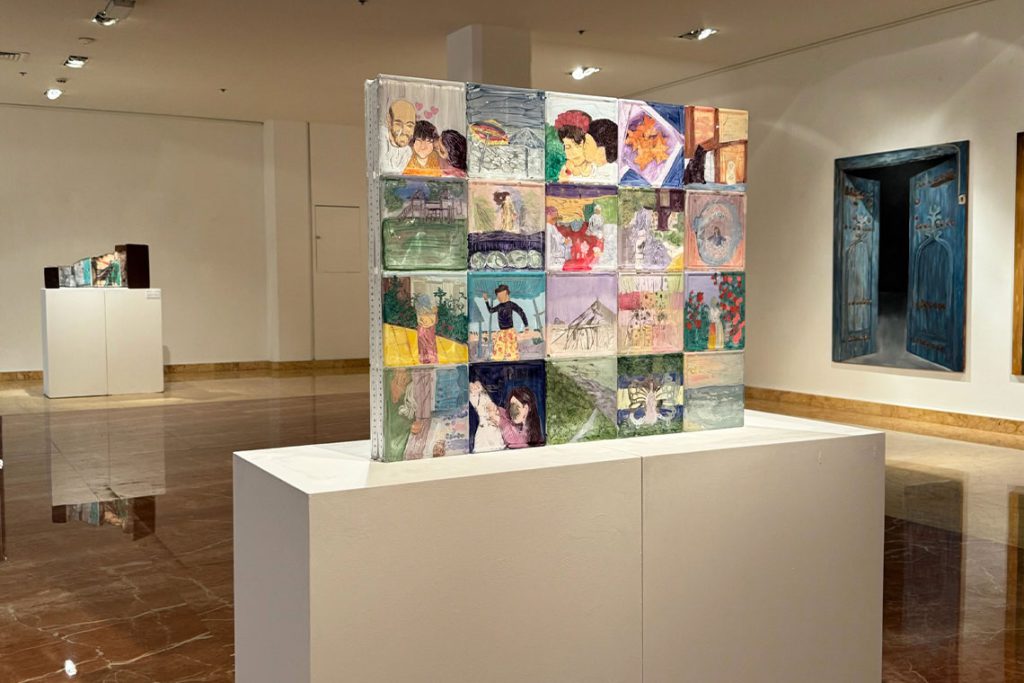
One of the exhibition’s more intriguing material gestures is its use of a glass brick wall as a canvas. Rather than treating the surface as a neutral backdrop, What Is a Person If Not Memories (2026) by Ghaya Al Meharibi works with its divisions and transparency, turning each brick into a small vessel for memories. Acrylic paintings capture fragments from the artist’s personal archive – a family gathering around a game of cards, two beach umbrellas on a sunlit stretch of shore and quieter, more intimate moments. The images are inevitably broken apart by the structure beneath them, giving visual form to memory as something fragmented, selective and unreliable. These scattered scenes form a portrait of identity assembled through the moments we retain, even when they can never be held in their entirety.
Somewhere between a confession and a conversation, Reem Alkatheeri’s words find their way onto the wall. In Build. World to Breathe (2026), 24 small wooden frames hold fragments of poetry that oscillate between fear, exhaustion and acceptance. There is something almost private about encountering them, as though the viewer has stepped into the middle of a conversation that was never meant to be overheard. One frame reads, “I speak to the tree when people betray me and they will hold what people never learned to hold”. The line feels like a quiet confession, finding comfort in nature when human relationships have failed to provide it. Across the series, Alkatheeri gives form to these moments of emotional release, allowing poetry to hold what can be difficult to say aloud.
By the end of Pull Up a Chair, it becomes clear that memory rarely arrives in neat packages. Perhaps that is the quiet charm of the exhibition. It asks you to slow down, linger a little longer and consider what we carry within ourselves.
Pull Up a Chair runs until 21 August
