

Through four chapters, Phantom Quartet examines the spaces between memory and oblivion, and the physical and imaginary.
Phantoms, as they appear, leave only traces for us to remember. As they linger, we extend their afterlives. We resist their erasures in our reclamation. We stage a quartet in their memory. We clap when the curtains close. We thank the maestro for letting us hear the music again. In Phantom Quartet, Hera Büyüktaşcıyan conducts an orchestra of resistance. She becomes a maestro to a choir of phantoms to harmonise from within, towards and against history.
Perhaps it was the weather, but Phantom Quartet hummed a heavy gloom. Tensions were palpable. Büyüktaşcıyan used Arter’s location, Dolapdere district, as a lever. The museum sits at ground zero for Istanbul’s most aggressive urban renewal projects. The hollowed-out architectures in the exhibition mirror the aftermath of Türkiye’s Law No. 5366 (Law on Conservation by Renovation and Use by Revitalisation of the Deteriorated Historical and Cultural Immovable Property), which authorised the seizure and gutting of nineteenth-century properties for new-money interiors. Each work, throughout the exhibition, became a verse to critique: an aggressive tête-à-tête dressed as a poetic dialogue.
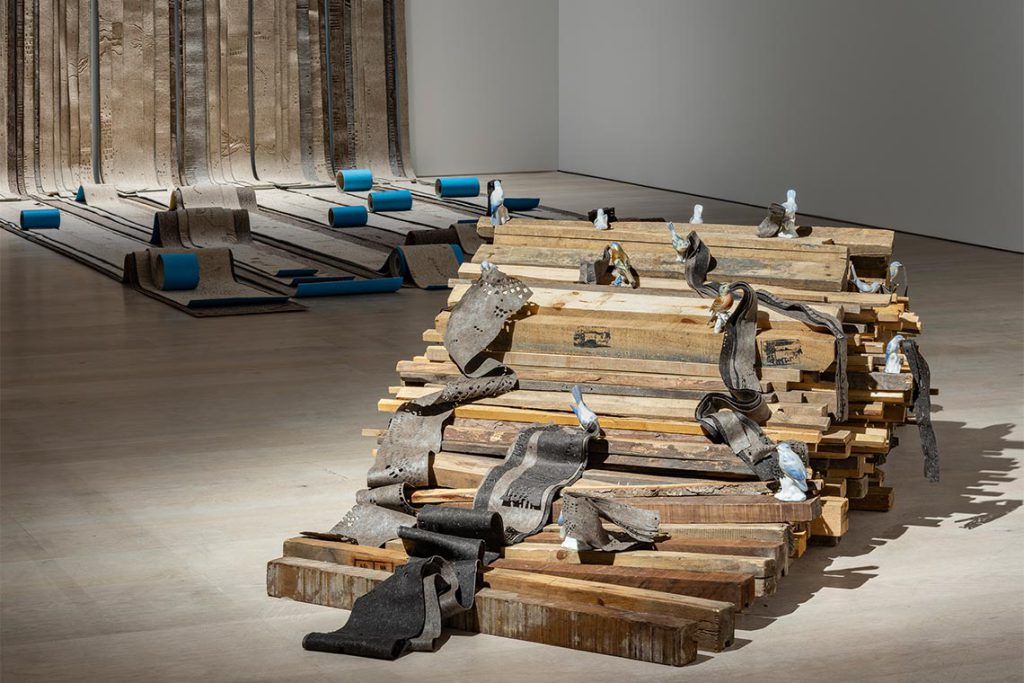
Centred on the organising principle of quartets, the installations use discarded materials to manifest the city’s phantoms. By exploring the concept of spolia, in which the remnants of demolished buildings are salvaged and repurposed in new structures, the artist examines how migration and memory endure despite physical loss. She seeks historical ruptures in renamed streets, piecing together lingering parts and debris foraged from dried-up rivers and demolished buildings. She constructs an abstract graveyard using geotextiles, filters and industrial carpets, its uneven depths questioning the nature of a hole and turning urban patterns into rhythmic scores that hold the ground’s memory.
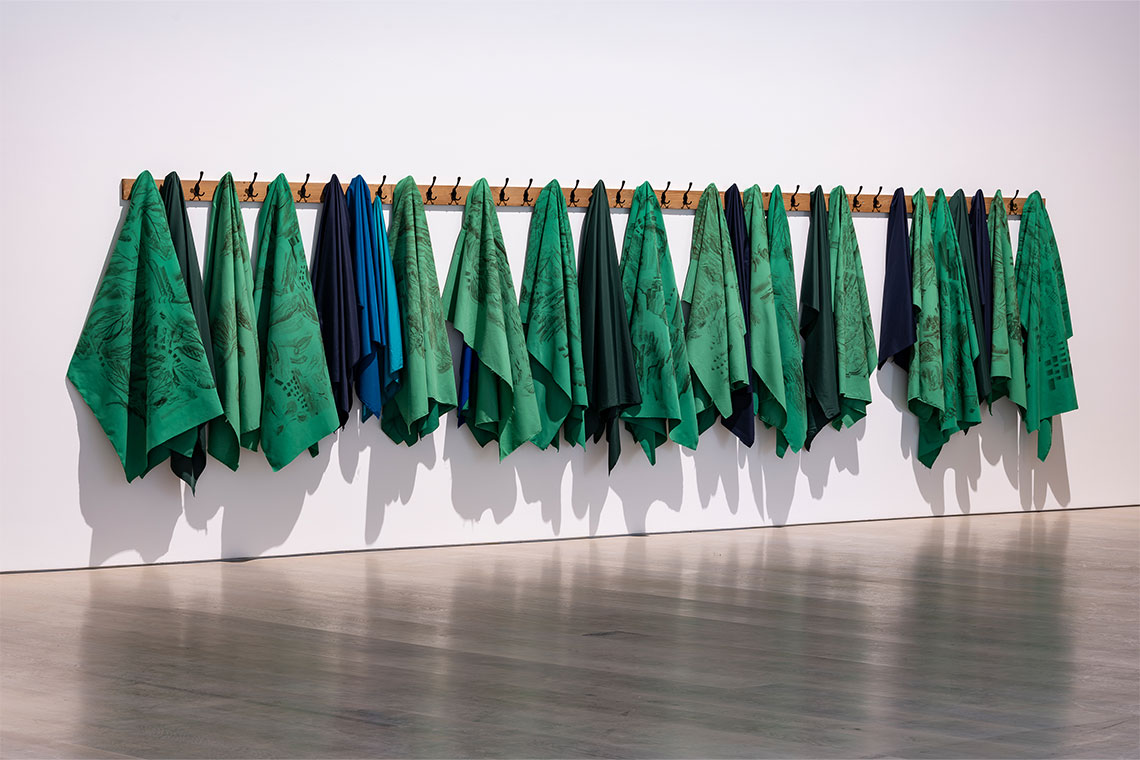
Beauty, in its forms of decay and glory, echoes through the exhibition. Gathered detritus, figurines and discarded scraps are reclaimed. History is given brass feet (An Archipelago Fugue, 2019–) and leaves are cast iron, swaying to a melancholic symphony (The Unquiet Balcony, 2025). Fire Birds (2025) sit on geotextile felt, fabric (The Coat of an Early River, 2025) is hung to rest nearby, carpets are suspended from the ceiling (Like an Avalanche Started by a Gentle Push, 2023) and capiz shells diffuse their own shadows.
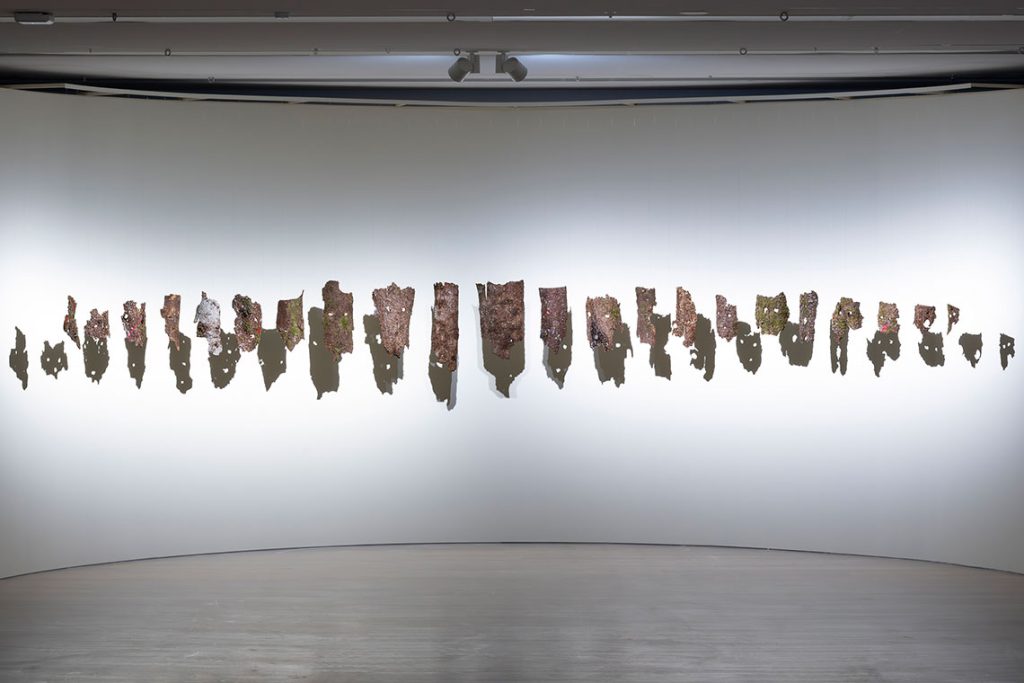
Adding a striking sonic dimension, Büyüktaşcıyan introduces Dendrologia (2023). Drawing on ecological displacement caused by post-Second World War dam construction, she incorporates diseased tree bark punctured by natural forces. These wounds act like scabs, protecting the wood while marking past trauma and producing a haunting hum that functions as a ghostly choir.
Retracing the outlines of the many phantoms I encountered in this exhibition, my earnest attempts to comprehend Büyüktaşcıyan’s exhaustive, growing body of work ultimately decayed into confusion. It is an overflowing river of personal, political and intellectual research. At some point, phantoms come and turn the sheet, revealing perhaps not a score of rhythmic haunting but a cartographic sketch. Or a map against oblivion. Or a scenic stroll. Or a beautiful staging of a vigil.
As she notes, “the phantoms of the rivers” show that the memory of water persists in these erased names. Memory is all we have, for the river has dried up. What else is there to do if all we can do is remember? We can only recall history, attempt to reclaim what we cannot access. To quote my fellow visitor, many weeks after we went to the exhibition and with whom I shared the rollercoaster of emotional and intellectual critique – “Now what?”
