

Cyprus’s young seafront art fair returns for its second edition at a moment of regional disruption, with a curatorial programme built around waves – literal, metaphorical and geopolitical.
Standing outside the warehouse complex that houses VIMA Art Fair, on the Limassol seafront, the sound is impossible to ignore. The waves are literally crashing – against the city’s coastline, and against a regional art calendar thrown into disarray by conflict and its cascading consequences. That this fair has chosen to make the wave its central metaphor for 2026 feels entirely apt.
VIMA arrives at its second edition, themed The Waves Crashing – in a landscape that has shifted considerably since its 2025 debut. Art Dubai – long the commercial anchor of the regional art calendar – was forced to reschedule to a reduced-format edition, landing – with some awkwardness – on the same weekend as VIMA. For galleries straddling both geographies, this created difficult calculations. Dubai-based The Third Line committed to both. “It’s certainly not the easiest arrangement,” says co-founder Sunny Rahbar. “Logistically, it means dividing the team in a way we’ve never had to before – splitting our director-level presence, coordinating two shipments, two installs, two sets of openings.” NIKA Project Space, operating across Dubai and Paris, also chose to appear at both. “It is intense,” admits founder Veronika Berezina, “but it also reflects the way we see our role – building connections across different regions rather than choosing one over another.”
That tension – between loyalty to the Gulf’s established infrastructure and a genuine belief in what Cyprus offers – runs through conversations at VIMA like an undertow. “VIMA can function as a space where conversations about the region happen, with the region in the room,” Rahbar adds. Third Line has calibrated its presentation accordingly, bringing a solo show of new paintings by Sarah Awad rather than duplicating what is on the walls of the booth in Dubai. “It draws people from Greece, Lebanon, Turkey, Cyprus itself, and from further afield – including audiences who might not be able to come to Dubai, especially due to the current events happening in the region,” Rahbar observes.
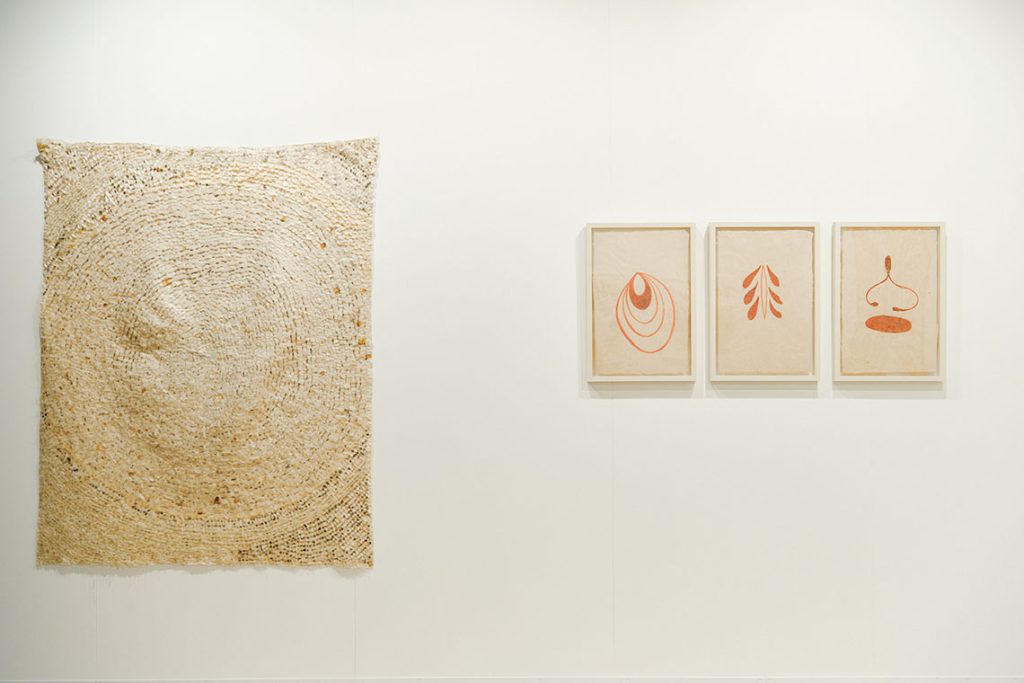
For galleries newer to the fair, Cyprus’s particular gravity as a meeting point is part of the draw. Gallery Isabelle, making its VIMA debut from Dubai, brings works whose materials speak directly to the sea: Richi Bhatia’s tapestry-like pieces constructed from dyed fish scales, and Zé Tepedino’s sculptures assembled from objects recovered from coastal environments. “There’s something very inspiring about this ‘feet in the water’ setting,” says director Jad Karam, “especially as the sea has always been a powerful source of inspiration for artists.”
Istanbul’s Öktem Aykut, another first-timer navigating the fair through what its director calls a “deliberate act of conviction” – the logistical complications of Turkish-Cypriot political relations demanding indirect routes and visa arrangements – presents a duo of Renée Levi and Mert Öztekin. For director Lara Özdoğan Kalari, the decision is ultimately straightforward: “We share the same geography and much of the same culture, so it makes sense for our artists to be here.”
That shared geography – and the idea that it might carry as much conceptual as geopolitical weight – is precisely what Greek curator Kostas Stasinopoulos has built his programme around. The Waves Crashing spans a group exhibition, live performances, film screenings and a series of takeovers by Cypriot collectives across the four days of the fair. It is, in itself, a deliberate rupture – Stasinopoulos describes feeling “compelled to critically interrogate the very context of the event itself”: an independent curatorial project embedded within the commercial architecture of an art fair, and one that makes no effort to play by that architecture’s rules. Many of the works he has assembled – performance, sound, film, durational installation – resist easy acquisition or rapid consumption.” Media like performance, sound and film naturally demand duration, attention and prolonged presence,” he says. “They ask the viewer to commit to an experience rather than simply acquire an object.”
The priority, Stasinopoulos adds, is to “create conditions where we can stay together for as long as possible, in ways that are deeply meaningful rather than purely transactional.” The curatorial framework is precise in its political situatedness, too. When Stasinopoulos first began developing the project, the insistence on “forging new ways to share time and space” was already central – a response to this particular geography and its overlapping histories. However, as the violence across the Middle East intensified, that proposition changed register entirely. “This insistence on a pause shifted from a curatorial proposition to a broader necessity,” he says.
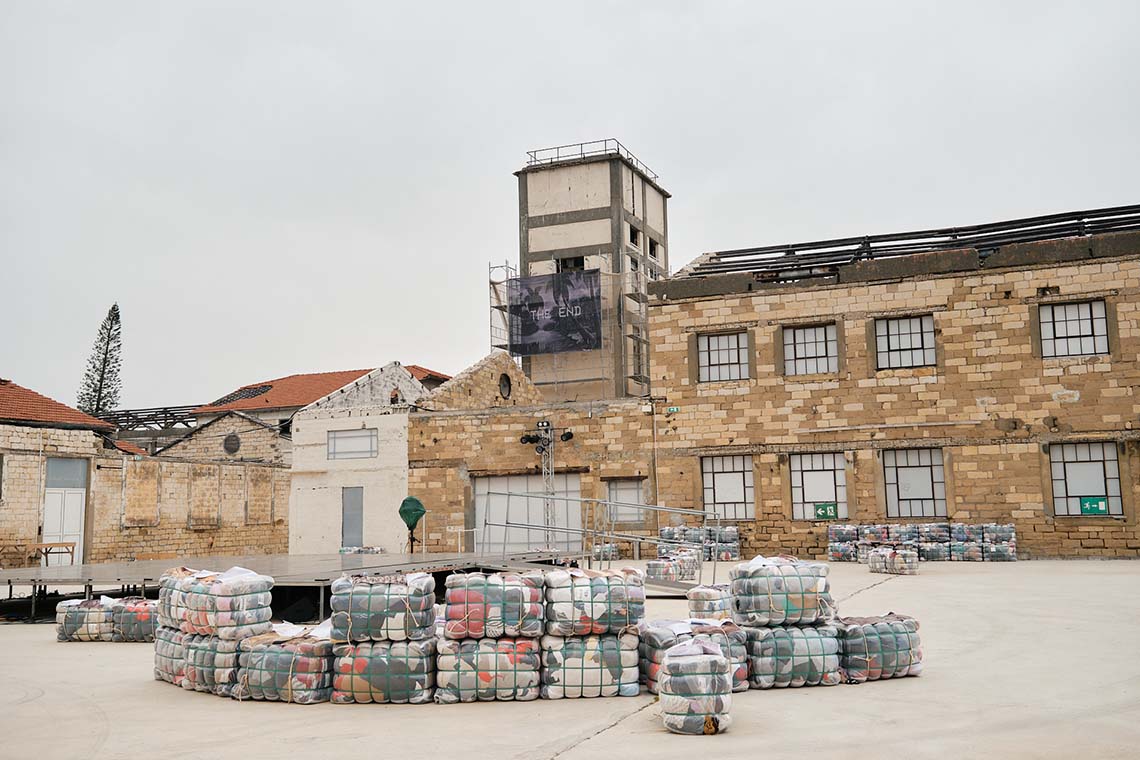
The results are arresting. Serapis Maritime – a four-person team whose work appeared recently at the Sharjah Biennial – transforms compressed used-clothing bales, fishing ropes and nets sourced from Limassol’s working waterfront into MOTHER TRADE 3 (I Love My Boat), a set of sculptural seating structures that double as shaded social space for the live programme. The 45kg clothing bales carry photographs from local Limassol shipyards printed across their surfaces, drawing threads between fast fashion, trade routes and the sea’s long role as a conduit for material circulation.
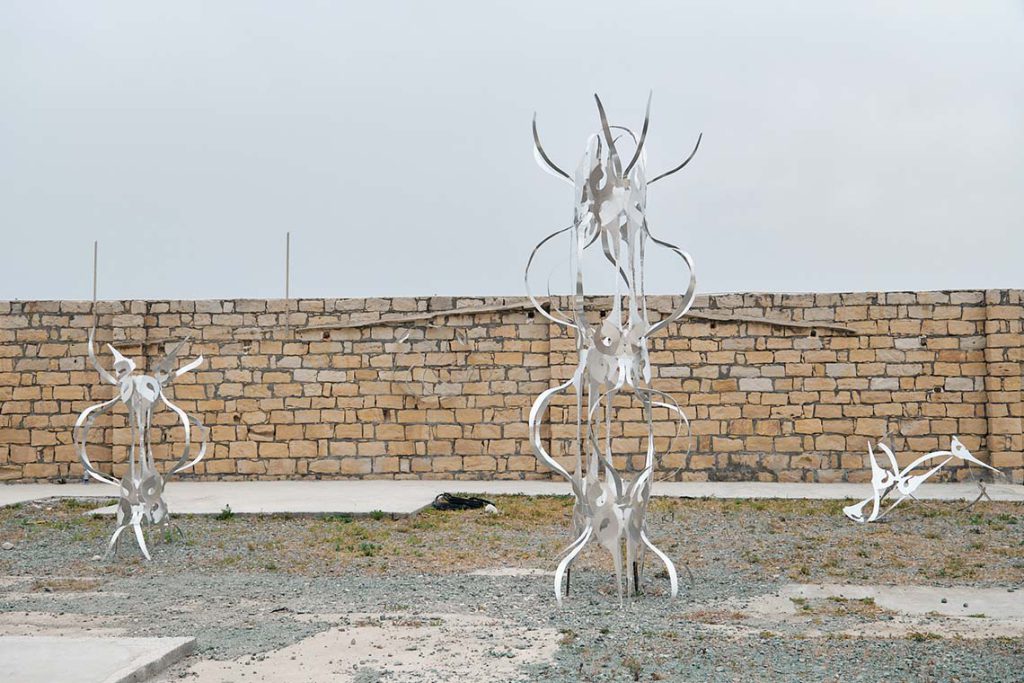
Equally compelling are Diogo da Cruz’s modular aluminium sculptures – breaching whale forms suspended mid-transformation – which draw on Alexis Pauline Gumbs’s Undrowned: Black Feminist Lessons from Marine Mammals (2020), treating the ocean as a model for surviving extractive systems rather than simply a backdrop. Manolis D Lemos, meanwhile, uses artificial intelligence to generate wave forms, extending the project’s enquiry into the rhythms and structures that increasingly govern collective life.
The takeover format – in which local collectives including Dance House Lemesos, korai Project Space and Sessions activate the live stages – gives significant agency to Cypriot practitioners. It reflects co-founder Lara Kotreleva’s ambition that VIMA function as a genuinely local, as well as international, platform. “We believe that the initiative that was just our idea in the beginning is now becoming bigger and growing through Limassol and Cyprus,” she says. Even the family programme – developed with museum partner A.G. Leventis Gallery – is folded into the curatorial logic, with children brought into contact with work that asks them to listen and attune. Stasinopoulos sees this intergenerational dimension as central: the next waves, quite literally.
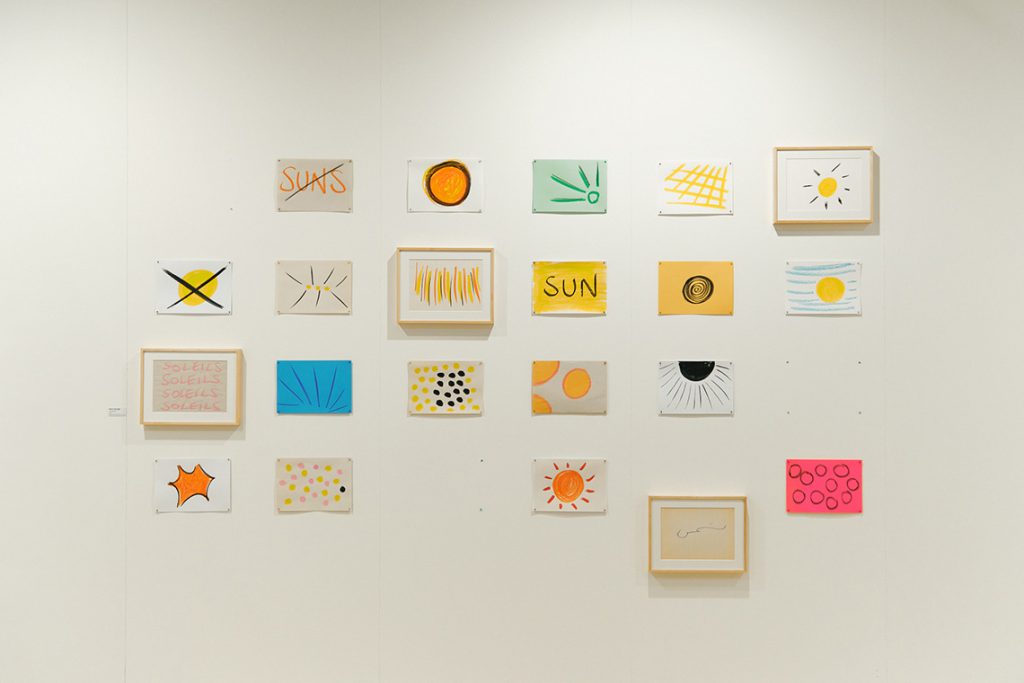
Scale matters enormously. For Takeover – the Beirut-based artist-run space now in its second year at the fair – the boutique format is not incidental but enabling. “What helps with VIMA is its scale,” says founder İeva Saudargaitė Douaihi: “it leaves room for conversations that aren’t purely transactional, where a practice can be encountered rather than quickly consumed.” Her framing of Takeover’s presence here is characteristically clear-eyed: “Bringing Takeover to Cyprus isn’t about ‘exporting crisis’ – it’s about carrying a way of working shaped by instability.”
That sensibility is echoed by CUT ART from Riga, presenting Ramina Saadatkhan’s meditations on memory and the Caspian Sea alongside the Eastern Mediterranean. “It’s less about explaining where we come from,” says director Viktorija Zaiceva, “and more about creating a connection through the work itself.” For Kalfayan Galleries, returning for a second time, it is “a sustained engagement with the region as a cultural continuum rather than a set of isolated markets,” as director Yuli Karatsiki puts it.
On preview day, VIMA announced a Public Acquisition Programme – a new framework connecting donors, galleries and public institutions to bring works from the fair into Cypriot museum and municipal collections. An administrative rather than glamorous gesture, perhaps, but a meaningful one: an attempt to ensure the fair’s encounters leave something permanent behind, rather than retreating with the tide.
VIMA Art Fair runs until 17 May
