

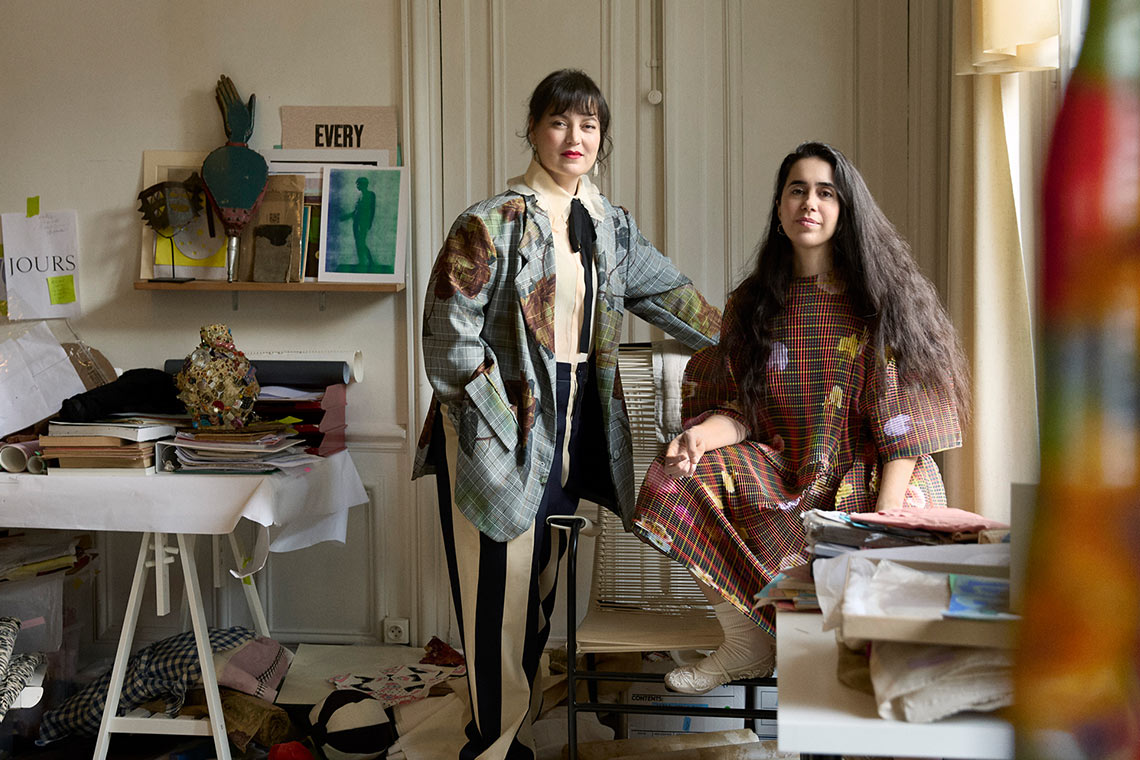
Representing the French Pavilion, the artist forges an unerringly insightful path through the complicated landscape of Moroccan and Western encounters.
Imagine the kind of political courage that spreads like dye. The stain may be slow, stubborn, often beautiful. It will take unshakeable hold. This is one way to look at Yto Barrada’s prolific body of work across photography, textiles, sculpture, film, publishing and installation over the past two-plus decades. The French-Moroccan artist creates unique networks of associations: colour theory mixed with found footage; fossils, flags and family memory; playgrounds and pedagogy; hand-dyeing and colonisation. Her references sprawl and spiral, organising into a library of delights. This year, she represents France at the Biennale.
Barrada’s art attunes to how we systematise our lives through rules and classification. She strips these structures for parts and tongues before reassembling them in what has been called her “grammars of resistance”. In the spirit of Jacques Derrida’s ideas of deconstruction, she cavorts with the building blocks of language itself – lexicons, glossaries, jeux de mots, anagrams, notations. Take the popular 2019 works Sheikh Speare Is Arab and Mnemonic Phrases, or playful, wry exhibition titles such as Bite the Hand and How to Do Nothing with Nobody All Alone by Yourself. Childhood is when we first imbibe the social structures with which we act and are governed. It is also when our curiosity, creativity and willingness to disobey, to ‘act out’, may be at their highest ebb. Barrada’s work often embodies a child’s point of view; when encountering a system of order, she prods and plays with its forms. “You can touch it,” she explains, when describing her practice for a child. “When I work, sometimes it smells really bad. But it’s magical.”
Barrada was born in 1971 in Paris, but spent much of her upbringing in Tangier. She returned to France to study history and political science at the Sorbonne before enrolling at New York’s International Center of Photography in the 1990s. Her mother, Mounira Bouzid El Alami, is an activist and psychotherapist. Her socialist activist and journalist father, Hamid Barrada, is a former political opponent of Morocco’s late King Hassan II. During a period of intense state repression, he was sentenced to death, eventually finding a way to flee the country at night with the help of the French Resistance leader, Lucie Aubrac. Barrada has sometimes treated her family histories and even children’s ideas as direct material, as in Tree Identification for Beginners (2017) and Hand-Me-Downs (2011). It is the syntax of those memories that buttresses her process – for instance, the fugitivity, creativity and collaboration that even made her father’s escape possible.
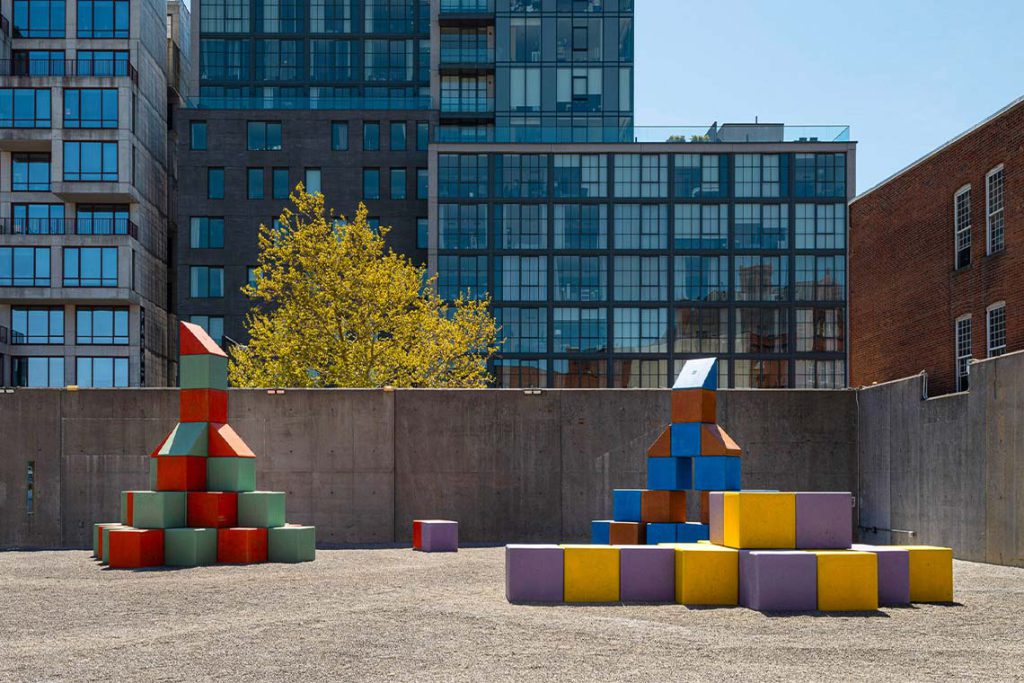
Several of Barrada’s works engage with the Montessori educational method, which prioritises self-directed learning and collaborative play for children. Tree Identification for Beginners combines found footage and stop-motion animation with Montessori toys to recount her mother’s experience on a USA state-sponsored travel programme, Operation Crossroads Africa, in 1966. This period saw the Pan-African, civil rights, Tricontinental and anti-Vietnam War movements. Barrada reimagines her mother there as a teenager, questioning what the USA is teaching her. The work celebrates disobedience and the autodidact, and we are shown a lineage of subversion passed on.
In a seemingly matriarch-driven practice, Barrada is fascinated by how women have seen and recorded the world – in writing, crafts, speech, art, film, theory, education. Telephone Books (2010) comprises photos of notebooks in which Barrada’s grandmother once made her own mark-making system to record her family network. The 2017 film Ether Reveries (Suite for Thérèse Rivière no. 2) and further sculptural installations examine the archive of Thérèse Rivière, a French anthropologist who enabled Chaoui Berber women and children to make their own sketches. Barrada recirculates their work in engaging with that of Rivière, who died prematurely after psychiatric confinement.
Barrada was also a close friend and collaborator of the reclusive American artist Bettina Grossman. After Grossman’s passing in 2021, Barrada became executor of her estate, preserving her once-overlooked archive of photos, films and sculptures. “The rapidity and rhythm of the art scene [means] things are very, very fast and changing,” Barrada says. “To keep up, do good work and to work with a lot of people … [needs] solidarity. This is the word I am gathering from working with other artists. Radical solidarity is my answer.”
Barrada’s first photographic series, A Life Full of Holes: The Strait Project (1998–2003), documented the effects of the 1991 Schengen Agreement on Morocco’s borders. Shot in Tangier, the images show people who dream of leaving, whether dangerously or illegally, a city – a country – trying to rebuild its image and architecture after occupation. Barrada told the Brooklyn Rail in 2018 how the Strait of Gibraltar became a “cemetery at some point … Everybody knows everywhere in the world that you can’t close the border. You just die more.” Similar themes appear in works such as The Sleepers (2006), Beau Geste (2009), the 2018 Barbican show Agadir – a city she has described as a “vitrine for the French” – and Le Grand Soir (2024–26). However many directions it flowers in, Barrada’s practice remains critical of Western and European attitudes towards the ‘subaltern’, from the colonial and postcolonial periods to the present. The artist’s own label of ‘French-Moroccan’ is a signifier of the coloniser-colonised relationship between France and the Maghreb – the hyphen between them an unstable see-saw. Beginning with the 1830 invasion of Algeria, French colonial agents consistently used anthropological, physical, legal, land-based, cultural and economic methods to control and suppress the autonomy and resistance of Maghrebi people.
To an extent, Barrada representing France in Venice – guided by Tunisian-French curator Myriam Ben Salah – is significant in gaining representation. The exhibition is entitled Comme Saturne [Like Saturn], invoking the Renaissance belief that artists are born under Saturn’s influence of “melancholy, withdrawal and slow thinking”. Further resonating with the “minor keys” of the late curator Koyo Kouoh’s vision, it references Saturn Devouring His Son (1820–23), one of 14 ‘Black Paintings’ by Francisco Goya. “There are a lot of puns, words, vocabulary, games, materials, basically around the myth of Saturn,” Barrada shares. Saturn (or Cronus) was the god of time and agriculture, who devoured his offspring from a fear of getting overthrown. Barrada presses the political point, referencing the famous French Revolutionary quote by Pierre-Victurnien Vergniaud: “Like Saturn, the Revolution devours its children.”
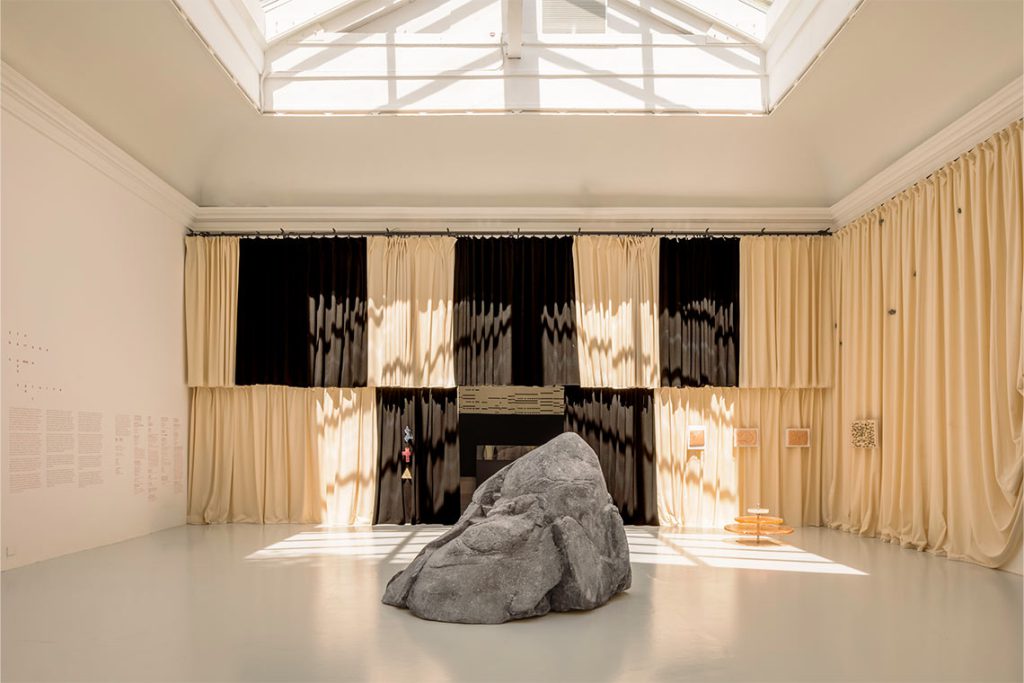
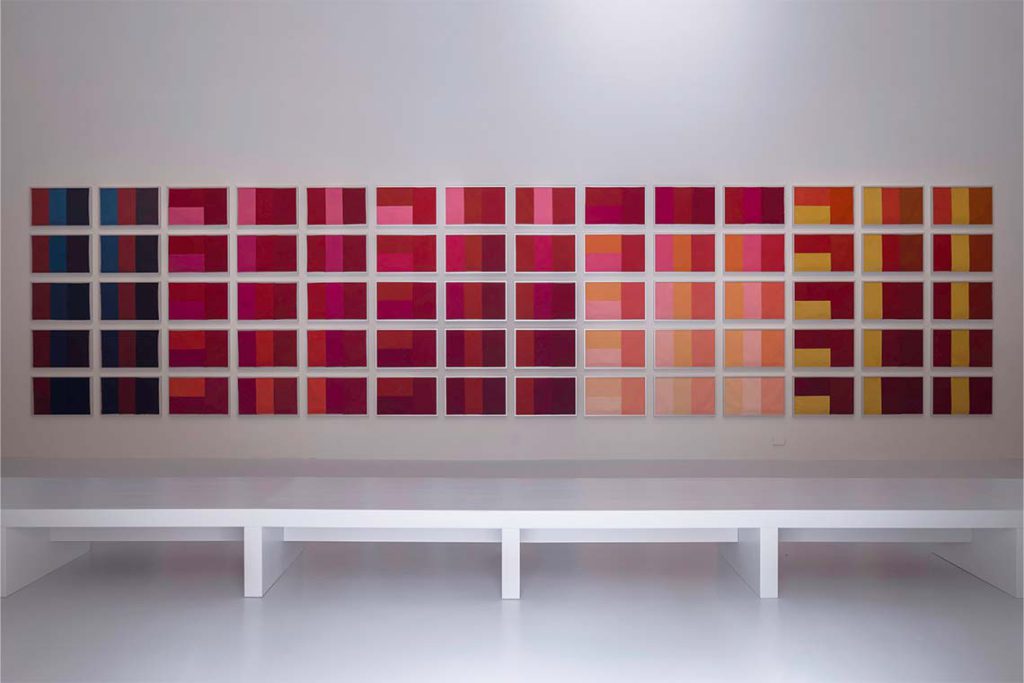
The pavilion is draped in this narrative-making – it prompts philosophical and critical thought through textiles, asserted as a valuable field with undervalued methodologies. “There’s something incredibly rich about the language of the textile, of restorers, conservators and dyers,” Barrada explains. “One technique of textile transformation is the dévoré, which means ‘devour’ in French.” Dévoré, her conceptual tool, is a finishing technique where a chemical substance creates ‘burn-out’, corroding fabric to the point of revealing its backing. Burn-out’s double meaning is intense consumption and exhaustion. “We let the work of the light devour the fabrics,” the artist says. Through French wool, she expresses a form of ‘material thinking’ with material history in France. There are more literary references, colour theory, masks, as well as a reassessment of the legacy of the Enlightenment. “In French, ‘enlightenment’ is lumière, the same word for ‘light’ and also the name of the brothers who invented cinema,” she adds.
Film is included, as are photography, sculpture, painting, printmaking and a publication. An installation features the Oulipo wheel, an experimental literary technique of rearranging text, while the publication puts images at the centre and moves words to the margins, shifting what is in power and what is peripheral. It is ambitious, committed and energised by its own hunt and pursuit of artistic world-building at a certain scale. Importantly, audiences form their own paths through, and therefore their own interpretations, as if from the same tarot card deck. It is another celebration of the autodidact, of exercising free thinking and spirit with one’s available ‘materials’.
The work of cultural institution-building in Morocco is part of Barrada’s practice in history, archives and education. In 2006, she co-founded the region’s first independent arthouse cinema, Cinémathèque de Tanger. This year it turns 20, with an expanding, publicly accessible collection of arthouse and SWANA films. Living between New York and Tangier, she then founded The Mothership, an eco-feminist dye garden, library, research and residency space overlooking the Strait of Gibraltar. Barrada has been dyeing and working with textiles for about a decade, and in Morocco began foraging for natural materials and growing her own plants to produce pigments. The Mothership’s work runs counter to the threat of monoculture on the land and among people in a country whose ancient, indigenous botanical traditions and output get displaced in neocolonial markets with Europe. “The idea of the garden is never finished,” Barrada says. “[Making] colours is a way to enjoy the continuity of the relationship to earth and soil. It’s not slow. It’s the right timing.”
Barrada’s three galleries span the various geographies of her life: Sfeir-Semler, Pace and Galerie Polaris. Her work is acquired by institutions such as Tate Modern, the Metropolitan Museum of Art and the Centre Pompidou. The MoMA holds work from her After Stella series (2018–19), which highlights the debt owed by Frank Stella’s 1960s paintings to Morocco’s visual forms – workers’ garments, landscapes, the Casablanca School. This is a Barrada motif: looking back askance at Western, male entrancement with his individual experience of the ‘Orient’. Textiles have become her vernacular to write back over the rules of an appropriative game. In Venice, every room in Comme Saturne is full of wool shorn (or ‘born’) in France. When Barrada ‘devours’ this fabric, she is searing the colours, stitches and binds of what constitutes French history, making irreversible marks.
The French Pavilion is located in the Giardini
This profile first appeared in Canvas 123: Venice Special Issue
