

At Sharjah Art Foundation, Laila Majid and Inaam Zafar approach the body indirectly, finding its traces in intimate objects and fragmented forms.
The chirping of the birds and the calm aura of Sharjah Art Foundation’s courtyards surround Body Quotidian, the dual exhibition of Laila Majid and Inaam Zafar. Inside Gallery 6, tumeric-coloured carpets stretch across the floor, their saturated yellow becoming the most vibrant element in an otherwise muted space. Against this warmth, the works approach the body through fragments, surfaces and forms, often leaving it only partly visible.
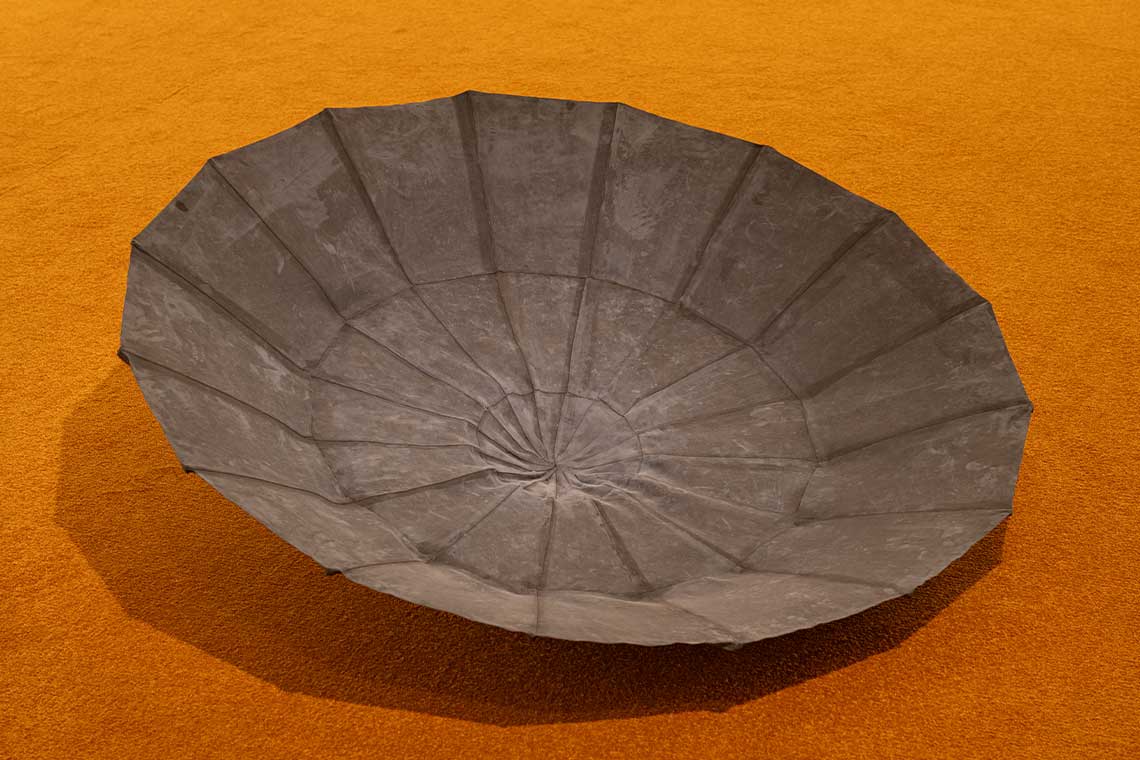
For artist Laila Majid, the body is rarely presented as a complete figure. Her sculptures and intimate works isolate their details, allowing the body, texture and contour to become subjects in themselves. dressing for pleasure 01 (2024), the only work positioned on the gallery’s floor, takes the recognisable form of an inverted black umbrella. Its dark, folded silhouette enters into a quiet exchange with Inaam Zafar’s Bent Moon (2025), whose curved form sits somewhere between a classic lamppost and the crescent shape suggested by its title.
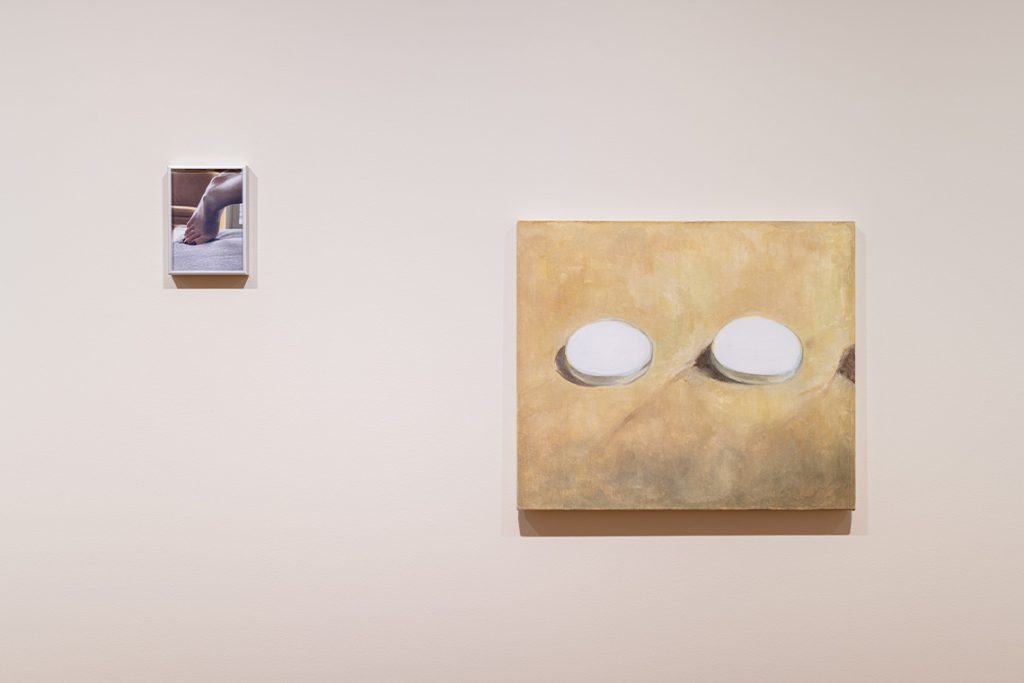
This connection carries through the exhibition, where some of the works are placed alongside a counterpart. The pairings draw out similarities and differences in the artists’ use of form, material and shape. This can be seen in Majid’s Sunday (2026), a photograph of a foot caught in an awkward, curated position, seemingly suspended between performance and physical struggle. Beside it, Inaam Zafar’s To See and Not See (2025) introduces another meditation on visibility, where a pair of pills are waiting to be consumed.
There is also a subtle play between shadow and form that could go unnoticed. In a corner of the gallery, the office blinds become part of this visual language, casting lines and shadows across the space while filtering the light. Almost blending into the architecture, Zafar’s Blinds (2025) introduces another layer of form and texture, quietly shifting the way in which the surrounding works are seen. Majid shifts towards more intimate spaces with Sink (2026), capturing the quiet familiarity of a sink and the steam that gathers around it, while the surface of the glass becomes clouded and almost opaque. Next to it, a dangling wire threaded with feathers forms part of the Chaser series (2025–ongoing), where fur, feathers and tinsel create a sculpture that seems to invite touch.
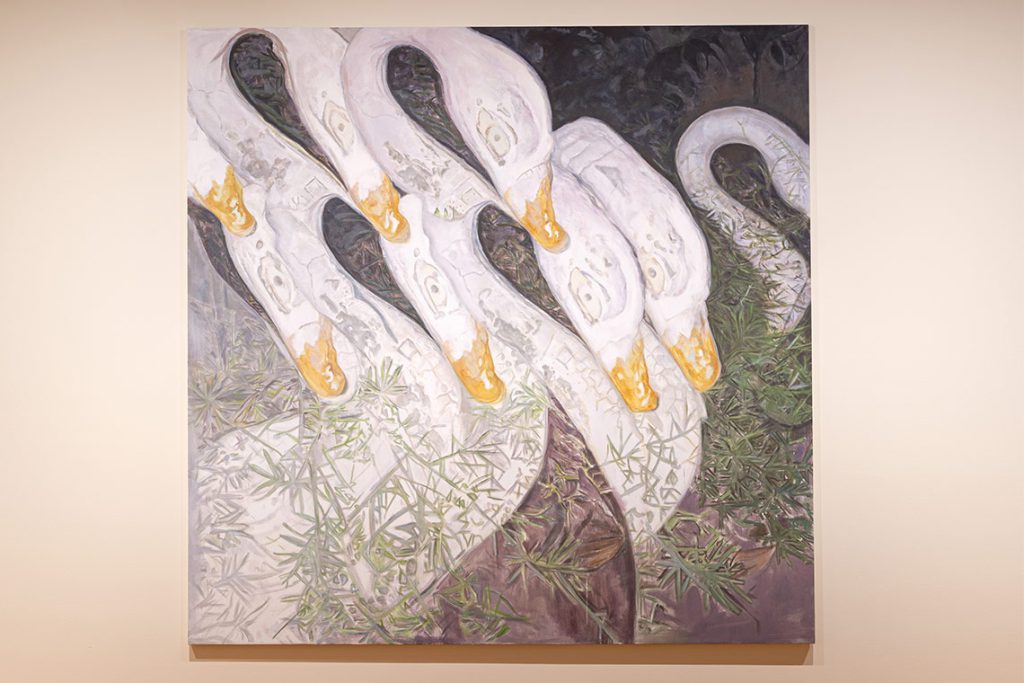
Where Majid approaches the body through intimate objects and fragments, Zafar turns towards the passage of time and the traces it leaves behind. His paintings and visual works often hold onto images and materials in states of change, suspended between disappearance and appearance. On a separate wall, Mourners (2026), measuring 229 × 231 cm, is the largest work in the show. A gathering of swans move through fields of leaves, their necks bending downwards towards the ground. The repeated downward gesture lends the scene a quiet, collective sense of mourning, while the surrounding foliage evokes the cycles of growth, decay and renewal.
In the outdoor courtyard, a ghaf tree provides shelter to the inhabitants of the ecosystem that surrounds it. Look more closely at its branches, and one of Majid’s wires can be seen dangling, almost becoming an extension of the tree itself. Birds remain perched among its branches, seemingly undisturbed by the new element woven into their habitat, as though the intervention has quietly found its place within the natural life of the tree. Nearby, Dressing for Pleasure 03 (2026), another iteration of the sculptural work first encountered inside the gallery as Dressing for Pleasure 01, resembles a crumpled piece of paper, its delicate, gathered form mirroring the fragility of its surroundings. Over time, the sculpture has become a haven for small forms of life, collecting water and allowing its own micro-ecosystem to develop around it.
For all its quiet correspondences, however, Body Quotidian occasionally engenders the feeling that something remains just beyond reach. The works speak to one another through material, gesture and atmosphere, but the conversation gently breaks into friction. There are moments when the exhibition seems poised to open onto something stranger or more affecting, only to retreat again into its composed stillness. Perhaps this is part of its proposition, a body understood not through declaration but through what is withheld. Still, one is left wondering what might have emerged had that restraint been interrupted, even briefly, by something less resolved.
Body Quotidian runs until 20 September
