

Less interested in the certainty of facts than in unresolved questions, Abdessamad El Monstassir’s exhibition at La Friche la Belle de Mai offers poignant encounters with that which is not easily made tangible.
In the past, ‘forgetting’ – or cloaking in silence – was a standard approach to the processing of suffering. Today, new generations feel the urge to know, and the need to acknowledge, the past as a much more prevalent expectation. Despite the contemporary desire to reevaluate history and to articulate its deep oversights, Abdessamad El Montassir wonders about the right to forget – and the relief that can stem from that process.
El Montassir is an interdisciplinary artist and researcher who collaborates with scientists and poets. A former resident of the Villa Medici in Rome (2024–25), he has presented his work in Paris at Bétonsalon and at the national Museum of the History of Immigration, and elsewhere in France at the Centre Pompidou-Metz and the FRAC Franche-Comté in Besançon. His latest show is on view in Marseille, at La Friche la Belle de Mai.
Although he extolls the right to forget, his definition of forgetting is not so much a form of escape as a reckoning with the past through more subtle forms of access. His projects unfold through installations that explore trauma dispassionately, examining how past violence can linger implicitly. According to El Montassir, plants, trees, mountains, sand and wind are actors capable of transmitting things that human voices and full sentences cannot always distill effectively. His work is rooted in what eludes verbal expression and communication, stressing that to bear witness is not just about human chronicle but also involves atmospheric transmission. Having grown up in southern Morocco, shaped by the Saharan environment, El Montassir developed a relationship to landscape that was formative enough to function as its own latent storyteller. Traces and fragments may not fully satisfy everyone, but his work considers them as indicative of larger concerns. What remains unspoken can still have sway.
The exhibition Sur les ruines, les pierres fleurissent (On the Ruins, Stones Blossom), curated by Gabrielle Camuset, brings together recent work and new pieces that ask the visitor to pay attention to arid landscapes functioning not as static spaces, but as replete with plant and mineral entities possessing their own gravitas. Although La Friche – a former tobacco factory reconverted into a sprawling cultural venue, including dedicated gallery spaces – is in an urban setting, its location, adjacent to the Mediterranean, makes it a fitting locus in which to contemplate touchstones from across the sea.
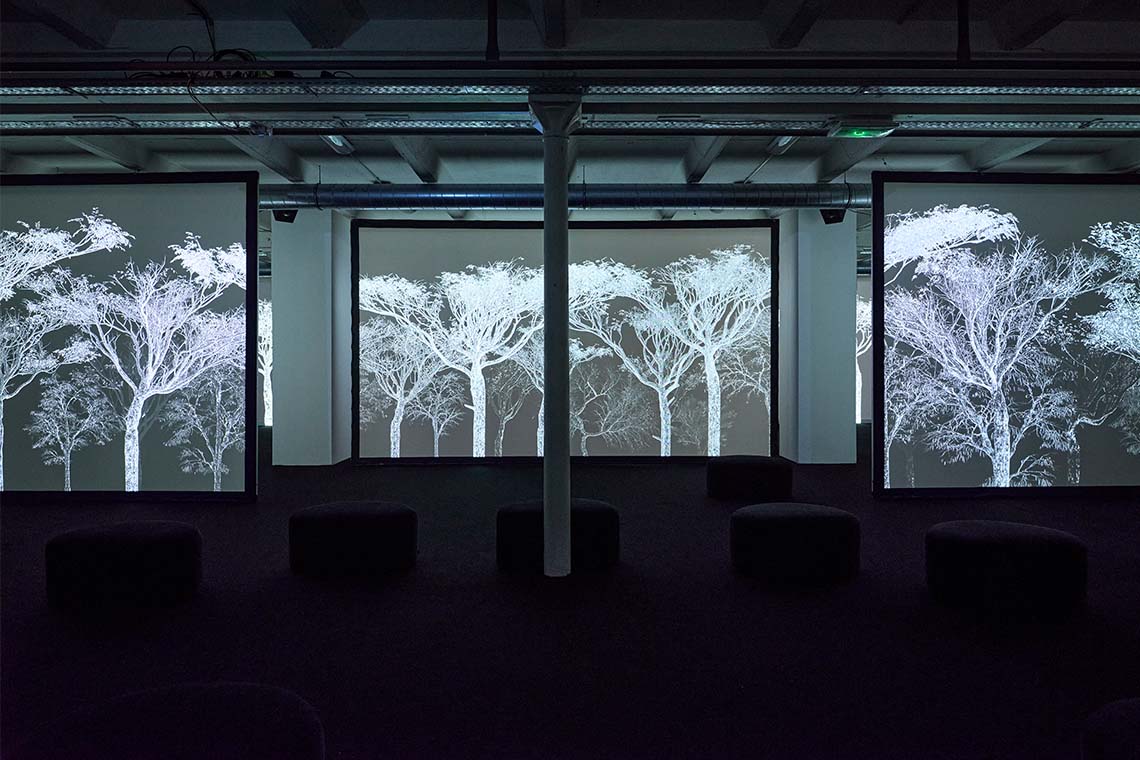
Sadra Kodia (2025), a soundless black-and-white video installation across five screens, explores a Sahrawi custom – the Sahrawis being an ethnic group native to the western part of the Sahara Desert, a mix of Arab and indigenous African tribes – linked to the acacia. Here, hauntingly, acacias are shown as white silhouettes against a pitch-black backdrop. The video, on a 10-minute loop, dovetails with a 22-minute sound work that El Montassir made in collaboration with Matthieu Guillin, Athar Dakira (2025). The piece is composed of reclamation songs from the Haratins, an ethnic group of formerly enslaved and formerly enslaved communities from the Sahara in North and West Africa, where forms of domination persist today, despite their ‘official’ suppression, and many people still live in segregated Haratin-only enclaves. In the sound piece, three separate voices mix with field recordings of plants and instruments crafted from Saharan flora.
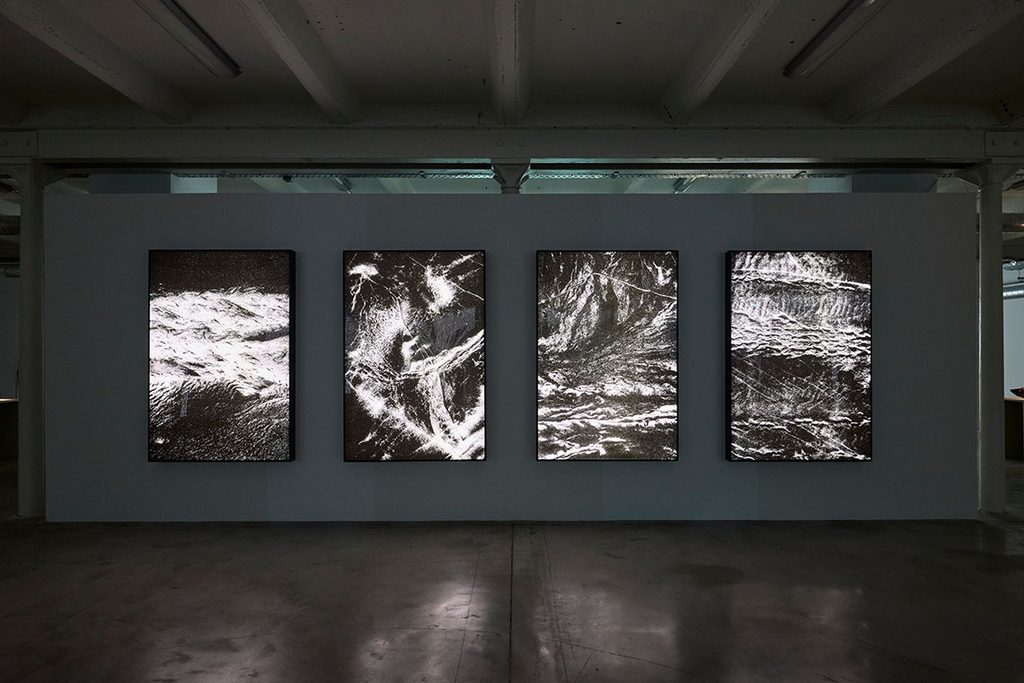
Behind the video installation is Asserfa (2025), a row of lightboxes, presenting a series of abstracted landscapes. These ‘illustrate’ oral accounts of Sahrawis recounting their displacements through topographical descriptions. The work is neither documentary nor representative, but rather a way to acknowledge the absence of archive. Fiction is an imperfect stand-in, a way to gesture at the inability to restore original experience. Incomplete remnants are the best-case scenario of what can remain.
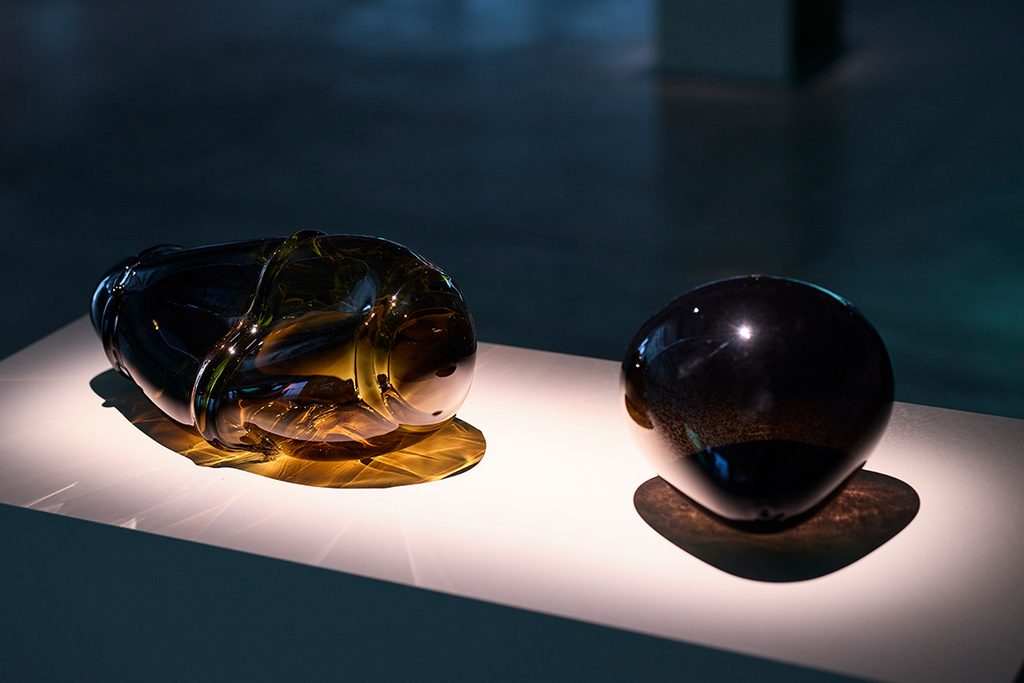
Flanking the lightboxes on either side of the room is the installation Âabide l’kadia (2025–26), two separate groupings of shapely blown-glass sculptures in variable dimensions. Their contours represent Saharan seeds and beads adorning Haratin hairstyles. The blown glass is executed through a collaboration with expert artisans at Cirva, a nonprofit blown glass and visual arts research centre based in Marseille. In the back of the gallery is Trab’ssahl (2023), a triptych of short films with three intergenerational protagonists (Mokhtar, Abnou, Sherif) in the Sahara.
In an understated way, the exhibition addresses the act of communicating through the imperceptible. The installations are underpinned by questions about whether one can share meaningfully what cannot be recounted explicitly, or how something can be resonant beyond the tangibility of direct speech. The fate of memories that cannot be properly restituted in the present seems like a melancholic reality. In a world of noise, where we are desperate for hard answers, resolutions, logic and immediate problem-solving, Sur les ruines, les pierres fleurissent is a quiet alternative and antidote.
Sur les ruines, les pierres fleurissent runs until 27 September
