

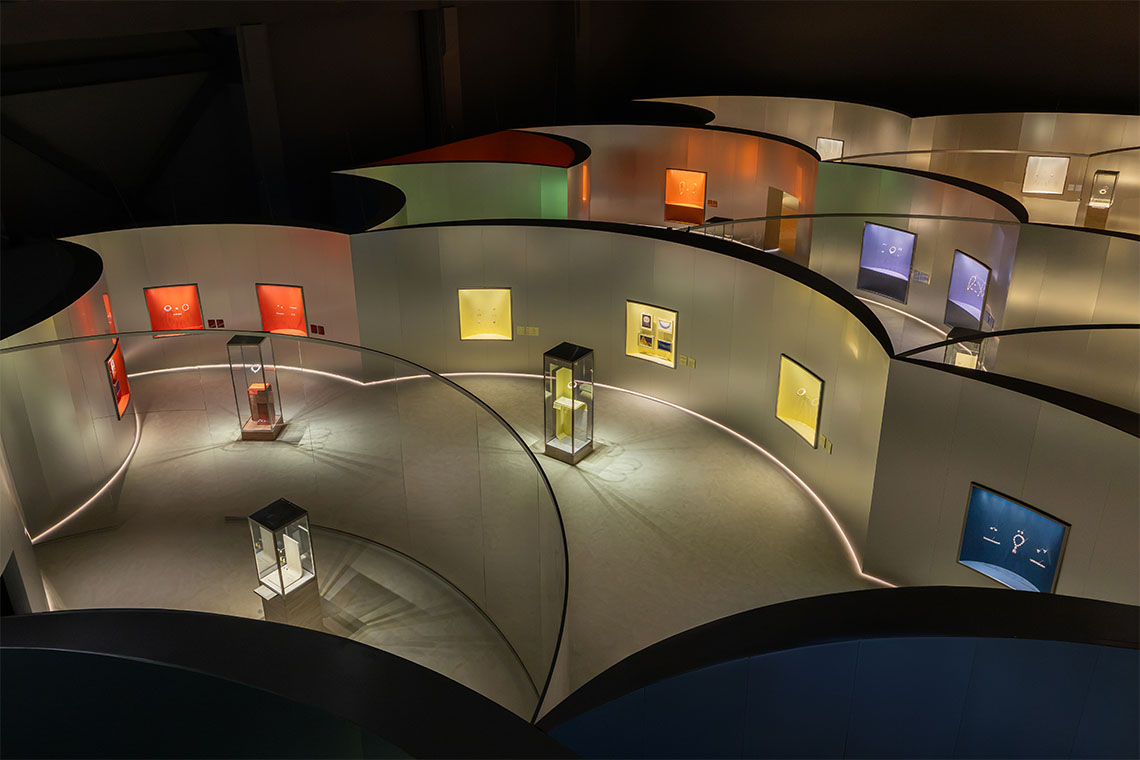
Bvlgari’s iconic designs are made with exemplary craftsmanship and vision, enhanced by its distinct approach to colour. Celebrating a revolutionary history, the Maison’s latest exhibition, Bvlgari Kaleidos: Colors, Cultures and Crafts, demonstrates there is much about colour yet to be explored.
Since its founding in Rome in 1884 by Greek silversmith Sotirio Bvlgari, the Maison has been known for exceptional refinement and artistic vision. However, in the 1940s, Bvlgari began exhibiting a distinct shift towards the unconventional. By moving away from the design standards of the time, which were oriented around platinum and diamond in geometric and Art Deco styles, Bvlgari quickly established a unique identity. “Its use of metals, gems and other unusual materials has allowed Bvlgari to create a truly chromatic language that is instantly recognisable,” says Gislain Aucremanne, Bvlgari Heritage Curator Director. Characterised by a bold foray into vibrancy, the embrace of colour would not only impact the trajectory of Bvlgari and forge the DNA for which it is now known but also reframe the understanding and use of colour in the industry.
“Throughout its history, three elements of innovation have marked the avant-garde of jewellery and distanced the Roman High Jeweller from the codes of traditional French fine jewellery,” explains Aucremmane. One was the incorporation of yellow gold – a metal that Bvlgari still favours. The 1950s then saw Bvlgari introduce striking combinations of precious and coloured gemstones. This inspiration came directly from its Roman roots – referencing art history and the landscape in its colour-blocking techniques and avant-garde chromatic mixes. The third was applying the cabochon cut to precious gems rather than just to lesser stones, as previously. An ancient technique dating back to antiquity, it was revived by Bvlgari in the mid-twentieth century as a way to enhance the depth of colour.
Revisiting and re-envisioning historical and cultural elements to fuel creative vision remains a core pillar of Bvlgari. Today, the Maison looks even further afield in pursuit of dynamic new inspirations to imbue its jewellery designs with deepened meaning, symbolism and aesthetic value, as well as to construct a further base of knowledge from which to draw. “Every exhibition is an opportunity for the Maison to look at itself from the outside,” notes Aucremanne. “When Bvlgari travels, it does not simply transport its heritage from one country to another. Each destination asks new questions of that heritage. These encounters expand Bvlgari’s creative vocabulary without altering its identity.”
Bvlgari – whether within its ateliers or through its art-focused Fondazione Bvlgari – embodies creativity, savoir-faire, inclusion, philanthropy, education and heritage preservation. It nurtures these values through international collaboration and cross-cultural exchange, which serve to generate dialogue, honour generational skills and shed light on fresh creative talent and craftsmanship, as well as explore new threads of research relevant both within and beyond the jewellery world. For example, courtesy of its iconic 1948 Serpenti design, Bvlgari has broadened the discourse around the iconography and magnetism of snakes through its jewellery, publications and multi-chapter Serpenti exhibitions across countries including India, South Korea and Italy.
The Maison’s history with colour has also taken a global journey. In 2021, Seoul’s Hangaram Design Museum displayed how Bvlgari harnesses the powerful creative energy of colour, while in 2025, the National Art Center in Tokyo hosted Bvlgari Kaleidos: Colors, Cultures and Crafts, marking both Bvlgari’s first exhibition in Japan in a decade, as well as its largest ever in the country. Now, Kaleidos opens a new chapter at mainland China’s first public contemporary
art museum, Shanghai’s Power Station of Art.
Grounding the exhibition’s mission are two Greek terms, kalos (beautiful) and eidos (form), symbolising the evolving union of beauty and creativity. The immersive scenography across multiple spaces – created by architectural studios SANAA and Formafantasma – sees visitors enveloped by a powerful expression of the delicate relationship between architecture, light and materiality. Featuring more than 300 jewellery masterpieces from the Bvlgari High Jewellery collections, Bvlgari Heritage Collection and private Italian and Chinese collections, in addition to artworks by leading Chinese contemporary artists Liang Manqi and Zhang Ding, Kaleidos delves into how unexpectedly different the understandings, experiences and use of colour can be. The exhibition also investigates the difference between factual theories on colour – how it behaves and interacts – versus a more subjective take, in which an emotional context guides. “This is one of the fundamental questions,” says Aucremanne. “Colour is something we can study endlessly, yet ultimately it has to be experienced. This is why the exhibition moves progressively through science, symbolism and perception. The encounter becomes richer precisely because no perspective is sufficient on its own.”
Kaleidos presents Eastern and Western colour theory, touching on the more philosophical frameworks of the East and addressing the West’s more scientific approach before addressing more forward-facing queries. The exhibition unfolds across three chapters: The Science of Colors, Color Symbolism and The Power of Light. The first of these explains colour theory, touching on the core primary colours and the complexities of harmonies through the lens of German writer, poet and polymath Johann Wolfgang von Goethe – who argued that colour is the result of the interplay of light and dark, carries psychological value and that humans seek it in balance – and French chemist Michel-Eugène Chevreul, the first to propose relational perception or the law of simultaneous contrast, whereby colour is perceived in relation to its surrounding hues. In turn, Bvlgari displays its understanding of colour theory and fearless application through pieces such as a necklace crafted with cultured pearls, rubies, sapphires, emeralds and diamonds (Bvlgari Heritage Collection, 1991), as well as another necklace from 1960, which embodies bold colour harmony through its incorporation of gold and platinum alongside turquoise and diamond.
Next comes Color Symbolism, which investigates the philosophical and cultural values of colour, honing in on notions from the East and on how colour can function as a language by focusing on the Chinese Wu Xing (Five Elements system). A 2000-year-old philosophy, the five core elements or natural forces of wood, fire, earth, metal and water are attributed with a colour, symbolism, seasons and corporeal component. Here, wood is associated with green, represents spring, birth, growth and creativity, and relates to the liver, while metal is connected to the colour white, connoting autumn, harvest, structure and consolidation, and is related to the lungs. These values are continuous rather than static concepts and work in relation to each other. A central philosophy, Wu Xing has informed disciplines such as traditional Chinese medicine and feng shui. Bvlgari’s interpretation of a more reflective, symbolic approach is evident through its intentional gemstone choice, imbuing each piece with a backstory and deeper intrinsic value for the artisan as well as for the wearer or collector.
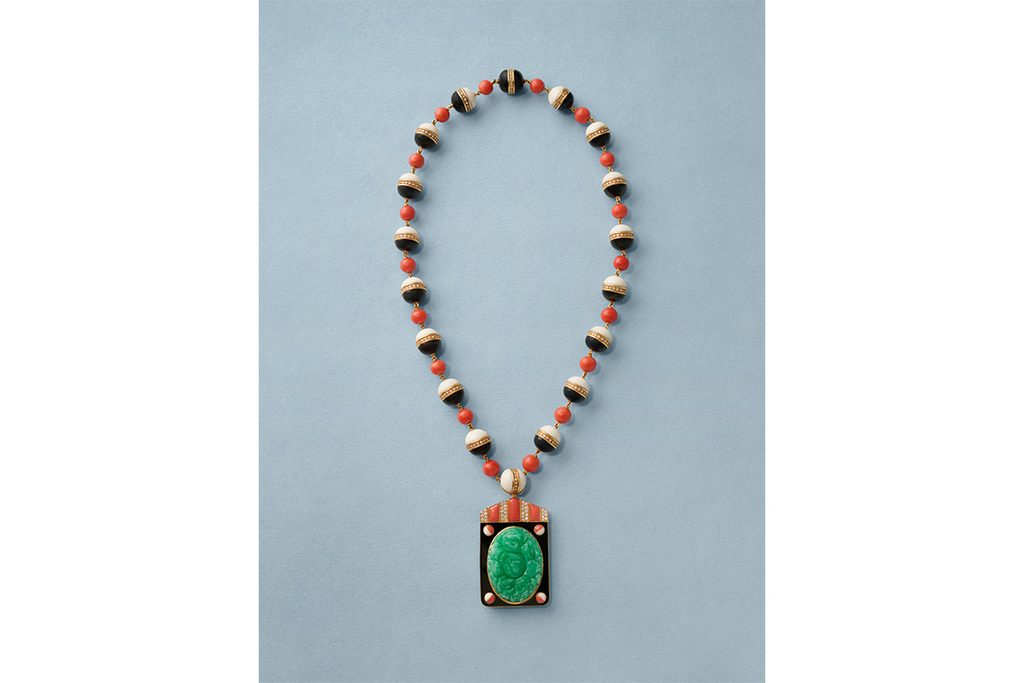
Kaleidos features a special, exclusive selection of jewellery creations, and in this chapter are pieces such as a 1993 gold necklace with rubies and diamonds, indicative of the vitality and prosperity expressed by the colour red in Chinese culture; convertible platinum pendant earring-brooches with natural pearls and diamonds from c.1952, which denote purity and refinement; and a c.1977 gold horse-head brooch adorned with onyx, ruby and diamonds in reference to 2026, the Chinese Zodiac’s Year of the Horse. The evolving dynamic between East and West has long been of keen interest to Bvlgari and informs much of its visual lexicon. This can be seen, for example, in the 1973 sautoir from the Bvlgari Heritage Collection, exhibited for the first time. Coral, onyx and diamonds in spherical form lead down towards an engraved jade medallion, as much in homage to Chinese tradition as to Roman frescoes. The display of the Monete Tubogas bangle in three-colour gold with Persian silver coin and diamonds from the 1970s is another example of the Maison’s ability to layer historical references while simultaneously demonstrating its pioneering use of metals.
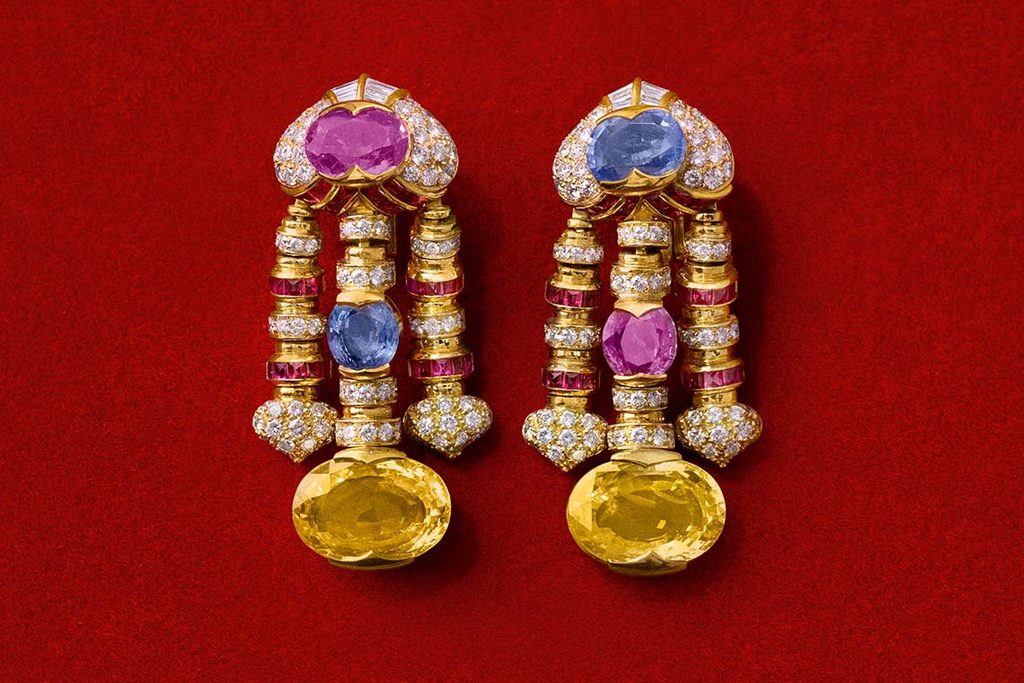
A more technical, craftsmanship-oriented exploration is held in the third chapter, The Power of Light. Examining how light affects perception, Bvlgari appropriated this ability to turn gold, silver and gemstones into ‘living surfaces’. Here, a 1991 gold necklace with amethysts, citrines, pink tourmalines, sapphires, emeralds and diamonds evokes a luminous mosaic where the eye experiences shifting colour values and transparencies. Another highlight are pendant earrings (dating from 1993) crafted with gold, rubies, yellow, pink and blue sapphires, and diamonds that celebrate the vivacity of colour as a result of light interplay.
The final element, and the one through which Bvlgari looks to the future, are the two installations by contemporary artists. “An artist can make us perceive colour differently,” says Aucremanne. “This is particularly important when working across cultures. The artist can reveal something that a theoretical explanation cannot, such as a sensation, a memory, an atmosphere or a psychological response. In that sense, the artist is not simply illustrating the exhibition’s ideas. They are challenging them. They allow colour to escape the systems we construct around it and return to something more intuitive, emotional and personal. The artist becomes a mediator between the visitors and the core of the exhibition.”
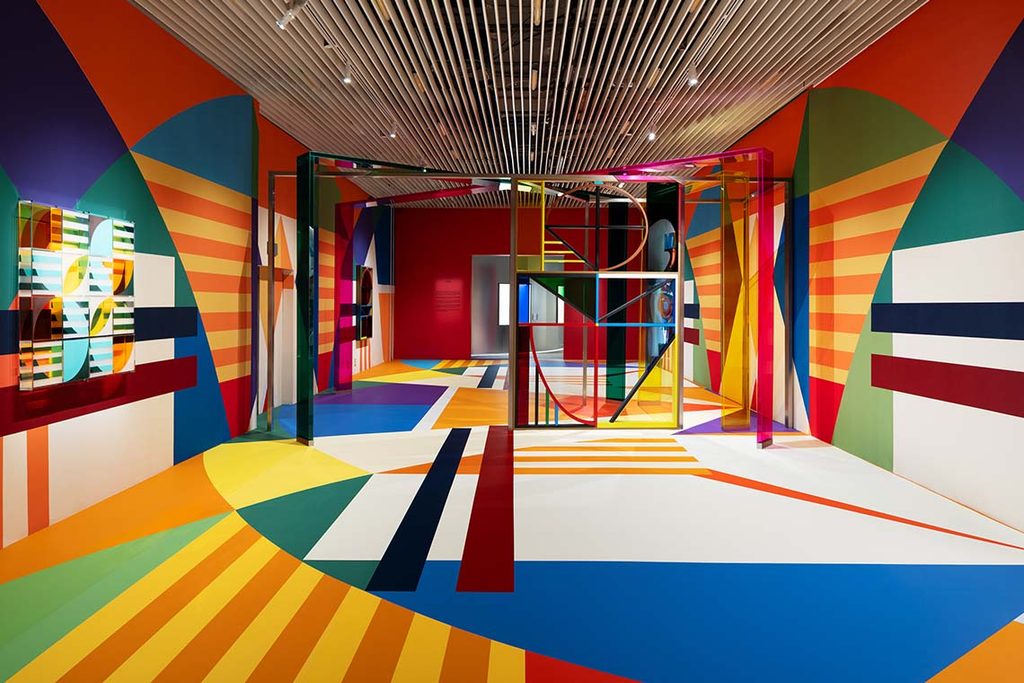
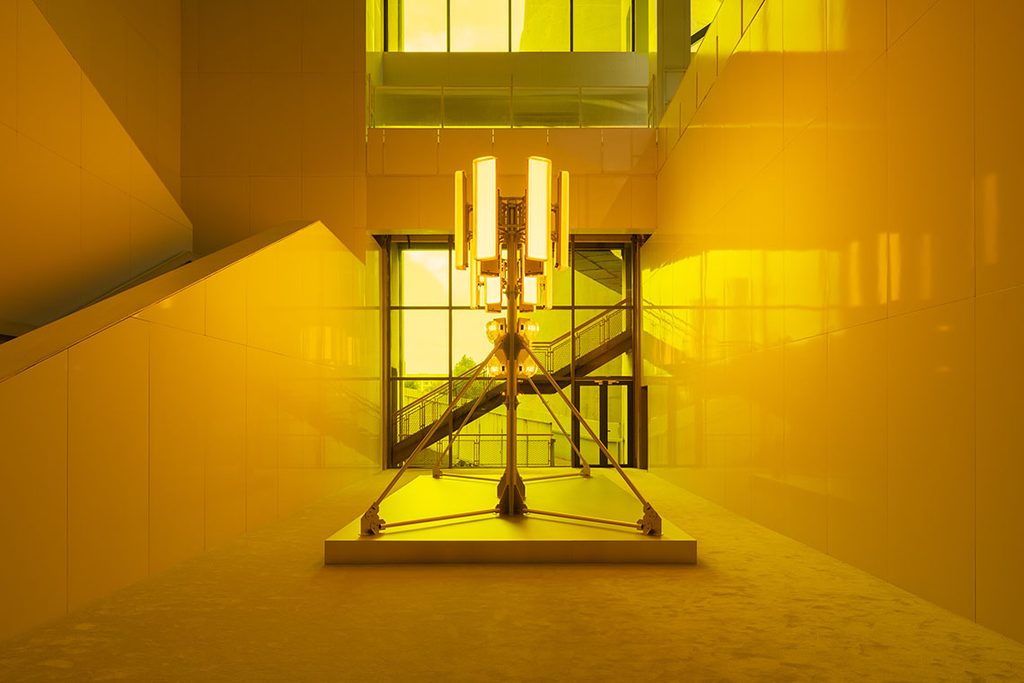
Boundless Synesthesia by Liang Manqi – known for her interest in Chinese geometric abstraction – is an installation that occupies three-dimensional space. Across walls and the floor, therefore placing the viewer in the midst of the work rather than in front of it, colour is used as a tool to produce an environment inspired by the artist’s emotions as well as the rhythms of daily life and the natural world. Meanwhile, contemporary artist Zhang Ding presents The Form of
Light, an immersive work comprising light panels that create a golden glow around transparent humanoid heads made of gemstone-like cut glass. The emphasis on the particular hue allows audiences to reflect on their relationship with light and on the ability of golden hues to evoke sensations of peace, purity and harmony.
Rather than being an exercise in comparing or contrasting individual pieces and works, or in establishing a hierarchy of systems, the most exciting part of the exhibition lies in its ability to generate resonance. Kaleidos invites viewers to consider each perspective as a physical phenomenon and cultural code, revealing the complex relationships between nature, science, society and artistry in singular and globalised contexts. The curation showcases the unique offerings of one epoch or culture and the expanded creativity which results when influences meet, as well as how a natural consequence of artistic output is the documentation and preservation of social and visual history. “Jewellery is an extraordinary form of historical memory because it carries knowledge materially,” explains Aucremanne. “A jewel can preserve a technique, a particular approach to colour or an aesthetic choice. It can also reveal the social and cultural context in which it was created. As sentimental gifts, pieces of jewellery bear the personal story of their former owners. They are a fragment of our human lives. This is why I believe heritage jewellery should not be understood simply as something beautiful from the past.” It is a means to read history, tastes and cultural exchange, not least – as Aucremanne adds – “because jewellery is made to be worn and carries something that many other forms of heritage do not. It was created to enter directly into human experience.”
By documenting the diversity of colour theory and expression through disparate cultures and exploring the nuanced zone of creative amalgamation and exchange, through Kaleidos Bvlgari is continuing its pursuit of opening new chapters for discussion. It is also widening the debate on the role in contemporary creation in advancing the discourse around colour. “Perhaps the greatest misconception is that colour is objective,” observes Aucremanne. “We tend to speak about colour as though red is simply red, but colour is profoundly unstable. It changes according to light, material, context, culture, memory and even the other colours surrounding it. A gemstone can reveal different personalities depending on the light in which it is seen. Two people can experience the same colour while having completely different emotional responses to it. That is perhaps the point at which Kaleidos ultimately arrives, highlighting how we need different perspectives to explain its complete potential. What remains fascinating is the space between colour as a physical phenomenon and colour as a human encounter.”
