

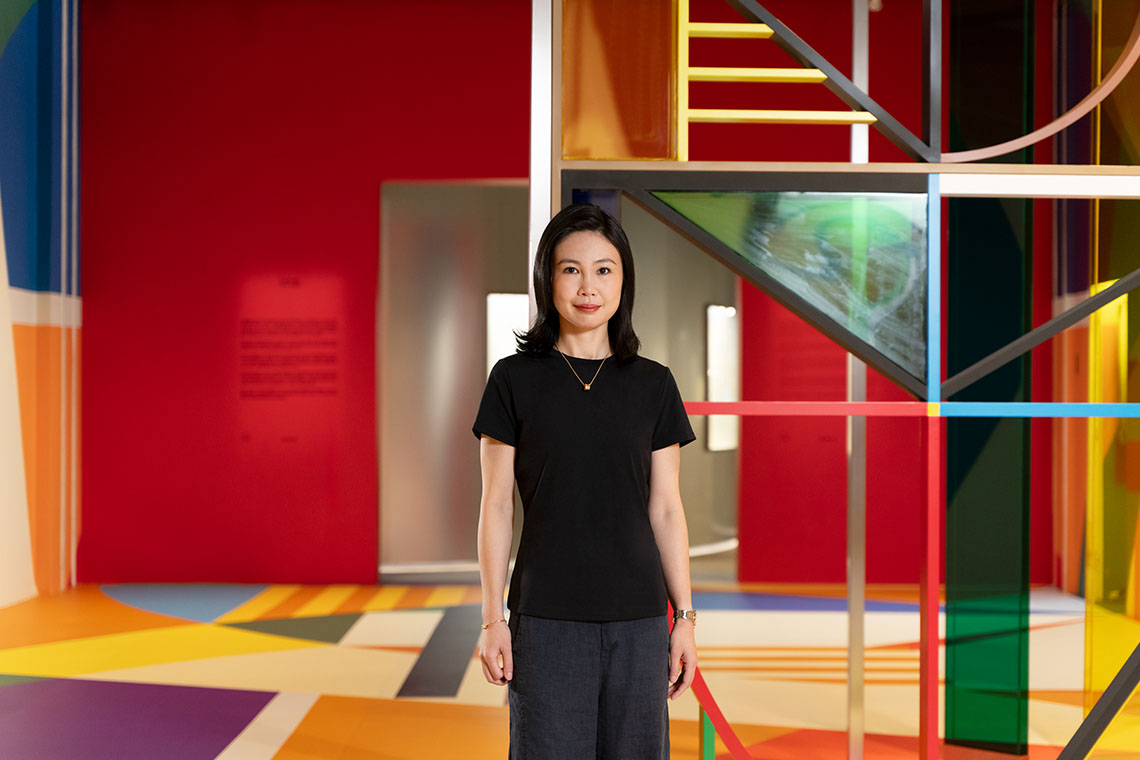
The artist discusses her site-specific work and how colour and light convey the human condition in Bvlgari Kaleidos: Colors, Cultures and Crafts.
Canvas: How do you balance rigid geometric shapes with fluid human emotions in your colour palettes?
Liang Manqi: Everything has form, and everything is formless. Here, ‘form’ can be understood not only as pure geometric shapes but also as rules, boundaries and constraints within society. Living in the present, many of our real feelings are accomplished simultaneously within constraint and release. Balance and harmony do not need to be deliberately introduced – everyone is already dealing with them in their own way, every day.
How do colours communicate emotions that words cannot?
Colour is emotional and intuitive. I don’t overthink my use of colour – I just put it directly on the canvas. When too many colour blocks feel inharmonious, I cover and adjust. When the paint feels too thick and ‘blocked’, I wait for it to dry, then sand it down to make it thinner and ‘unblock’ it. Through the process of painting, I gradually get to know colour and have a dialogue with it.
How do your experiences of daily life and nature influence your colour palette?
In nature, colours change in different weather conditions and natural light spectrums. Under bright sun, colours are especially vivid and saturated whereas on cloudy days there is a natural grey filter – quiet and harmonious.
Is there a particular colour that holds special meaning for you?
The combination of orange and green – when paired at certain levels of brightness – feels very comfortable to me. This is just based on my own experience with colour mixing over more than a decade of painting, I wouldn’t say that it holds any special meaning.
What role do the concepts of spatial depth and overlapping layers play when you create a work or installation?
My understanding of spatial depth differs from the scientific understanding of perspective space. Different colours, the physical thickness of paint, and the layering and sequence of dots, lines and planes can also generate psychological spatial depth. On a two-dimensional canvas, this understanding and expression of space is very subtle. The process is more important than the final visual result.
Can you tell us more about your work, Boundless Synesthesia, for Bvlgari’s Kaleidos exhibition in Shanghai? What inspired the concept?
Boundless Synesthesia is a site-specific art experiment and an exchange of emotional experience. It combines my two-dimensional paintings with new colour-geometric acrylic installations. I chose acrylic because I wanted light to pass through it and refract unexpected surprises beyond the boundaries of the material itself. The hard-edged form instantly becomes formless, transforming in an instant into a flow of emotion.
Why did you choose the title Boundless Synesthesia and what does it signify?
The work is limitless, formless. What the eye can see is only a tiny fraction of the materiality of this world. Transforming and sensing it is what I want to convey the most.
How did you approach transforming painting from a two-dimensional medium into an immersive spatial environment?
I began experimenting with this as early as 2013, with my first project in Hangzhou. I was no longer satisfied with creating only on a two-dimensional canvas – and happened to have the opportunity to try working on a larger, three-dimensional ‘canvas’.
How does this work expand on your current practice?
The initial intention was very simple and direct – it was simply that energy overflowed. Over time, more galleries and museums began to invite me and I gained more opportunities to practice and advance my spatial painting installation.
What does Kaleidos mean to you? How does your work with Bvlgari expand on the exploration of colour?
Radiance, polyhedron, kaleidoscope. I had similar explorations of colour during 2015–18, so one could say it was a meeting of minds.
Do you see the viewer as an observer, a participant or a collaborator in this installation?
Collaborators – they must be collaborators. Without them, my site-specific painting would not come to life.
