

In the Cairo-based gallery’s latest exhibition, six artists use textiles to examine the limits and possibilities in acts of repair.
With a brief and rather cryptic exhibition statement, Gypsum’s latest group show, The Mountain Cannot Repair Itself, showcases the work of gallery-represented artists alongside young and emerging artists who are not (yet) affiliated with it. The exhibition’s focus on textiles is alluded to briskly in the statement and then the works of each participating artist is summarised and explained. The exhibition title already brings to mind the possibility and impossibility of the act of mending, with the idea that ‘stitching’ is not only an act of repair but also of bringing disparate parts together. This latter metaphor perhaps encapsulates the works in the exhibition.
The exhibited works, by a total of six artists, cluster around notions of received memory and the traces that linger, expressed specifically through textiles, whether linens, tablecloths (in the work of Gözde İlkin and Layla Tag), handwoven tableaux (Marianne Fahmy) or elaborate constructions and the marking of space (Aisha Azab and Omar Abd Elbaqi). I struggled to place the work of Rawan Abbas in this constellation. Her fabric tableau and soft sculpture seemed to reference something specific to the artist and her practice, but not immediately perceptible to an audience in the context of this particular exhibition.
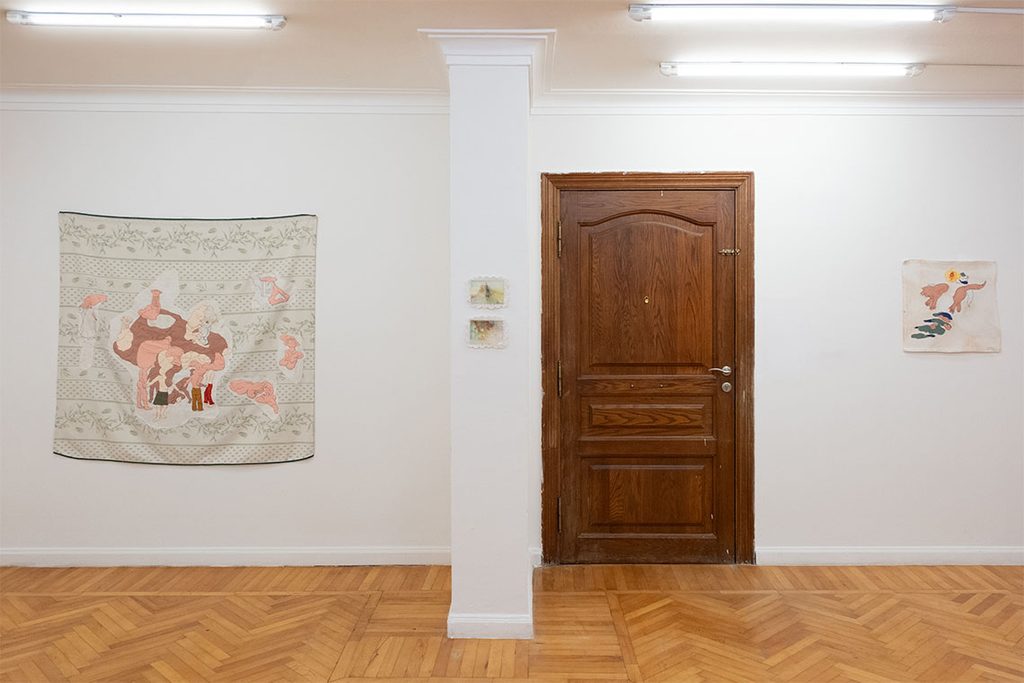
Perhaps the most visually captivating work is that of Layla Tag. The subtle elaborate constructions, in the series WHY DO PEOPLE DREAM? (2024), HOW DID YOU KNOW WHEN TO STOP? (2026) and Wonderfully Damaged (2024), project a significant sense of fragility with their flesh tones and watercoloured abstracted human/floral figures, underscored by a hint of macabre eroticism. There is the feeling of being exposed to something intensely private, and yet the scale, sense of colour and intricate stitching bring back the idea of mending or bringing together experiences and realities that are difficult to integrate.
This dimension is somehow mirrored in İlkin’s appliqué piece, Zeytin | Olive (2019), with its collected fabrics and textile tokens that look markedly personal but which also give an unmitigated sense of warm domesticity. Parts of the fabric, which are taken from tablecloths (and other household items), will immediately remind the viewer of their own childhood and family home. The soft human forms that she weaves against and on top of these fabrics reinforces a sense of intimacy and softness that is both delicate and beautiful.
Certain works bear resemblance and affinity to others. Abd Elbaqi’s Panoptic (2021) echoes some of the work of Shady El Noshokaty (specifically his work Latitude, part of the project Colony, which was exhibited at Gypsum in 2015) and also of Rodeina Fouad, They Fossilized Us (2023–25) and Tapestry of Self (2023). Abd Elbaqi’s more subtle mapping of certain urban elements of the Sayeda Zeinab district in Cairo, on sheer organza, gives a sense of fragility but also of an elusive transparency. Something that is seen and unseen. The stitching of urban forms that look like hybrids on sheer fabric raises the question of their possible survival and visibility.
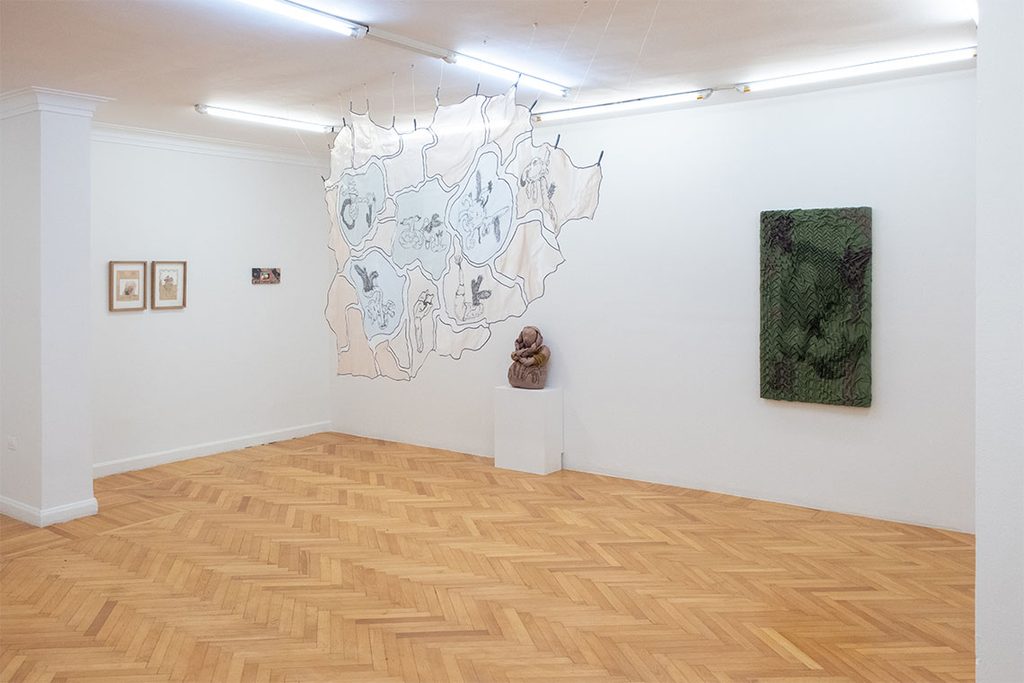
A more private and yet impersonal kind of mapping is Azab’s small-scale abstract, layered mappings in The mountain can’t repair itself (2026). It is a painstaking mapping of a certain geography that is analytical but purposefully private, with what look like secret coded guides to an unknown place. There is a certain interiority to the work, akin to that of Tag’s, but Azab’s piece is visibly more abstract.
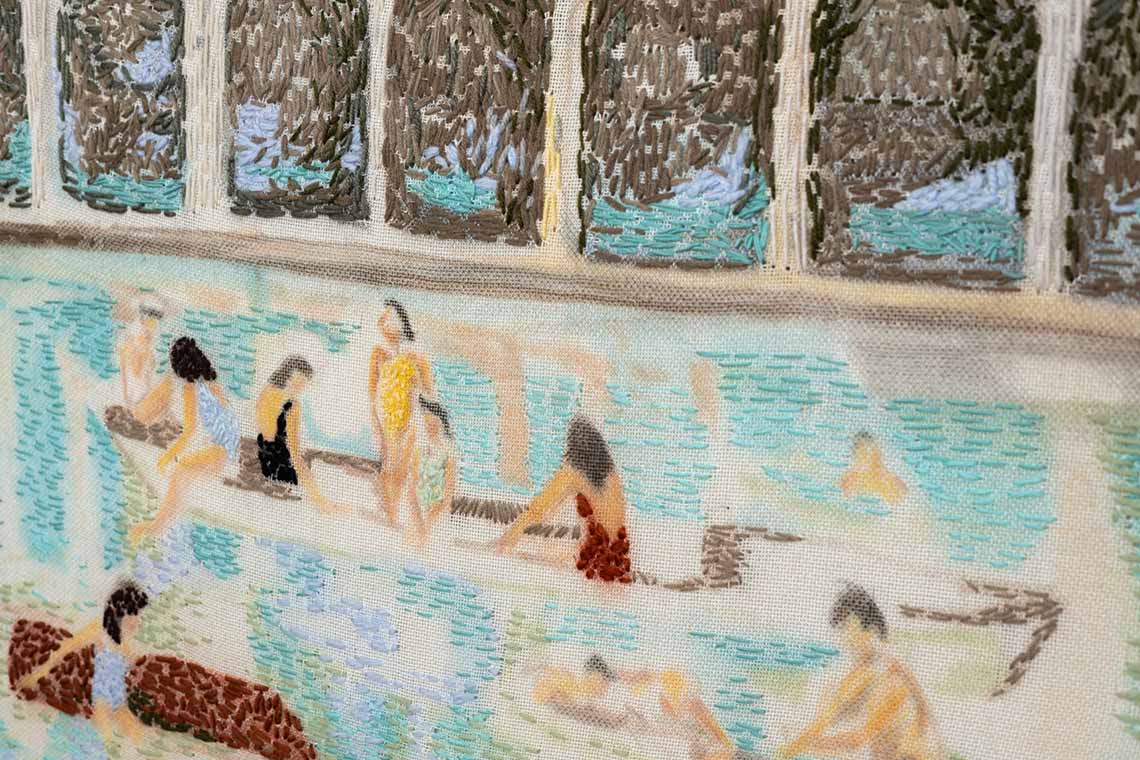
In all of these pieces there is a particular interiority and play with hybridity and form that is at the opposite end of Fahmy’s work. The two large-scale tableaux mimic vintage cartes postales of Alexandria and bring to mind the notion of not only bygone memories but also fantastical future projections of what might become of the past. There is a lightness and space in Fahmy’s embroideries that is a welcome change from the compact intensity of some of the other textiles. Not that her work is less intricate or meticulous, but its stitching technique gives a certain abstracted form of space that suits the speculative element in it. What kind of future can we imagine from a certain point in the past?
There is something to ponder about the mountain as a fault line or as the point where tectonic plates meet, collide or slide against each other and distort the earth’s surface to create different varieties of geological formations. Mountains will eventually wither away, although not at any scale of time that is intelligible to humans. The question lingers, what can we do to repair a fantastic distortion? Perhaps this can be achieved through the simple act of mending, as subtle and meticulous as the works in this exhibition.
