

The opening in Czechia of the NHK Collection for Lidice exhibition marks a welcome opportunity for European audiences to encounter a diverse range of works from Türkiye and Central Asia for the first time.
Thirty minutes by car west of Prague, the greyscale blur of Istanbul’s spires appears proudly in Miloslav Vorlíček’s decentralised curation of 65 artworks donated to the Lidice Art Collection by Turkish-British collector Huma Kabakci. The photograph, Salep’ Seller in the morning light on the old Galata Bridge (1957) by Ara Güler, makes a statement in rural Czechia, where strains of Eurocentric Islamophobia worsen legacies of Western supremacy and ethnic conservatism in the heart of the European continent.
Entitled simply NHK Collection for Lidice, what sounds like an entirely bureaucratic admission of rote programming unfolds with aesthetic and multicultural breadth. The exhibition is a welcome addition to a largely unsung collection that conserves and exhibits a bold sweep of early contributions to twentieth-century art movements, including the Fluxus of Joseph Beuys and the Capitalist Realism of Gerard Richter, Sigmar Polke and Klaus Peter Brehmer.
The in-house curation by Miloslav Vorlíček, head of the collection and alumnus of the Curating Contemporary Art MA programme at London’s Royal College of Art, brings selected works from the Nahit & Huma Kabakci Collection into precious focus. The choice to foreground artists from Turkic-speaking countries bears a peculiar ring in a landscape overshadowed by the city of Prague and darkened by the first documented Nazi war crime.
In 1942, German troops razed the village of Lidice in retribution for the assassination of leading Nazi official Reinhard Heydrich, in the process executing nearly 200 men, orphaning children and sending women to the infamy of the death camps, from nearby Kladno to Ravensbrück and Auschwitz. Since its founding in 1966 by British philanthropist Sir Barnett Stross, the Lidice Art Collection has exemplified international revitalisation efforts and the value of cultural resistance in the face of gross inhumanity.
Vorlíček, who is also from a small Czech village of some 100 people, has upheld the spirit of the collection, which garnered public attention and art historical importance almost immediately when René Block responded to Stross in 1967 to make the collection relevant. At great personal risk, Block packed his Volkswagen van with art by Beuys, Polke, Richter and others before driving into Communist territory and thereby transporting the German avant-garde to the Eastern bloc.
By spiralling out further eastward, NHK Collection for Lidice challenges the art world of Czechia to look beyond its usual frames of reference. Foregoing nationalist, Western canonisation and the fleeting contemporaneities of the market, it offers a refreshingly comparative insight into regions whose artists are often overlooked, from Türkiye to Kazakhstan – a sentiment familiar to Czech artists as part of the greater Slavic region of Central Europe and the Balkans.
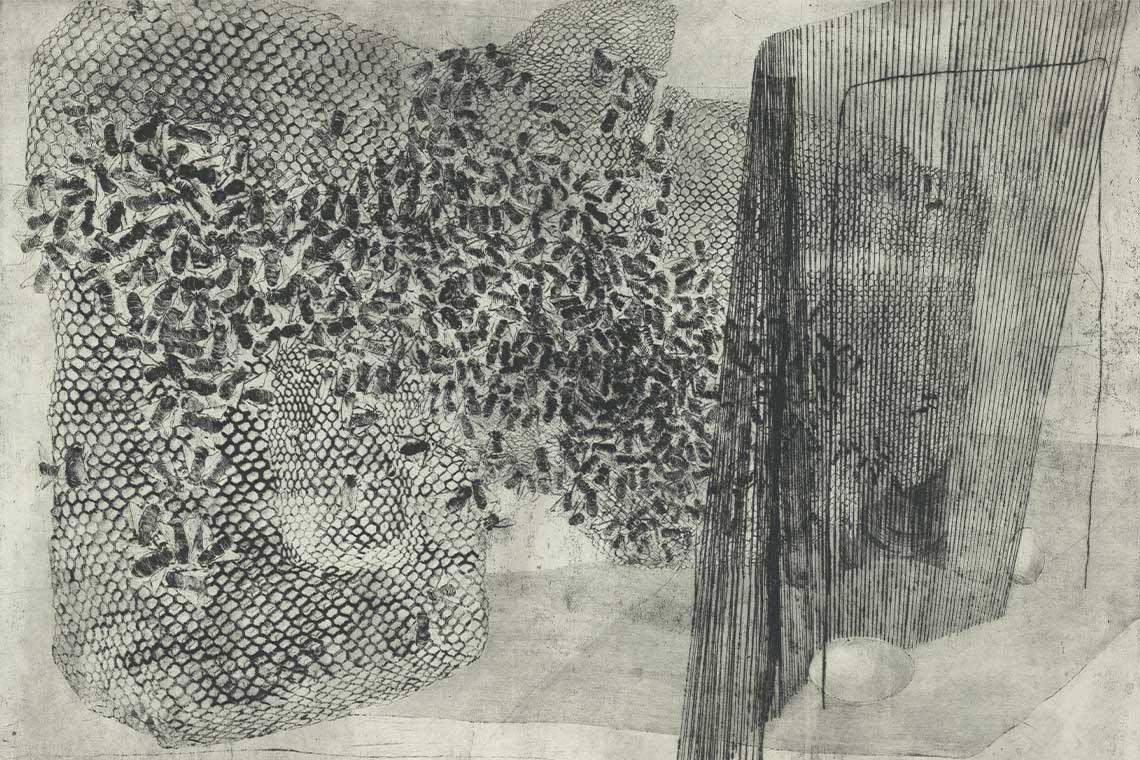
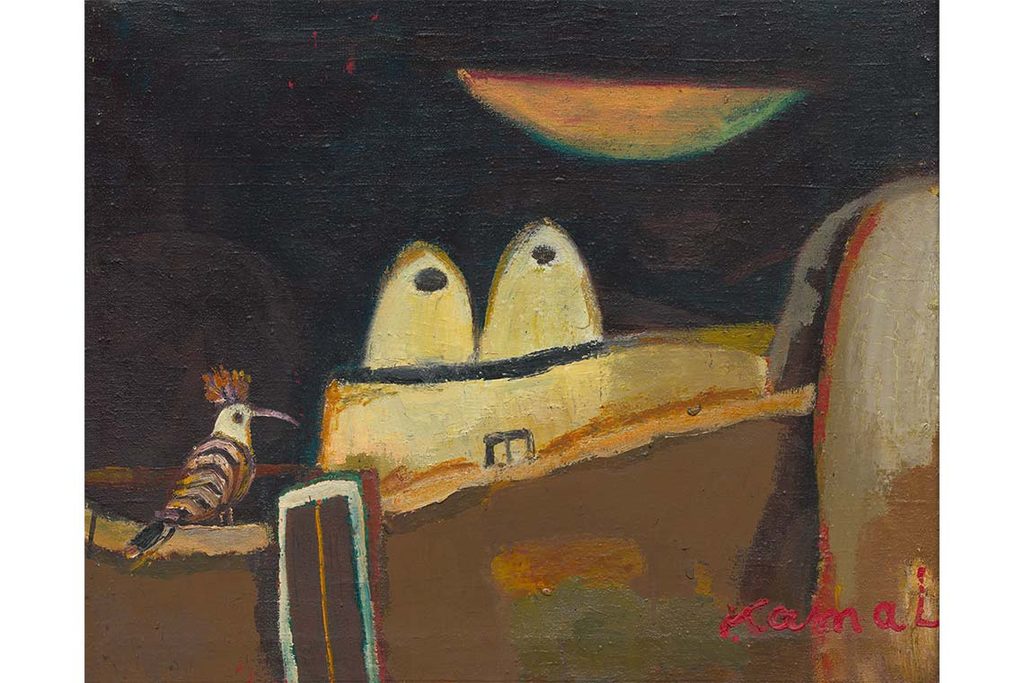
Immediately once inside the Communist-era gallery, ostensibly the largest edifice in the village, Untitled (2000s) by Azerbaijani painter Kemal Ahmedov conveys an expressionist talent with a range that buries the social realism of the Soviet Central Asian political order under a moonlit, architecturally organic view, a bird prominently perched on a wall, stargazing alone in a village. Beside it, Untitled (1987) by local Czech artist František Burant, which Vorlíček chose from the house collection, has a resonantly bucolic air, as a bee spreads its wings over a face-like comb of honey. The print, like Ahmedov’s oil on canvas, adapts the countrified, naturalist gaze with an emotional charge, one nostalgically dystopian and with a whiff of the post-traumatic lingering.
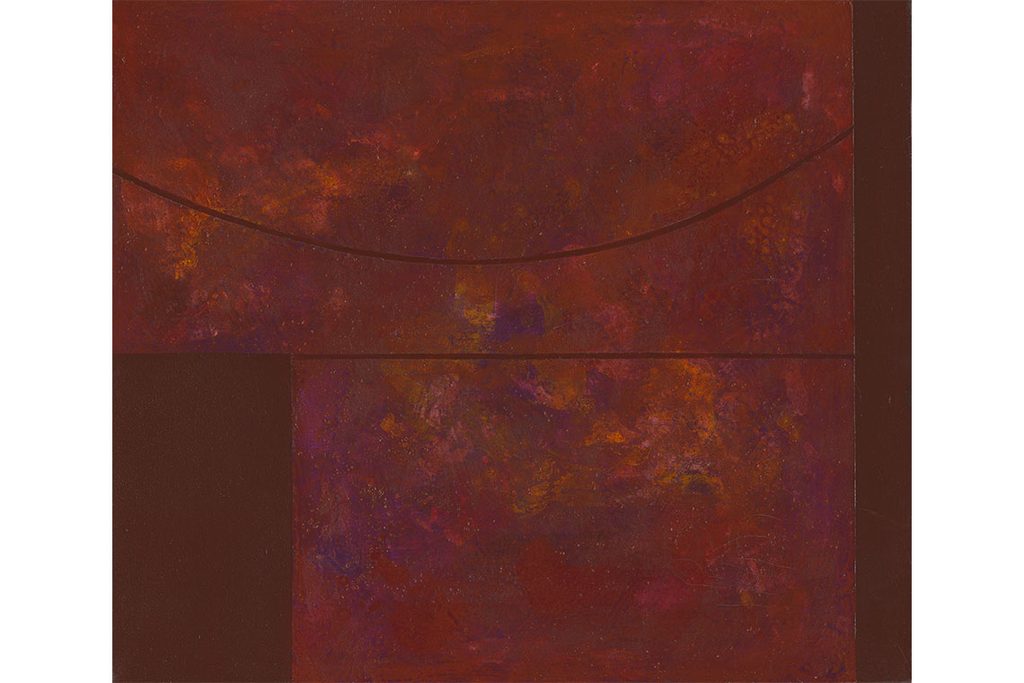
Figurative compositions only scratch the surface of Vorlíček’s curation, tactfully installed on wooden shipping crates to emphasise the very recent, welcome arrival of the donation to one of Europe’s more eccentric public collections. Abstraction abounds, whether in the clouding of glossy acrylic under a span of lines in Turkish painter Devabil Kara’s Resistance (2007), petroglyph-reminiscent globules of entomological antennae in Untitled (1990s) by Baku-born Altay Sadıkzade, or the crowded chaos of broadly-stroked oils in White Pulsation on a Green-Blue Background (2000) by Kazakhstan-based Uighur artist Isa Abdulkerim. The show’s range of contrasts transcends prosaic representations of cultural geography in favour of personal visions of ineffable, human transformation.
Yet, there are nods to the history of the image and the word as their forms have descended into the amorphous mutabilities of modern art since the fall of the Berlin Wall. Particularly indicative is Malevich Marlboro (1988) by Russian-American artist Alexander Kosolapov, a darling piece for Vorlíček, who admires its iconoclastic play on both Capitalist and Social Realism. There is an omnipotent irreverence in the show under Vorlíček’s roving eye, critical of ideology – whether of the East or West – and in search of more universal, artistic liberations.
Far from shifting abruptly from abstraction to modernist abandon, with the NHK donation the Lidice Art Collection is emboldening its mark on the global art map in line with its historical focus. Such pieces as those by seasoned feminist Turkish artist Ipek Duben, Kosovo I (2010) and Kosovo IV (2010), retrace seams torn by displacement in the face of armed territorial conflict. Her framing of prints on wool as delicate as flesh, battered and scarred, are no less alive than the faces they portray. By homing in on the Balkan country with tenuous recognition and embattled sovereignty, Duben’s work is a stunning reflection of the nonlinear geography of the greater Eurasian region whose artists grapple with both Western and Eastern assimilations, articulating the aesthetics of peripheral emergence in the throes of late capitalist globalism.
NHK Collection for Lidice runs until 7 March 2027
