
The 16th Gwangju Biennale, under artistic director Ho Tzu Nyen, alongside curators Che Kyongfa, Park Gahee and Brian Kuan Wood, brings together 43 artists and groups at a single site, in a journey of understanding and embracing change.
On the surface, the Gwangju Biennale’s title – You Must Change Your Life – is a bold suggestion. Yet underneath is more of an observation, or declaration, as change takes place whether you like it or not. It happens at varying speeds and scales: at a glacial pace, as an accumulation or even unnoticed. Equally, it could be a violent eruption, with great intensity, happening in a flash.
Inspired by the last line in Rainer Maria Rilke’s 1908 poem Archaic Torso of Apollo, artistic director Ho Tzu Nyen describes a moment when the poem reframed his perception of life, and how this has been translated into the context of Gwangju. The city was the location of the 1980 Gwangju Uprising, when nearly a quarter of a million people protested against the military government in an act of resistance seen as a pivotal moment for South Korean democracy. “Rilke’s poem begins with an intensely personal encounter between one viewer and one work of art,” Ho shared at the opening press conference. “Transplanted into the rich soil of Gwangju, a city of democracy, a city shaped by change, that inward transformation inevitably opens towards something more collective… The question is no longer simply how I might change my life. It also becomes: how do our lives change one another? How does individual transformation connect to collective transformation? How do solidarity, history and shared experience alter what a life can become?”
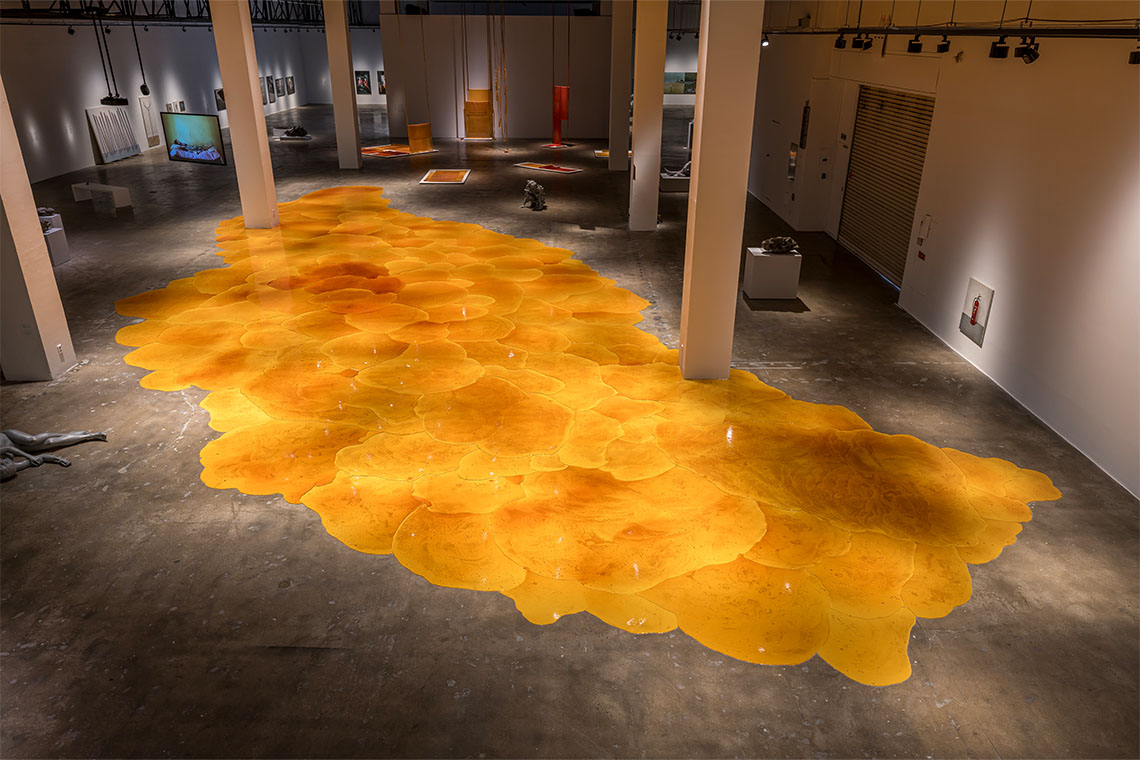
Echoing this collective spirit, E Roon Kang’s banners and posters, Image-Poems (2026), punctuate the biennale site and across Gwangju, with four-line texts generated using the participating artworks and Rilke’s poetry as prompts, engaging the entire city in this dialogue. More specifically, the biennale is divided into five sections, posed as five different worlds of varying scales and atmospheres. The first gallery hall is called Molecules and Me and is flooded with an amber hue from Goldin+Senneby’s Resin Pond (2026). Two tonnes of pine resin are spilled across the centre of the space. The substance is the tree’s protective toxin, immune response and repair barrier, but the overflow of the material also alludes to autoimmunity and a body at war with itself. Something meant to protect becomes altered and suddenly excessive, in turn causing harm. Similarly, dotted around the same hall rocks from the Volcanoes of Jeju, which are listed as participating ‘artists’ in their own right, and are remnants of a slow build-up in geological pressure that swiftly turned violent. Now frozen moments, they exemplify both an act of slow accumulation and the shock of a sudden outbreak.
Bodies and Bonds, the second gallery hall, follows on as a natural progression in scale, and explores how bodies and relationships are shaped by repeated actions, family, society, political forces, illness and ageing. It underscores that changes over a long period of time often go unnoticed until documented or challenged, and as Ho shared during a tour: “Think of the faces of the people we love, the people we see every day. Their faces are constantly changing. Yet precisely because this change is continuous, we hardly notice it.” Mona Benyamin’s single-channel video, Trouble Again (2018), stars the artist’s parents in an investigation into humour as a coping mechanism for dealing with the trauma of the Nakba and Israeli occupation. The two appear as if they are in a sitcom, complete with a laugh track, monotonously reading jokes that get progressively darker. İnci Eviner’s video National Fitness (2013) examines how modern architecture, national identity and official ideologies shape perceptions of the body, while Nursing Modern Fall (2012) delves into how modern architecture imposes systems of space and knowledge while suppressing cultural differences. The moving figures in both works challenge the constructs and controls imposed on the body through repetition and movement.
Tehching Hsieh’s written statements of intent document the artist’s five One Year Performances and Thirteen Year Plan, running consecutively from 1978 until 1999. For each performance the artist shared a signed declaration outlining the clear rules of each piece, with each requiring commitment, body and mind to complete; for example, “I shall stay OUTDOORS for one year, never go inside…” or “I shall punch a Time Clock in my studio every hour on the hour for one year…”. Each sheet of paper documentation maps the passing time in a material form and serves as a repetitive dedication to creating art and pushing the limits of the body.
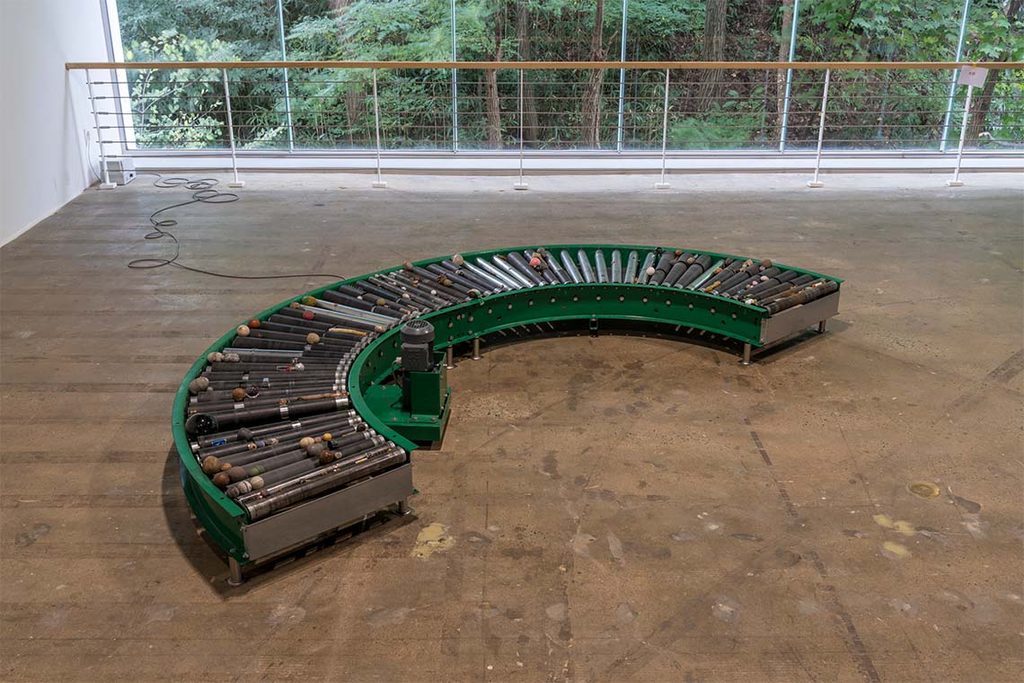
Expanding the scope further, the third gallery entitled Landscapes and Learning extends beyond the human as the land becomes a marker of time – tides, agricultural cycles, changing seasons – and how in turn we learn from fluctuations. CAMP’s large-scale video installation Bombay Tilts Down (2022) accumulates footage from a single CCTV camera during the Covid-19 pandemic, as the recordings are not only a tool of surveillance but also of learning. The rooftop site looks over the city to reveal a landscape cultivated by time and warped by landmarks, roads and geographical formations, as well as its inhabitants, labour, history and memories. Nina Canell’s Necromancer (2026) is a conveyer belt filled with pebbles, bones, lighters, dice, coins and more, as natural materials and human waste revolve endlessly, trapped between the rotating rollers. The futile motion allows the objects to coexist in a repetitive cycle as a commentary on the relationships between human traces, mechanical systems and living with the land.
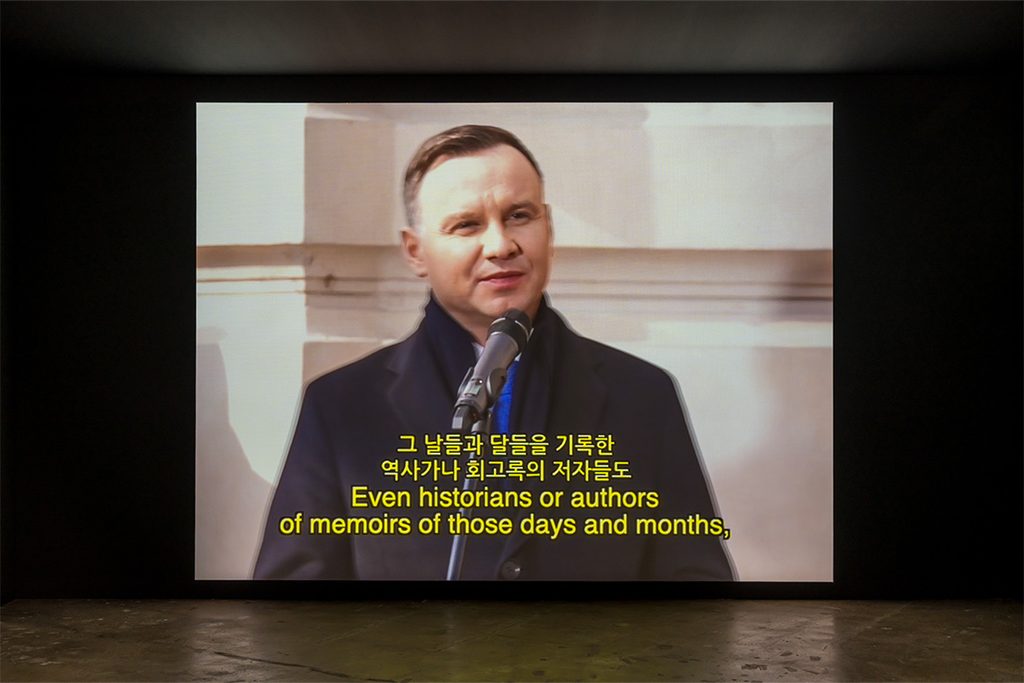
There is also a more sinister tone, as learning and shared knowledge can enforce predictability and patterns, be hard to break free from or see beyond – unless we actively decide to change. James T Hong’s Apologies (2012) brings together videos of political and religious leaders in a collection of public apology videos. The nearly 11-hour film layers years of regret from 200 notable figures and, perhaps through this repetition, questions authenticity and asks if it is possible to learn and move forward.
On what is perhaps the largest scale, the fourth gallery – Cosmos and Change – goes beyond Earth to the universe and encompasses concepts such as life and death. In Lu Yang’s DOKU the Self (2022), DOKU the Flow (2024) and DOKU the Creator (2025), the artist’s avatar traverses past, present and future in a moral and spiritual pursuit and test of self across time and space. Saodat Ismailova’s film Melted into Sun (2024) traces how memories survive, are fragmented and reshaped over time. Melvin Moti’s On a Clear Day (2021–26) highlights the fragility of life, as the work was developed while caring for his partner with a chronic illness. The film features frogs as the main characters, with a repetition of the phrase “now I breathe”, forcing attention to one’s own breathing, body and existence. The final gallery, much like Moti’s work, brings us back to reality in Air and Articulations. As the curators note, it was conceived more as an epilogue and a wall between worlds, with Jacqueline Kiyomi Gork’s monumental installation Not Exactly BPM (Variation Rrose) (2026) becoming this wall, literally and physically. Plastic barriers inflate and deflate to form a maze, with smoke machines and multi-channel music creating a club-like atmosphere as the experience sharpens one’s awareness of body and space.
Across the biennale, movements – whether large or small – are framed by acts of gradual repetition or sudden transformation to underline the importance of recognising the inevitable. How we experience the changes that we are faced with is one thing, and not entirely under our control. However, how we understand their implications, and what decisions we take as a result of such knowledge, is a different matter entirely. The biennale’s artists provide some useful pointers in this respect, challenging us to take personal accountability in a fast-changing world where none of us can hope to remain immune.
