

The latest edition of the Lyon Biennale strikes a particularly timely note as it interrogates the sense and reality of what we see before us and questions our own states of mind.
Synchronised gunfire welcomed me to Gerland, one of the Lyonnais districts grappling with drug-related conflicts and part of a city lately racked by student demonstrations and outbreaks of unrest. A woman’s wailing echoed as I walked through the gates of Les Grandes Locos, the repurposed industrial complex that is now one of Lyon’s most important cultural venues. Tethered to an earnest expansion of the ‘principles of poetic economy’ first developed in the 1960s by the artist, filmmaker and activist Robert Filliou, more than 118 artists have gathered for the 18th Lyon Biennale. Under the theme Passer d’un rêve à l’autre / To pass from one dream to another, directed by curator Catherine Nichols, they are questioning “What is inherited and owed, cared for and desired, made, exchanged, used up and passed on.”
Shifting from one style of perception to another, passageways – or traboules – connect all 11 venues of the biennale. In her curatorial engagement with Lyon’s long history of circulation, Nichols reflects on Walter Benjamin’s unfinished Arcades Project, where he “explored how material history and collective dreams become entangled, and how imagined futures that were never realised persist within the present.” To pass from one dream to another, as she explains in her essay, “involves a moment of awakening”.
The moment of my own awakening came as the gunshots began again. What I perceived as a restaging of violence was, in fact, a Māori ceremonial call of welcome. In The Usual Cries of Welcome (2026), Ashleigh Taupaki retraces the approach of Ngāti Hako members summoned before a rūnanga, or pan-tribal council, in 1879. Close by, Taupaki laid tree trunks cut into many halves in the gutter, arranged in the form of a fallen Kahikatea, the tallest indigenous tree in Aotearoa (the Māori term for New Zealand).
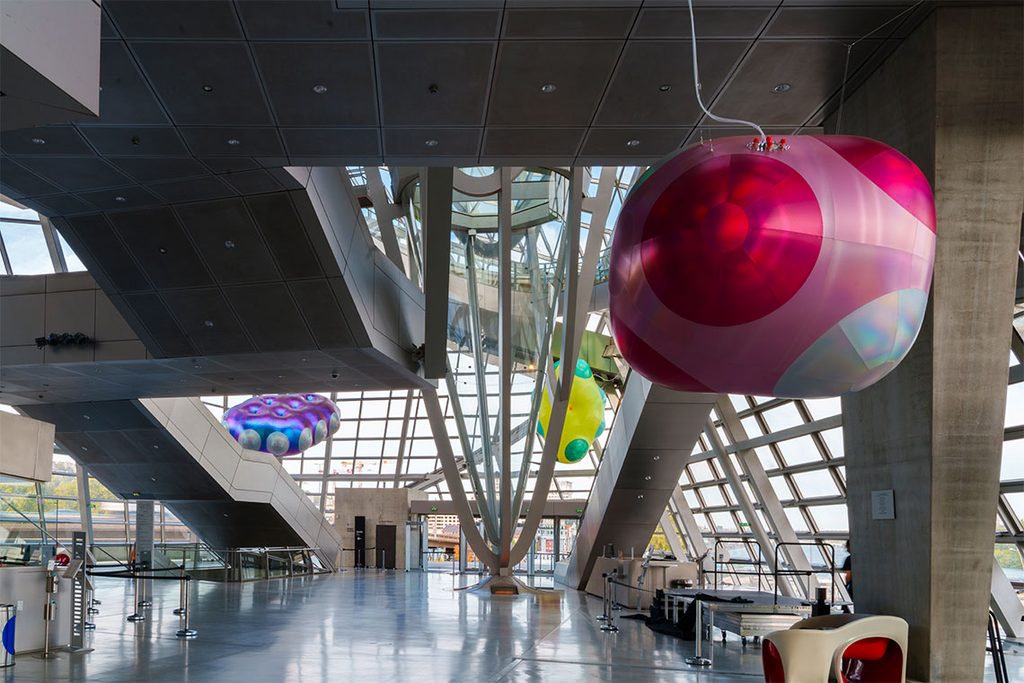
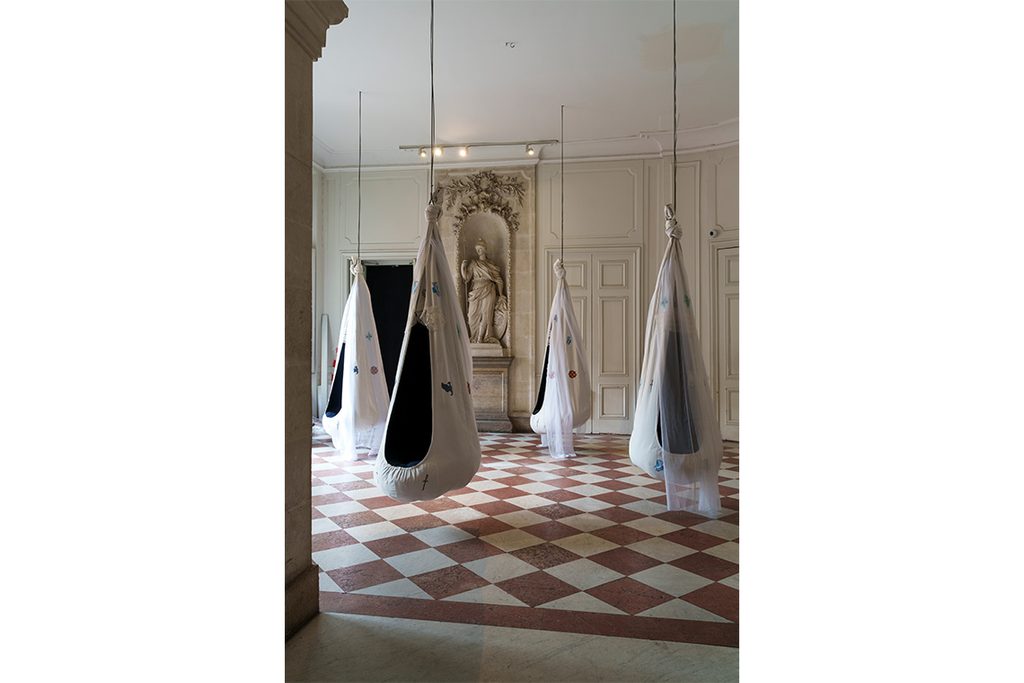
Still at Les Grandes Locos, from a distance, Luz Broto’s Put Oneself in the Place of the Other (2026) served as instruction before entering the building: “When you arrive, put your keys on the table. Take a set of keys that are not yours to go sleep in that house tonight.” As I moved to the other venues, passing through the river, I caught a glimpse of Monira Al Qadiri’s inflatable sculptures of molecules, BENZENE FLOATS, through the glass walls of the Musée des Confluences. I saw another Luz Broto billboard, shouting in bold serif, in French, this time at the Musée des Tissus et des Arts décoratifs. Somehow, I hoped to see non-textile works, or less of them. But, as predicted, textiles across different contexts, scales and colours hang at varying heights. Silks are blue and embroidered in gold. Jacquard is imprinted with data. Fraying rugs, colourful tapestries and other over- and underwhelming fabric installations. There are cotton hammocks commissioned from Lyon’s Armenian community by artist Lucia Kagramanyan, Oror. Women’s song for the future. (A cradle, a sanctuary) (2026). Evoking both womb and cradle, turning into intimate space for rest or, in my case, a nap. It was there that I began to question the earnestness, if not softness, of this biennale.
I think of the hammocks, chairs and interactive installations begging an audience to take a rest. Nichols asks, referring to Filliou’s poetical economy, “What if value were measured not by profit but by creativity and play, imagination and generosity?” But what happens when generosity overburdens itself and circles back into profit? Should we doubt the generosity offered to us, by way of translations, themes of healing, a diversified artist list, and so on and so forth, or should we remain comfortable eating it all up?
As if sounding an alarm, Robert Filliou’s handwritten project woke me. At MAC Lyon, where many of his works are on show, he writes “You wherever you are”. I found myself coasting through the exhibition as though navigating a traboule. Pausing to see several works, I stumbled upon an archival passage of photographs, garments, advertisements and essays that led me to Archana Hande’s rotating light sculpture Weaving light (2009–2023–2025). I also walked through unpicked, unravelled rugs by Ouassila Arras. There was Pol Taburet’s bronze sculpture Papa (2025), which bore traces of the fears and desires of the legendary figure Papa Tonnerre, and somewhere I saw a hole punched through a wall, leading to a tropical landscape. Some cats were encased, too, and birds? These works upheld contradicting, if not perplexing, material history. What is actually being cared for here? What is merely being used up?
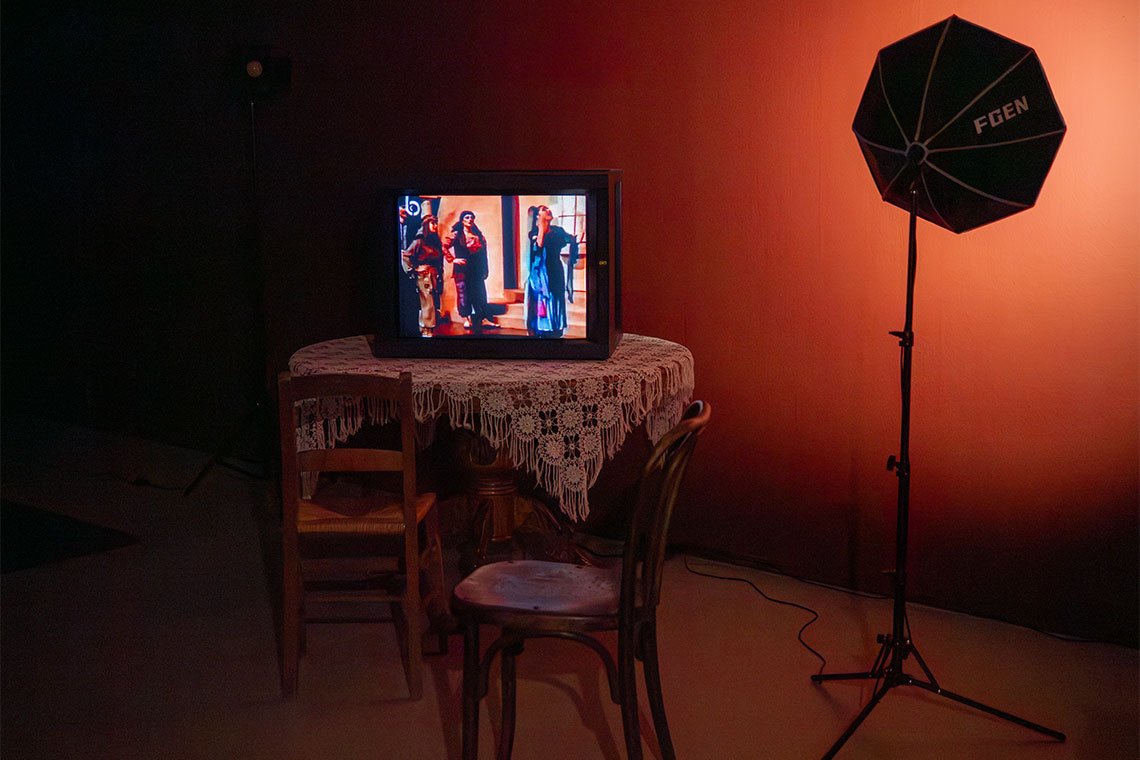
Retracing my steps, I examined Yasmeen Al Daya’s Embrace (2024). A small unfired clay sculpture, vitrined and spotlit, all its sides reflected on glass. A human form shrunk to be held in one hand, crouched in a foetal position. The tiny work in front of me was apparently made amid – and I quote the wall text – “[the] humanitarian crisis and destruction in Gaza following the strikes and military operations carried out by the State of Israel after the Hamas-led attacks.” The work was a replica. Is this what curatorial generosity looks like? Can artistic gentleness flatten radical art as it pursues political correctness? When institutions sanitise violence and crisis, are they protecting their own economy? At the Institut d’art contemporain, Lebanon’s collapse is examined in Disappearance Is Not Death (2026) by Joyce Joumaa. Revolutionary figure Youssef Bey Karam, along with his beliefs, writings and exile, becomes the film’s focus as it questions connections between memory and crisis, sovereignty and self-determination.
Eventually, I went back to Les Grandes Locos. Eventually, I found the biennale’s rough, radical edges. Installations are massive and moving, gigantic and consuming: a well-thought-out, well-arranged, seamless curatorial cluster of chaos. There is an aftermath of a rave, long ropes suspended, balloons, newspapers, office workers, a hand, a fish, a bicycle, a billboard. A dream passing into a dream. I walked through a salon and eventually ended up in front of a leather jacket pinned with a dead butterfly. In front of it was Samuel Georgy’s film installation, Life Is Difficult (2026), where a crying man was being shaved bald. A mirror presented itself, and I began to understand what I was looking for: a wake-up call. Or, honestly, the exit.
Walking out of the gate, the same gunshots woke me from a fever dream, leaving me questioning whether it was better to drift into an altered state of mind. Biennales, after all, are not established to answer queries, so I left carrying more questions. Is this dream merely a curatorial anaesthetic, a way for institutions to avoid dealing with realities outside their doors? Or are we too deep in doom that all we can ever do is dream?
The 18th Lyon Biennale runs until 13 December
