

A group exhibition by Tabari at London’s No.9 Cork Street contends with what persists of our energy and presence after we have departed.
What is left when the light goes out? Where do we go once our time on Earth has come to an end? Tabari’s latest exhibition at Frieze’s No.9 Cork Street grapples with these questions, attempting to capture, through various media, the essence of what remains in Afterglow: From the Residue of a Departed Sun.
The four participating artists, Maitha Abdalla, Omar Kholeif, Mohamed Monaiseer and Randa Maddah, “turn to the unseen, to radiance that outlasts its source. For all their reckoning with mortality, they extend the possibility that what ends on Earth resumes elsewhere”, as explained on the wall text debuting the exhibition on the first floor of the gallery.
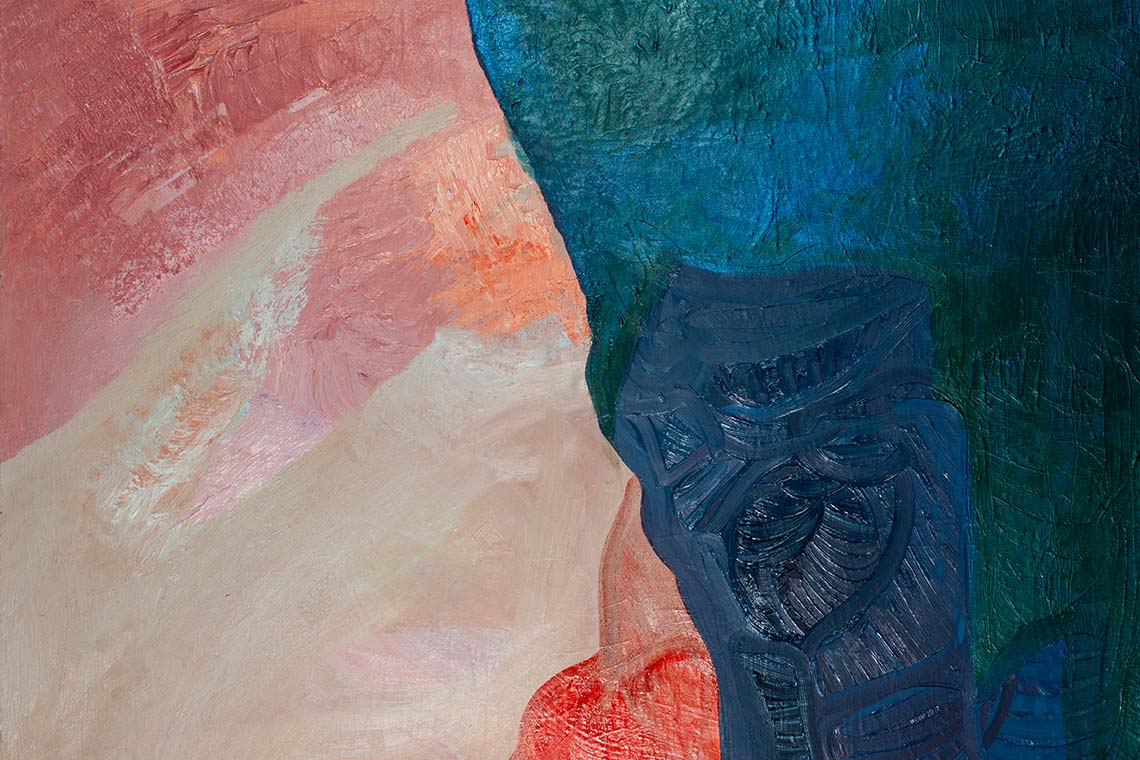
In a large, brightly lit room with warm wooden floors, the first half of the exhibition unfolds as a conversation between the practices of Abdalla, Kholeif and Monaiseer. Colourful textured oil paintings by Kholeif dominate the space, filled with fluid lines and amorphous forms that straddle the human and the natural world. The shadowy forms bring to mind both the imprint of a departing person and the shapes found in a setting sun, a shadowy landscape or a tangled garden.
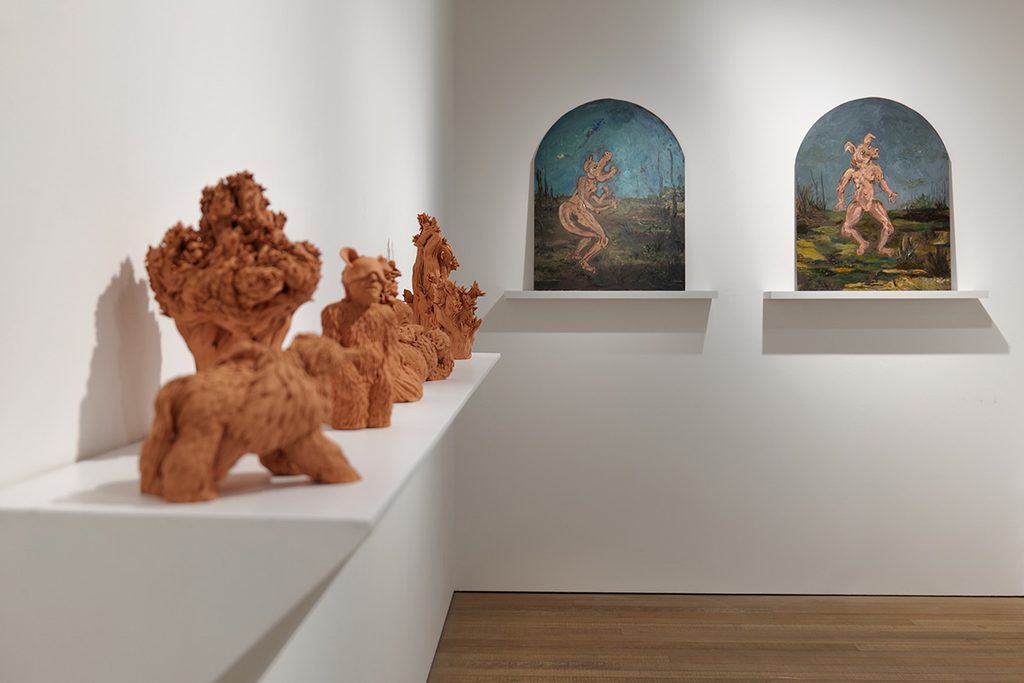
Scattered among these are smaller paintings by Abdalla. Despite their size, they command attention amidst their larger counterparts, with each depicting hybrid beings that are somewhere between animal and human. Inspired by the local folklore that was part of Abdalla’s upbringing in the UAE, these characters embody an altogether more frantic energy than Kholeif’s pieces. In one, what appears to be a naked figure kneels by the edge of a dark forest, the placidity of the pose broken by rough strokes of paint and charcoal. In another, a pig with the breasts of a woman appears distorted, as though writhing in pain and in confusion at its existence, while elsewhere a man with the head of a wolf howls at the distance as he sits alone in a chair in the wilderness.
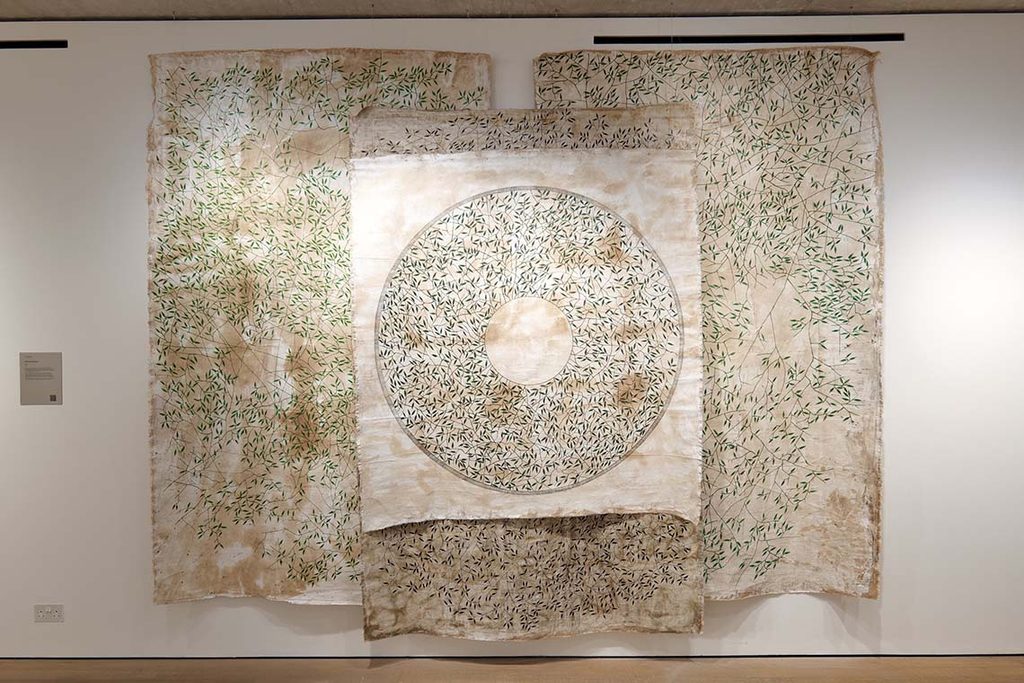
If Kholeif’s work captures the subtlety of what is left once we are gone, that of Abdalla incarnates a slightly more restless state. This is tempered by the large-scale work of Monaisser, which stretches out over almost an entire wall of the room. Carefully drawn leaves adorn four shrouds that look almost stained with earth, like one might find underneath an olive tree during the harvest season. The centrepiece features two circles inside a square cut of fabric, a reference to the patterns found in Islamic geometry. The installation continues the artist’s exploration of the threshold between life and death, known as barzakh in Islamic cosmology, echoing the liminal spaces in Kholeif’s oeuvre.
Although materially and gesturally at odds with the work of both Kholeif and Abdalla, Monaisser’s shrouds find their counterpart in a second, smaller room in Randa Maddah’s sculptures. Made from clay, these humanoid figures dot the gallery space, covered in what looks like plumage or leaves, blending in with the numerous trees that Maddah has created. These figures, inspired by the belief in the artist’s home of the occupied Golan Heights that, after death, the soul reincarnates in a new form, bring the soil of the Earth physically before us, to propose – as Abdalla does – that the space between is deeply rooted in the more elemental and primal facets of existence.
None of the works in Afterglow: From the Residue of a Departed Sun is labelled, though a poem is displayed near each piece by Kholeif. All authored by the artist, these evoke themes of loss, longing and the pain of remembering in what is presented as a verbal embodiment of his paintings. In the first room of the exhibition, they risk propelling Kholeif’s practice into being the focal point of the whole show, but as one reads the poems they start to serve as guides to the exhibition in its entirety, touching carefully upon all that endures after a departure.
“Plumes and plumes and plumes and plumes”, Kholeif writes in The Flood, near Monaisser’s scattered leaves but long before visitors encounter Maddah’s feathered plant beings. In Lover’s Afterglow, the artist and poet recounts: “An ancestor once told me/ that the fox kept/ our secrets–in the shadows, bore it in their enigma/from which we could not return.” In the evocation of the trickster, a figure found in many ancient tales around the world, Kholeif’s imagining of the afterlife joins that of Abdalla in a space where what lingers exists in the space between two realms, navigating it more swiftly than mere mortals can comprehend.
Afterglow offers multiple, if not always cohesive, propositions for what comes to pass after we or those around us have left this world. Its title is perhaps the most misleading element of all, conjuring up images of the warm residue of a setting sun while the contents of the exhibition suggest numerous far less peaceful alternatives.
Afterglow: From the Residue of a Departed Sun runs until 22 November
