

The Palestinian artist’s latest solo exhibition at NIKA Project Space in Paris continues her exploration of the role of food in preserving culture, while honing in on the diasporic experience.
Palestinian artist Mirna Bamieh melds food and storytelling, creating an on-the-record registry of cuisine and tradition. She has spearheaded Palestine Hosting Society since 2018, drawing from generational recipes to both honour – and reactivate – regional foods. Her present exhibition, Sour Things: The Door, is part of her ongoing and committed gesture towards preserving culinary practices, especially as they become ever more complicated by geographical displacement.
Curated by Anne Davidian, the show is on view at NIKA Project Space, nestled in a cluster of galleries outside of central Paris in Romainville. Davidian, who curated the Pavilion of Armenia at the 59th Venice Art Biennale, notes that the “diasporic voices gathered in the filmed conversations testify to persistence of tastes, recipes, forms of transmission that predate and outlast borders.”
This show follows up on Bamieh’s solo presentation, a series of ceramic wall pieces and suspended ceramic objects, which inaugurated NIKA Project Space’s Parisian arm in 2024 (acting as a sister space to the headquarters opened in 2023 in the UAE). “Bamieh zoom[ed] in on the pantry, an essential and forward-looking space in the home, intended to provide sustenance during times of scarcity and seasonal shortages”, per an accompanying exhibition text by Nat Muller in 2024. More widely, the gallery focuses on artistic practitioners from the Global South; Bamieh’s exhibition, founder Veronika Berezina writes, reflects that “preservation is not only about the past, but about protecting the possibility of continuity.”
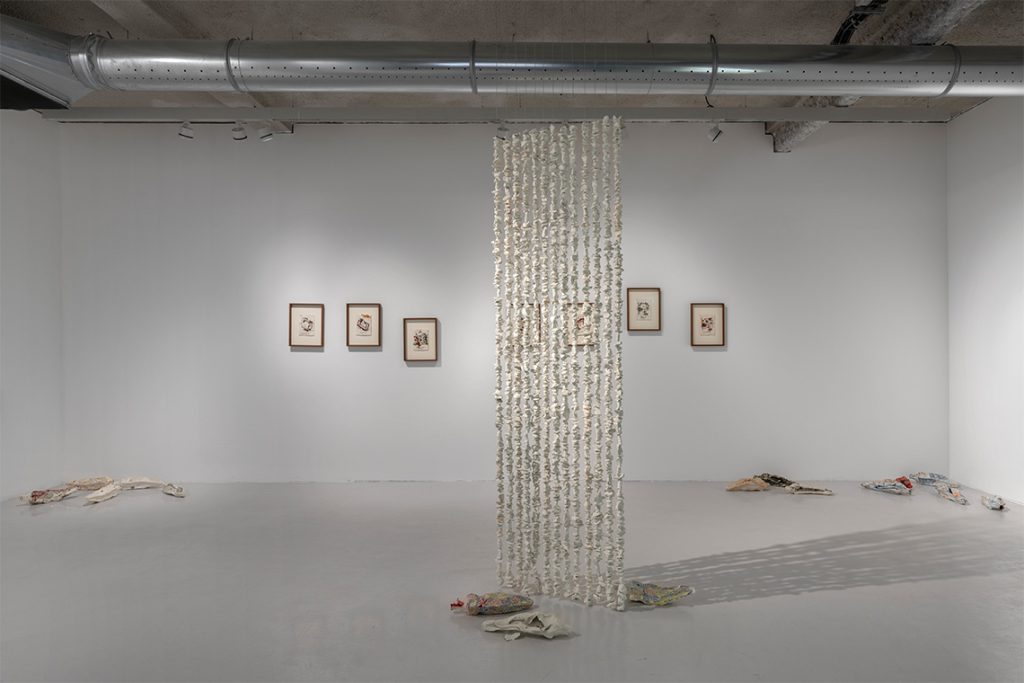
For Bamieh’s latest chapter, glazed and unglazed porcelain silhouettes appear underfoot: she has scattered 24 small-scale okra sculptures on the floor throughout the space. Okra is totemic for Bamieh. Her family name is the word for okra in Arabic, and her mercantile great-grandparents transported dried okra across North Africa and the Levant.
In the midst of the gallery, a curtain-like suspension constructed out of porcelain shards doubles as a divider, standing in for the peril of thresholds permitting entry or refusal, the symbolically precarious terms on which movement is authorised or refused. Bamieh writes of the door as emblem: “it carries the weight of permission”.
Since leaving Jerusalem in 2023 and relocating to Portugal, Bamieh has explored steadily what it means to connect to home using the through-line of taste. The series is here expressed through a multidisciplinary take on migration and what we carry to keep our sensual connection to our roots. At the entrance of the exhibition, there is a sound piece that doubles as a breathing exercise, which visitors can listen to via headphones, in which Bamieh counts methodically and names domestic things around her, from plants to perfume.
Nearby, there is a wall of watercolour on cotton paper drawings of maps and travel suitcases overwritten with Arabic calligraphy and which evoke the journeys cited in the neighbouring three-channel video installation on suspended PVC screens. The glazed ceramic stools on which to perch and watch these videos are made by Bamieh herself, bearing inscriptions from the drawings and videos both.
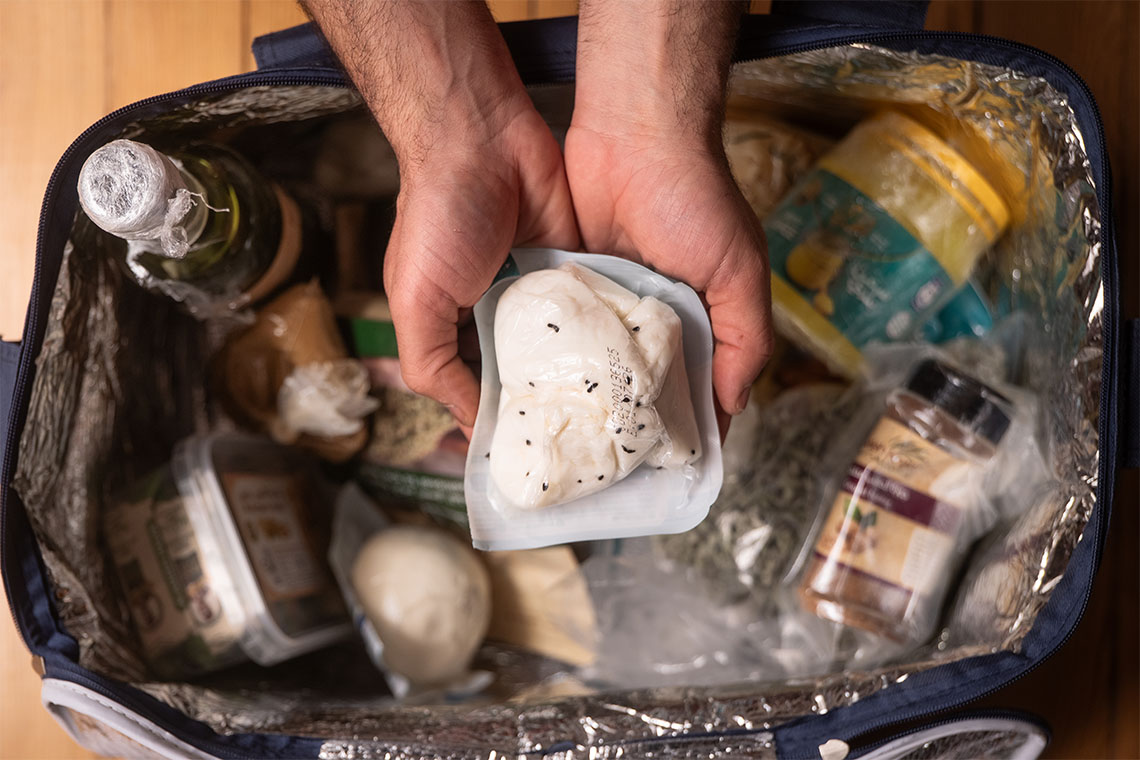
The three-channel video installation includes testimonies from SWANA-region immigrants living in Lisbon. Bamieh’s friend group – varied in ages and origin stories – catalogue how they seek to counterbalance conditions of displacement. Filmed in domestic settings, more than a dozen participants speak about the ingredients they pack in their luggage when returning from their homelands: zaatar, olives, sun-dried tomatoes, labneh, tea from Kenya, couscous from Tunisia, El Mordjene hazelnut spread (the “Nutella of Algeria”), rose water, orange blossom water, harissa (“there isn’t a single dish we cook without harissa”), Roumi cheese, sumac, pomegranate molasses, dried thyme, sweet oranges and saffron, among others.
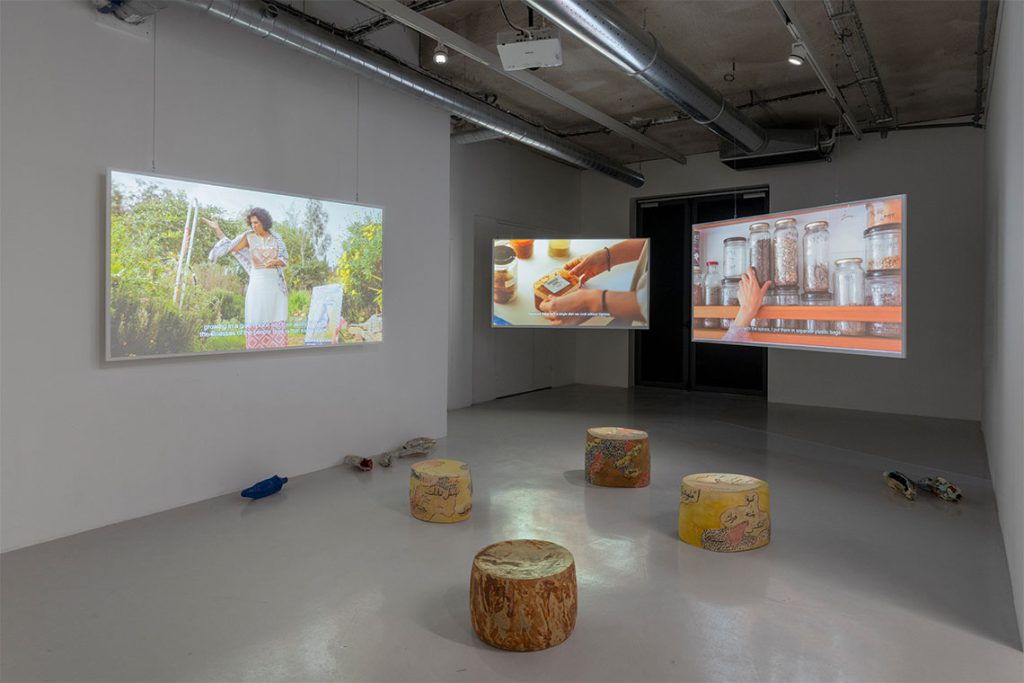
There are also accoutrements that come too, like the haradha, a robust Yemeni stone pot in which to cook and serve. There is the beauty of planting seeds from home, to make things grow locally, finding recipes written by hand by a family member, and the signature regional motions of eating – with bread and one’s hands.
The videos address the tenuousness of movement by way of what is packed in suitcases and luggage, a kind of intimate smuggling, despite the innocence of travelling with something as anodyne as dairy. (“I firmly believe every expatriate must have food in their suitcase”, one video contributor affirmed. But another countered: “Of course, we are always randomly selected for further investigation at the airport”.) There is the risk of leak, and the crueller risk of confiscation, but the risk is worthwhile, because the preciousness of these quotidian ingredients is so high. “It felt like someone had brought me diamonds,” one woman said of a visiting friend who gifted her goods from their homeland.
Inversely, having these goods seized feels like a violation, compounded by heartbreak. For one woman, airport security personnel not only took the goods, but put them directly in the garbage. They “threw away the only half kilo of pastirma in all of Portugal,” she lamented.
A separate screen features the artist’s mother in Palestine, reflecting on the act of packing food across generations – what her own mother had once carried from Lebanon, and what she would like to send to her daughter from Palestine. Bamieh’s mother holds up old photographs and talks about the complications of travel and maintaining communication before cell phones.
All together, the videos shift between personal memories and collective narratives. Bamieh’s documentaries ripple with collective joy and melancholy both, but the exhibition is ultimately about embracing what simply cannot be confiscated: pride in one’s origins.
Sour Things: The Door runs until 23 May
