

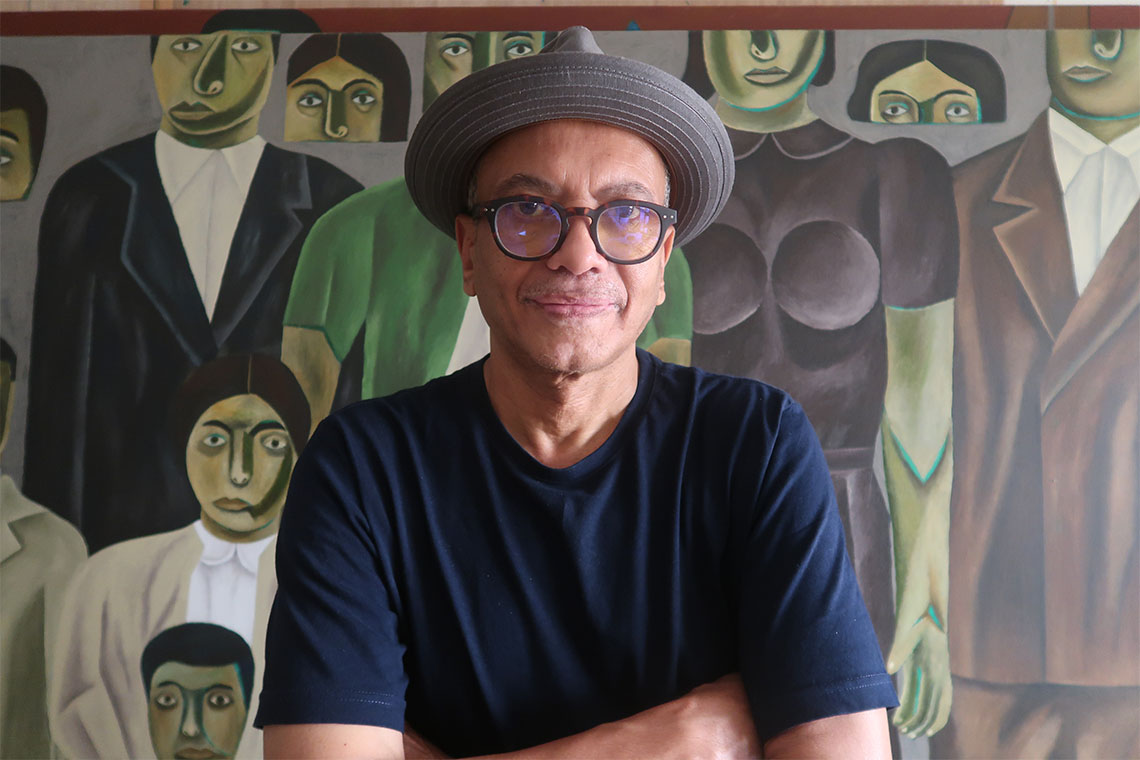
Ever curious about the unknown, the artist’s creative quest for knowledge is inspired by his father’s former photography studio in Sudan.
Salah Elmur was an art student four or so decades ago when he came across boxes of photographs sitting in a room at his family’s home in south Khartoum. The discovery was less of a surprise given his architecture-trained father’s profession as a studio photographer in the Sudanese capital’s Souq Al-Sajana market. The revelation, however, was in the epiphanic nature of prints that were all discards and rejects left over from his father’s subjects. Double exposures and out-of-focus shots had rendered the portraits undesirable, but the young artist-in-the-making saw painterly potential in their unintentional blemishes. “I was fascinated by their visual qualities, especially the ways in which faces and figures could overlap,” Elmur tells Canvas. It was a “new visual world” that he was on the brink of crafting. “What might have been considered a technical failure in photography became, for me, a source of inspiration,” he reveals.
The impossibility of grasping the stories of the various sitters keeps igniting painterly promises for the Cairo-based artist, even decades after the initial encounter with his father’s heaps of discards. In his acrylic paintings, mirroring visages and dream-like compositions present themselves joyously to marry reality with imagination. Between knowledge and fantasy, they honour the past by cracking open the flatness of a referenced photograph from which gush stories that are told, imagined or lived.
Today, Elmur works from a growing image archive composed of mid-twentieth century photography from across the globe; the artist’s holdings reach over 20,000 pictures of faces, gestures and what he describes as “unexpected visual qualities found in these historical images”. Anonymous posers and remote places populate his daily studio life, all the way from flipping through his finds until putting the final brushstroke on the canvas. The journey grants the 60 year-old artist the possibility to push the chronological span of a person’s existence – in particular his own – and bend time and knowledge into meditations on the beauty of inhabiting a slippery instance. There, he finds the unparalleled freedom to “move beyond the boundaries of my own lifetime” and eventually craft a notion of time which “we can inhabit throughout memory, imagination, and cultural experience.”
In a suite of paintings from this year, a young man meanders across a sprawling desert riding a wild feline; seagulls, plants and mountains surround their demure quest, or a football player tosses a ball on the thick green grass, backdropped by earthy geometric patterns. Multiplied faces and moody landscapes leave a yearning taste on the palette of the viewer. Both an elegy for the untold past and an anticipation towards an unpredictable future, the vignettes visualise the slipperiness of the very moment.
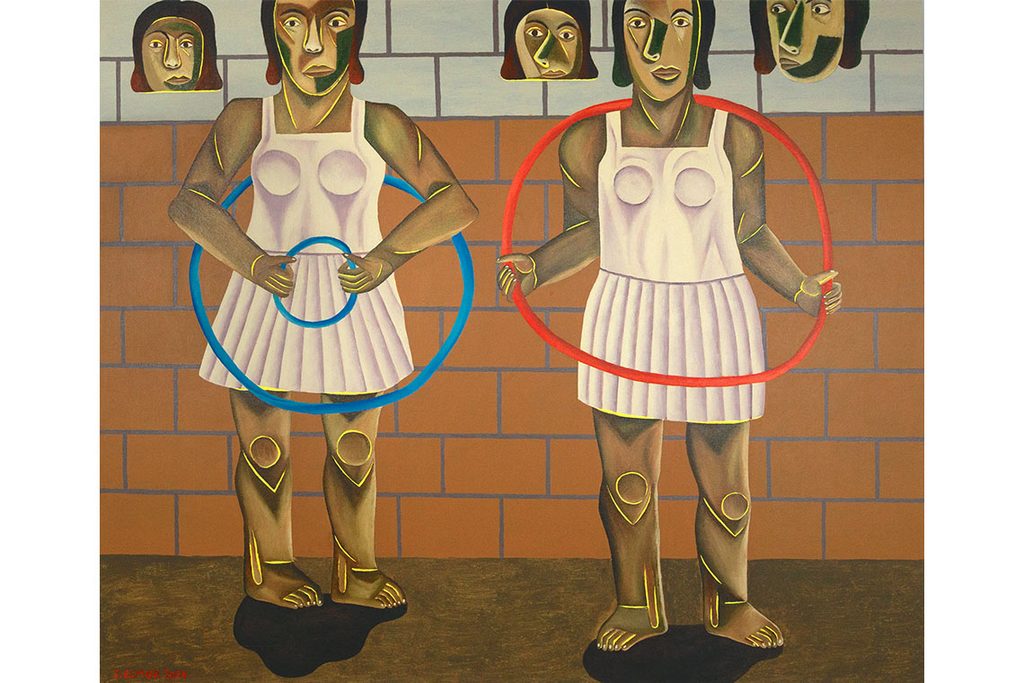
Over three decades later, Elmur still fuels his fascination for times and places he has never experienced in person, but he yearns to “bring together different historical periods and allow them to coexist within a single image”. He often strips his compositions of immediate historical and geographical signifiers and alchemises an otherworldly proposition to inhabit. In The Yellow Wall (2024), a mostly nude young man crouches to stare at a black dog in the eye while clutching a long pink string. Helloub Wall (2024) strengthens the artist’s dreamlike visual vocabulary with two girls whose faces echo across the horizontal composition with their multiple likenesses. Like the rippling of a drip falling on water, the figures’ repeated expressions complicate and gratify the very reality of being. The hula hoops around their waists imbue the scene with a mundane ease and add an abstracted edge to the painter’s otherwise lushly coloured figurative universe. A jab at the exactness of picture-making is not amiss, either.
“A photograph is much more than a record – it is a fragment of time that has survived long after the circumstances in which it was taken have disappeared,” says the artist. A joy which he allows himself along the way is the time he takes to imagine the lives captured in his rich “living reservoir of visual memories”. Chance, however, is a notion that Elmur grapples with to ground his methodology. “Many things we describe as coincidences are intentional, even when that intention operates beyond our immediate awareness,” he says. The accrual of a decades-long investment in his project, according to the artist, defies odds and probabilities and rather embodies an “internal process of psychological and intellectual struggles, accumulated experiences and continuous exploration of the medium.”
A pillar cemented in his paintings – which sit in the collections of the Museum of Modern Art, Sharjah Art Museum, Centre Pompidou and Zeitz MOCAA – is a perpetual search for a “kind of tarab or musical tonality” within his juxtapositions. At first glance, earthy tones and enigmatic gestures are among his familiar traits. For Elmur, however, the cinematic impact of form and hues results from a commitment to the harmony between colours and the “rhythms they create”. He does not overlook the promise in tensions and assures a trust in the fruitfulness of the contrasts, which he considers “essential to give the painting
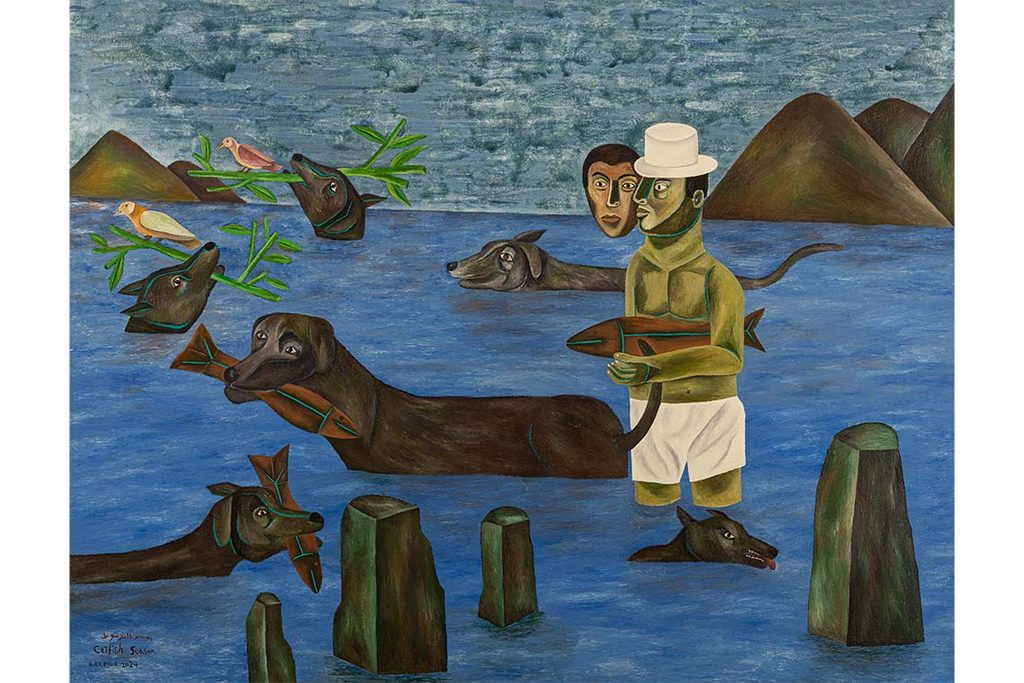
its vitality and allow different elements to interact”. Take, for example, the dynamic he orchestrates between humans and animals. Rabbits, dogs, goats and fish appear in enigmatic even surreal compositions – they are witnesses and companions as much as agents of knowledge and mystery. The animals’ central positioning is innate rather than ornamental, tying Elmur’s practice primarily to his own upbringing: he grew up with a pet monkey and other animals that cohabited with his family in the rural community of Al-Jerif West, on the western bank of the Blue Nile.
The artist’s early years occupy a substantial real estate in his creative output. Memories of fishing along the bank of the Nile, of occasional plunges with his friends into the water, and of helping his grandfather on the farm have not only endured but also continuously moulded his painterly growth. Besides visual snippets of his earlier life, Elmur pays attention to the stories and the knowledge that these moments have passed on through their witnesses. “I’ve come to understand that oral storytelling is an immense reservoir of the stories people exchange in my community,” he explains. “This environment has profoundly shaped my visual memory and cultural sensibility.”
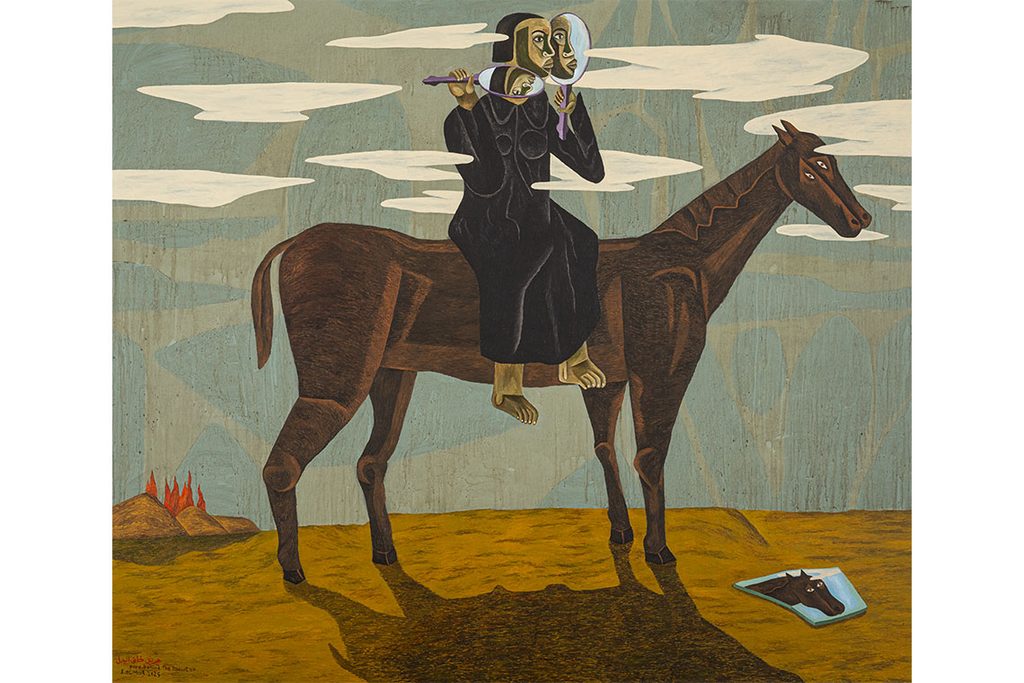
Elmur still returns to his formative origins and spends time on the riverbank with his family and friends. Jameel Arts Centre’s current survey, entitled Just as the Heart of a Mango is a Stone, traces the stories that have shaped the artist’s repertoire, both those he recollects from coming of age in Sudan and others that he happened upon in a distressed black-and-white portrait. In Fire Behind the Mountain (2025), a horse-riding woman gazes with sharp determination at an invisible horizon. The mirrors she holds in both hands add other dimensions to her serene visage, reflected on each glass surface as fractions of her body and mind. The horse’s commanding aura is not compromised either: a broken shard on the earthy ground reflects the animal’s fierce stare towards the same direction, all while a blazing fire seems to burst out in the far distance. Dependent on one another out in the scorching desert, the figures’ harmony echoes with Elmur’s reflection on the personal and communal in the stories that he narrates on the canvas or comes across in pictures. “Personal memories are rarely isolated from the experiences of others,” he says. “My photographic archive allows me to engage with people and periods that I have never experienced personally but which gradually become part of my own imagination.”
Just as the Heart of a Mango is a Stone runs until 14 March 2027
This article first appeared in Canvas 125: In Pursuit of Knowledge
