
The Saudi Ministry of Culture presents an exhibition curated by Sara Almutlaq and Dr Aurora Fonda, exploring cartography through historical objects and contemporary art.
For thousands of years, cartography has been a method of illustrating human knowledge of the world’s geography, whether of land or sea or the cosmos. Maps are often seen as a legitimate source of knowledge, and therefore taken for granted. Yet this exhibition problematises such a view by revealing their cultural dimensions. Historic maps and objects loaned from 30 institutions and contemporary works from 29 artists are presented across two floors of the Abbazia di San Gregorio in Venice, and narrate a history of cartography situated between reality and myth, emulation and composition. Rather than a museological and archaeological survey, the exhibition explores how humans navigate, imagine and narrate the world’s chief centres and less well-known corners, always on their own terms.
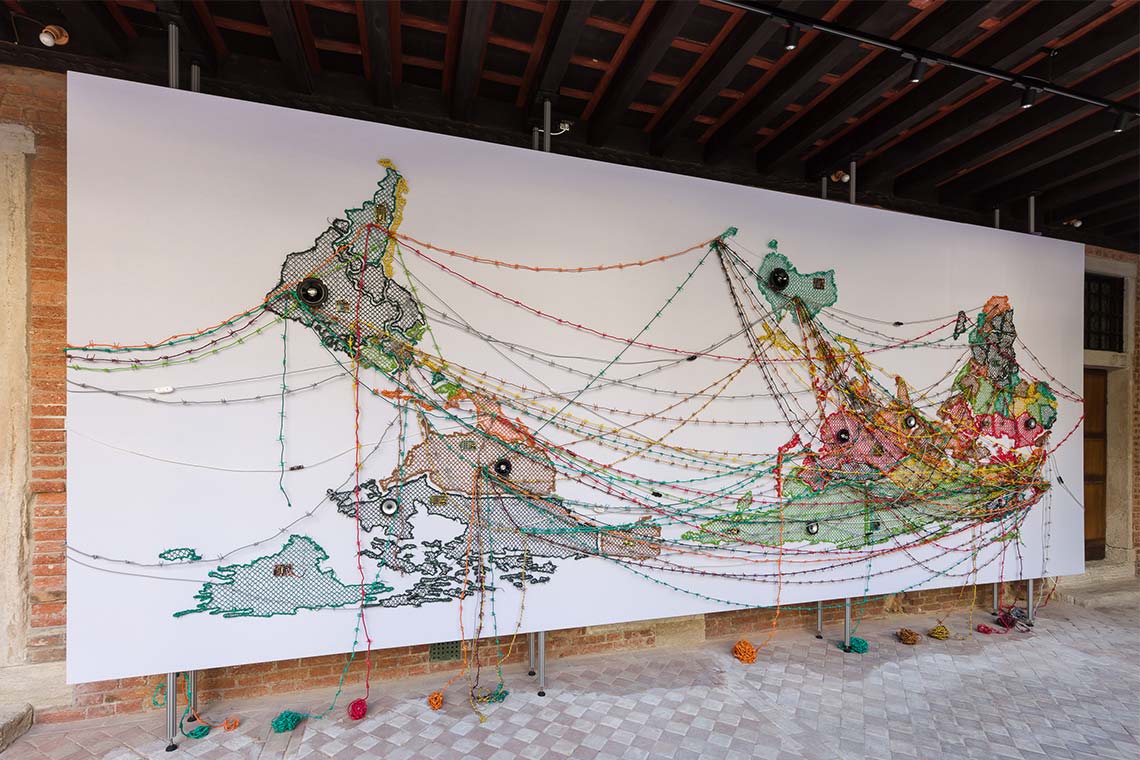
Throughout the exhibition, the curatorial team has worked to juxtapose Islamic and European worldviews. Early Islamic maps oriented south to the top – as most early Muslim cultures were located north of Mecca, they imagined looking up (south) towards Mecca, which they put in the centre. By contrast, so-called Mappa Mundi (‘Maps of the World’) compiled in Christian regions put east at the top with Jerusalem in the centre, as the Garden of Eden was understood as having been located in the East. The ubiquitously present Mercator projection – devised in the sixteenth century by the eponymous Flemish cartographer – put north at the top and the Atlantic Ocean at its centre. On the ground floor of the show, Indian artist Reena Saini Kallat responds to these different perspectives by creating her own. In Woven Chronicle (2018), the Atlantic-centred map is oriented upside down; alongside this disrupted mapping convention are immigrants’ trajectories, now equally valued and expressed in electric-cable-borne migratory routes connecting six continents.
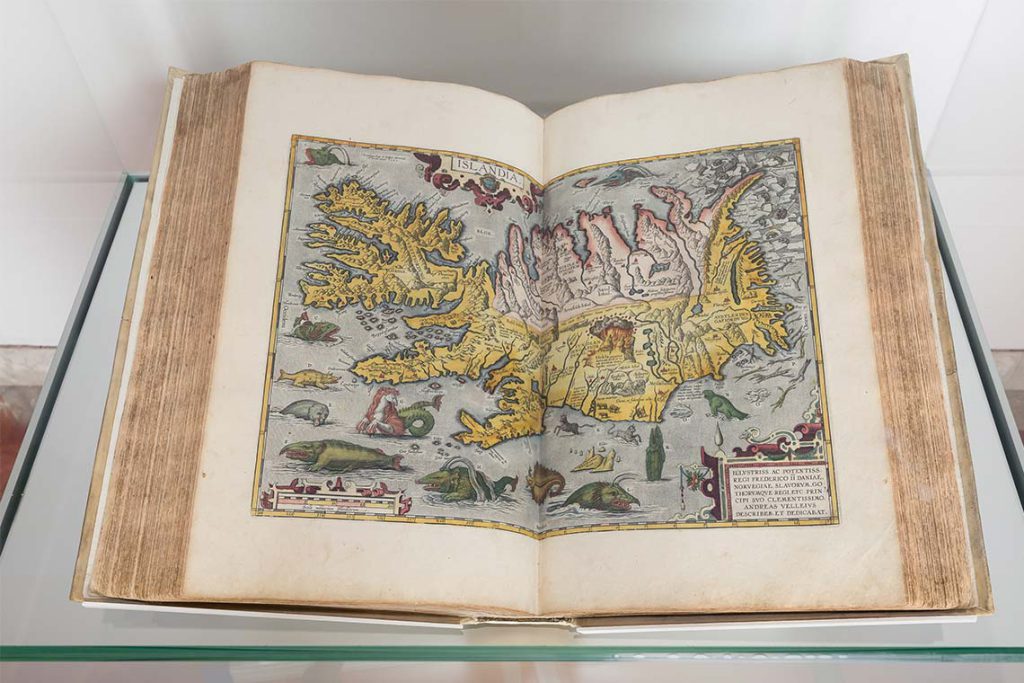
While ways to delineate the known world differ by culture, the use of tales and fantasies to ‘fill in the gaps’ and depict the unknown is common to all ancient cartographers. In many early Islamic maps, the known world of three continents is surrounded by a wall of mountains, seen as protecting Earth from what lay beyond. Egyptian artist Wael Shawky adds another fictional layer with his wood-carved relief The Gulf Project Camp (2019), in which the mountains separate the city of Mecca from a dinosaur-looking behemoth that overlooks it. This presence of jinns corresponds with the 1595 European map Islandia, drawn by Dutch cartographer Abraham Ortelius, on display in the same gallery. Here, elusive and fantastical creatures inhabit the sea that surrounds the fjords and volcanoes of Iceland, whose territory remained deeply enigmatic to Europeans of the time.
Although most maps are illustrated from a god’s-eye view with an air of omniscience, the human-centred perspective of navigating Earth from ground level is also valued. Saudi multimedia artist Marwah AlMugait’s This Sea is Mine (2021) traces these embodied experiences by enacting ancient vocal traditions. The orientational chants which once helped coastal communities navigate the sea have now turned into tunes and rhythms that inspire a collective choreography. In Enej Gala’s multichannel video installation Meta (2026), a marionette puppet made from old maps is operated, trudging across a desolate and barren landscape. Despite carrying geographical knowledge within it, the puppet walks in a disoriented, confused manner, uncovering the dilemma embedded in all cartography: what is charted does not necessarily refer to what is known.
In many contemporary artists’ practices, mapping is a poignant method for delineating conceptual territories, whether corporeal or ethereal. Ahmed Mater’s 100 Found Objects (2015) archives physical items collected in Mecca over several years. Ranging from copies of the Qur’an to packs of tobacco, the objects were documented in a mapping format in the vicinity of the Ka’ba, illustrating various dimensions of pilgrims’ lives. Meanwhile, Qiu Zhijie’s Terrurian 5: Geography of Interests (2018) works essentially as a word cloud. Ideologies that exist across time, space and disciplines intersect on the tellurian, without necessarily attaching to particular geographies. Words such as ‘primitivism’ and ‘modernism’ coexist peacefully on its surface.
On an end note, My Little Big Data (2019) by Eva & Franco Mattes questions the risks and hazards that the omnipresent application of maps imposes on us in post-modern and neoliberal life. Thirteen years of the artists’ personal data, browsing history and emails are analysed by an algorithm, resulting in a cartography of their behaviour patterns, travel routines and, occasionally, more private aspects of their lives. This disturbing presentation reveals the challenge of subjugating ourselves to the all-pervasive data management system that renders every aspect of our lives visible and traceable, while keeping its own internal operations opaque and elusive to us. It further talks to the power asymmetry embedded the act of mapping – an increasingly pressing issue with the current technological hegemony.
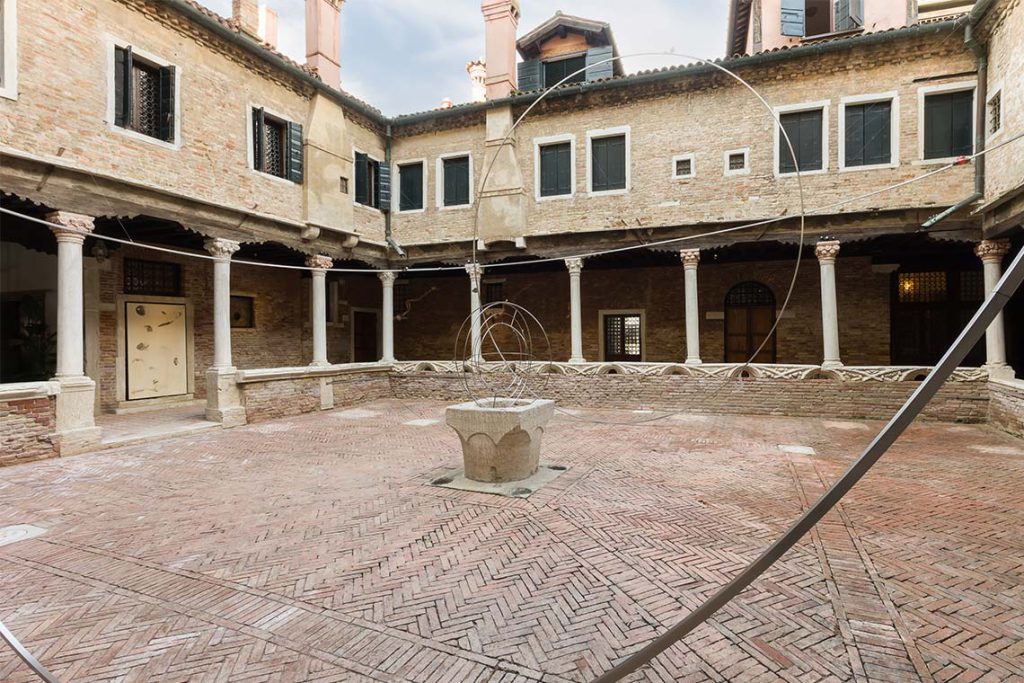
A Necessary Fiction puts maps from different sources side by side to destabilise each one’s inherent authority. When enshrined within their own cultural context, these maps remain unchallenged sources of knowledge. Yet, when juxtaposed they become contested worldviews, whose biases, blind spots, narratives and ‘fictions’ are exposed and magnified. The contemporary works remind us that cartography can be a formidable way of documenting personal experiences and feelings. As Nasser El Salem’s installation Each Time a Star Goes Astray (2026) suggests, being lost without a map at times is probably not as bad as how we assume it to be. The show also reflects on how trying to find one’s way, locating oneself, orienting and reorienting, are fundamental struggles that historically have been shared by all humans. It is somewhere between the known and the unknown where we try to live, navigate and narrate our longing for directions and for each other.
A Necessary Fiction: Maps, Art, and Models of Our World runs until 22 November
