

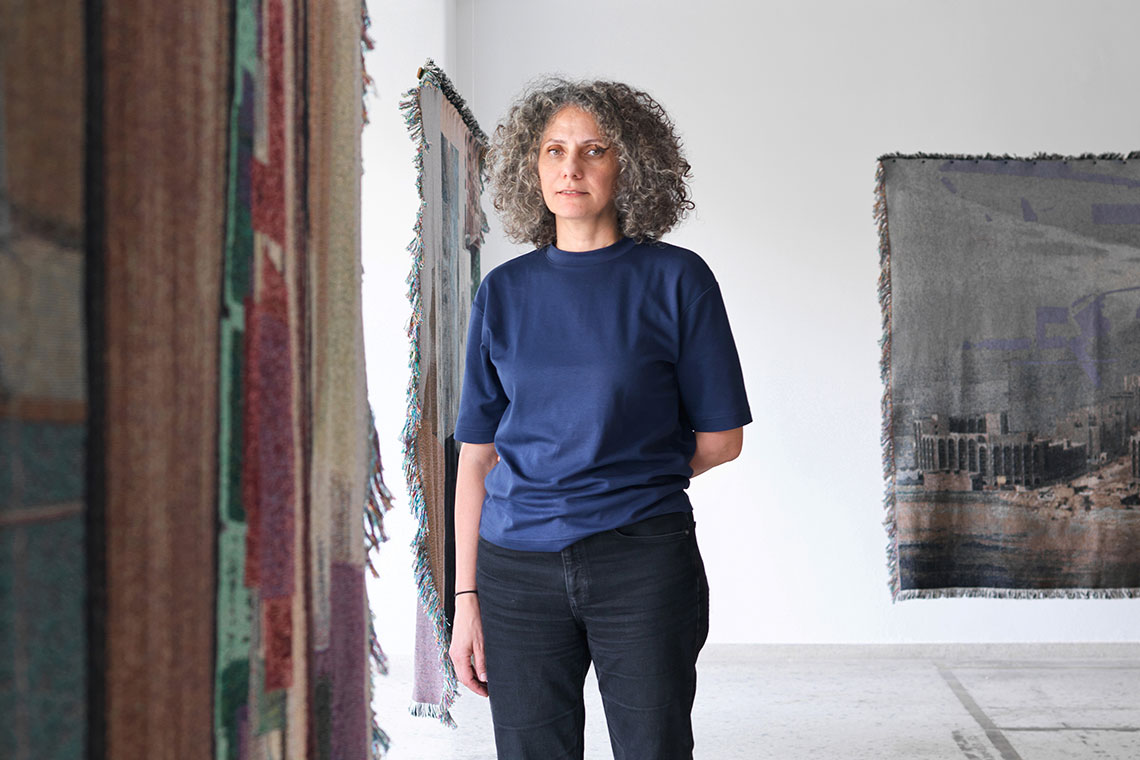
Through a research-based practice that utilises archives and artefacts, the artist and curator investigates how knowledge is shaped and shared.
For Ala Younis, history is an archive of objects, images and memories in flux and collision. In her work, spanning some two decades, the Kuwaiti research-based visual artist, curator and writer has addressed subjects such as street planning in Baghdad, the construction of the Aswan High Dam and manufacturing as a propaganda tool in post-revolution Egypt. She uses documentary photographs, film and documents, as well as objects and artefacts as varied as sewing machines, double-sided mirrors and legions of tin soldiers. In her most recent solo exhibition, Battles in a Future Estate: Haifa Street at Tavros Art Space in Athens, Younis explores the myriad representations of the titular thoroughfare in Baghdad, built during the Iran-Iraq war. Drawing on a vast array of architectural plans, photographs, texts and videos, spanning four decades, she traces the street’s urban and architectural transformation. But, as the curators note, “these four decades function as a palimpsest for a broader narrative, where Haifa Street becomes the crux for unlocking several chapters of modern Arab history and its ripple effects around the globe.”
The design and use of buildings – shaped by urban planning, politics and war as much as by everyday life and business – is a strong thread running through the presentation, one that echoes Younis’s former training as an architect. The Tavros show, which is just one element in an ongoing project, is partnered with a parallel exhibition by the Greek artist Vangelis Vlahos, collectively presented under the title I Wake from History, Alive. Younis’s own art projects are combined with a broad array of curatorial assignments. In 2013, she curated the first Kuwaiti Pavilion at the Venice Biennale. The exhibition, National Works, aimed to disassemble “symbols of grandeur in paused/post glorious times, in an attempt to re-interpret Kuwait’s modernisation project” by juxtaposing figurative works by sculptor Sami Mohammad and contemporary photographs by Tarek Al-Ghoussein. In the years since, she has curated exhibitions at Kuwait Museum of Modern Art, Mathaf: Arab Museum of Modern Art (Doha), New Museum (New York) and Berlinale (Berlin). “I engage as a curator because I respect how artists work, research and care for the process as much as the output of their artistic endeavours,” she says. “There are no clear lines where I function as an artist or as a curator, researcher or writer, or even publisher. I vent out where available and as needed.”
Younis was born in Kuwait in 1974 to Palestinian-Jordanian parents. “As a child, I lived my summers in between cities before settling in Amman from 1984,” she recalls. “I consumed a multitude of accents, creative works, advanced technologies and curricula.” Creativity was ever present, her childhood infused with art. “For our new home in Amman, I remember my father framed his 1960s paintings and put them up around the house. They were fine oil works of serene landscapes, and I always admired them. My mother developed her own embroidery designs, many of which were traditional urban landscapes, which intrigued our visitors and produced a conversation about her new ideas and innovative colour palettes. Otherwise, I consumed art in political posters and children’s books.” There was also an early fondness for categorisation. “My father gave me his collection of stamps and I spent so much time rearranging them according to the artwork printed on them.” Younis recalls. “I also arranged my collections of books and stationery according to colour.”
Younis studied architecture at the University of Jordan in Amman, graduating in 1997. “At the time, the city was going through major social and intellectual changes due to the impact of Iraqi migration in the aftermath of the Gulf War,” she says. “I benefitted a lot from studying architecture, where I learnt how to prioritise function and make it inform the aesthetics, communication and ambience of the piece I am working on.” However, shortly after graduating she turned to graphic design. “It was a new and intriguing domain where computers, software and the web were all novelties,” she explains.
One of her first jobs was designing the website for Darat al Funun, a centre for contemporary Arab artists. Its founder, artist Suha Shoman, would sit with Younis, discussing changes. “The process was like a crash course on Arab art, where I was not learning how to make art but rather how to construct a narrative and create an institution’s public and digital interface from its documents.” She became the Darat’s artistic director in 2009.
It was at around that time that Younis also began painting, but she soon turned to research-led art. “My interests, I believe, were always in looking into what shapes the knowledge, and thus the attitudes, of contemporary Arabs,” she says. In the mid-2000s, she formalised those interests, studying for a Masters in Research in Visual Cultures at Goldsmiths, University of London. One of her first major works was Nefertiti (2008) – created during a residency in Cairo, in the context of PhotoCairo 4: The Long Shortcut exhibition – for which Younis presented a series of sewing machines – icons of praise, criticism and nostalgia – that were produced by a military factory to empower Egyptian housewives following the 1952 revolution. They were objects of sovereignty, “not just to Egyptians but to all Arabs,” she notes. The piece was later presented at the Delfina Foundation in London in 2010 and continues to travel the world.
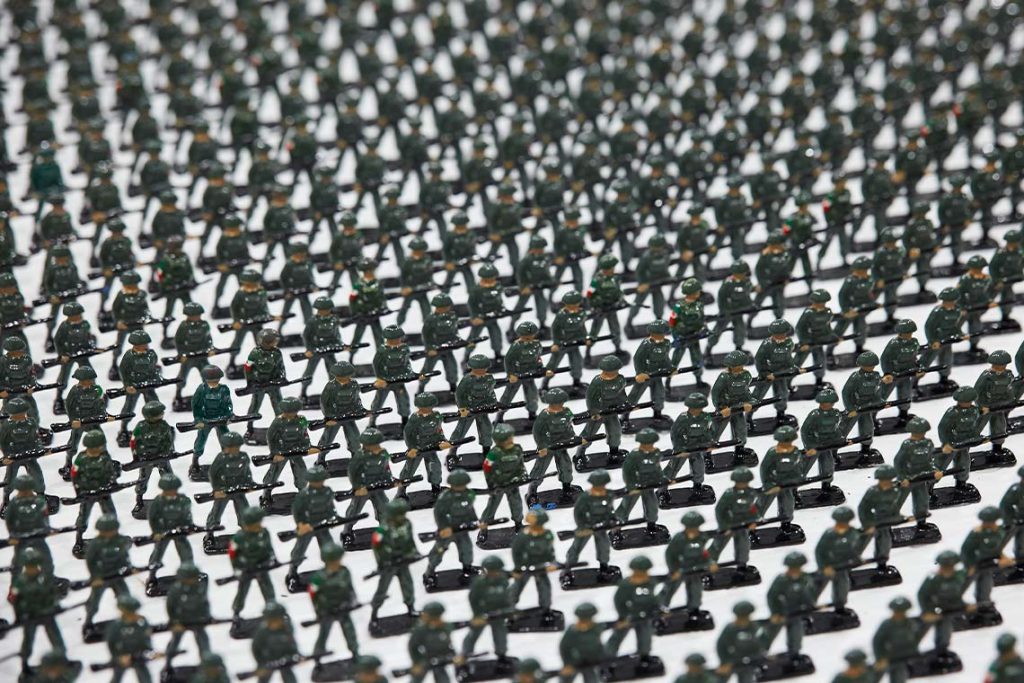
Younis often produces different iterations of her works. Her Tin Soldiers (2010–11) project – a “depiction of nine armies that were implicated in, or subject to, acts of war in today’s Middle East” – has been an installation, publication and exhibition (and she is currently considering a mural on High Dam and a sequel book on Tin Soldiers). For the Istanbul Biennial in 2011 she presented Tin Soldiers, comprising 12,261 hand-painted toy figurines. “The tin soldier industry peaked between the two World Wars, while the Middle East was undergoing a process of remapping,” elaborates Younis. However, the region’s “contemporary armies have yet to be rendered in toy soldier sets.” Similarly, there have been several incarnations of High Dam (2017–), including lectures, exhibitions, sculptures and photographic collages in which Younis delves into the various representations, both state-sanctioned and highly personal, of the damming of the Nile at Aswan in the 1960s. The work offered insight into the processes that governed the politics of the era, she explains, particularly the propaganda apparatus of the short-lived United Arab Republic and the USSR.
In 2021, Younis co-curated, alongside Madhusree Dutta, the exhibition Hands at Akademie Der Kunste in Cologne, which addressed tactility in the time of Covid-19. The narratives surrounding the pandemic have already shifted, Younis observes. “So much has happened since Covid that makes it sound like it happened in someone else’s lifetime. I think it encouraged a transition into technologies and online presence, including for generations who might have previously expressed a disinterest in what was happening online.”
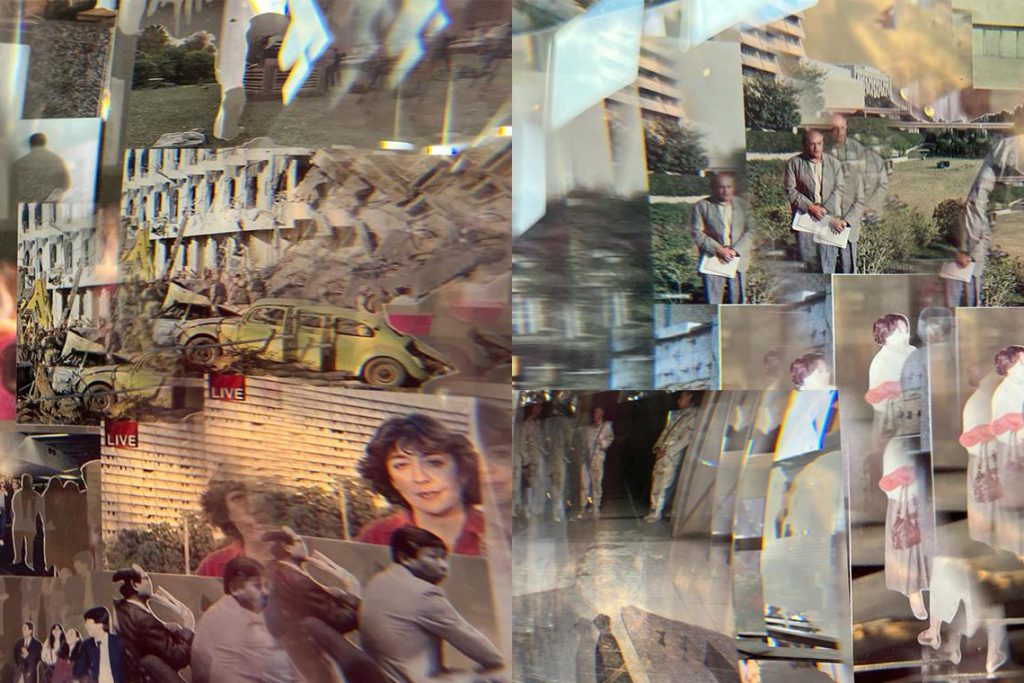
The impact of industry and technology on the personal riffs through her work. For instance, her installation Double-Sided Mirrors (2023), commissioned for the Jameel Arts Centre in Dubai, reinterpreted two-way spy mirrors, supposedly a common feature of the Al Rasheed Hotel where international press stayed in Baghdad during the Gulf War, as a decorative chandelier. A critical analysis of edifices – whether symbolism, propaganda, social media or surveillance tactics – lies at the heart of Younis’s myriad cultural activities. “How do power dynamics impact people’s access to knowledge? What technologies trigger, communicate, or shape these dynamics or our resistance to them?” These are the questions to which her art and exhibitions return, time and time again.
