

At the Erth hotel in Abu Dhabi, Mirage provides a space for revelation and exploration of the immaterial.
Founder of Verytgo and curator of Mirage Nicolò Venelli states in the press releases that this collective show “fascinates itself with both revelation and uncertainty, a space where the ritual and imagination intertwine”. Presented in association with Thaer Select, Mirage’s catalogue of 18 artists span from the Arabian Peninsula to Europe. The exhibition bestows a myriad of perceptions moulded through memory and desire, and is on display at the Erth hotel in Abu Dhabi, where architectural evolution collides with the surreal.
Despite Venelli defining Mirage as “an oasis that does not exist”, it is hard to believe this explanation at first sight. Upon entering, the exhibition unfolds like a journey through the desert. Three trails of sand lie beneath the various artworks and the noise of cascading water reverberates in the background. Mamali Shafahi is the first artist to instigate our ascension. His sculptural works The Watcher I and The Watcher II (2025) stand across from each other. With both their beards ornate and eyes piercing blue, they perform as vessels of wisdom, our guides on this didactic journey as we immediately embrace the fantastical realm. Created out of flocked epoxy clay, these luminous figures produce a black or blue glimmer – dependent on how the sunlight floods in. Shafahi feeds into the dialogue of the crucial role played by sculpture in recording cultural identity, yet instead of embodying an evocation of power, The Watcher I and II almost provide a sense of comfort as we venture forth.
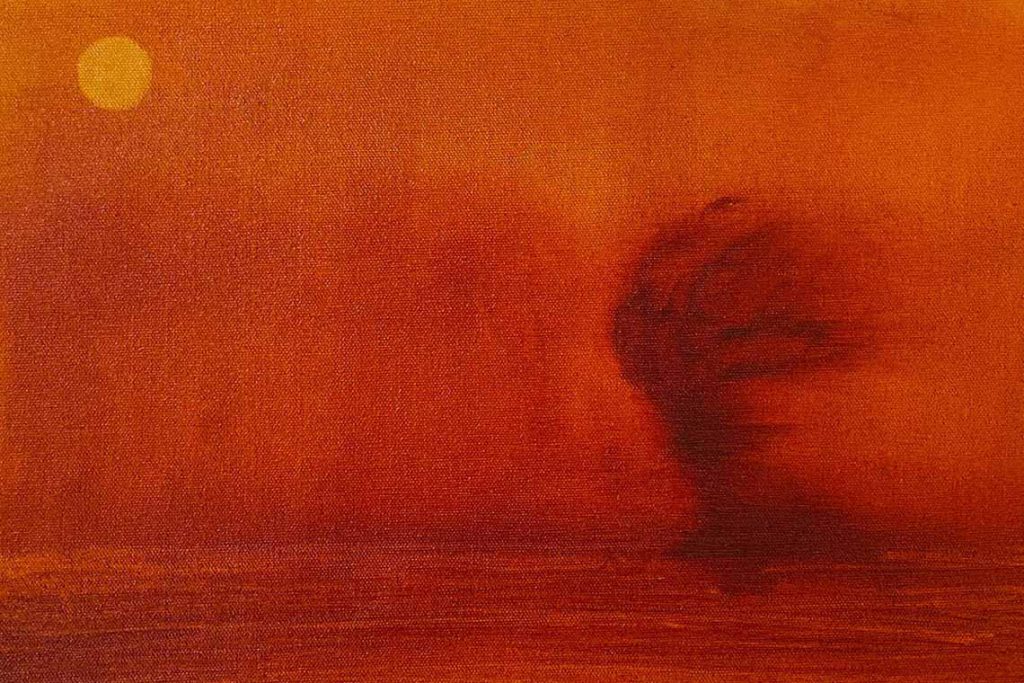
The desire to reconfigure identity seeps into every canvas and sculpture, but the visitor may be especially drawn to Husna Samer’s landscape oil painting, Wistful (2024). Used as the cover art for Mirage, Wistful is surprisingly small in scale, deliberately provoking deeper inspection, and with the warm hues of yellow, red and orange giving some certainty that this is a desert at sunset. Yet, through the texture created by her dry brushing, specific details are mystified and speak to the existential. Samer utilises the landscape not to portray an objective reality but to access our own interior world, with Venelli observing her work as “a mutable vessel of experience, where memory gathers, erodes and transforms”.
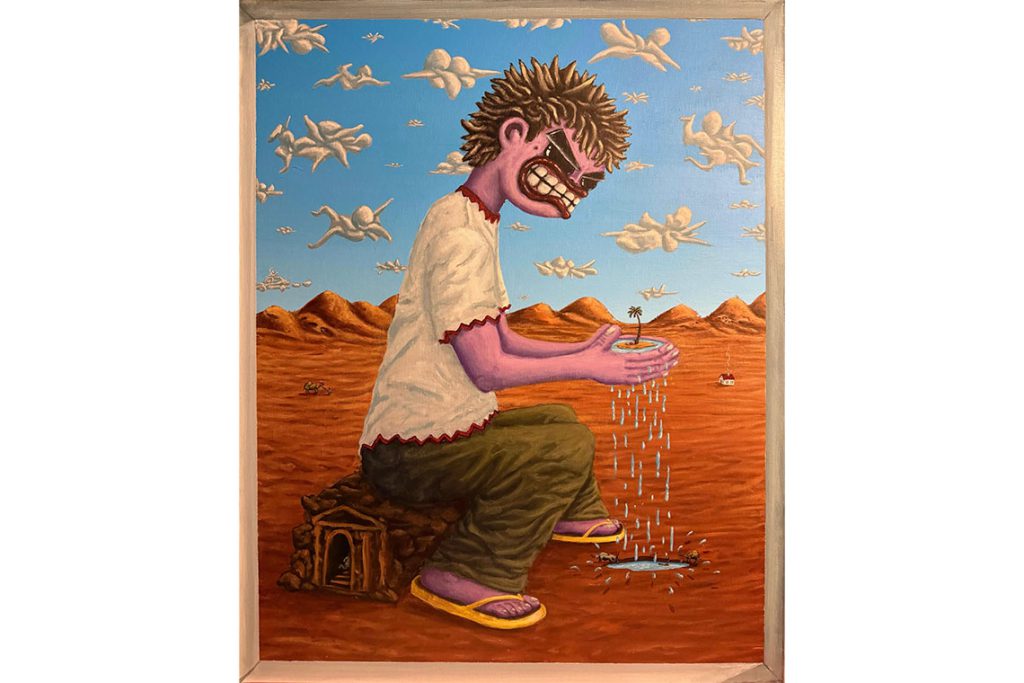
Mirage ricochets constantly between hope and angst, the instability being infectious. We transform from spectator to traveller, uncovering our own truths and cleansing ourselves in the process. HazzA’s Air Time (2025) and Ziad Al Najjar’s Harut and Marut (2025) are both explorations of masculinity and anxiety within the human condition. For HazzA, his character portraits are surrenderers to his subconscious, often conveying deep rage and confusion. Our subject in Air Time depicts all the signifiers of rebellious youth: alternative clothing, stylised hair and a face of fury. In this dreamlike setting he attempts to contain an oasis in his palm as the water spills out beneath, affirming that there is not only tension in our co-existence with one another but also with the divinity of the natural world. Will we ever learn that we cannot control the sublime?
The grapple with identity within Harut and Marut is executed through mixed media. Unlike the surrealist nature of Air Time, Al Najjar leans more into the mythic. A human head overlays a spiritual figure, created in tones of putrid yellow and rippled by latex. The tactility of the canvas invites the temptation to touch, and our obsession to inspect matter on the canvas transpires into inspecting our own bodily thresholds and digging deeper.
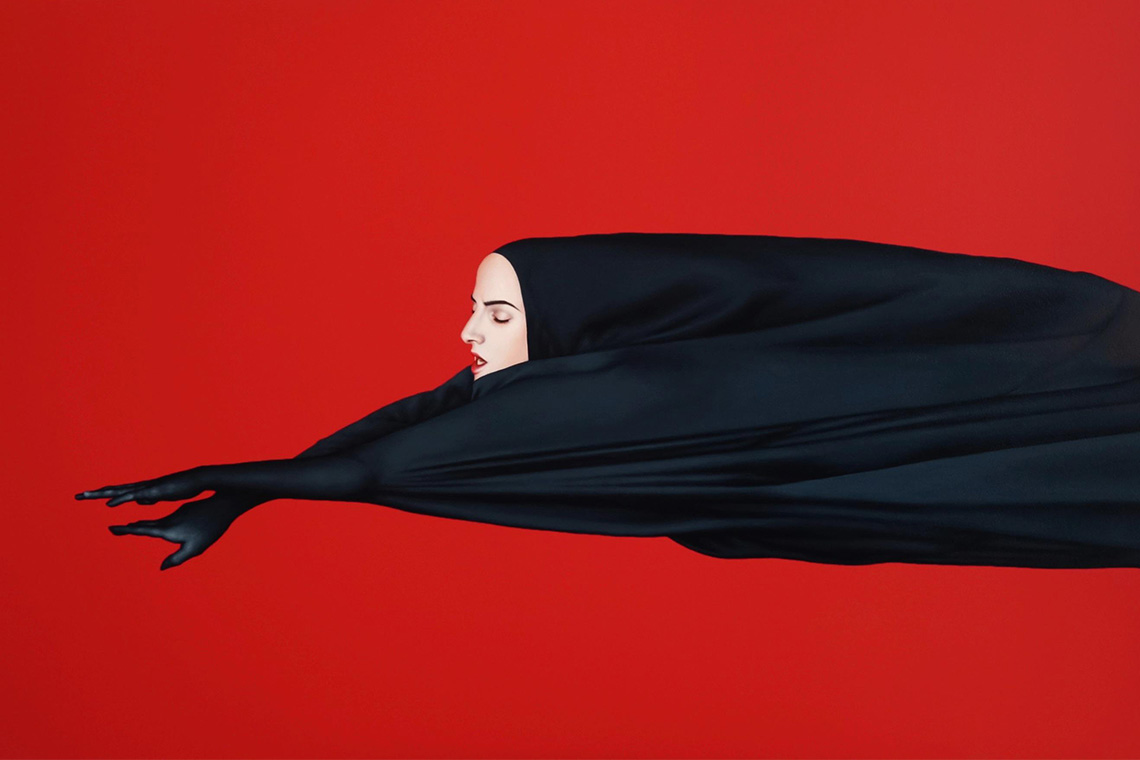
At times, you may find yourself disoriented by the blur of the material and ethereality within Mirage. However, Samo Shalaby’s portrayal of different points of finality provides poignant moments of relief. Presented at opposite sides of the exhibition, Ecdysis (2025) and Genesis (2025) symbolise the epic moment of beginning and rebirth. Both paintings depict figures in motion contrasted by a still background. Genesis portrays a woman flying through a block red acrylic background, eyes closed, arms outstretched, completely unbound. The starkness of the red suggests bloodshed, at once barbaric and celebratory in the creation of life. Ecdysis incorporates radiant tones of blue and purple with motion blur to underpin the momentous event of metamorphosis.
Each work showcased in Mirage is an infusion of the artistic world and the immaterial, positioning revelation as a necessary focal point in a world riddled with superficiality. In doing so, Mirage transfers purpose and clarity from canvas and clay onto the spectator. At the end of the journey, you are held in an abyss of what is and what could be, quite abruptly finding yourself cemented back in the physical world, albeit in a beautiful hotel.
