

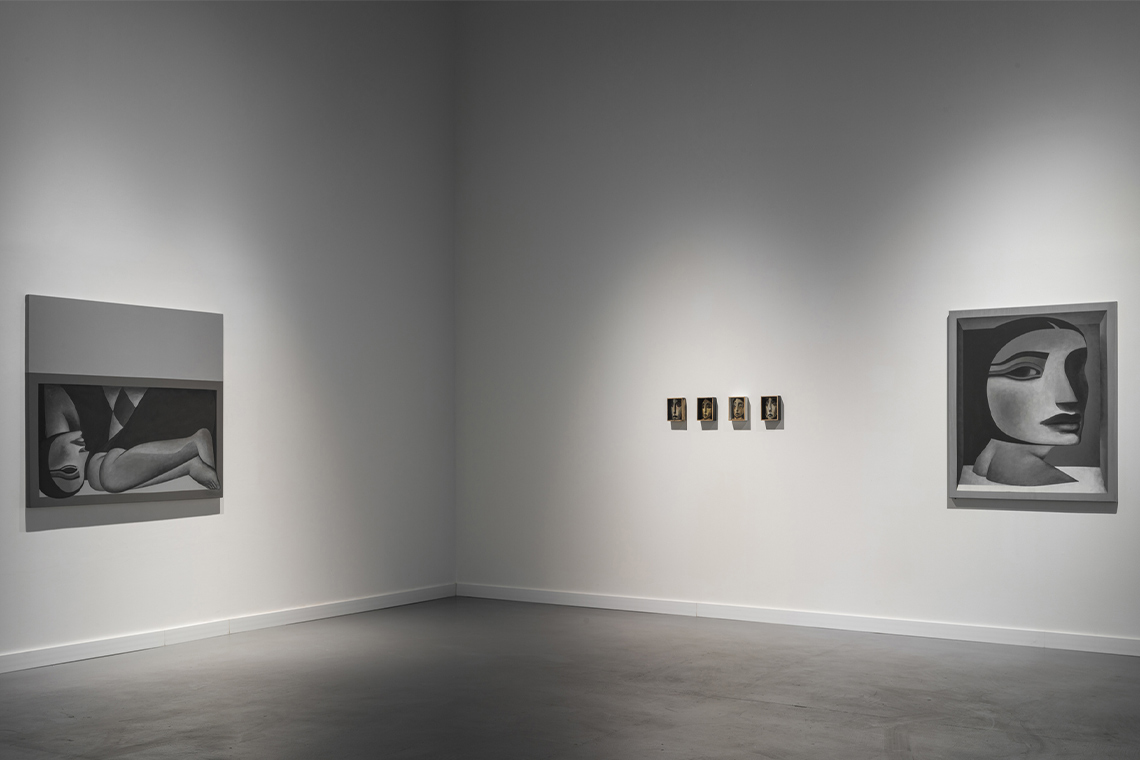
Safwan Dahoul’s Dream series stages the human figure as a form under pressure, shaped by limits of space and perception.
A single eye stares out from a body that seems unable to unfold itself. Elsewhere, limbs curl into tight formations, pressed against borders that leave little room for movement. Throughout Safwan Dahou’s latest exhibition, The Eye: An Aperture Into the Soul at Ayyam Gallery, the human figure appears locked in a continuous negotiation with the spaces it inhabits. Across a career of more than three decades, the Syrian artist has expanded the visual and psychological terrain of his practice, developing a distinctive monochromatic language.
The exhibition takes shape through a series of paintings that immediately immerse the viewer in Dahoul’s familiar world of greys, blacks and whites. Colour is largely absent, allowing attention to settle. Upon entering the space, Dream 290 (2025), establishes many of the thematic elements that resonate throughout the show. A solitary figure occupies the centre of the work, its body folded into itself and compressed within a tightly controlled pictorial space. At first glance, the anatomy appears difficult to decipher. The figure seems suspended between movement and stillness. Emerging from it are two wing-like forms that, while smaller than the body itself, command a visual presence, suggesting both flight and restraint.
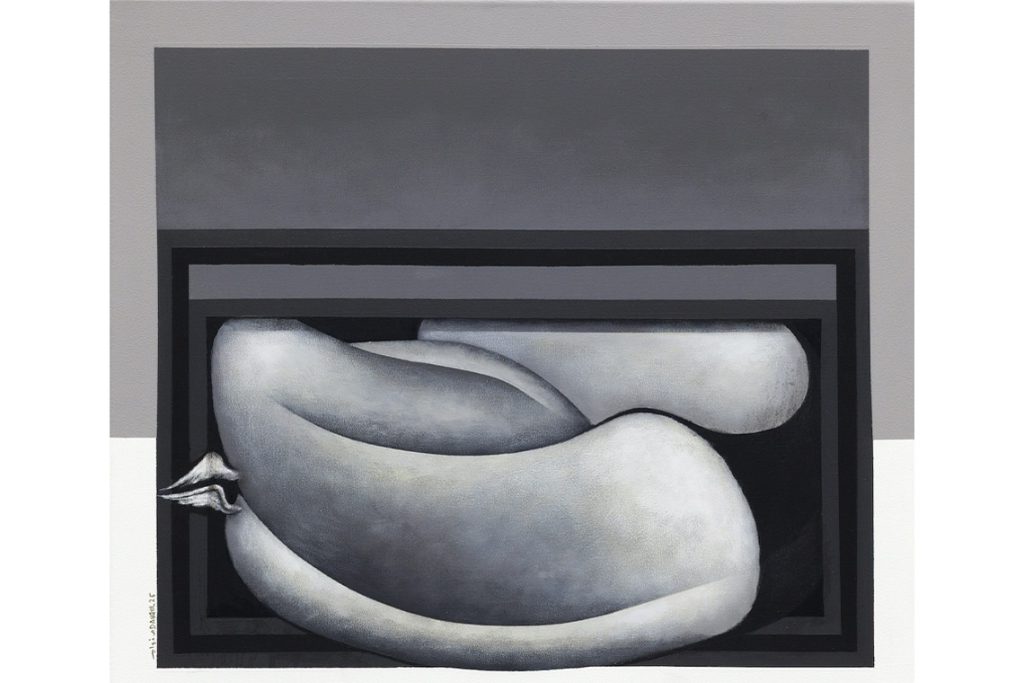
The dialogue between body and space continues throughout the exhibition. Dahoul’s figures seem comfortable within their surroundings, seeming to adapt themselves to the spaces available – folding, bending and curling in response to invisible pressures. They also appear densely packed, as though arranged in sardine tins, squeezed within their cramped environments In several paintings, such as Dream 287 (2025), the body dominates such a large proportion of the composition that it appears to press against the edges of the canvas itself. Bodies are stretched across the canvases while torsos twist into improbable configurations, creating a tension between movement and restriction. In Dream 281 (2025), the toes of the figure protrude beyond the painting’s borders, gently disrupting the sharp edges. Dahoul’s figures appear to have entered into a quiet agreement with the spaces around them, their bodies bending and reshaping, finding unexpected comfort within its confines.
This sense of compression is evident in Dahoul’s use of geometric structures. The spaces he constructs rarely offer the body room to breathe. Rectangular frames and sharply denied borders repeatedly interrupt the compositions, establishing a visual contrast with the fluidity of the human form. The soft sculptural curves of the body encounter rigid architectural divisions that seem to organise, contain and at times restrict them. Space is never simply a backdrop in these paintings. Instead, it functions as an active force, shaping the emotional and physical condition of the figures that live in it.
Set apart from the larger paintings, a group of smaller framed works draw the viewer closer, encouraging a more concentrated mode of looking. Many of them gradually reveal a female figure, whose elongated features and eyes emerge from dark backgrounds, meeting the viewer within an intense, unwavering gaze that at times appears frightened or surprised. Other pieces isolate fragments of the body within narrow compartments, where figures appear compressed or suspended with confined spaces. Despite their modest scale, these works carry a strong emotional charge, condensing the broader narratives into compact, focused moments.
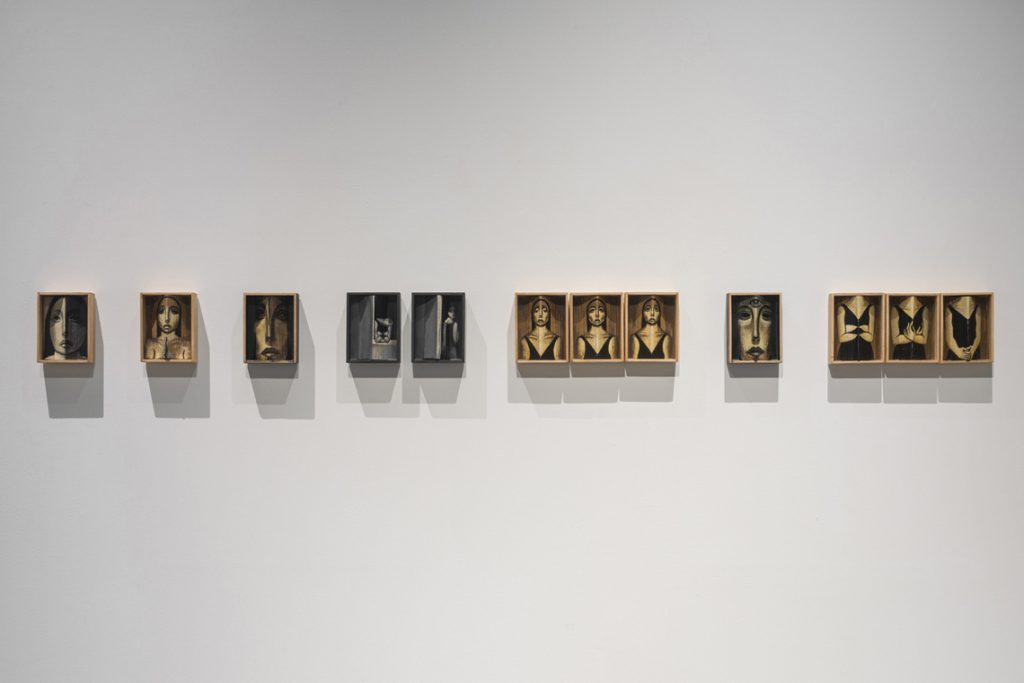
The brown wooden frames introduce colour that subtly interrupts the monochromatic environment of the show, while the use of cardboard draws attention to the work’s materiality and handcrafted construction in which Dahoul uses the corrugated surface as perspective. Through folded surfaces, the material itself becomes part of the works, partially concealing and revealing a female figure. Together, these elements create a tactile tension that complements the psychological intensity of the paintings.
Despite the recurring themes of confinement and introspection, the exhibition resists any descent into despair. If the body serves as the physical subject of the show, it is ultimately the gaze that carries its emotional weight. Some eyes appear enlarged and dilated, piercing through the surface with an almost unsettling intensity, while others recede into shadow, their energy seemingly diminished. Whether alert or withdrawn, the gaze becomes the show’s most persistent presence, leaving the viewer with an uneasy sensation of being watched.
The Eye: An Aperture Into the Soul demonstrates Dahoul’s ability to conceptually expand his visual language while remaining committed to the themes that have long shaped his practice. By carefully calculating the relative values of scale, material and composition, the exhibition explores the relationship between the self and the spaces that contain it. Rather than offering definitive answers, the works encourage a slower, more personal engagement, drawing viewers into moments of introspection and contemplation. If the body of these works appears bound by the edges of the frame, the eyes remain unconstrained, continuing to gaze outward long after the viewer has looked away.
