

The public art exhibition’s second edition narrows its geography but sharpens its intent, turning to the medium of light as a tool for casting new perspectives on the city’s built heritage and natural ecologies.
Abu Dhabi’s historic Mina Zayed port is a fond memory for those who grew up in the capital, and a foundational part of its history. Opened just a year after the UAE’s unification in 1971, it was the city’s first point of entry; people, goods and ideas came in by water, and Abu Dhabi’s own life moved out through and along it. Over time, the port settled into a life of its own, with a collage of uses from hosting markets, warehouses and family-favourite toy stores to the gradual emergence of an arts scene.
A space built on the thresholds and orientations that have shaped Abu Dhabi’s culture and economies, Mina Zayed now serves as a fitting point of departure for the second edition of Manar Abu Dhabi, the biennial public art festival that engages light as its working medium, returning under the theme The Light Compass.
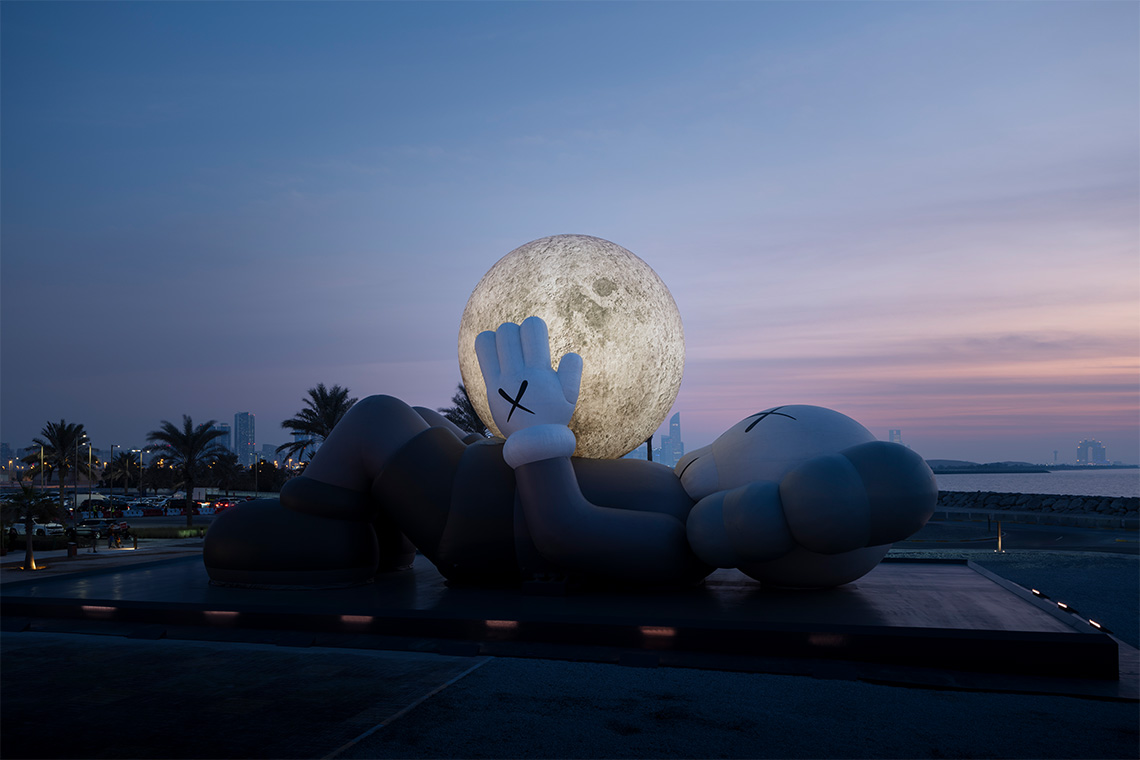
Along the harbour – and with the city’s glistening skyline held at a distance – one of the works lays a 32-metre-long character from another world on his back, cradling a giant luminous moon. It is the very Instagram-friendly KAWS: HOLIDAY Abu Dhabi (2025), created by Brooklyn-based artist KAWS with an engineered steadiness that keeps the moon afloat with uninterrupted continuity. Its colossal presence opens up the curatorial thinking of artistic director Khai Hori, for whom the moon and its shifting phases have served as a conceptual anchor – a “celestial guide” and “the world’s original light source” – for its poetic charge, attunement to natural cycles and guiding of civilisations across land and seas since the start of time.
Compared to Manar’s inaugural edition, which cast a wide net across the archipelagos in search of connective threads and to shed new light on their diverse natural beauty, this year’s iteration feels more modest and yet imbued with equal sincerity. With a focus tightened around a clearer curatorial proposition and a span concentrated on two core sites, attention is paid to how light can open a conversation between past and present, and allow us to rethink our relation to the natural world through light.
This dimension feels most intentional at Al Ain city’s Al Jimi and Al Qattara Oases, with interventions placed amid landscapes shaped by centuries of cultivation; of traditional mud-brick dwellings, restored archaeological remnants set amid ancient irrigation channels, and stretches of protected palm groves.
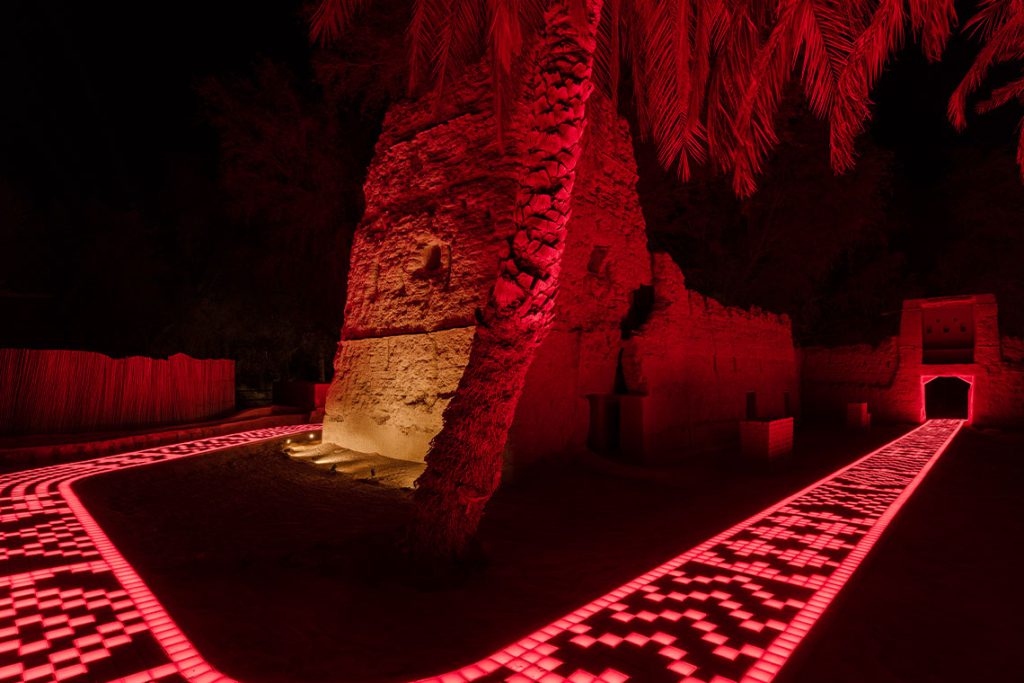
At the gateway of Souq Al Qattara, Khaled Shafar’s Sadu Red Carpet (2025) is a welcome invitation. It activates a seventeenth-century fort once used to defend the oasis with a glowing red path that moves around and through the structure. Through pixelated motifs of glass and brick, Shafar reimagines the geometric vocabulary of traditional Bedouin Sadu weaving, using light as a way to keep heritage both legible and renewed.
A short cart ride away, the heavy thrums of Rafael Lozano-Hemmer’s Pulse Canopy (2025) resonate across the oasis, quietening only for the calls to prayer and releasing a soaring canopy of light synchronised to the heartbeats of its visitors. In a nearby courtyard, he also scatters streams of Arabic calligraphy across the ground that disperse and regroup with each footstep.
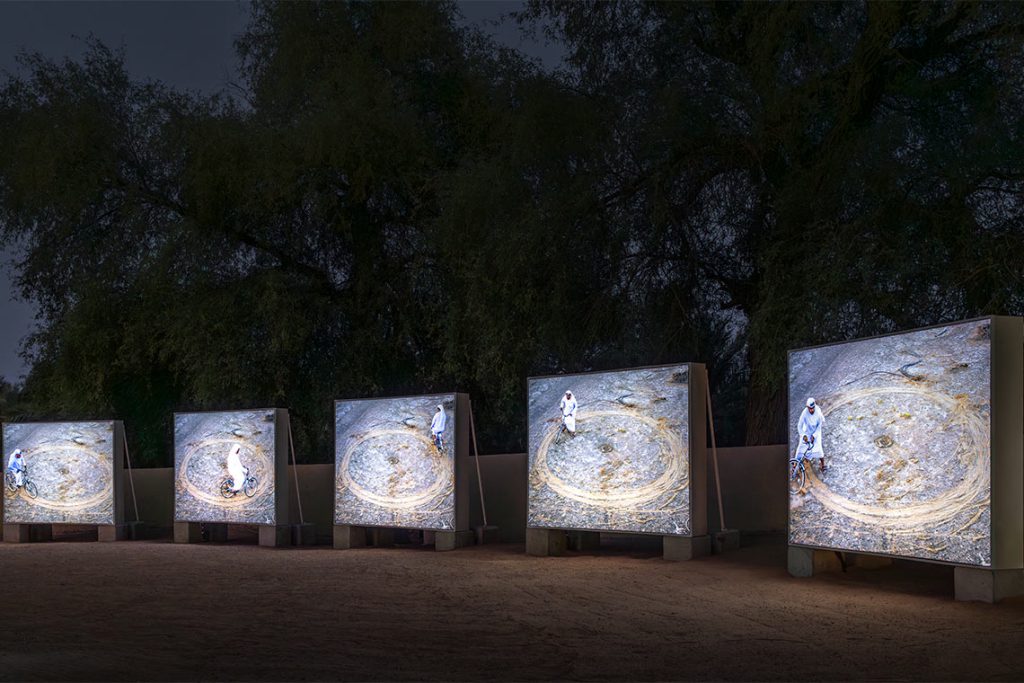
While these works map pulse and movement onto architecture and air, Amar Al Attar’s Cycle of Circles (2025) is a more contemplative approach to the medium, one that slows the relationship between body, space and light. Hori has explained Manar’s interest in the different states in which light can exist and operate, and Al Attar takes this up through photography’s most elemental condition — how an image depends on the meeting of exposure and shadow – to depict self-portraits born from a childhood memory across five lightboxes.
The introduction of light into the UNESCO World Heritage network opens a dialogue between contemporary artistic intervention and environments already marked by history, one that is executed with a careful sensitivity. At the second location, Jubail Island, the works feel markedly different, often demonstrating a playfulness in terms of how artists allow their materials to respond to the site. There are some dazzling monumental experimentations with interactive technology, such as DRIFT’s nightly drone show and their whispering forest of light carved into the sand, perhaps encouraged by the scale of the site and the openness of the terrain – Hori has spoken of it as a kind of a “raw canvas” on which these various different scenographies can unfold without losing the specificity of place.
Lachlan Turczan, who often works with water, presents the ethereal Veil I (2025), carrying the language of reflection into the desert. The work is a mirage of laser light suspended in air and sand, with a drifting mist that creates the illusion of a shifting sky, recalling older modes of navigation that once relied on reading Suhail or moonlight to find one’s way.
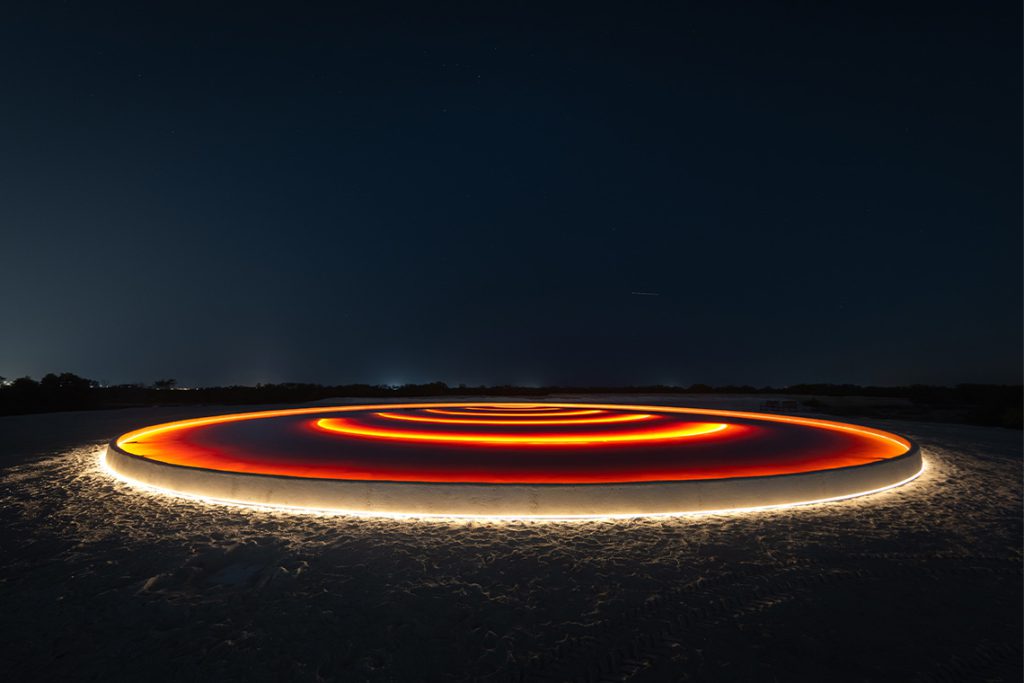
A subtler marvel, although equally considered and one that leaves perhaps the most lasting impression, is Shaikha Al Mazrou’s Contingent Object (2025), which turns towards the conditions of the site, allowing light to emerge from the ecosystems themselves. The Emirati artist creates a vast, glimmering pool of seawater infused with salt and pigment-producing algae and bacteria, which interact with heat and wind to gradually deepen the red hue through crystallisation and evaporation. The effect is brought to life by the slender luminous ring tracing the salt field’s circumference and giving it the quiet presence of a low resting red moon. Surrounded by darkness and mangroves, the glow is legible as both grounded and celestial, echoing the lunar metaphor that anchors Manar’s thematic vision.
Nature, in all its expressions, from the natural to the artificial and the grounded to the atmospheric, sits at the centre of the thinking across these works. “This year seeks to pair nature with the nature identical,” says Hori. Co-curator Alia Zaal Lootah framed this sentiment simply by asking “what happens when light meets people, nature and water?” Land interventions, sculptural works, interactive installations and architectural pavilions thus sit alongside one another with that question in mind, engaging visitors of different ages and levels of familiarity with contemporary art to appreciate the beauty of Abu Dhabi’s built and natural heritage through new light.
Manar Abu Dhabi 2025 runs until 4 January
