

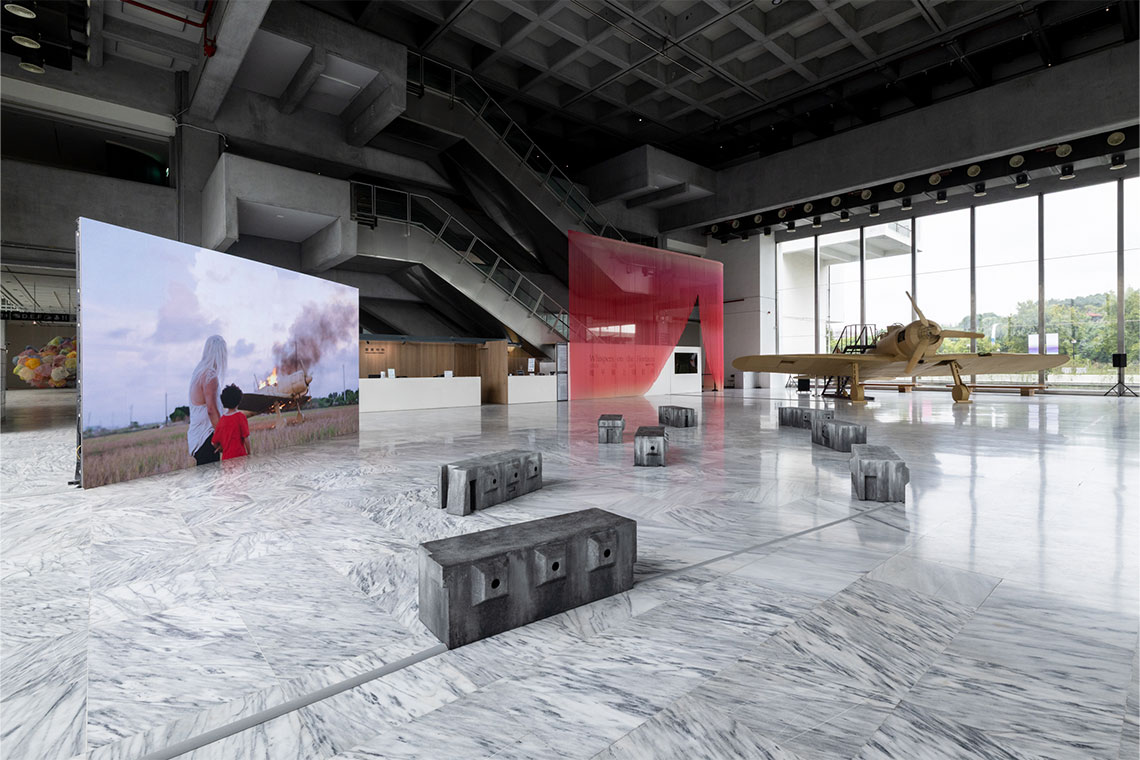
The latest edition of the Taipei Biennial, Whispers on the Horizon, opened as a space in which a universal sense of longing. Yet it also acknowledges that the “horizon” may never be reached.
Rooted in historical and local cultural context, the 14th Taipei Biennial – curated by Sam Bardaouil and Till Fellrath – uses three objects as its departure points, while including further works from the expansive collection of the Taipei Fine Arts Museum. The three guiding vessels comprise a puppet from Hou Hsiao-Hsien’s film The Puppetmaster (1993), a diary featured in Chen Yingzhen’s 1960 short story My Kid Brother Kangxiong, and a stolen bike from Wu Ming-Yi’s novel The Stolen Bicycle (2017), each representing a different kind of longing, loss, memory or desire, from private to social and across generations.
Setting the stage at the start of the exhibition is one of 54 participating artists. Zih-Yan Ciou’s multimedia installation Fake Airfield (2025), modelled after the decoy airfields that the Japanese built across Taiwan during the Second World War. In the playful fictional film, a young boy and a man take flight in a cardboard airplane in a historical re-enactment inspired by the days of Japanese colonial rule. The duo are mid-flight, being shot at by, and shooting at, the planes around them. The child initially asks “Are they from our side?”, as loyalties are unclear. The conflict leads to the eventual crash with fireworks from the wreckage as the pair watch it burn in a whimsical culmination. Fake Airfield highlights how identities are shaped by the complexities of history and political forces, while our understanding of the past changes through, relationships, memories and retellings.
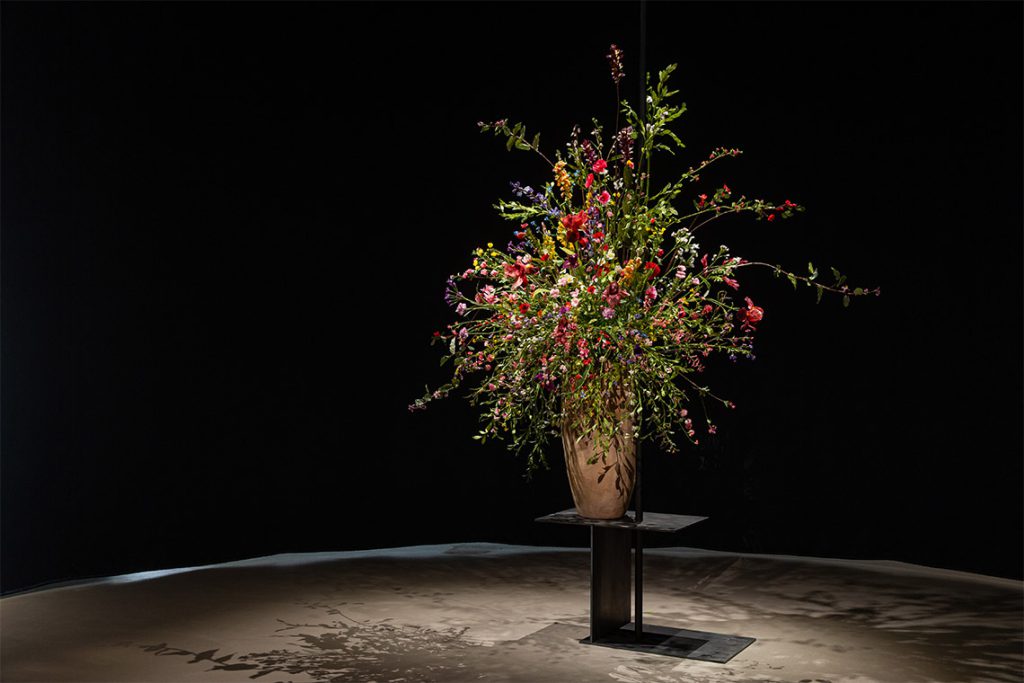
One of the gallery spaces opens to Omar Mismar’s Still My Eyes Water (2025), where a floral arrangement is set against the backdrop of black curtains in an unnerving yet opulent display of the type one might see in a hotel lobby or grand entrance. Yet upon closer inspection the bouquet is artificial, in a lifeless stance with no scent and an unnatural, ageless perfection. The work draws from the 1870 book by Swiss missionary Hannah Zeller, Flowers of Palestine, which featured 54 colour illustrations of local plants. Still My Eyes Water becomes a reflection on fading memories, on what is kept alive and who decides.
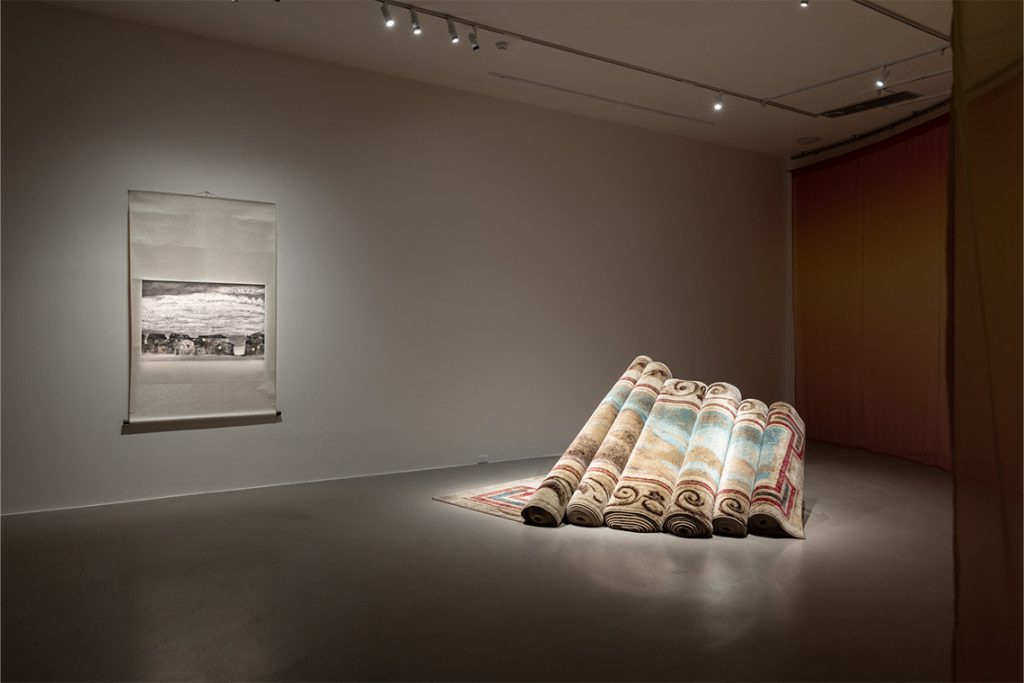
Hera Büyüktaşcıyan’s work, Destroy Your Home, Build Up A Boat, Save Life (2015) brings attention to survival and life in the face of violence and displacement. The title references the Epic of Atrahasis, an ancient Mesopotamian story in which a man builds a boat to survive a flood inflicted by higher powers to punish humans. The work connects land and sea, life and death, loss and strength, and becomes an act to save memories and knowledge during personal or societal disruption. The artist also reflects on the Istanbul pogrom of 1955, when minority communities (mostly Greek) were violently displaced. Resonating with the biennial’s theme of yearning and human persistence, the rolled-up carpet becomes a symbol of home to be easily moved and carried away in quick departure or, on the contrary, to be laid down to set new foundations elsewhere.
Love After Death (2025), Korakrit Arunanondchai’s horror-tinged film and installation, examines time, loss and renewal through the lens of memory and dreams. Teddy bears hide behind the transparent film screen as a fog machine pumps soft clouds that eerily obscure the setting. Lights flicker and buzz along with the film, creating a space for possession. Utilising supernatural elements and mythology, the work brings together spirits and ancestry as it asks what happens when spirits inhabit a space, connecting the past and present. As the film suggests, “If you pay attention to the darkness, you might notice the ghost sitting alongside you”.
The state of unalive yet living runs through other works. The installations of Ivana Bašić include Passion of Pneumatics (2020–24), a large-scale sculpture that evokes the fragile human condition and pushes the boundaries of what the body could be, liberating it from earthly restrictions in a deep yearning for a freedom that cannot be reached in this material world. The work draws from the artist’s childhood of war, violence, trauma and the collapse of Yugoslavia, probing notions of life and death. Each material carries symbolic weight, as the artist explained during a panel discussion: wax represents mortality, derived from paraffin and fossilised bodies; blown glass signifies life’s fragility, with trapped breath evoking death’s final exhalation; stainless steel resists both life and death through its permanence and resistance to oxidation; stone embodies matter shaped by pressure that slowly succumbed to life’s forces; dust signifies anonymity, the state to which all things can be reduced; and bronze symbolises protection.
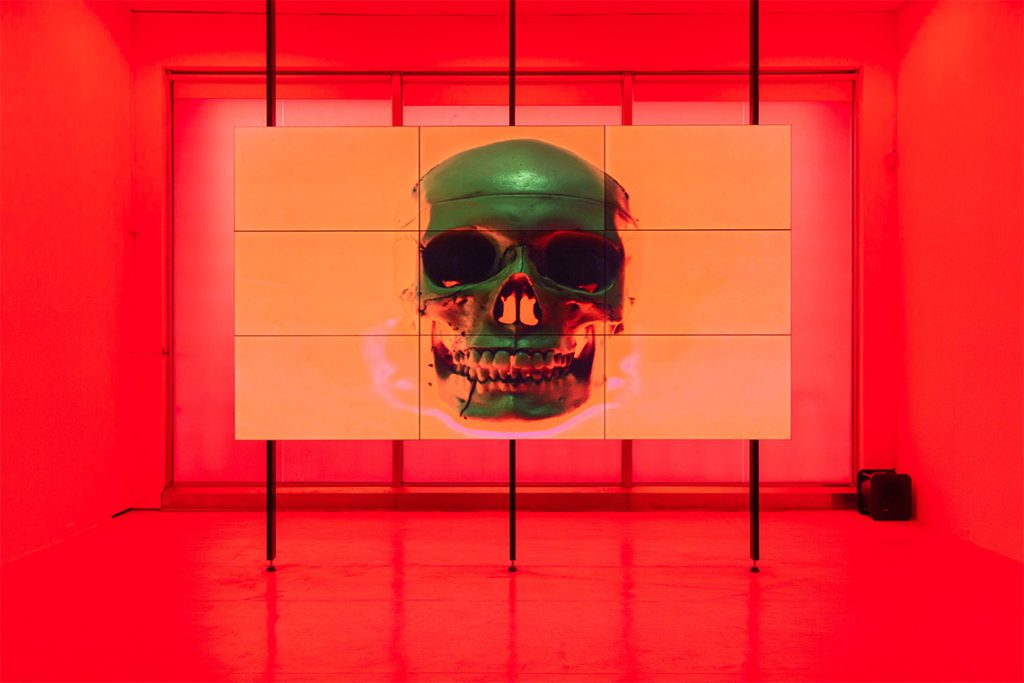
artist, Commonwealth and Council and Taipei Fine Arts Museum
A bright pink-lit room features P. Staff’s Skeleton (2025), a looping video of a human skeleton – sometimes revealed bone by bone – that makes the invisible visible and examines how power structures control or define bodies, and how those often overlooked in society disappear unseen. The work fades in and out of focus, playing on the human desire to be acknowledged and the longing to be included and seen in life and death. Simon Dybbroe Møller’s Bag of Bones (2023) animates an Iron Age-dated naturally mummified body found preserved in a Danish bog. The 3D version is inflated and deflated with artificial breath, connecting the physical with digital representation and, perhaps in a more sinister way, the installation brings the dead back to life, probing who has control over our remains and images when we die? Mohammad Alfaraj similarly reflects on temporality and the capture of fleeting memories through images. Like Tea Leaves in Water (2025) brings together palm sculptures, photography, sand and charcoal writings that contemplate how eventually everything that exists will inevitably change or disappear.
However, when does chasing the impossible become futile and the desire for people, places and things to be immortal simply a decadent pursuit? Afra Al Dhaheri’s monumental Weighted PAUSE (2025) highlights the importance of both slowing down to feel the weight of the present, and of reflecting. The sense of longing does not become an impossible feat in the distance, but a necessity to rest in the now. Perhaps it is a testament to our contemporary times, where the world is on edge yet there is an urgency to keep going. Throughout the biennial, the audience is invited to stop and share uncertainty rather than seek closure, as uncomfortable as that limbo may make us, but we can at least acknowledge a collective feeling that brings us together, even if that horizon never comes.
