

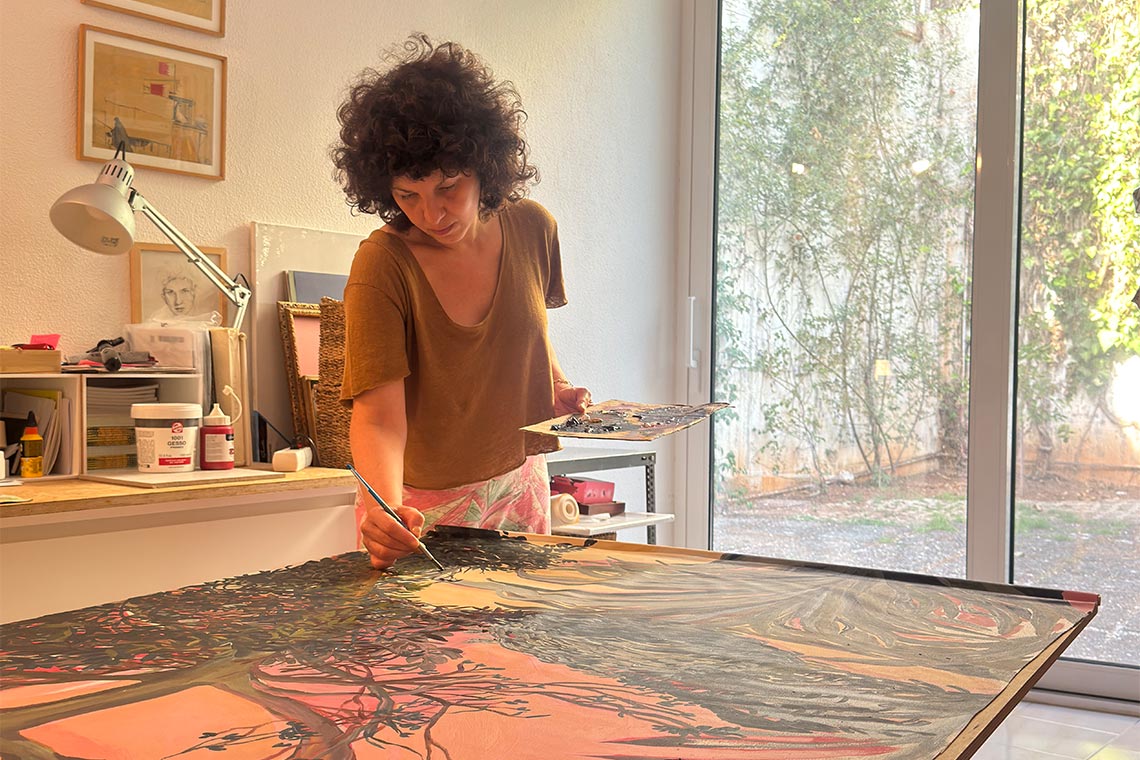
The Alexandria-born, Athens-based artist explains how her emotions influence the background colours of her urban and natural landscape paintings.
Canvas: How would you describe your paintings to someone who has not yet experienced them?
Farida El Gazzar: There is very much an element of conformity to my grid. I don’t use rulers, so there’s always a little bit of a twist to that rigidity, a humorous element I want to put in the architecture, but there’s also the contradiction of architecture that’s depicted in this way. When you’re in a wild natural space, such as a field of plants, it creates a sort of free-form architecture. I’m interested in forms and shapes, so I juxtapose these two elements, the rigid against the free-flowing. The two are usually connected by a vibrant or uniform background, because I’m also interested in bringing out the subject and making it more monumental.
Nature is an ongoing inspiration. I might pass the same object many times, but with each encounter, something has changed. I like that evolution or zooming in just to capture something, like a detail.
Does that have to do with the colours you use, reflecting the evolution through the seasons?
Subconsciously, yes. I think that when I’m painting, depending on where I am and what time of the year it is, the colours that I choose and the way I’m painting have a different feel. That’s why I usually know around what time or what period I was working on these paintings. They tend to have something subtle in common. But again, when I combine them with another group of paintings I have done before, they start to create a new dialogue.
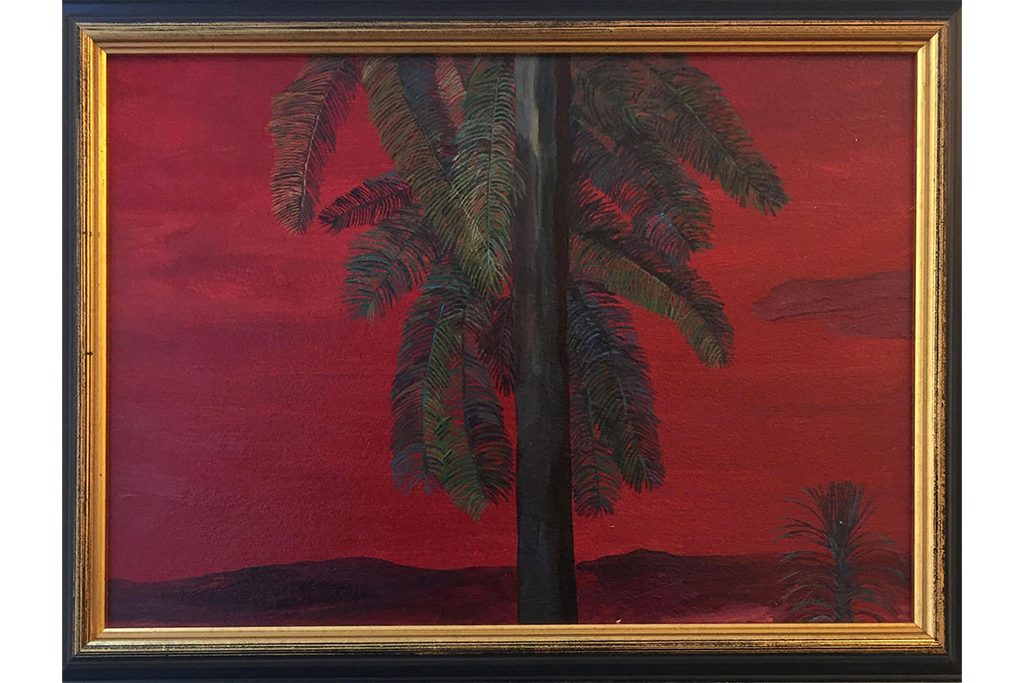
Were Together Tangled and Red Moon Blossom created around the same time? They both feature lone trees centred on a deep blue or red background.
Those two works were created for an exhibition called Night Garden in 2019 at Kalfayan Galleries in Athens. The paintings are between the metaphysical, the subconscious and the dream, alluding to that trance-like state you can go into when in nature. At that time, especially, I felt like I needed to dive into my painting as a form of meditation. Looking back at those pieces, I realise that they’re a bit darker than my more recent ones. I like the element of bringing light within darkness, so I try to enhance that aspect, especially in that series of works.
Do you have an idea of the background colours before you start to paint?
I don’t like to fixate on a set idea before I paint because there’s always another energy when there is a sense of flow. I usually have an idea, but I don’t stick to it necessarily. It’s always a work in progress. If I don’t like something, I just add a layer on top.
I am often inspired by what is around me. My favourite time of day is sunset, because it creates a sort of stillness, a pause. In Athens, where I live, the light is great, so that also inspires me. For example, in Neighbours (2015) you can see the colours of the setting sun behind an apartment block. The quality of the sunset can vary so much, depending on the place. I find that in Egypt, the light is a little bit more orange, a bit more golden.I like to play with those colours.
How do you compose your images?
I take a lot of pictures and use them as my resources, mixing and matching them, creating snapshots to capture a moment. I also take photographs while travelling, as that is when we see things objectively, with a clear mind. So I pick up on these little characteristics of a place, but again, there aren’t any people in my works. The energy of human presence is felt, not seen, through the creation of structures, the way the landscape has been formed, or the remains of what has been left behind.
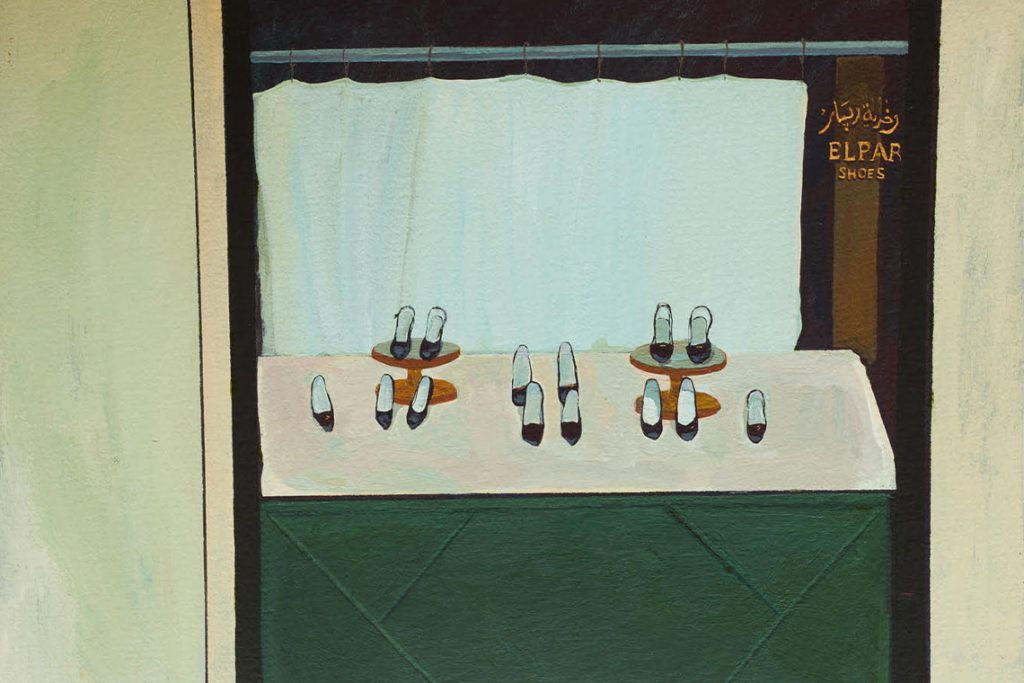
Sometimes that human presence feels more overt, such as in Untitled (15) (2011), which depicts the vitrine of a shoe shop.
That was from a series of paintings called Alexandrian Vitrines. It started when I was in Alexandria, where my family is from. This particular shoe shop is in the downtown area, in the alleyways where there were traditional shops, including jewellery shops, tailors, hatmakers and antique sellers. The way the vitrines were displayed felt very timeless, as though they could have been from 60 years ago, but nothing had changed. There was a certain kind of safety and security that I felt from that. I also found the way the jewellery was generously displayed in the vitrines of the shops, shown for everybody to see, very beautiful. This generosity, and the gold, made me feel very happy as I was walking around. There was a sense of energy and euphoria there.
What does colour mean to you? What can it convey that lines cannot?
Although many times I think of painting in black and white, which I like for that interesting use of greyscale tones, colour is a strong element of expression in my work because it always enhances an emotion.
