
The artist transforms the mechanics of censorship into a visual language of its own – one in which what is missing proves as potent as what remains.
In post-revolutionary Iranian cinema, a woman in a short skirt might suddenly find herself obscured by a digitally inserted vase, Ali Kaeini tells me. A Francis Bacon triptych in Tehran’s Museum of Contemporary Art is displayed without its central panel – the two figures lying on a bed, quietly disappeared. These are not hypothetical scenarios; they are real instances of a censorship apparatus so pervasive that it has generated, as Kaeini puts it, “its own visual grammar”. It is this grammar that underpins Missed Mist, Kaeini’s exhibition at NIKA Project Space in Paris, the French outpost of the Dubai gallery.
New York-based Kaeini, an Iranian artist whose practice draws on his country’s history, art and architecture to explore displacement, memory, power and solitude, probes how decades of state censorship and self-censorship have shaped the visual language of intimacy in Persian pop culture. Rather than referencing specific films, the works in Missed Mistimagine what might have existed had restriction not intervened. For each work, the artist constructs his own narrative – a scene that would have been censored had it been committed to film – and renders a single still from that imagined moment. “It’s about years and years of making art under limitation,” he says. “I’m just imagining if it had been created differently.”
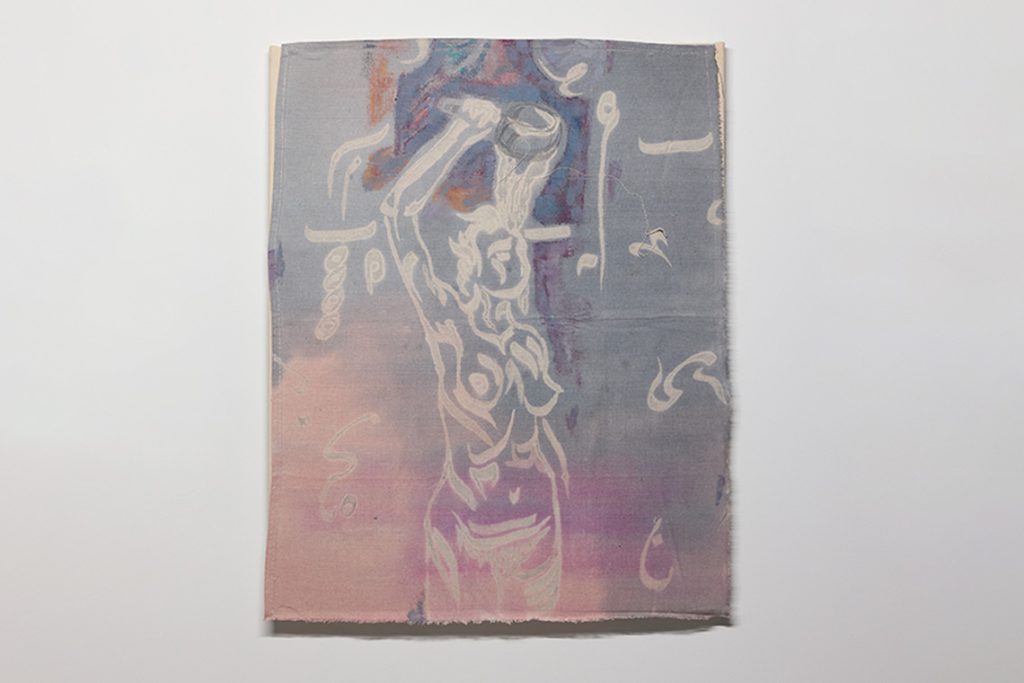
The exhibition’s central series of works on raw canvas – executed in fabric dyes, acrylic, ink, spray paint and fabric collage – produces figures that surface through erasure rather than addition. Spectral, mist-veiled bodies emerge from muted, near-monochrome grounds recalling the palette of early cinema. Kaeini’s use of bleach on dyed fabric as a primary technique is both practical and conceptual: “I see paintings as individual works, but also as part of one ongoing idea that is always transforming. Bleach works the same way for me – it allows me to go back and forth.” The method is freighted with meaning. “Conceptually, bleaching is also an extreme form of erasure, and whether we want it or not, it connects directly to the logic of censorship,” he explains. These are bodies described by the artist as “non-masculine” – a deliberate refusal of binary categorisation that allows him to explore figuration and sensuality without rigid definitions of gender.
The materiality of the works rewards close and sustained looking. Raw canvas – appealingly rough in texture – appears placed on its backing frame with deliberate casualness. Fabric overshoots the frame’s boundaries and in Scene No. 6 (Strap Fix) (2025), a corner of the stretcher bar is left exposed. A cluster of loose threads hangs from the same work in a loop, almost cobweb-like, while a single stray thread haunts the surface of Scene No. 3 (Eleanor Sauna) (2025), in which a ghostly figure pours water over herself from a pan. The canvases look weathered, as though they have lived through something.
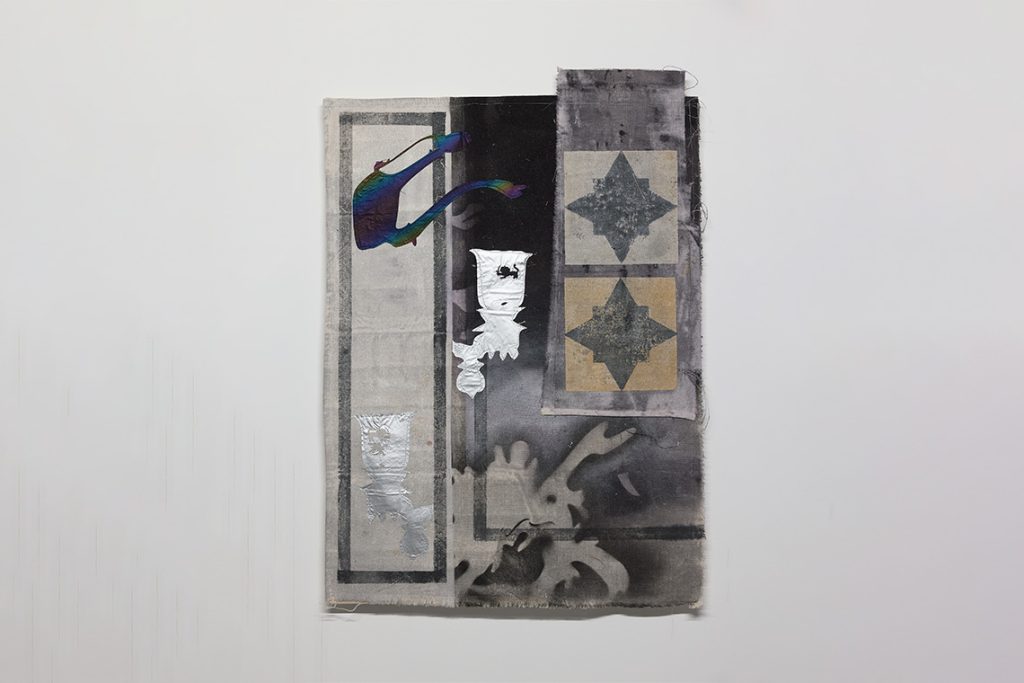
Ali Kaeini. Decanter and half chandelier. 2024. Fabric dyes, acrylic, ink, spray paint and fabric collage on raw canvas. Photography by Alexei Kostromin. Image courtesy of NIKA Project Space
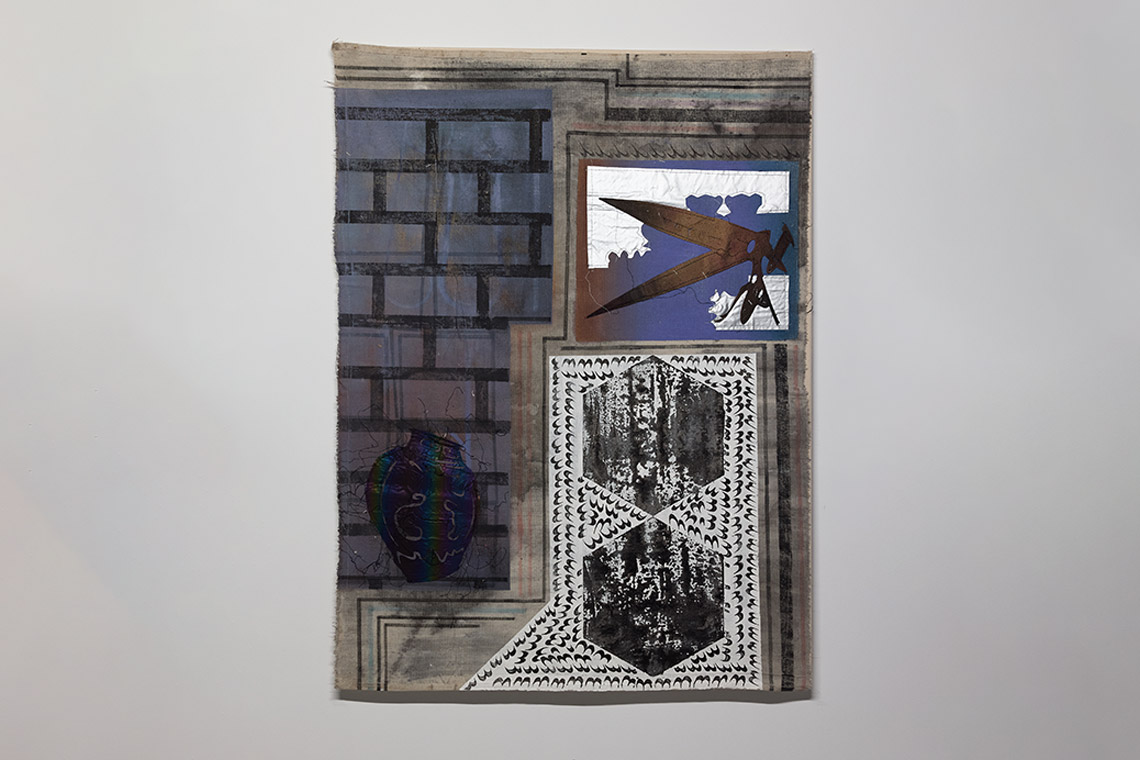
Other works layer different fabrics – raw canvas combined with metallic fabric in silver or iridescent rainbow tones – as in Decanter and half chandelier (2024) and Crow and the wall (2024). The latter demands particular attention. What appear to be loose threads spilling from a painted vase are in fact carefully sewn on, an exercise in the slippage between accident and intention. A V-shaped form that the title identifies as a crow reads equally as a pair of scissors – a quiet allusion, perhaps, to cutting. Also cut from the fabric in Decanter and half chandelier is the silhouette of a lion seemingly holding a curved shamshir sword – a visual evocation of the Lion and Sun, the historic Shir-o-Khorshid emblem of Persian identity, itself a victim of erasure, banned after the Islamic revolution as a symbol of the deposed monarchy. Since reclaimed by diaspora communities and anti-regime demonstrators, its reappearance here carries a distinct political charge.
A series of calligraphic ink drawings, the Untitled Series, Figurative Calligraphy (2023–25), offers a counterpoint to the layered, spectral canvases. These works hum with movement; their sinuous black-and-white forms suggest musical notation, carrying an almost jazz-like rhythm – a resonance that gains an additional edge given that music itself was criminalised in Iran after the 1979 revolution. They draw on a tradition born of prohibition – the calligraphic figures that emerged when Islamic authorities banned figurative imagery and artists began shaping sacred words into human outlines. Kaeini has taken this legacy further, developing what he describes as a “fictional language” suspended between Farsi and Arabic calligraphy. “I created this fictional language almost to not communicate in the expected way,” he says. “Still, it slowly finds its own way of communication.”
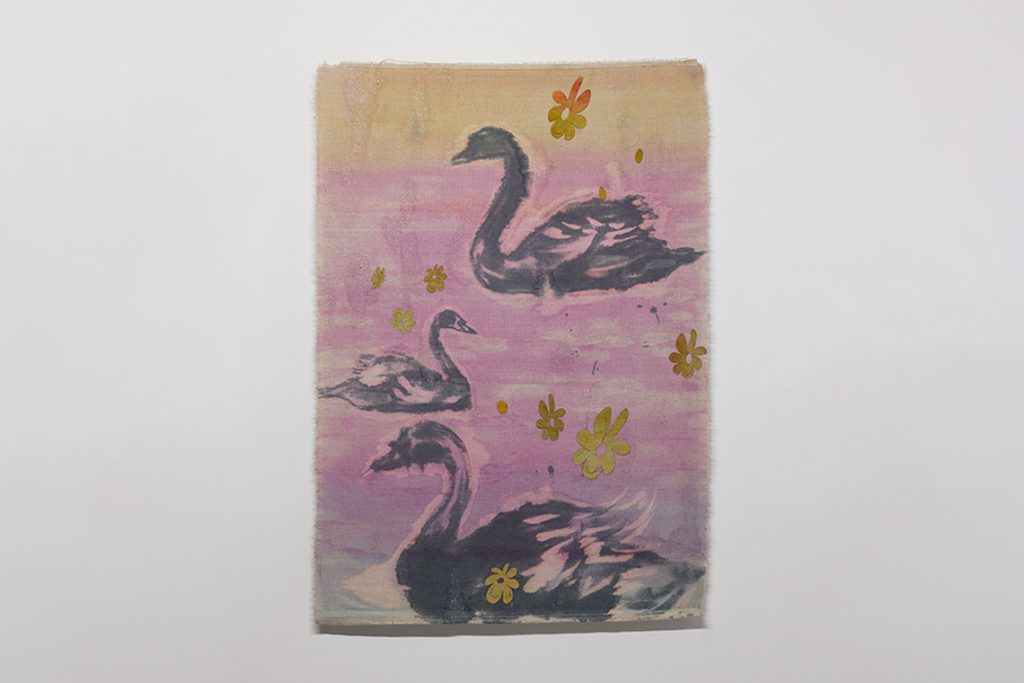
Throughout, domestic and decorative motifs recur as loaded signifiers. Swans and Blossoms (2025) glimmers with glitter – one imagines the swans drifting across a Tehran park, the flowers drawn from the ornamental vocabulary of Iranian homeware. In Flowers (2025), a corner of the canvas is cut away entirely and the composition – which appears to depict a painted triptych – is crossed by lines of canvas fringe that intersect with the painted marks to create a pattern that reminds me of bars. Domestic and decorative motifs, Kaeini suggests, have long served double duty in Iranian visual culture, functioning as tools of censorship as much as ornamentation.
The poet Omar Khayyam, referenced in the exhibition text, compared the human body to a vessel: both made of clay, both destined to break and return to the earth. Kaeini takes up this metaphor, working with silhouettes of museum objects – jars, vases, decanters – digitally processed, laser-cut and collaged onto canvas. These forms become stand-ins for the displaced body, containers for what has been emptied out by the censor’s hand.
Missed Mist is a phrase that came to Kaeini while half-asleep on a train, and it retains that liminal quality – erotic and spiritual, nostalgic and elusive. An epigraph to the exhibition text by the filmmaker Abbas Kiarostami – “The viewer completes the film” – feels apt. Kiarostami was, Kaeini reveals to me, perhaps the only Iranian director who chose simply never to shoot certain scenes, avoiding the need for anyone to censor them. Kaeini conjures the scenes that were never made, and then partially erases them all over again.
Missed Mist runs until 11 April
