

Tamara Al-Samerraei presents an ecology of abstraction in The Bed is Still Warm at Marfa’ in Beirut.
The paintings of Kuwait-born, Lebanon-based artist Tamara Al-Samerraei are at once figurative and abstract, depicting subjects from the artist’s life, whether material objects or figures found in photographs. Her practice is one of abstraction, in the specific sense that her work develops from a process of repeated representation that abstracts the subject from its mundane reality. Once removed from the world, the image becomes a character in the lively creative life of her canvases. The Bed Is Still Warm, the artist’s latest Beirut exhibition, includes acrylics, mixed-media works on paper and wallpaper pieces in an ensemble that might be read as a map of the artist’s abstraction practices.
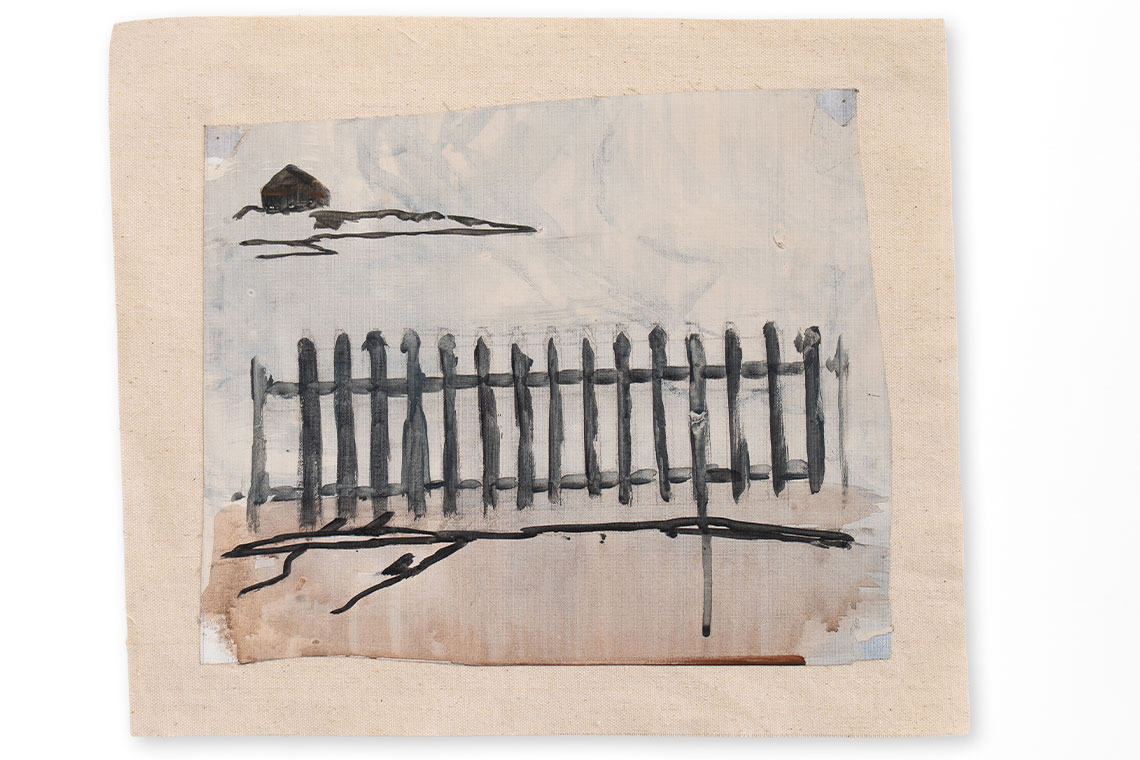
Replication of images is a prominent feature of Al-Samerraei’s oeuvre. Birds, interior rooms, potted plants, sculpted human forms, fences, human nudes, hunched four-legged beasts, all have inhabited multiple works over the years, slightly altered by materials, media and circumstances. The works on paper (24 x 18.5 cm) are primarily landscapes created during a 2026 residency in Cyprus. Composed with watercolours in tones of grey and taupe, and completed with touches of acrylic, graphite, or charcoal, they mute the blues and greens of their coastal locations. They enshroud other figures – a ghostly fence, a grinning roadside carnivore, suggestions of structures – that ground the pieces in Al-Samerraei’s universe.
The formal antecedents of these works on paper are small mixed-media canvases like Cocoon (32 x 36.5 cm), Fence (33 x 38.5) and Hill (32 x 36.5 cm) (all 2025), whose subjects seem to be obscured by mist. The sharp-lined subject of House (2026), is all but occluded by the dissolving, precipitous terrain in the foreground. It is as if the artist were painting in order to clarify or distil an image amidst a swirl of location and material, memory and media.
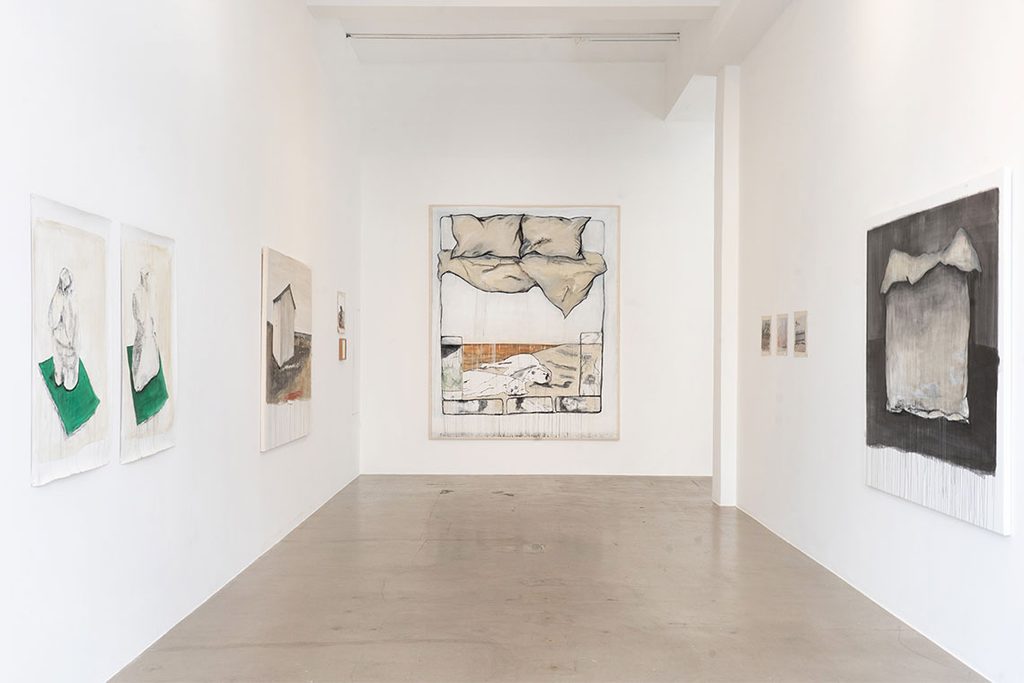
At some point in their career, Al-Samerraei’s images may become motifs in one of her wallpaper works, the termini of the artist’s ecology of abstraction. Each wallpaper is a montage comprising a single repeated background image, initially composed in Photoshop from excerpts of past works, with different motifs superimposed upon individual frames. The artist intervenes upon these printed backgrounds – highlighting certain features and adding freehand paintings and drawings.
Marfa’ is showing two wallpaper pieces from 2024, hung as ceiling-to-floor scrolls, with a pair of small works between them. The scale of the wallpapers and the array of elements suggest allusive shards of narrative. The background of each frame is a reproduction of a watercolour of potted plants, which the artist has bisected vertically with broken lines of green paint. Motifs set among the plants include a female nude lying on a couch; an open laptop computer; barefoot toddlers crawling across the frame; a headless female figurine, holding up an offering; three hunched, hyena-like beasts. Among the plants’ branches drift fragmentary drawings of nudes, like ghosts of past lovemaking.
Distinguished by their refined, expansive aspect, the principal canvases of The Bed Is Still Warm are where the images in Al-Samerraei’s creative ecology find resolution. The exhibition title references one of the artist’s recurring subjects, the bed, which appears here in the 2024 acrylic Bed 5 (272 x 223 cm). This narrative painting comprises multiple scenes that resemble a film montage on canvas. On the top half of the surface, the principal scene shows the bed itself. Recalling the solidity of classical and renaissance depictions of draped fabric, the textured indentations and creases of pillows and duvet form a grey escarpment rising from an expansive plain of white mattress.
Other familiar forms appear on the lower part of the surface, in a series of separately framed associative scenes. The largest shows a pair of creatures sleeping on a floor rug, somewhat domesticated reiterations of the monstrous figure that stalks the artist’s oeuvre. The five rectangular frames that bracket the sleeping beasts depict another of Al-Samerraei’s favoured themes — human nudes in postures of lovemaking.
Among the more common motifs of the major and minor works in this show is a structure set on a landscape. Those at the centre of three of the show’s major works, all from 2026, are decisively material. Two of the canvases are handsome pieces from the artist’s Shed series (2025–26), capturing apparently identical scenes of a structure. Streaks of grey paint stream down its walls, suggesting it has begun to melt.
The colour range of Shed 2 (2026) is particularly varied and nuanced, not in the structure itself but in its setting. The provocative translucency of the layers of green and dark grey in the foreground gives it the reflective quality of liquid. A fitting complement to the structure’s disturbed sturdiness, the juxtaposition of solid and fluid alludes to impending transformation.
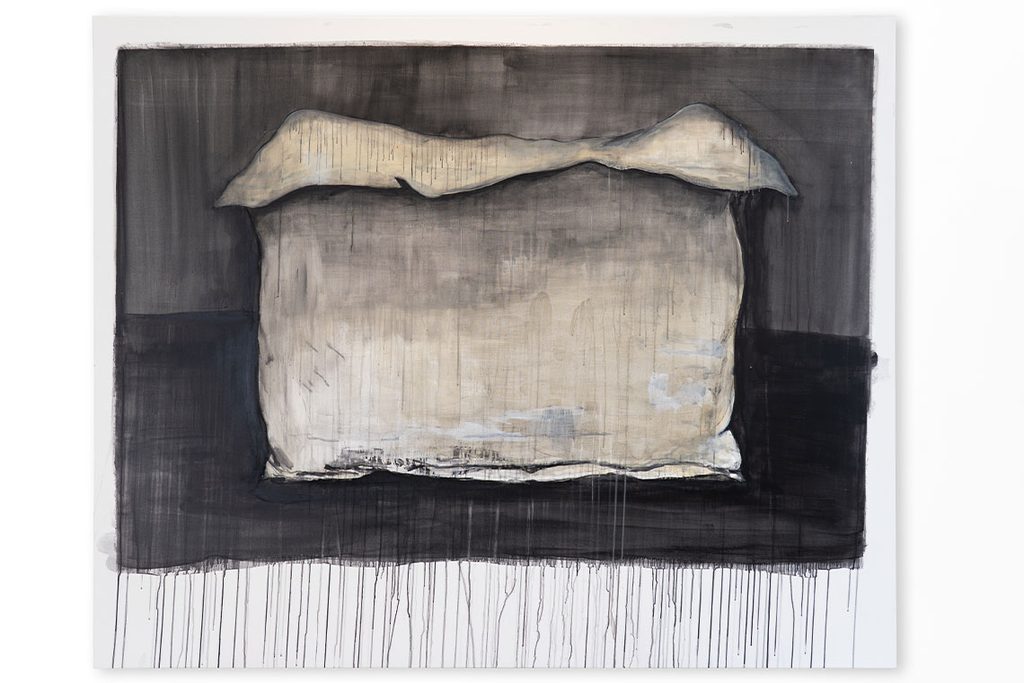
Totem Shed 2 (2026) suggests one possible course of change. Here, the subject is bereft of naturalistic context, save for a horizon line between two shades of grey. Looking far less sound than the structures of the Shed series, its dilapidated roof, sagging and crumpled walls exude the texture of fabric. It’s almost like something you’d lay your head on.
The Bed is Still Warm runs until 30 December
