

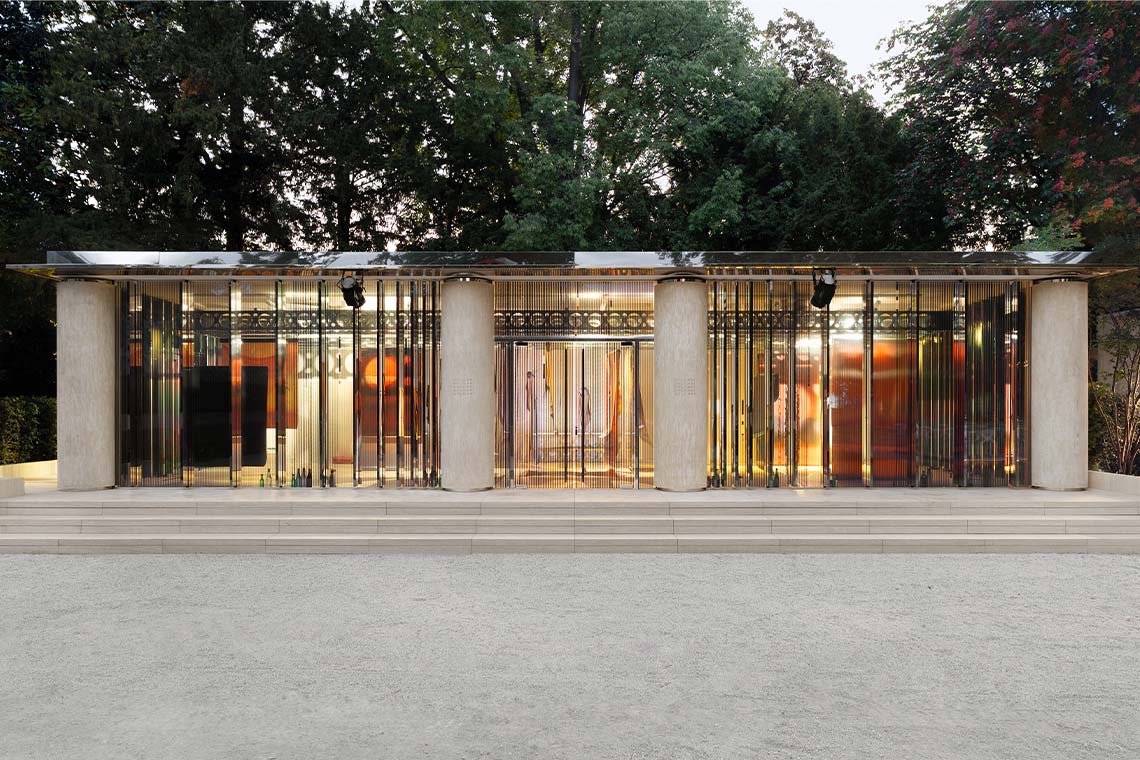
The new three-edition exclusive partnership between Bvlgari at Biennale Arte 2026 marks renewed dynamism for the Maison as it expands its artistic patronage and commitment to supporting creative dialogue.
Continuously upholding an ethos of vibrant expression and artistic liberty, Bvlgari is renowned for its sophisticated Italian craftsmanship and dedication to excellence and creativity in the world of high jewellery. Founded in Rome in 1884 by Greek silversmith Sotirio Bulgari, it has pushed the boundaries of creativity ever since, bridging and generating dialogue between art forms as it has expanded its take on luxury to the art of living, watches, accessories, perfumes, boutiques and hotels worldwide. The Maison has ensured throughout that it honours the past as much as it points to the future.
Memory is at the foundation of Bvlgari’s creative language. The Maison was “born from the idea of dialogue between the past, present and future, and of interpreting time as living heritage through a contemporary lens,” explains Laura Burdese, deputy CEO of Bvlgari. “Time is never nostalgic, it’s always seen through the lens of hope.” This is evident, for example, in the Maison’s use of iconic motifs such as the snake, which hark back to its roots while being continuously reinvented courtesy of evolving technologies, methodologies and perceptions.
More broadly, Bvlgari understands heritage as a source of infinite potential inspiration and has several initiatives focused on cultural conservation. It has participated in the restoration of important historical sites such as the Scala d’Oro at the Palazzo Ducale in Venice, the Spanish Steps and the polychrome floor mosaics of the Baths of Caracalla in Rome. It has also contributed to the restoration of artworks, including paintings by Paolo Veronese in the San Pietro Martire church in Murano. On a more contemporary front, in 2024 the Maison launched Fondazione Bvlgari with the goal of building a more meaningful future through philanthropy, art and savoir-faire, and has forged institutional partnerships with the likes of the Whitney Biennial in New York and MAXXI – the National Museum of 21st Century Arts in Rome, with which it has been jointly presenting the emerging talent-focused Bvlgari Prize since 2018.
Such strategic patronage underscores a firm commitment to expanding the understanding of art as a universal language that generates discourse and innovation. Bvlgari has now embarked upon an exclusive collaboration with the Biennale Arte 2026, for which it will serve as the exclusive partner across the 2026, 2028 and 2030 editions. It is a major milestone for the Maison and one that extends beyond pure sponsorship. It is about joining forces, asserts Burdese. “We do not want to do something on our own or to just give money,” she explains. “Together with an art institution, it is about creating something that can have a long-lasting impact, which is absolutely crucial. Everything we do is with longevity in mind.” This approach chimes perfectly with its environment, as Bvlgari CEO Jean-Christophe Babin shared in an early statement: “Venice holds profound symbolic meaning for our Maison as a timeless crossroads where cultures have met for centuries, and where today, the dialogue between identity, heritage and modernity continues to flourish in extraordinary ways.”
The 61st edition of the seminal art exhibition – curated by the late Koyo Kouoh – is titled In Minor Keys and follows a theme which the Cameroonian-Swiss curator detailed in a statement as being “grounded in a deep belief in artists as the vital interpreters of the social and psychic condition and catalysts of new relations and possibilities.” It is an invitation to consider introspective and more softly expressed ways of receiving the surrounding world and its rhythms. If beauty is a responsibility to be “valued, protected and sustained through critical thinking and research” – as indicated by Pietrangelo Buttafuoco, president of La Biennale di Venezia, following the partnership announcement – then Bvlgari is an ideal collaborator. It is presenting two exhibitions at this year’s Biennale: the Bvlgari Pavilion in the Giardini’s Spazio Esedra sees a new commission by multidisciplinary artist Lotus L Kang, while a special showcase as part of the Biennale’s collateral programming features artists Lara Favaretto and Monia Ben Hamouda at the Biblioteca Nazionale Marciana in the Piazza San Marco.
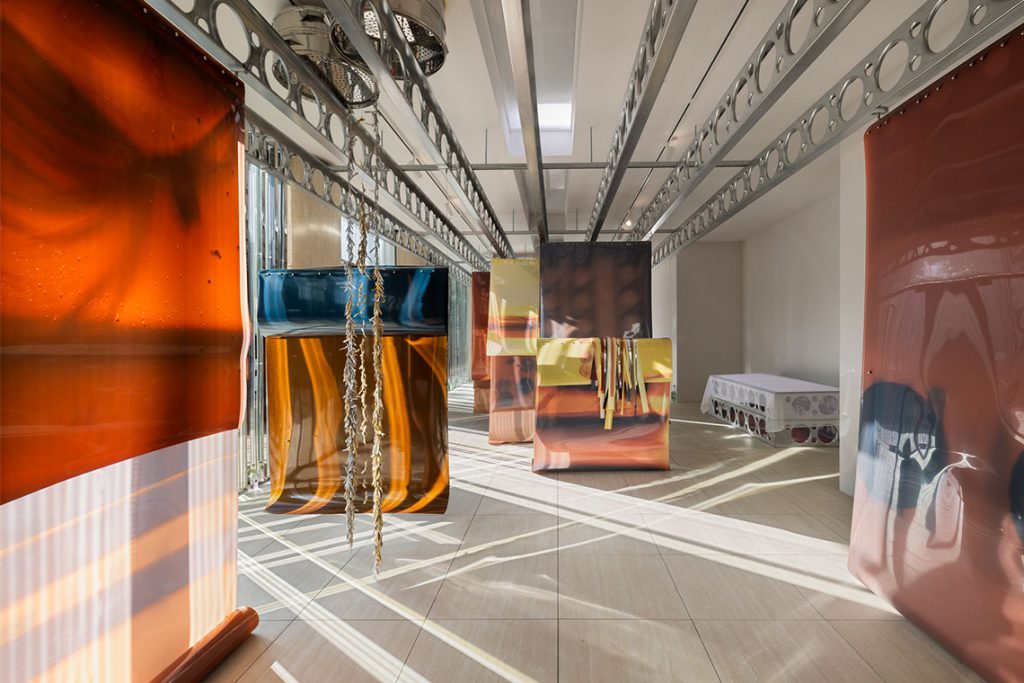
Strengthening cultural and social synergy through the arts drew Bvlgari towards New York-based Canadian artist Kang, who works across sculpture, site-responsive installation, drawing and photography in the pursuit of ‘becoming’ via layered queries into impermanence, inheritance, translation and memory. She has works in the permanent collections of MoMA in New York, LACMA in Los Angeles and the Whitney Museum in New York, where the Bvlgari team first encountered her. “We loved the way she was able to reinterpret metamorphosis and reflect on time in a very modern and contemporary way by using a mix of media, cinematographic sculpture and painting,” says Burdese. With the Biennale and Bvlgari also sharing the belief that art embodies a space for evolving knowledge and exploration while also capturing the zeitgeist, Kang’s Venice work – entitled The face of desire is loss – is a very apposite expression of the moment.
The installation comprises unfixed photographic film hanging from a steel joist – where the light and humidity exposure within the pavilion will allow the images to develop during the course of the Biennale – plus new sculptural works made of objects including tatami mats and cast objects, and 35mm celluloid film lengths encasing the pavilion windows. Playing with plane dimensionality and light, the work unpacks the multiplicity of time by considering its non-linear and contingent qualities. Detailing the piece in a statement, Kang explained that “The face of desire is loss brings together multiple time-spaces, condensing them into an environment contingent on light, time and the viewer’s body in space. Collaged together in an assemblage that refuses fixity or singularity, the body-as-environment is in a process of transmutation and transformation towards exhaustion, death and rebirth. Inside is turned outside and vice versa.”
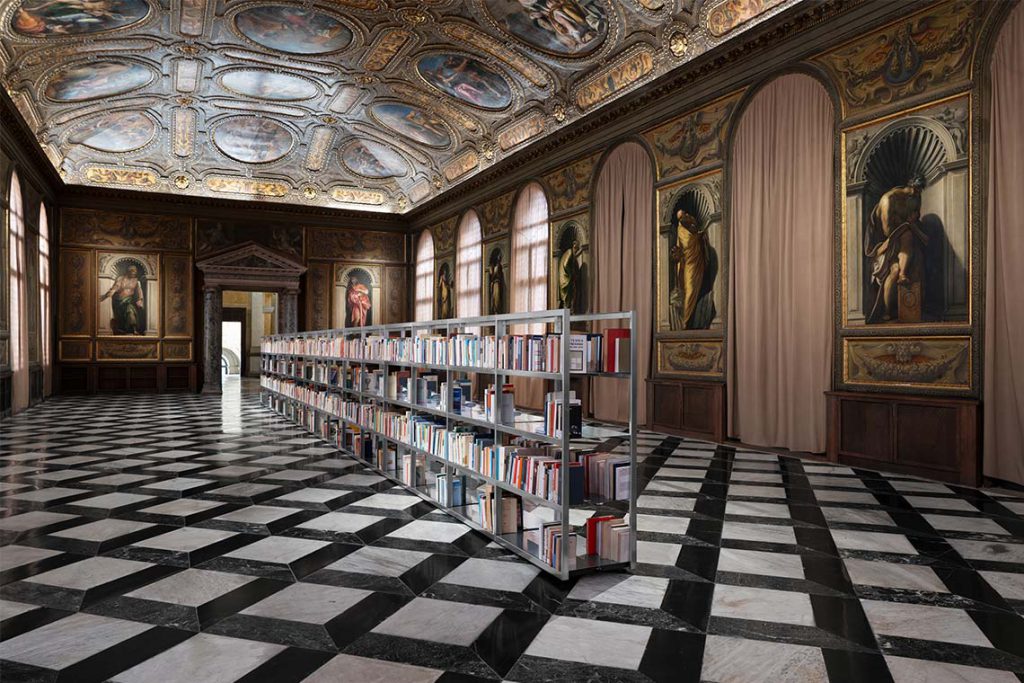
For the second exhibition, Burdese reveals that the curatorial decision to feature two Italian female artists was in response to discussions that Italian artists are not as well represented as they might be, both within local contexts and at a more global scale. It also celebrates the long-term partnership with MAXXI, with which both artists have ties: Favaretto received the 2004–5 Prize for Young Italian Art with a work for MAXXI that was then shown at the 51st Venice Biennale, while Ben Hamouda won the Bvlgari Prize in 2024. “On top of this – and this is something we love – both artists have very different practices, expressing individual perspectives on themes that are very dear to us, namely reflections of time, eternity, metamorphosis and renewal,” adds Burdese.
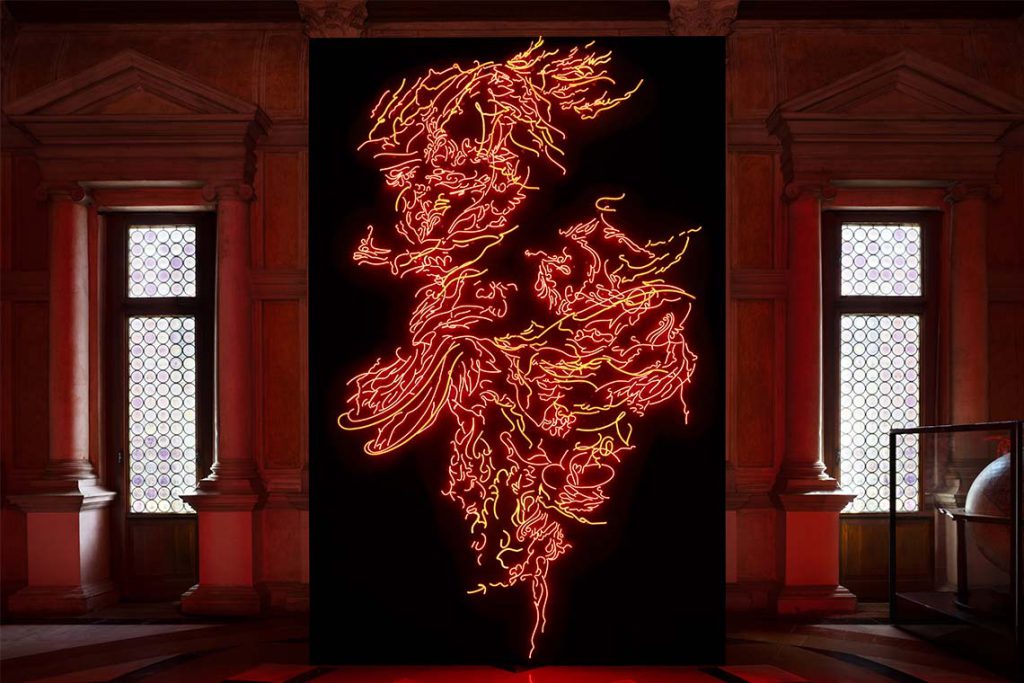
The two site-specific installations engage with the history of the Biblioteca and its role as a space dedicated to preservation. Favaretto’s Momentary Monument – The Library is installed in the Salone Sansovino and is the concluding chapter of a series that addresses permanence and memory through seemingly ephemeral works. Ben Hamouda’s Fragments of Fire Worship, installed in the vestibule, merges cultural, spiritual and political layers. Her emphasis on transformation is dichotomous, with the work both inviting the viewer in as well as acting as a threshold. Burdese highlights the parallel with Bvlgari, nodding to its snake motif. “The serpent is very much a symbol of the transformation that we believe in and put at the centre of our creation,” she explains. “Nothing at Bvlgari is static. We have 140 years of heritage, but we have a philosophy of constant, eternal renewal. That’s why we love that these themes are represented at the Biennale by three amazing artists.”
Art has always been, and will remain, an essential part of Bvlgari’s DNA. The Maison refers to its craftsmanship as “artsmanship” and uses artistic principles as its guiding instinct. However, it also defines art as a means of complete creative freedom. Burdese, who will take the helm as Bvlgari’s CEO from July this year, explains that what the Maison, artists and Biennale all share is the courage to break boundaries and turn technical constraints into opportunities. “This is why the partnership felt so natural,” she says. “We have an aligned mission to create a space for dialogue, for cross-pollination, for experimentation… a space where people can create freely and be guided solely by their imaginations and identities.” The Bvlgari Pavilion provides a calm platform for reflection and expression, and, notes Burdese, in a time of global division and fragmentation this is the most relevant approach for today, as well as for tomorrow.
The face of desire is loss is located at the Bvlgari Pavilion in the Giardini; Momentary Monument – The Library and Fragments of Fire Worship can be seen at the Biblioteca Nazionale Marciana
This feature first appeared in Canvas 123: Venice Special Issue
