

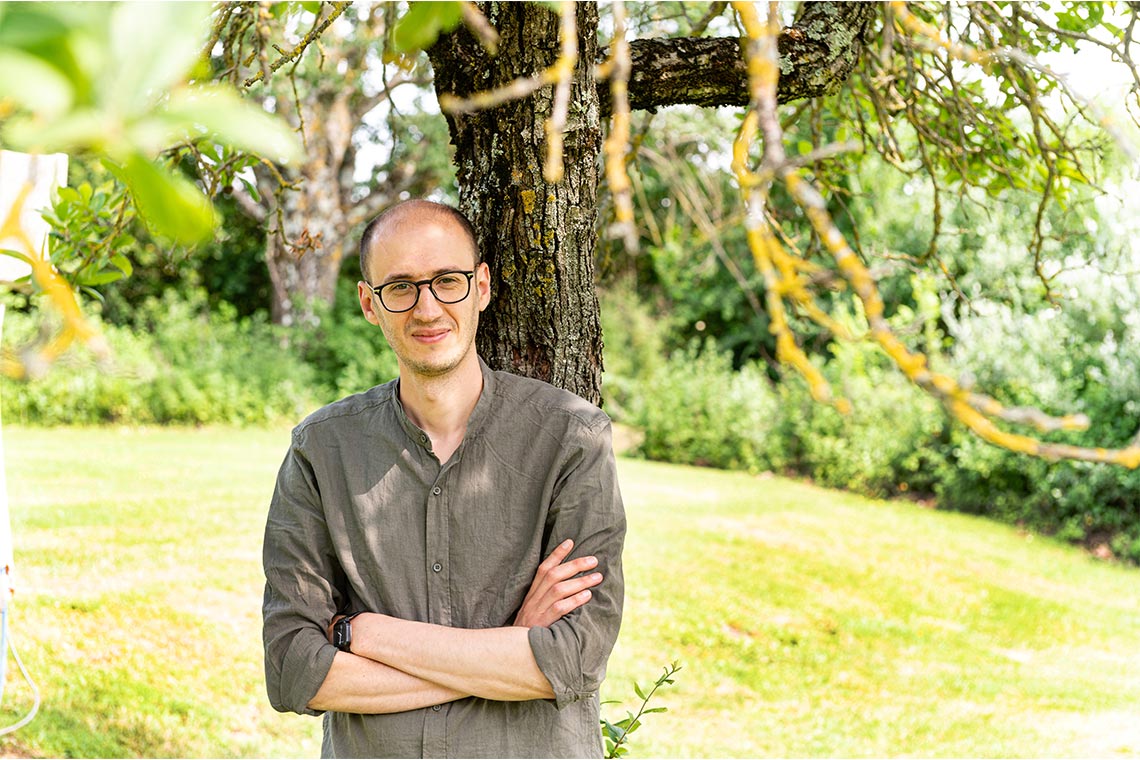
Endlessly open to opportunities and encounters, the artist deploys humour and a deep sense of history to craft his characteristic works.
I encountered the art of Massinissa Selmani for the first time in January 2023 at Selma Feriani’s South Kensington gallery (see page 60). I had never heard of him and chanced upon the opening of this particular show through a listings website; I stepped through the doors purely because I was in the area and had an hour to kill before dinner. I’m glad I did, because it made an immense impression. What I saw was a large group of whimsical yet sparse drawings – Selmani habitually leaves most of the page blank, rendering the white space as integral to the image as any mark he makes – depicting odd, caricatural figures in absurd or impossible situations, communicated with a rare charm. There was a distinct good nature to them, but beneath the veneer of idiosyncratic humour common to all of them lay something more complex and quite possibly troubling: those oceans of blank space might be divided up by forbidding fences; watchtowers might loom ominously over the loosely defined pictorial horizon.
It might seem strange that an artist would choose to evoke the spectre of confinement, or political repression, through a cutesy, illustrative idiom more normally associated with zany greetings cards than serious contemporary art. Yet perhaps it shouldn’t. When I spoke to Selmani over Zoom a few weeks ago, he was hard at work in his studio in Tours, western France, where he has been based since studying at the city’s art school 20 years ago. Arranged on the wall behind him was a thematic jumble of his trademark drawings and scraps of diverse archival material, reflecting a practice that pairs methodical historical research with the absolute liberty offered to him by pen and paper. When I put the apparent contradiction in terms to him, he replied without missing a beat: “For many people, in terrible situations, humour is the only reasonable reaction.”
He knows of what he speaks. Selmani was born in 1980 in Algiers, where his father ran a copy shop. When he was eight years old, the country erupted into a vicious civil war which pitted the forces of the ruling Front de Libération Nationale, which had dominated Algeria’s politics since independence from France in 1962, against various groupings of insurgent Islamist rebels. The conflict saw civil society riven asunder, with ordinary people menaced by the warring parties – both of whom were responsible for lethal acts of terror. Over the course of the ensuing decade and a half, political assassinations, bombings and mysterious “disappearances” became the norm. For the average Algerian, life became not only terrifying but thoroughly confusing.
Selmani has been drawing for as long as he can remember, and the medium itself remains the primary concern of his work. An early source of inspiration came from his father’s love of newspaper cartoons which, even in the darkest moments of the 1990s, remained a rare forum for satire and humour. “There’s a strong tradition of this kind of cartooning in Algeria, and yes, it was important for me,” the artist explains. A particular influence, to whom Selmani’s work bears a visible and conscious debt, was the New Yorker cartoonist Saul Steinberg. Like Selmani, Steinberg liked to depict everyman figures cornered into absurd or surreal contexts; also like Selmani, the Romanian-born cartoonist had first-hand experience of repressive political regimes, initially in his native country, then in Fascist Italy.
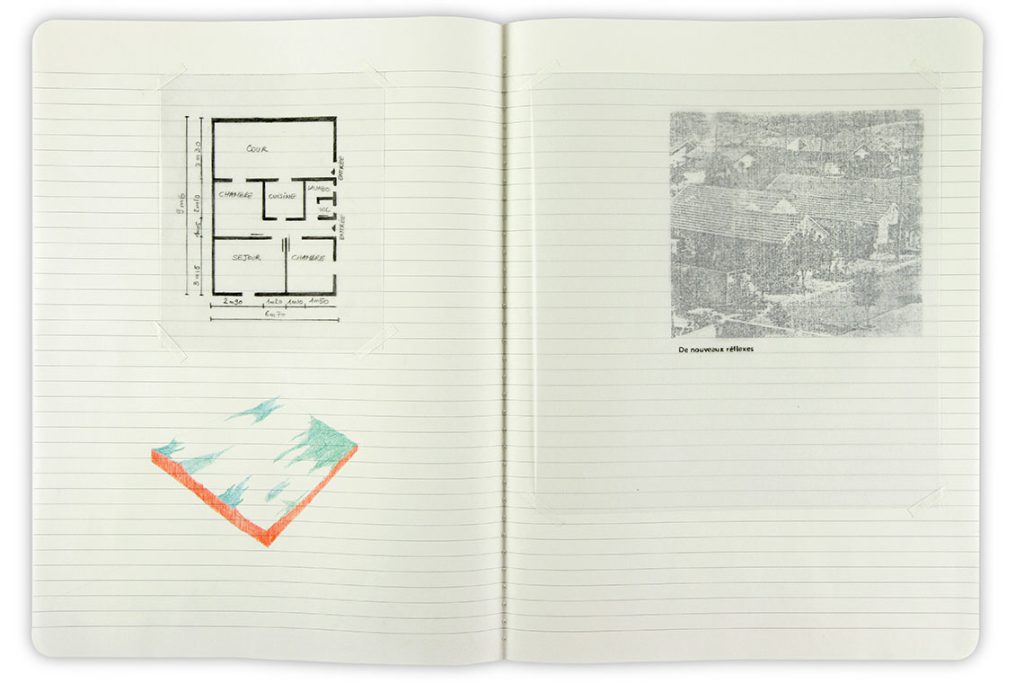
Perhaps the main thing the two artists share, however, is the embrace of drawing as a medium of limitless possibility. “It’s open-ended,” Selmani says. “I get started on a project and I never really finish.” You can see what he means. He is particularly attracted to historical episodes that have faded in the collective memory, to the point that they become more like rumours than anything more concrete. An example is his ongoing series 1,000 Villages, the first fruits of which were shown at the 2015 Venice Biennale. The project concerned a utopian agricultural policy adopted by Algeria’s government in the 1970s, when a plan was drawn up to create 1000 model socialist villages across rural parts of the country. Like many such ambitious, top-down projects in postcolonial Africa, it got little further than the drawing board. The prefabricated structures proved inadequate to the needs of the Algerian rural population, and by the beginning of the following decade, when only a handful of communities had been built, the plan was quietly shelved, living on only as a hazy memory in the minds of those it had affected. Selmani approached the subject by displaying his own bright, clean-lined sketches of the planned villages alongside progressively more faded photocopies of archival materials related to the project. The results seem oddly wistful, perhaps nostalgic for a more optimistic past. I ask whether he might harbour some sadness for the failure of the bright, technocratic future augured by such projects? “To an extent, but not really,” he admits. “I mean, I’m too young to be nostalgic for that post-independence time.”
Another, more personal, series has seen him investigate four photographs taken by his father in the town of Tizi Ouzou during Algeria’s independence celebrations in July 1962. He asked several family members to describe the photographs, each of them presenting a series of different, sometimes conflicting interpretations that interrogate the notion of objective historical perspective. The raw documentary detail is beside the point; even the specific context of Algeria is merely a convenient focus for the wider field of exploration. What interests Selmani, principally, is how such a grandiose scheme as this one can pass into the realm of barely articulated mythology, leaving him free to exploit it as (in the words of the curator Roger Malbert) “fictional documentation”. It is, he tells me, his role as an artist to exploit the vagaries between factual documentation and subjective memory.
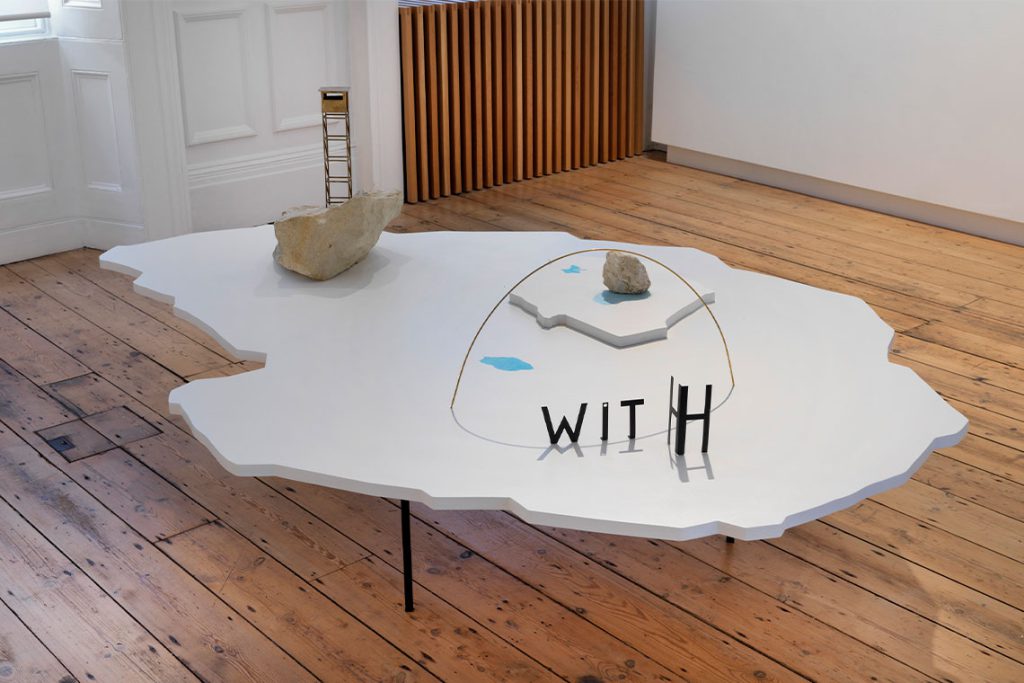
Not that he confines himself to drawing alone in the course of these serial projects. In London, when I first saw his work, I was particularly struck by a sculptural tableau, laid out like an old-fashioned museum diorama. Entitled Even Distances are Continents (2022), it was essentially one of his drawings translated into three dimensions: the white space that so characterises his draughtsmanship covered a jagged tabletop, like a sheet of ice adrift on the Arctic Ocean. On it were placed several objects of open-ended significance: rocks; an arc of copper wire; unevenly shaped pieces of wood spelling out the letters of the word “with” stood horizontally, like a frontier post denying access to a sparse, ambiguous expanse. “I have difficulty describing these works as ‘sculptures’,” Selmani confesses. “They’re more like objects, let’s say.” More impressive still are his animations, which bring to life the universe he conjures in his drawings in short, seconds-long loops that turn what might ordinarily seem like humorous situations into repetitive, entropic continua. One sees a man attempting to insert a voting slip into a ballot box as a bystander applauds, but the reel finishes before he can complete the action. Cute though it might seem, it’s as succinct an expression of futility as any imagined by Samuel Beckett.
Selmani’s vision has not gone unnoticed in his adopted homeland, where he has exhibited at various major institutional venues – notably Paris’s Palais de Tokyo in 2018 – and been selected as a finalist for several significant prizes, including France’s most prestigious award for emerging contemporary artists, the Prix Marcel Duchamp, in 2023. Nor is his reputation likely to slide in years to come: the immediate future will see him stage shows in China, at the Aranya Art Center in Qinhuangdao, and in Marseille (“I can’t wait – I love Marseille!”). But does he, I wonder, harbour ambitions to extend his practice to new frontiers entirely? It’s not, for instance, a stretch of the imagination to think of his animations being developed into something akin to feature films. “I really couldn’t say,” Selmani responds. “One day, maybe… but the truth is that I just like to see how things develop.” Anything, then, is possible, and it will be fascinating to see how Selmani continues to exploit such space and scope.
This profile first appeared in Canvas 117: The Maghreb Issue
