

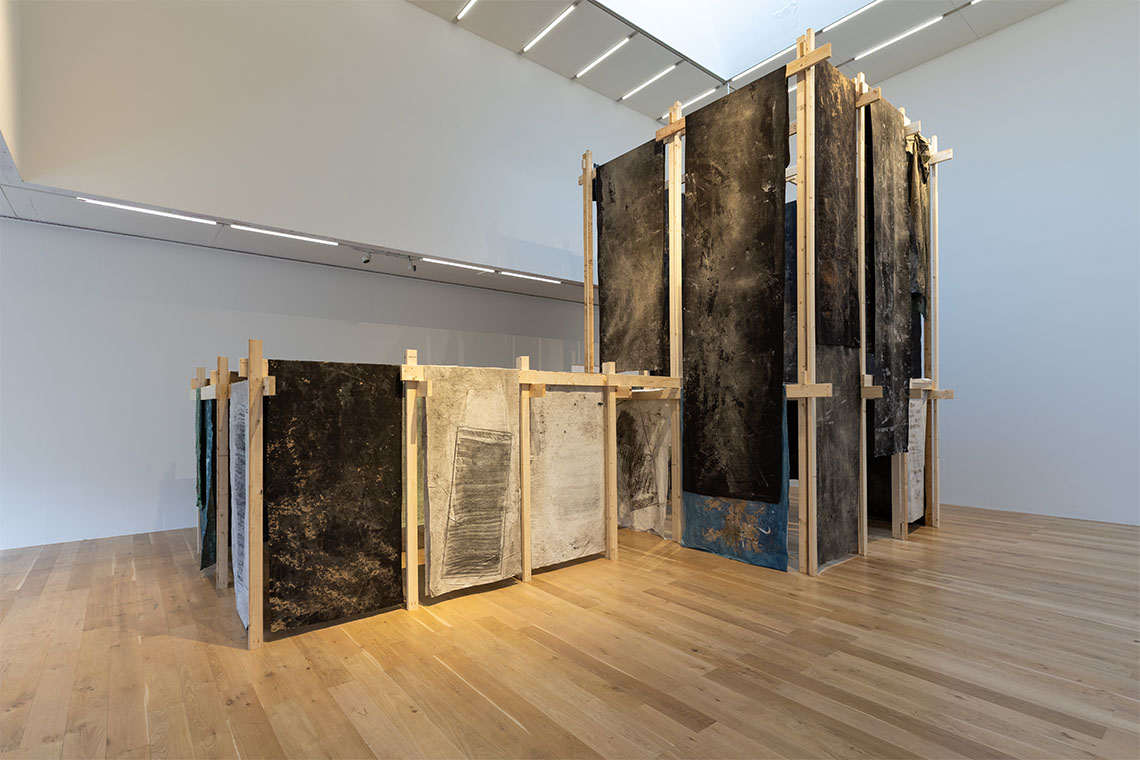
In Cemetery of Martyrs at Nottingham Contemporary, Dala Nasser introduces us to seminal cultural figures from the Arab world and, through death, to an unusual history of the region.
In the heart of the British Midlands lies an unlikely exhibition for an area of the UK which has lately seen a sharp rise in anti-immigration sentiment. Although ideas of revolution and resistance underpin the very essence of the cultural figures honoured in Cemetery of Martyrs, at first glance the exhibition appears relatively innocuous. Dala Nasser has erected two monumental wooden structures in adjoining rooms at Nottingham Contemporary, which support large pieces of black, blue, green and white fabric, constituting a makeshift “graveyard”. Each of the 43 pieces of cloth denotes the grave of an artist, writer, poet, filmmaker, historian or journalist from the Nahda or Arab Renaissance of the late nineteeth and early twentieth centuries through to more recent cultural figures. These individuals have shaped much of the Middle East as we know it by fighting for freedom, sovereignty and independence in the midst of colonial rule and socio-political subjugation.
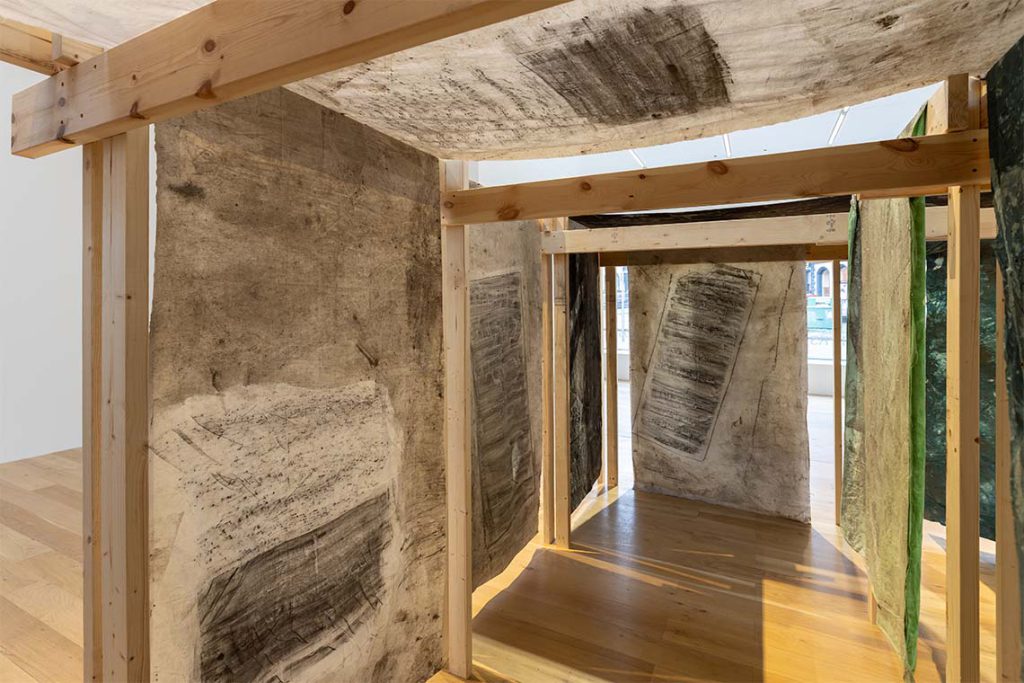
For graves that were found and accessed, Nasser has made rubbings of the tombstones on white sheets. For those figures whose graves were lost, such as Maroun Baghdadi, a pioneering Lebanese filmmaker who died tragically in a fall at his parents’ house, the artist Saloua Raouda Choucair, whose grave was not found by Nasser, and Mahmoud Darwish, whose tombstone is now fenced off, either a blue cyanotype featuring the person’s name written in sand or a green malachite and indigo dyed sheet (green being the colour of paradise) is used instead. Interspersed throughout are black mourning sheets, creating canopies above visitors’ heads.
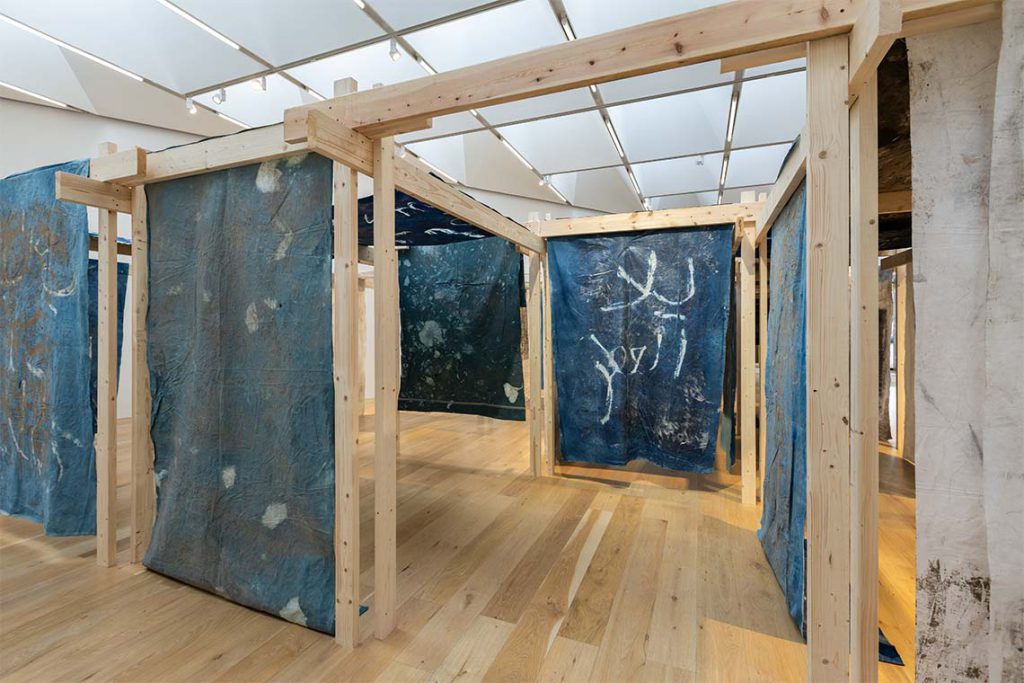
People speak in hushed whispers upon entering the room, as though intuiting something before fully knowing it. The only other sound is the exhibition’s accompanying audio recording, sourced from eight cemeteries across Lebanon, according to Katie Simpson, who curated the exhibition alongside Klara Szafrańska. The sand used to etch the names in Arabic on the sheets representing unfound graves also comes from Lebanon, as does the dirt and debris rubbed onto and across the fabric by Nasser in her studio – her way of physically bringing a piece of these resting places into the exhibition space. The effect is both simple and raw. The sheets move gently as one walks by them, as if a gentle breeze from the Mediterranean had passed through, and they hang sombrely yet elegantly from their perches. A closer look reveals the material chaos of the dyed and stretched cloth, with bits of charcoal and dirt affixed to them, bits of place that are inescapable to the eye.
One could easily just access Cemetery of Martyrs as an immersive sensory experience and still leave feeling in awe of the sheer scale and materiality of this indoor mourning space. Simpson explains that the show holds “different layers that you can get involved with, if you want to read, if you want to just experience it as an art installation”. The exhibition’s accompanying booklet indicates whose graves are where, with a short text about each person in turn, and provides a deeper opportunity to learn about the struggles and lives of a region so often depicted in oversimplified and prejudiced ways. Nasser’s snappy writing eulogises each figure as if they are old friends, including her own aunt, Siham Nasser. Of her, the artist writes, referring to herself in the third person: “In mourning her, her niece smoked a cigarette with her by her grave, as the writer would have liked.”
Each figure’s tribute benefits from Nasser’s sense of wit, adding a wholly unexpected twist to such a dark topic as martyrdom. A history of the region, through the life and death of these cultural figures, is told through short snippets of tragic deaths, personal anecdotes, declarations of love, of loss and, above all, refusal to conform to imposed norms, whether through a spirit of rebellion or through a sense of that simply being the way of things.
Particular standouts include Anbara Salam Khalidi’s eulogy, detailing her accidental rebellion as the first woman to remove her hijab in public in Lebanon, a spur of the moment agitative decision in an otherwise more intellectual pursuit of women’s rights: “According to a recounting of her biography, King Faisal of Iraq infamously warned her father of her strong spirit claiming that ‘she carried rebellion in her heart’”, and the political writer Sonallah Ibrahim on whom Nasser quips “after years of writing on political class and exile he said, ‘Enough of this… I want to write a love story’”.
In the context of an ever-hardening attitude to immigration and minority groups in the UK, Nasser has achieved what no news segment or documentary could. She has, through death, given a human face to the Middle East and Arab world, while tackling the complexities of the past century’s upheaval and displacement (through such instances as Paul Guiragossian’s three periods of unwanted exile and Ibrahim Jabra’s escape from death at the hands of the Ottoman Empire). The imperialist violence imposed on the region is addressed in such an unassuming way that it is impossible not to understand the issues at stake.
One of the exhibition’s strengths is how Nasser’s eulogised figures are presented not as a tragic news story but as real people – brave, sometimes unassumingly, forward-thinking, marked by passion, full of love and strong convictions. They were people who were not afraid to seek change, despite the personal risks and potential lack of recognition in the wider public eye. Perhaps the most enduring image, and key to understanding Nasser’s matter-of-fact approach to memorialising the dead, is a cigarette butt, stubbornly stuck to one of the blue-dyed sheets. It is a remnant no doubt, Simpson tells me, of the dirt collected from one of the cemeteries in Lebanon.
