

This year’s Whitney Biennial seeks to unhook and lay bare the ways in which American authority both shapes and reflects the contemporary canon.
Curated by Marcela Guerrero and Drew Sawyer, the 2026 Whitney Biennial seeks to redefine American art by measuring the geopolitical influence of the United States through the prisms of segregation and relationality. In the limited space across four levels at the Whitney Museum of American Art, works by 56 artists, duos and collectives portray the ever-expanding landscape of US influence worldwide, both present and back in time.
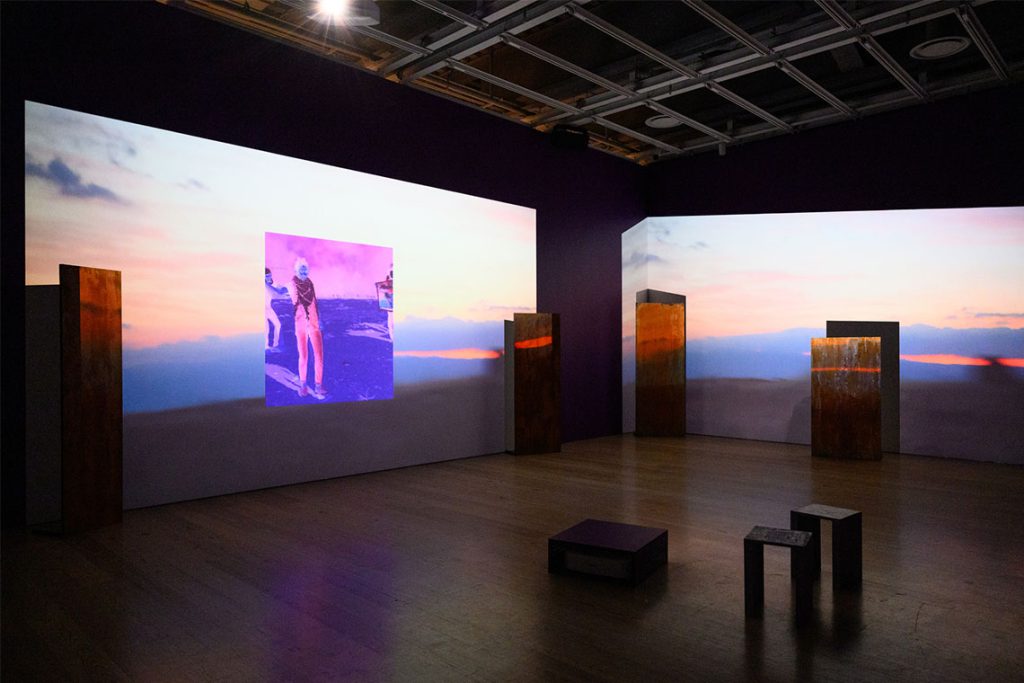
On encountering Basel Abbas and Ruanne Abou-Rahme’s sound and film installation Until we became fire and fire us (2023–ongoing), visitors are immediately met with waves of subwoofer beats. The three-channel projection interweaves footage of thriving indigenous plants in war-torn landscapes with scenes of chanting and dancing. The persistence of the plants metaphorises the resilience of both land and the communities erased by the Israeli-Palestinian war, in which the US partakes. Rusted metal barricades covered with reproduced film stills, paintings and poems stand alongside the projection, serving as ephemeral memorials. The visceral, pulsating soundtrack reverberates through the body – an invitation to join the artists in an act of commemoration.
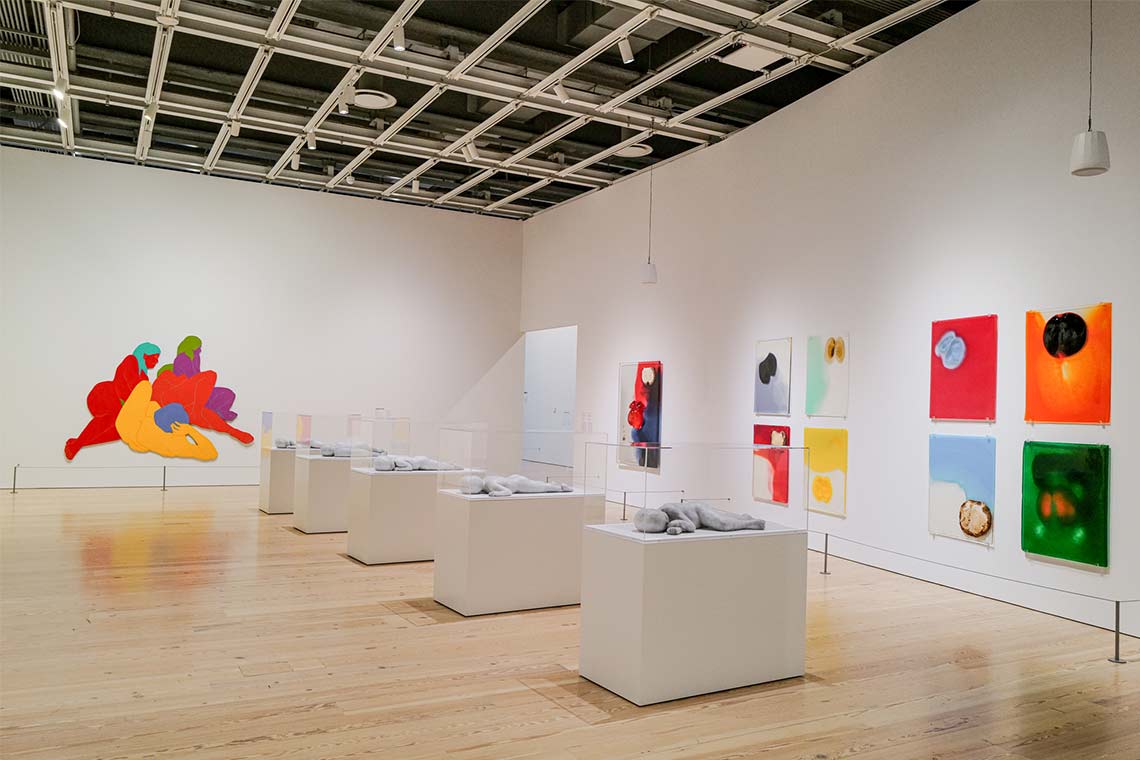
While the work of Abbas and Abou-Rahme engages with forced segregation, American artists Carmen de Monteflores and Andrea Fraser foreground intimacy and connection. Fraser’s sculpture series Untitled (Object I–V) (2024) depicts toddlers in deep sleep. Cast in soft wax that never fully hardens, the works evoke a shared moment of vulnerability and dependence. Their subdued tones stand in sharp contrast with de Monteflores’s bold, large-scale paintings, which depict two figures locked in gaze, a cuddling couple and four women basking in the sun. Together, the two bodies of work reflect the profound yet ubiquitous forms of kinship embedded in everyday life.
Alongside these works, similarly exploring the theme of relations and connections, are Nour Mobarak’s resin reliefs Reproductive Logistics 4 (2026) and Recto Verso (2024–25). Across the nine pieces, subtle protrusions and indentations trace the contours of the artist’s body. Here, the physical form becomes a shrine and shelter – a point of return from the worldly disturbance. The resin’s shifting colours evoke the light and shadow perceived through the body, reminding us of the immense meditative power inherent in it to withstand external turbulence.
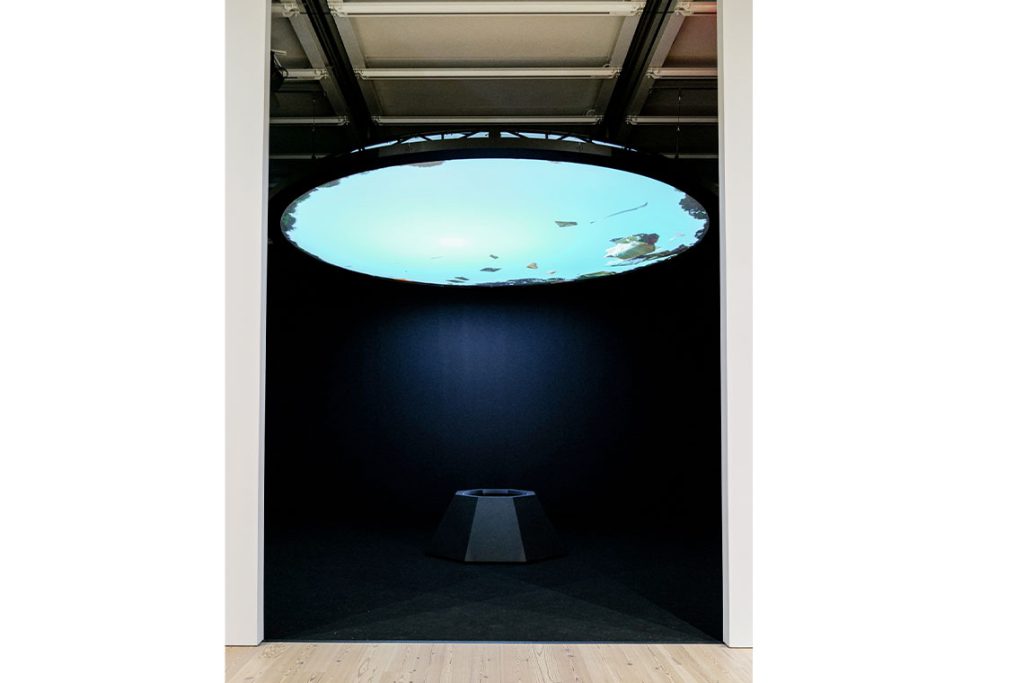
On the sixth floor, Michelle Lopez’s Pandemonium (2025) opens up the gallery with a sense of unfolding chaos. Suspended from the ceiling, the circular projection places viewers in the eye of a tornado that sweeps up all manner of debris into the air – news clippings, US flags, magazine covers. Prompted by the aftermath of 9/11, the work reflects on the accumulation of debris in both material and symbolic terms, alluding to the broader collapses across our environmental, ideological and social systems.
Behind the gallery of Lopez’s monumental work, Samia Halaby presents a series of computer-programmed kinetic paintings from the 1980s. On a row of 13-inch monitors, simple lines and shapes accumulate rhythmically to form images such as Central Park and Bread. Their aliasing edges, grainy texture and saturated neon colours offer a playful glimpse into the nostalgic post-war period when the world was still at peace and thriving – a much-needed throwback amid surrounding pieces reflecting crisis and disorientation.
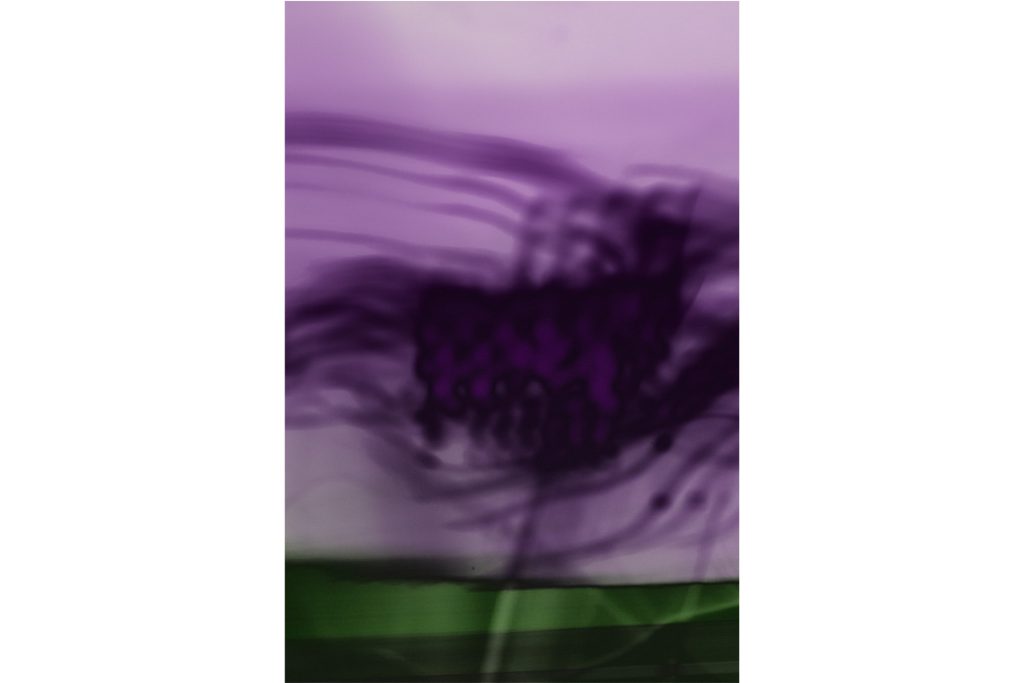
On the wall across is Aziz Hazara’s print series Moon Sightings (2024). Derived from retinal scans and biometric data extracted from night-vision goggles left behind by soldiers in war-torn regions, the images show clusters of fluorescent green interweaving with the distant horizon. These spectral landscapes reflect the lingering presence of US military influence.
Elsewhere on this floor, Ali Eyal’s Look Where I Took You (2026) approaches segregation through a more intimate lens. The large-format oil painting captures the artist’s childhood memory of his mother taking him to the top of the Ferris wheel in Baghdad for the last look at the city before the outbreak of the Iraq War. The earthy-tone canvas and the figures distorting along the momentum of the turning wheel capture a childlike yet stifling moment before the war.
A different historic lens emerges in Okinawan artist Mao Ishikawa’s series, Life in Philly (1986). Documenting her visit to Myron Carr, a former US soldier she befriended during the American postwar occupation of Okinawa, the series draws parallels between the experiences of Japanese and Black Americans. These photo portraits reveal the enduring structure of discrimination and illustrate the complex entanglement of segregation and connection embedded in history.
Across from Ishikawa’s photographs are Kamrooz Aram’s series of installations and paintings exploring relationality through abstraction. These works emphasise the expressive and conceptual value of ornaments, challenge its marginalisation within Western art history and address the shared roots between Eastern architectural ornamentation and Western painting traditions. Consisting of ceramics, book pages, a folding screen and lines in pencil and crayon, they form a layered visual field in which geometry and texture interact in a language of ordered chaos.
Outside the galleries, Taína H Cruz’s I Saw the Future and It Smiled Back (2025) comes into view in the open air. Installed on a billboard across from the museum, the graffiti work depicts a girl gazing towards the sun, caught between wonder and the pain of its glare. A moment that mixes hope and danger, the scene mirrors our present historical moment. Placed at the exhibition’s conclusion, this image reads as a quiet message of hope extended by the biennial to the world. It invites us to trust in the future – to believe that, even amid darkness, light will endure, and that those who have been separated will one day find their way back to one another. By unfollowing a preset theme, the 82nd Whitney Biennial also taps successfully into the pulse of our time – it expands the scope of contemporary American art through the lens of today’s political landscape and takes shape as a rare edition deeply attuned to our shared, lived experience.
Whitney Biennial 2026 runs until 23 August
This review first appeared in Canvas 123: Venice Special Issue
